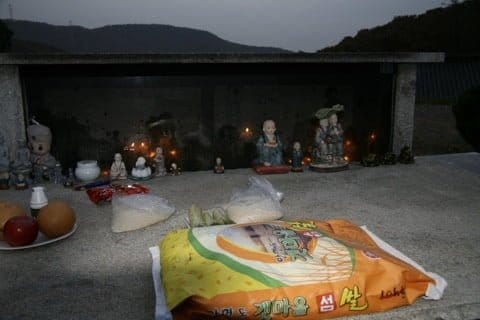
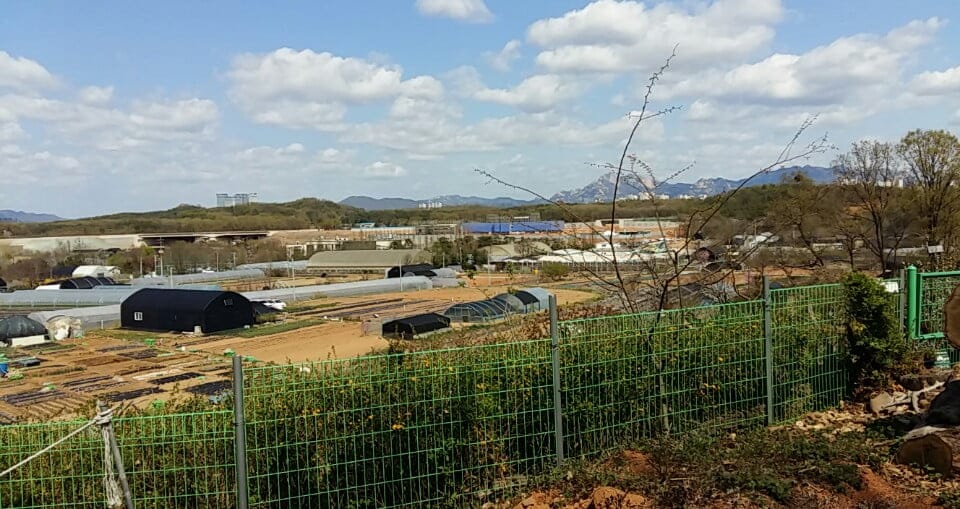
From Goyang to Rotterdam, the silver wave is rising. Korea now ages rapidly; the Netherlands follows not far behind. Behind the numbers sits a deeper question: how do we remain connected, dignified, and engaged — even in old age? This challenge reflects the realities of the Korean aging society. The Jijang Fractal illustrates the interconnectedness of aging societies.
In Korea, answers often grow from community and ritual; in the Netherlands, from welfare and healthcare systems. Perhaps the real key is what binds us: compassion — and the realization that being old is not an ending, but a phase full of meaning. Insights like these also resonate with my reflections in The Koreans and I.
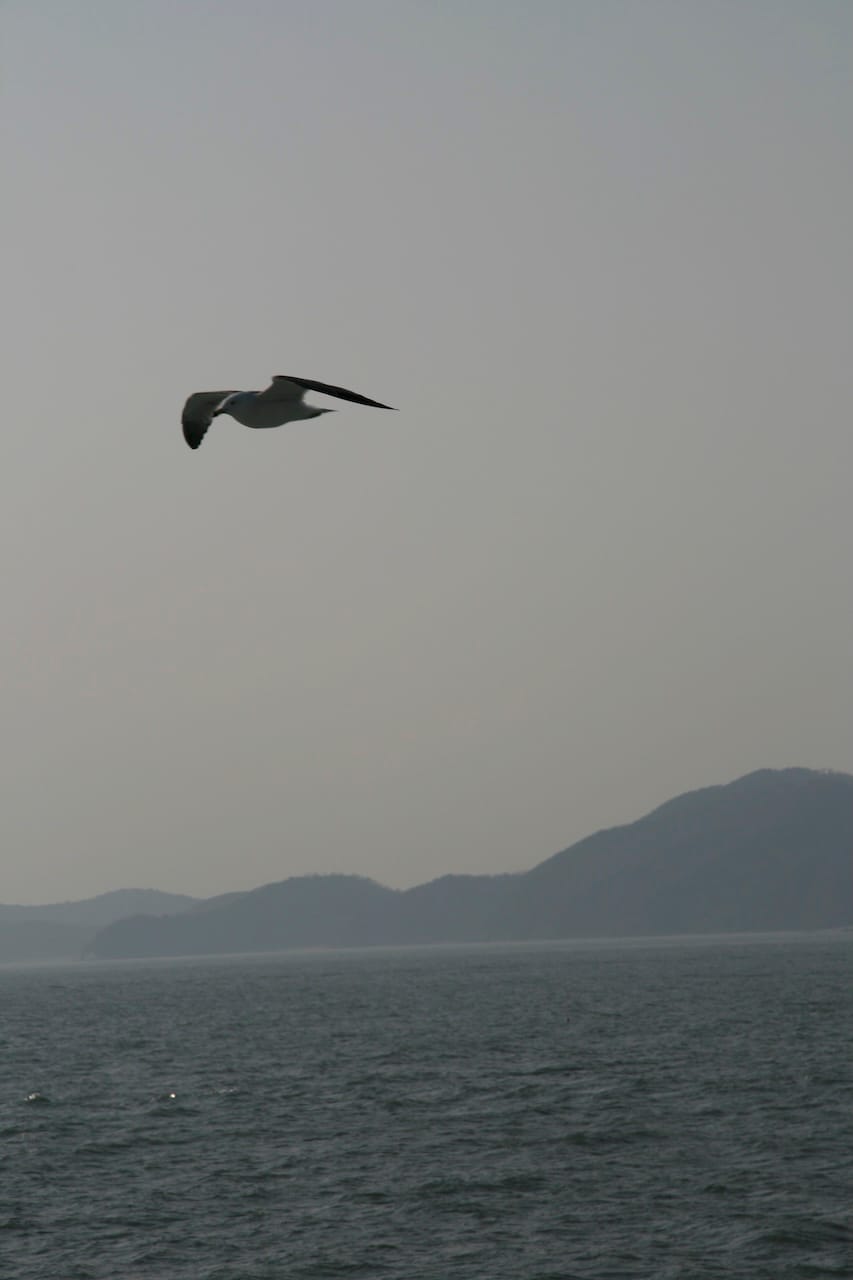
A bird over the mountains — symbol of a world in transition.
I look out over a world stuck in transition, while I feel the beginning of something new. It’s as if I’m on a mountaintop, watching values, systems, and certainties expire. Growth exists, but it feels like the convulsions of an old model. Inflation and interest swing like mood shifts; what felt secure yesterday can feel like a panic attack today.
The planet has a fever; the poles melt like forgotten ice cubes. Climate meetings resemble therapy sessions caught in vague intentions. Fossil habits collide with green ideals, and the clock keeps ticking.
Power drifts. The U.S. ages; China moves with middle-aged confidence; Russia smolders like a bitter ex; Europe strains in the middle. And South Korea? High-tech and self-aware — facing the North, the silver wave, and the question: must we pretend to be young, or may we grow older on our own terms? The Netherlands, pragmatic and small, tries to adjust the thermostat in a house on fire.
And wars flare like pain in the body: Ukraine, Gaza, Sudan — old conflicts in new disguise. Dear reader, I’m not exaggerating. I’m paying attention. These reflections tie back to the cultural shifts I once explored in Journey to the West.
Walking route from Baedagol to the new Wondanggol garden in Goyang.
The journey from the old Baedagol Theme Park to the new Wondanggol garden is more than symbolic. It is a short walk of just 3–4 kilometers through Goyang-si, yet it represents a much greater transition: from childhood play to senior reflection, from noise to silence, from history to renewal. This path between Baedagol and Wondanggol shows how Korean culture weaves continuity into change.
Both Kim Young Soo and I feel this is not a time to do nothing. His original Baedagol theme park — a meeting place for children, animals, and living history — had to stop at its first site. Now, the new Baedagol grows in Wondanggol: a garden of rest and reflection for seniors, a place of plants, peace, and care.
I think of a poem I wrote in 2004 — first published on Mantifang and later revisited during my pilgrimage to Bogwangsa:
Human Nature
Qi rides the wind and scatters.
But not when she meets water.
Then she shatters and becomes wind,
rises and becomes a cloud.
If she is angry, it thunders.
Falling, it becomes rain.
Underground she becomes Qi again.
The Pungsu Jiri qi arises from the wind.
Thick or thin, but certainly invisible,
she imbues man with nature.
The oak tree at the new Baedagol in Wondanggol, Goyang.
The oak in Korea often symbolizes endurance — slow growth, strength, and long life. Villages speak of namu-shin, tree spirits and ancestral guardians. Such symbols bridge the visible and the spiritual.
The Jijang Fractal did not appear to me in isolation. It was in Korea, through its culture of ritual, nature, and quiet resilience, that the pattern first revealed itself. Without the gardens of Baedagol and the generosity of Kim Young Soo, I might have missed it. My study and creativity as a writer shaped the words, but the insight itself was born from Korean soil. In that sense, the Jijang Fractal is not only my discovery — it is also a gift of Korea’s culture, and of the friendship that helped me see how compassion and interconnection take root in daily life.
“True virtue is to serve quietly, with no thought of reward, yet with the whole heart.” To create a place where others can rest is the highest form of service. Such a place gives the silver wave enough energy to support those who come after us — grandchildren, neighbors, students, colleagues, community. They will inherit our exhausted earth; every gesture of care may tip the scale.
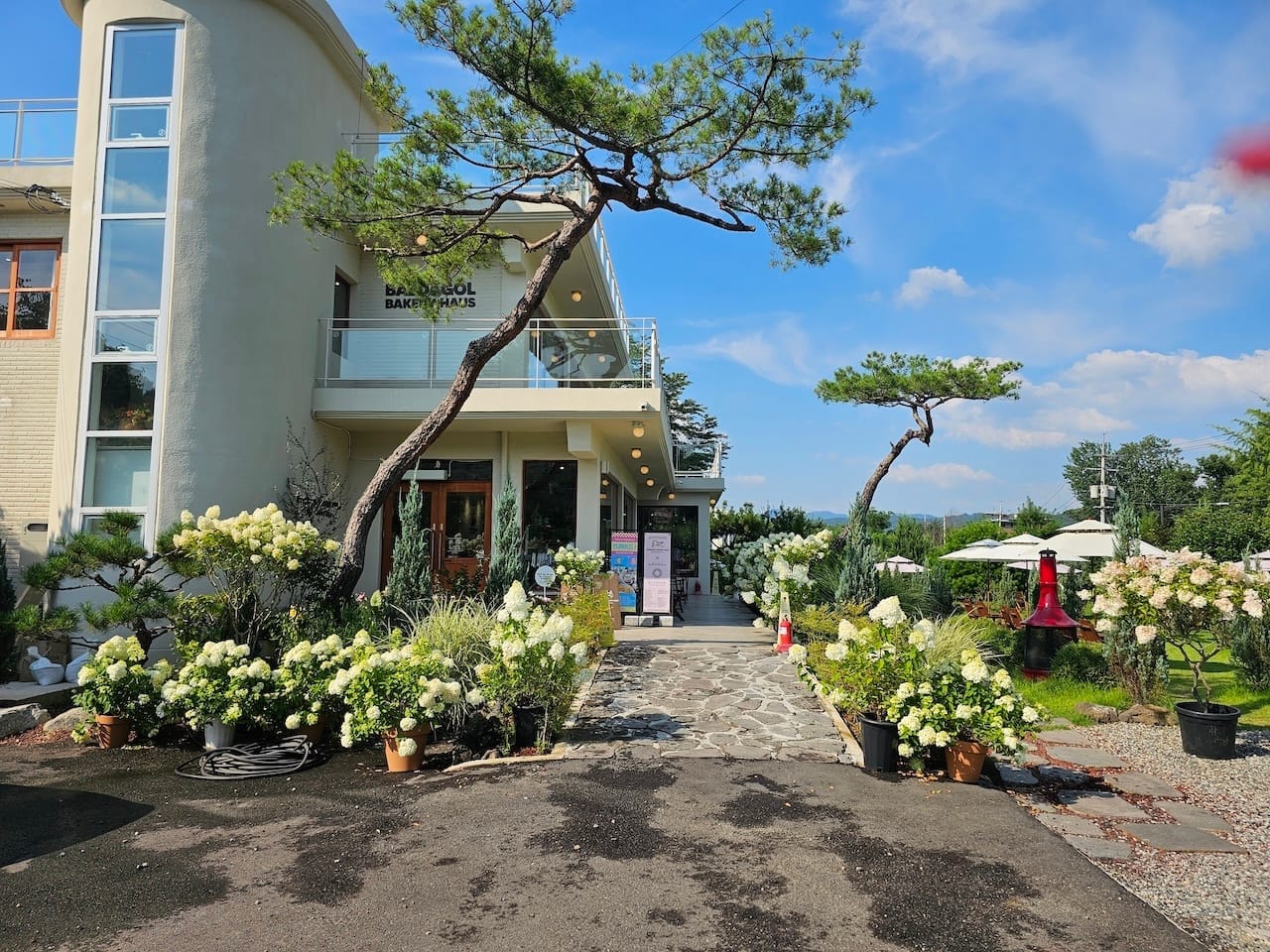
Baedagol Bakery in Wondanggol, Goyang — a place of food, care, and togetherness.
In Korea, food is more than sustenance. “밥 먹었어요?” — “Have you eaten rice?” — carries the care of generations that knew hunger. It is not formality; it is belonging. Baedagol Bakery in Goyang-si has that spirit: warm, generous, unhurried — a counterbalance to a faster Seoul.
A well-set table nourishes the body; a blooming garden nourishes the soul. Together, they make us whole.
The garden may be very Korean, but the desserts are European. Cream cakes and sugar — new flavors charming the Korean tongue. When I first came to Korea, bread was rare; now that Kim Young Soo bakes it, I am no longer allowed to eat it. Diabetes (type 2) asks for a stricter path: sugar-free, salt-free. After a severe hypo — ambulance and all — I set myself a regimen most would find joyless. Luckily, I have a Korean past.
While Baedagol serves cream cakes, I experiment with Jijang kombu sauce — with chicken and stir-fried vegetables — a dish even his wife would enjoy. I keep writing my book and helping Mickey care for the grandchildren. They grow up in a world in menopause. In their eyes I hear the silent question: give me the tools to restore this world.
If you’re in the mood for some pastries and want to enjoy the beautiful garden: Baedagol Bakery House155-3 Wondang-dong, Deogyang-gu Goyang-si.
That is the difference: my old age brings limits; the mess we leave is worse. Still, as long as we breathe, we can set the Fractal wheel in motion — like Kim Young Soo, who with trees, flowers, and bread quietly helps the world heal. Perhaps not grand — but enough to say: we still can. These reflections echo themes I first touched upon in Song of the Mantifang.
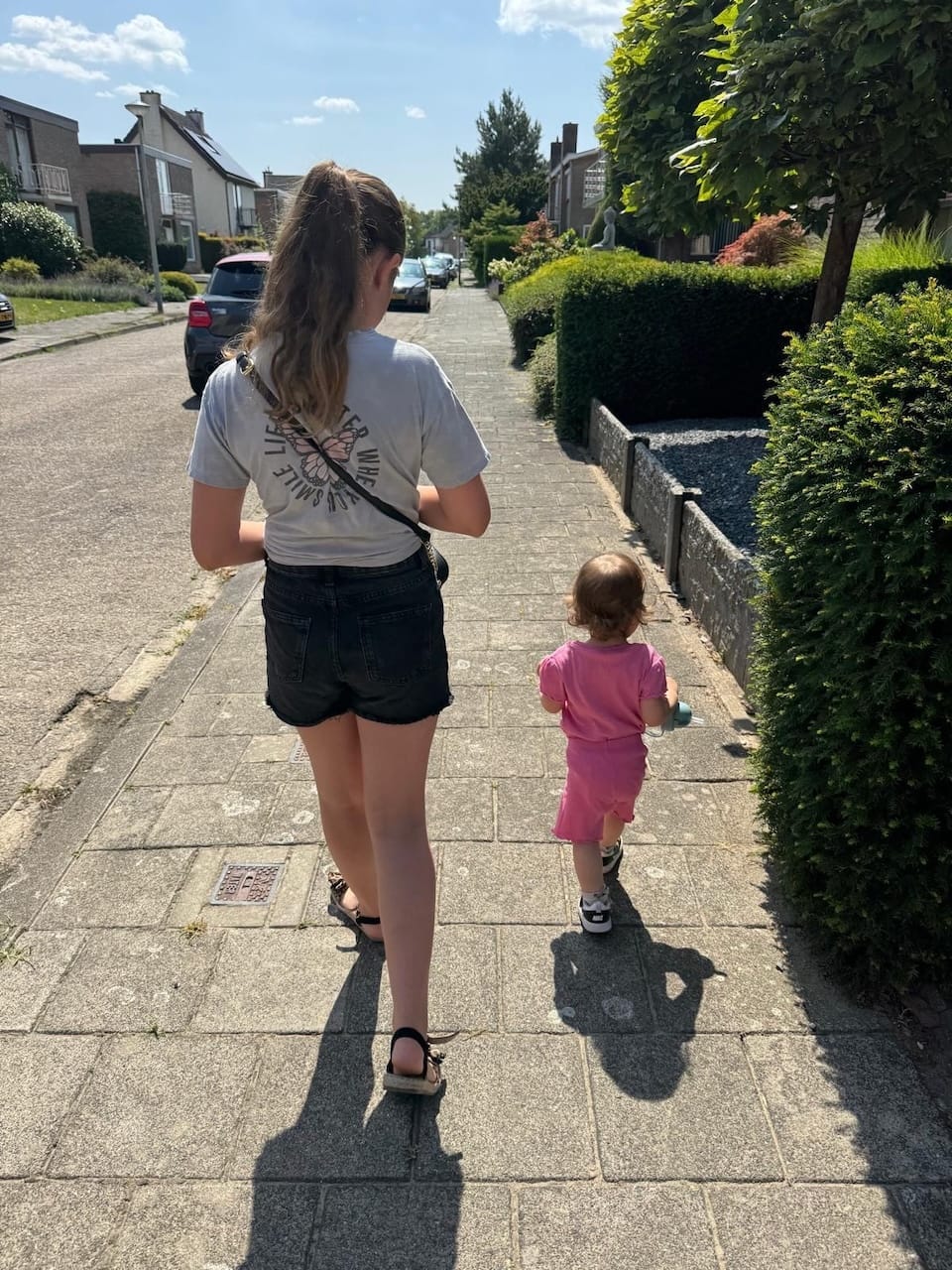
Two little ones walking forward towards the future — with the Buddha quietly present in the shadow.
Oh drop of water belonging to the grey wave — keep the Jijang Fractal in mind and start helping the little ones to create a world warm, generous, and unhurried. A place like the renewed Baedagol theme park, breathing in Wondanggol, South Korea.
As the little ones walk forward towards the future, even the shadows reveal more than we expect. In the outline of a Buddha in shade, and in the statue further down the path, presence becomes visible. The Jijang Fractal teaches that what seems hidden still shapes us — quietly, patiently, and with compassion.
These words close the circle, yet remain open — just as in Bogwansa, the story continues through memory, compassion, and renewal.
In the days after publishing part one and two about the Bogwangsa temple and its profound symbolism, I received a message from Venerable Lee Kong, a monk of the Jogye Order. His words weren’t a correction, but something subtler—something that felt more like a compass than a commentary:
“With my head directed toward Buddhahood, and my heart committed to the liberation of others…”
Though this moktak does not belong to Venerable Lee Kong, his chant carries the same steady rhythm—clear, grounding, inescapably present. It echoes not just through the hall, but through the silence within.
His voice, though distant, arrived with a quiet clarity. It wasn’t about verifying details—it was about staying aligned. Aligned with the Dharma, with sincerity, with compassion.
He resides in Haeryongsa, a small hermitage resting at the base of Seongbulsan, one of the outer ridges of Mount Biseulsan. It sits just beyond the edge of the city—close enough to be reached, yet far enough to breathe. He serves as a meditation guide, quietly offering practices that range from yoga to qi-gong to traditional Buddhist meditation. He resides in a small hermitage, where simplicity and silence form the ground for inner work. Though the place is modest, its spirit is vast.
He also serves Venerable Beopta, the revered josil (senior meditation teacher) at Eunhaesa, one of the main temples of the Jogye Order, nestled in the mountains of Palgongsan. His path has not been bound by one lineage alone—he also spent many years practicing alongside Thai monks, deepening his perspective through both Mahāyāna and Theravāda traditions.
A Dream of Alignment
Perhaps it was his voice. Or the quiet weight of the teachings that I carried with me into the mist of Bogwangsa temple. But somewhere in that mist, the dream returns—softly, without demand.
I see myself again, seated in the open square in Seoul, between two titans of Korean memory: Admiral Yi Sun-sin, standing in unwavering readiness, and King Sejong, seated in quiet contemplation. One defends with the sword. The other teaches with words. And between them—on a simple mat, Jijang-bosal and Gwanseum-bosal share a bowl of tea. No doctrine. No ceremony. Just presence. Just listening. It wasn’t a dream of meaning.
Bogwangsa Temple Korea
It was a dream of alignment.
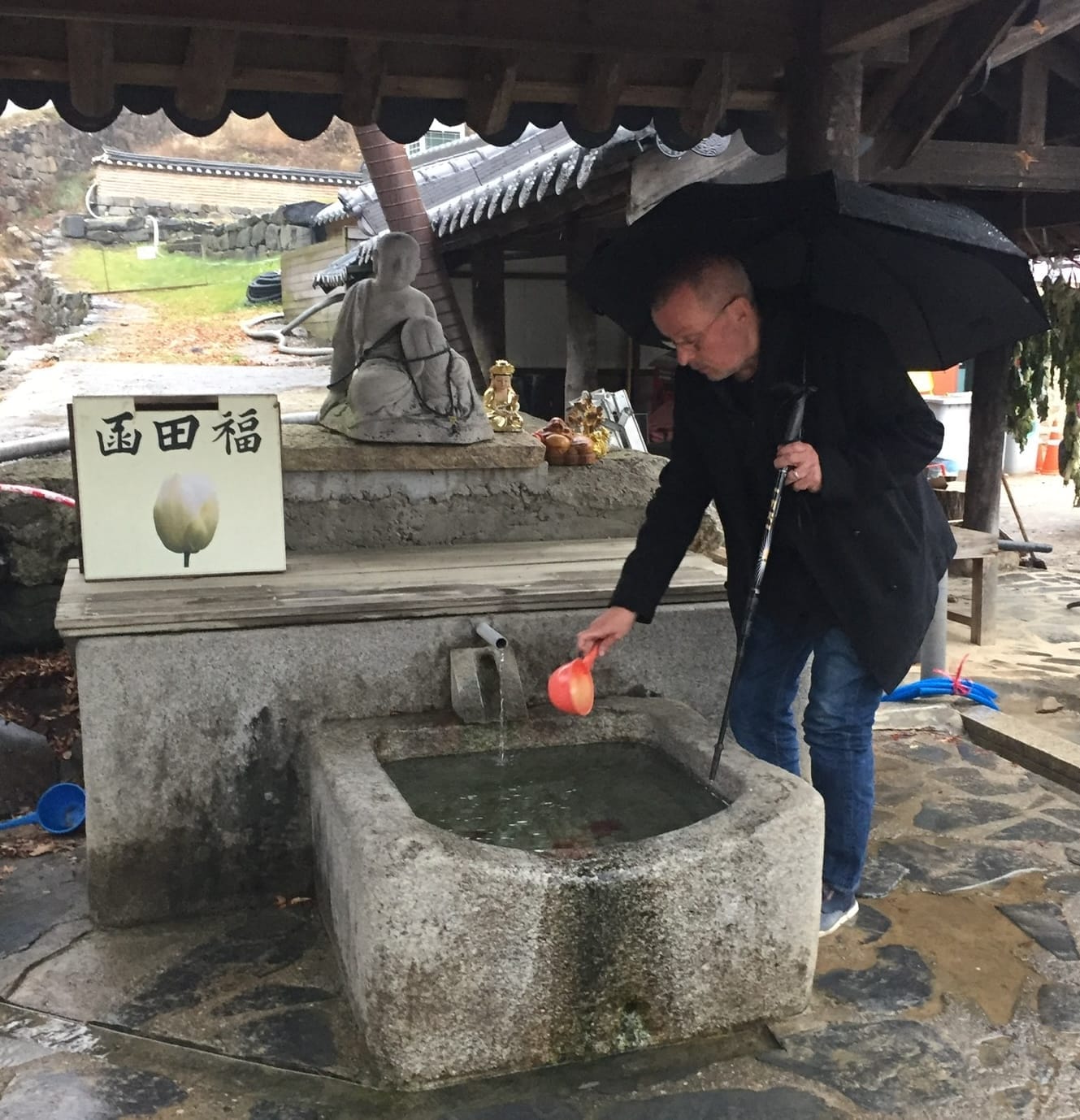
The writer at the spring near the entrance of Bogwangsa temple, I pause beneath the drizzle to draw water. Behind me, the sign reads 圃田福 — Bojeon Bok — a phrase that translates as “blessing of the field” or “prosperity from the garden.”
And still, the sky over Goryeongsan hangs grey and damp. Yet I feel thirsty—not only spiritually, but physically too. What I saw in the main hall didn’t just move me emotionally—it touched something in my body as well. A sensation I know all too well: tight, burning nerves, and a mouth as dry as the ashes of incense. Thankfully, near the entrance, I remember a spring. From it, I draw water—renewing both body and spirit.
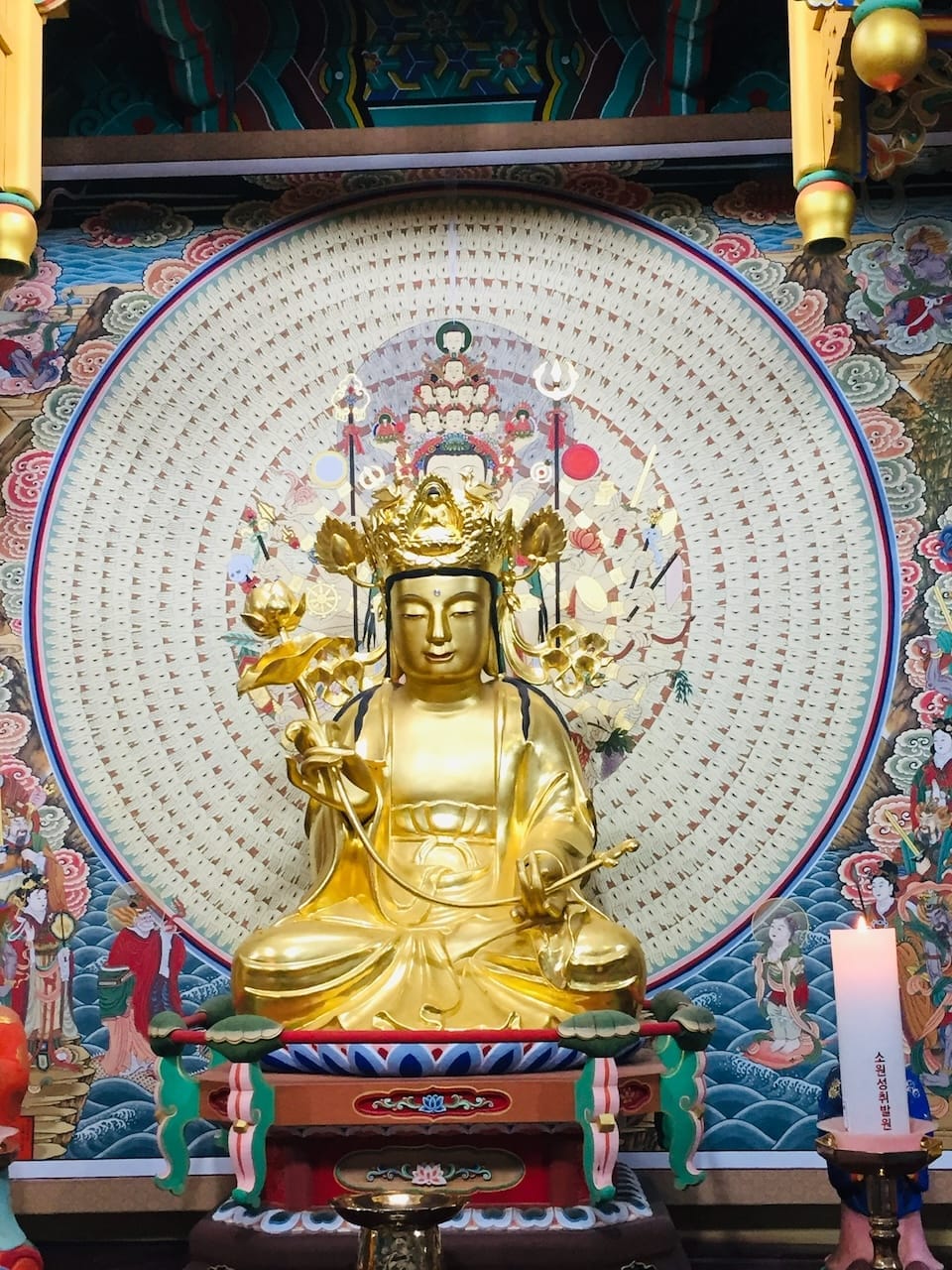
Gwanseum-bosal in Full Presence This full view of Gwanseum-bosal at Bogwangsa temple Korea reveals her surrounded by a mandala of a thousand compassionate hands and eyes. Every detail—from the golden lotus to the crowned head of Amitabha—embodies the essence of spiritual heritage in Asia. A visual hymn to Buddhist symbolism and fractal compassion.
At the core of the Bogwangsa temple, the Wontongjeon glows with quiet grace. The Wontongjeon (원통전) is dedicated to Avalokiteshvara Bodhisattva—Gwanseum-bosal (관세음보살), the bodhisattva of compassion. The term Wontong means “universally penetrating” or “all-encompassing illumination,” reflecting Avalokiteshvara’s ability to hear and respond to the cries of suffering souls across all realms.
This image of Gwanseum-bosal is not merely a religious icon, but a profound visual expression of the fractal nature of compassion, awareness, and interconnection. Both the physical representation and the symbolic backdrop situate her within a cosmic field—one where every sorrow is seen, every soul heard.
She is, after all, the Bodhisattva Who Always Listens.
In her thousand-armed form, she reaches in all directions, responding to every call. Her presence in Bogwangsa suggests compassion not merely as emotion, but as a cosmic principle—woven into the fabric of transition, of life and death. Though this temple is primarily dedicated to Jijang-bosal, Avalokiteshvara stands here as the embodiment of universal receptivity—a listener beyond the boundary of self. Together, they form a sacred symmetry: one leads, the other listens.
Shared Compassion at Bogwangsa Temple Korea
The Golden Lotus of Bogwangsa Temple Korea Held with both hands, the golden lotus symbolizes shared compassion. Not merely offered, but uplifted together—between bodhisattva and seeker, between wisdom and action. A gesture deeply rooted in Buddhist symbolism.
What strikes me most is how Gwanseum-bosal does not simply hold the golden lotus—she supports it. Her left hand lifts it gently from below, as if to say: compassion is not only offered; it is also carried together. Her gesture suggests that compassion is a partnership—between bodhisattva and seeker, between wisdom and action.
Amitabha’s Crown and the Depth of Buddhist Symbolism at Bogwangsa Temple Korea
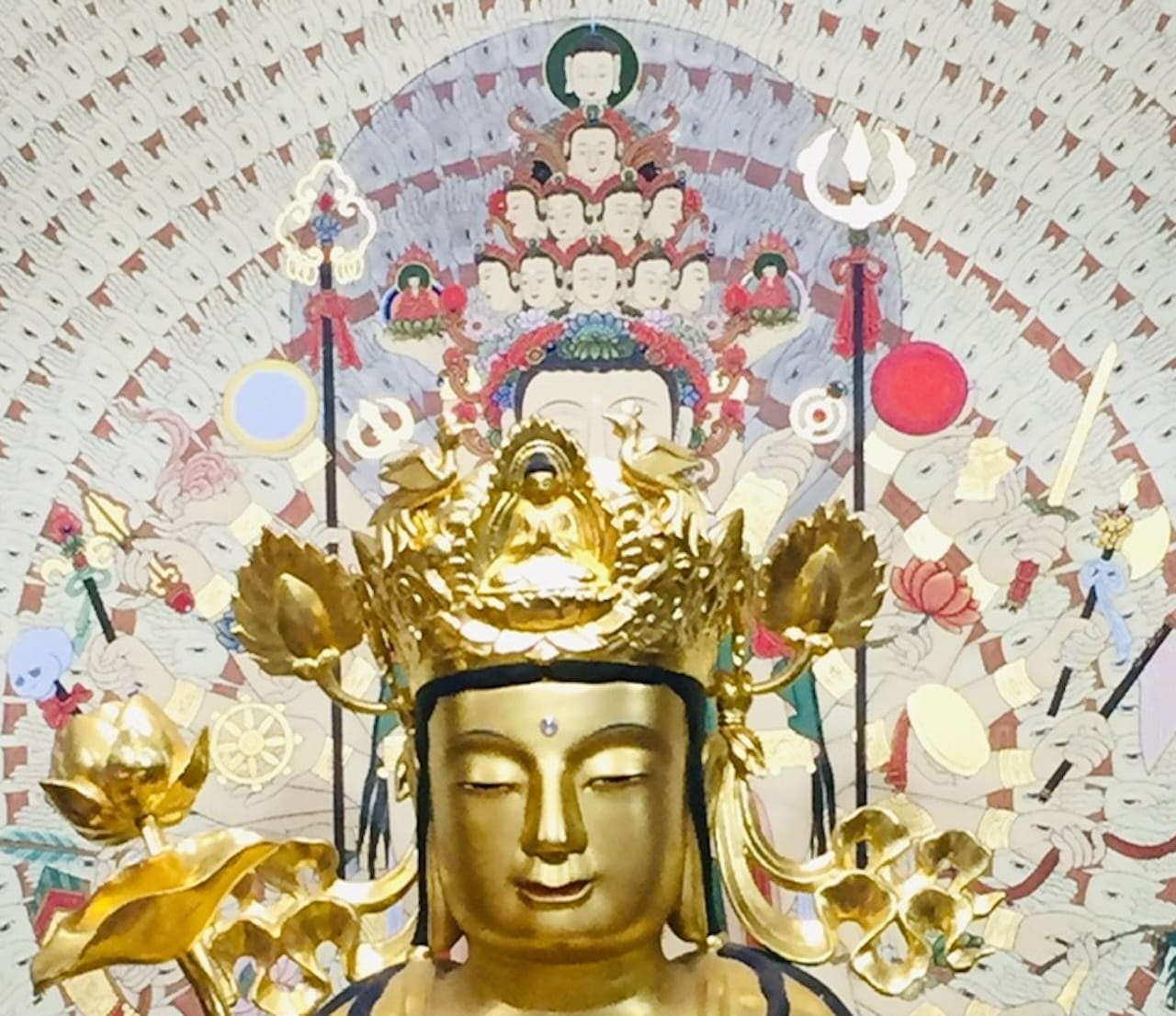
Crown of the Compassionate One The crown of Gwanseum-bosal at Bogwangsa temple Korea radiates symbolic depth. At its center sits Amitabha Buddha, linking her to the Western Pure Land—a key element in spiritual heritage Asia. The crown unites earthly compassion with celestial guidance.
Her crown is richly adorned and bears the image of Amitabha Buddha, a reflection of her spiritual origin and goal: the Western Pure Land of Liberation. Her face, radiant and serene, eyes half-closed, speaks of an inner peace that remains steadfast even in the face of cosmic sorrow. She seems to gaze both inward and outward at once. And I can’t help but wonder—what is it she sees?
Tea and Truth
Tea and Truth: A Spiritual Dialogue in Bogwangsa Temple Korea
And then I remember what they were saying. Not in words alone, but in the weight behind them. The tea, the silence, the question that still echoes.
In that dream—so vivid it feels like memory I found myself back in the spiritual quietude of Bogwangsa temple, where dreams and doctrine gently dissolve.
Jijang-bosal takes a sip of tea and turns to Gwanseum-bosal: “You listen to the voices of those who suffer in this world.
I guide those who search for their way after death. And yet, their burdens return again and again. How do we help them let go?”
Gwanseum-bosal smiles softly, her hands circling the warm cup. “Suffering is like this tea,” she says. “Warm. Bitter. But fleeting. Its taste does not stay. Still, many cling to it as if it were eternal.”
Jijang-bosal nods. “I show them the path, but many fear to take it. They fear what they must leave behind, or what awaits beyond. But in truth…”
Gwanseum-bosal finishes the thought: “…there is nothing to hold on to.” Jijang-bosal watches the steam rising from his cup. “Exactly. Just as tea was once water and will soon return to vapor, so are we always in motion. Suffering is not something to carry —but something to let flow.”
She lifts her cup one last time. “And when they realize this, there will be nothing left to release.” The tea is gone. The cups are placed down. No longer full. But not empty either.
The Thousand Eyes of Avalokiteshvara and Buddhist Symbolism
Fractal Hands of Compassion A close-up from Bogwangsa temple Korea, this sea of hands evokes the thousand-armed Gwanseum-bosal—each gesture a vow to listen, to heal, and to uphold the temple’s Buddhist symbolism in endless compassion.
Each hand is a vow. To see suffering—not in the abstract, but in the detail of every trembling soul. To reach out—not just from afar, but here, now, in the intimacy of shared breath.
A thousand hands. A thousand eyes. Not to overwhelm, but to reflect: compassion, too, is fractal. It repeats, not for redundancy, but for presence. And in that repetition, I find something: She does not need to move. The eyes move for her. She does not need to touch. The hands have already begun. And I—still, small, silent—am seen.
Sansin and the Arhats
Gwanseum and Mary: Shared Devotion in the Spiritual Heritage of Asia
Of course, Gwanseum reminds me of Mary. Back home, I had seen people weep before her statue, just as visitors here whisper their grief to Gwanseum. The devotion feels nearly identical. Surrounded by flowers, candlelight, and prayers, both embody the archetype of compassion.
I have no doubt this comparison will be met without resistance. Korean Buddhism is profoundly inclusive—after all, even Sansin, the shamanic mountain spirit, has found his place on temple grounds.
The main altar left me with a sense of reverence, a humble awe before Seokgamoni-bul and his companions. But when I bowed before Gwanseum, I felt something warmer. She is, indeed, like a loving mother. What hasn’t changed is the weather. The sky still weeps its soft drizzle. Thankfully, in the Sansingak (산신각), it is dry.
The Spirit of the Mountain: Sansin in His Pavilion
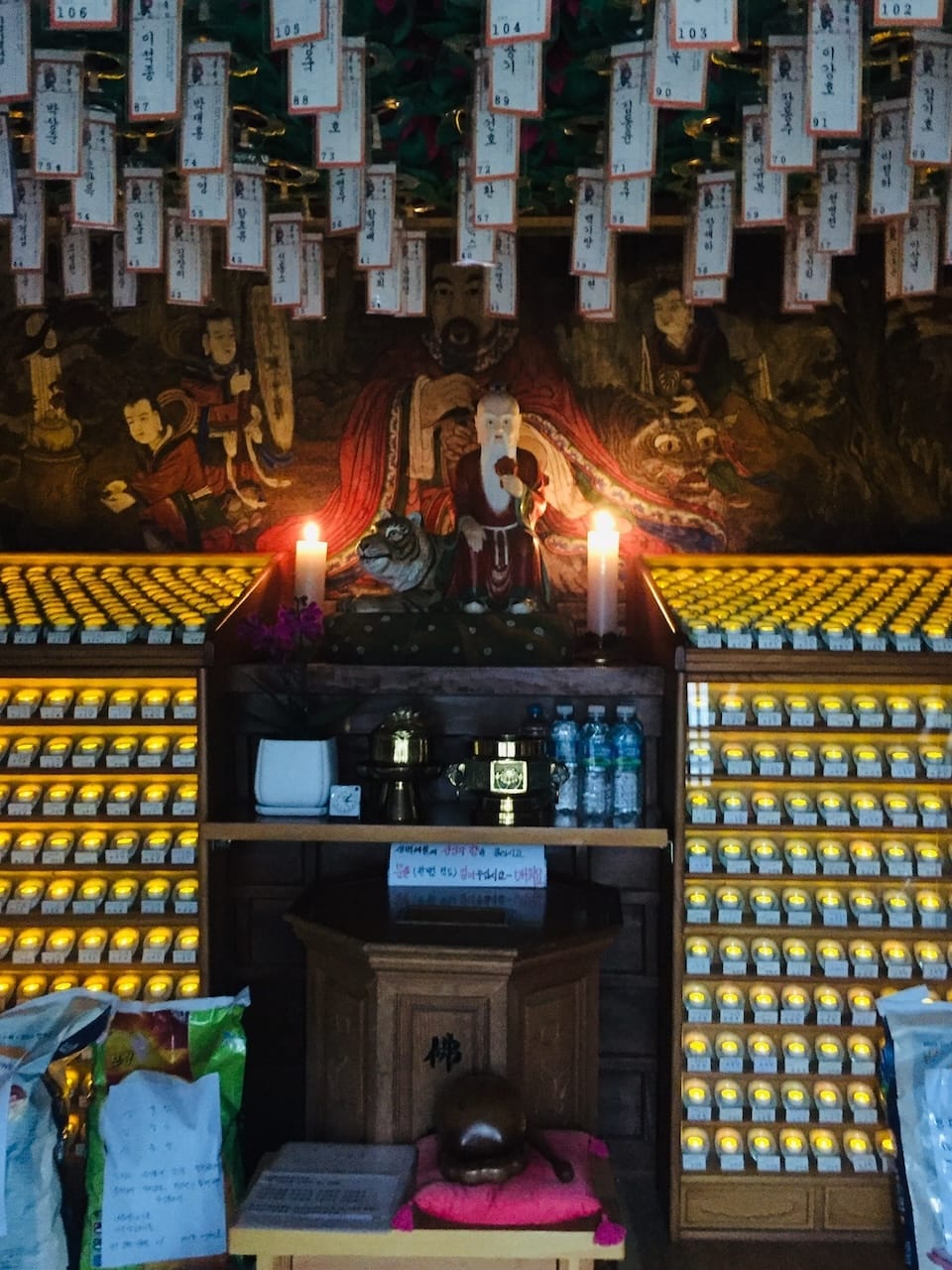
Sansin at Bogwangsa Temple Korea. Surrounded by offerings and lanterns, the mountain spirit Sansin sits with his tiger—honored in quiet rituals that reflect Korea’s rich spiritual heritage in Asia.
This is the pavilion dedicated to Sansin (산신), the mountain spirit of Korea. The space is intimate, almost humble in its simplicity. At its center sits Sansin himself—an elderly man with a long white beard, clothed in traditional Korean garments. By his side rests his tiger, a powerful symbol of protection and a link to the wildness of nature. Behind them, painted on the taenghwa, Sansin appears again—this time surrounded by attendants and mountain spirits, guardians of his mysterious domain.
Though Sansin’s roots lie in Korea’s shamanistic past, his worship is fully woven into the fabric of Korean Buddhism, especially in temples nestled deep in the mountains.
The Meaning of Sansin
Sansin is revered as the protector of wisdom, a guardian of health, and a granter of long life. He embodies the raw force of nature and the spiritual energy that flows through Korea’s mountainous landscapes. His role as a guardian of temples built on powerful geomantic sites—like Bogwangsa—is deeply respected.
Rituals and Reverence
Monks and visitors alike bring offerings of rice, fruit, water, or wine to Sansin. Their prayers seek protection, well-being, fertility, or success in spiritual practice. These rituals often lean toward the shamanic—more personal than ceremonial—but they live in quiet harmony with the Seon Buddhist traditions of Bogwangsa.
The Sansingak is more than a side building; it is a threshold. A place where nature, spirit, and humanity meet. It reminds me of the strength of the mountains, of unseen protectors who guard the sacred, and of the beautiful entanglement of shamanism and Buddhism in Korean culture.
In the quiet power of Sansin’s presence, I recognize echoes of another sacred encounter—one where Korean reverence and Tibetan ritual once converged.That story, too, continues in Holy Korean and Tibetan Transitions.
Guardians of the Dharma: The Arhats in the Nahan-jeon of Bogwangsa
Arhats at Bogwangsa Temple Korea These serene figures represent enlightened disciples of the Buddha, quietly guarding the Dharma in the sacred stillness of Bogwangsa temple Korea.
Deep within the Bogwangsa temple complex, nestled among ancient trees and mist-laden hills, lies the Nahan-jeon (나한전, Hall of the Arhats). This sacred space is dedicated to the enlightened disciples of the Buddha, known in Korean as Nahan (나한), or Arhats.
The Nahan-jeon radiates an atmosphere of deep contemplation. Upon entering, I am greeted by a row of serene icons, each seated on a vibrant, lotus-shaped cushion. Their faces—pale and tranquil—appear timeless, almost human, as if they embody silence itself. Clad in simple monk’s robes, their hands rest gently in their laps or fold softly into mudras. Behind them stretch richly decorated murals, filled with scenes of the Buddha’s teachings and spiritual journeys through distant lands and mystical realms.
In Korean temples, Arhats are often depicted as a group of sixteen or eighteen figures (십육나한 / 십팔나한, Sibyuk Nahan / Sibpal Nahan), each with unique expressions, gestures, and spiritual attributes. Some hold scrolls or malas (prayer beads), others a staff or symbolic objects like bowls or dragon pearls. Though they have attained enlightenment, they remain in the world—as guardians of the Dharma and protectors of the temple.
The most recognized among them is Pindola Bhāradvāja (빈두로 바라문, Binduro Baramun), often identified by his long eyebrows—a mark of deep wisdom. Challenged by the Buddha to demonstrate his spiritual powers, he became known as the Arhat who endures as long as the Dharma endures. Another highly regarded figure is Kāśyapa (가섭, Gaseop), protector of esoteric teachings and keeper of profound meditative practices.
In Bogwangsa’s Nahan-jeon, time seems to stand still. The soft glow of candlelight reflects in the polished eyes of the Arhats, while the air is thick with the scent of incense. Here, monks and visitors meditate and offer homage, seeking to awaken the Arhats’ wisdom and resolve within themselves.
As I leave the hall, a quiet sense of peace lingers. The Arhats remain unmoved on their cushions, keeping watch over the Dharma, ready to welcome the next traveler in search of awakening.
Nearby stands the Jijangjeon, a hall dedicated to Jijang-bosal (Ksitigarbha Bodhisattva, 지장보살), the bodhisattva of the afterlife and protector of souls in the underworld. People often pray here for the deceased, asking for their safe passage and favorable rebirth. Positioned closer to the entrance, it lies lower in elevation—closer to the earth, and thus to the realm of the dead.
Closing Vow
The air outside the hall is still damp, heavy with the scent of pine and mist. Somewhere behind me, the incense still burns. But I carry a different kind of smoke now—one that rises inward.
I think of the hands that reach. The eyes that see. The tiger beside the mountain god. And the Arhats at Bogwangsa Temple Korea who watch in silence, not because they demand anything, but because they already understand. And then I remember what they were saying.
Not in words alone, but in the weight behind them. The tea, the silence, the question that still echoes.
In that dream — so vivid it feels like memory — Jijang-bosal takes a sip of tea and turns to Gwanseum-bosal:
“You listen to the voices of those who suffer in this world. I guide those who search for their way after death. And yet, their burdens return again and again. How do we help them let go?”
Gwanseum-bosal smiles softly, her hands circling the warm cup. “Suffering is like this tea,” she says. “Warm. Bitter. But fleeting. Its taste does not stay. Still, many cling to it as if it were eternal.”
Jijang-bosal nods. “I show them the path, but many fear to take it. They fear what they must leave behind,
or what awaits beyond. But in truth…”
Gwanseum-bosal finishes the thought: “…there is nothing to hold on to.”Jijang-bosal watches the steam rising from his cup. “Exactly. Just as tea was once water and will soon return to vapor, so are we always in motion. Suffering is not something to carry — but something to let flow.”
She lifts her cup one last time. “And when they realize this, there will be nothing left to release.” The tea is gone. The cups are placed down. No longer full. But not empty either.
In the soft rain outside the Bogwangsa temple, I bow— not because I am close to enlightenment, but because I understand, now more than ever, that the path itself is sacred.
The great wheel turns. Not away from me, but with me. And I, still shaped by longing and learning, am not ready to leave it behind. But I can walk it with care.
With my head directed toward Buddhahood, and my heart committed to the liberation of others. Not as a destination — but as a vow.
I’ve done my utmost to describe the icons, halls, and rituals of Bogwangsa Temple Korea with care and accuracy. Still, any misidentifications or symbolic misreadings are entirely my own. Should you spot any such errors, your insight is warmly welcome. But above all, I hope what resonates is the spirit of the story—the atmosphere it conjures, the openness it invites, and the sincerity with which it was written.
There is a second altar in the main hall of Bogwangsa. It houses a group of five major Buddhist icons:
Five beings in stillness. Five manifestations of being. In the center, Seokgamoni-bul holds the earth with a single touch. Around him, compassion, healing, insight, and radiant light take form. This altar is not a display—it is a mirror.
At the center sits Shakyamuni Buddha (석가모니불, Seokgamoni-bul), the historical Buddha Siddhartha Gautama, who attained enlightenment and shared the Dharma. He is seated in the Bhumisparsha Mudra—his right hand gently touches the earth, a gesture that symbolizes his awakening under the Bodhi tree. His face is calm, his eyes half-closed in deep meditation.
To his left sits Amitabha Buddha (아미타불, Amita-bul), the Buddha of Infinite Light who rules over the Western Pure Land (Sukhavati). His right hand is raised in the Vitarka Mudra, a gesture of teaching and wisdom.
A compelling example of the Amitabha Triad in Korean Buddhist art is preserved in the Cleveland Museum of Art.
Healing and Ignorance: A Moment Before Shakyamuni Buddha
To the right of Shakyamuni is Medicine Buddha (약사여래, Yaksa Yeorae), also known as Bhaisajyaguru—a figure of healing and spiritual wellness. He is venerated in Mahayana Buddhism as a protector against both physical and mental suffering. Often depicted with a medicine pot or healing fruit in his hand, he symbolizes the promise to cure all beings of the ailments that arise from ignorance.
My state of mind makes me realize that Medicine Buddha is not merely a healing guide, but a mirror—an icon that reveals suffering, including my own, as a result of ignorance. Not just mental, but also physical. An ignorance that is not guilty, but formative. And perhaps healing begins there: in recognizing what I do not yet understand.
A notable example of a Korean Medicine Buddha can be found in the collection of the Museum of Fine Arts, Boston.
Eyes half closed, as if watching both this world and the next. The right hand calls the earth to witness. The left offers no command—only openness. I did not speak, but he heard me.
On the outer left side stands Avalokiteshvara (관세음보살, Gwanseum-bosal), the Bodhisattva of Compassion—one of the most revered figures in Mahayana Buddhism, known for listening to the cries of all sentient beings. Avalokiteshvara can appear in various forms and genders, and is often depicted holding a lotus or a flask of holy water, radiating peaceful grace.
The Metropolitan Museum of Art holds a renowned 14th-century depiction of Water-Moon Avalokiteshvara, embodying the grace and serenity of this bodhisattva.
On the far right: Mahasthamaprapta (대세지보살, Daeseji-bosal), the Bodhisattva of Great Wisdom. A key figure in the Amitabha Triad, he embodies the spiritual strength and insight that lead toward liberation. Where Avalokiteshvara expresses compassion, Mahasthamaprapta represents the power of awareness and wisdom. He is often shown holding a lotus or a vessel, calm and resolute.
Between Wisdom and Compassion: Bogwangsa’s Fivefold Vision
I sat here, unsure if I belonged. But the silence did not ask for credentials. Only presence. Only breath. A place for stillness, no matter who you are.
The icons deeply move me. Their golden bodies, contemplative faces, and the exuberance of color seem to take hold of my soul. I don’t know if it is allowed, but I sit down in front of the altar and try to become one with my surroundings. I smell the rising smoke from the incense burners—like prayers drifting toward the spiritual world.
No… I’m not sure if I am allowed to sit there, or if it’s even presumptuous of me. But I do it with respect and dedication to the Buddhas and bodhisattvas. Jijang may not be present on this altar, but perhaps he rides on the curling smoke.
As part of the larger narrative “The Jijang Fractal,” this exploration weaves together place, memory, and spiritual inquiry. 👉 The Jijang Fractal – book hub
Murals, Memory, and Dialogue
The Murals Behind Shakyamuni: Visions of Bogwangsa
Behind the figures is a vivid thangka-like mural. I believe it shows Shakyamuni Buddha surrounded by bodhisattvas and celestial beings.
I say believe, because as someone raised in the Catholic tradition, distinguishing these figures is not always easy. Where I make mistakes, I hope to be gently corrected—and forgiven.
The central figure appears to be an exalted form of Shakyamuni, seated within a golden halo. Around him are disciples, bodhisattvas, and guardian deities, symbolic of his teachings. The painting is rendered in bright reds, blues, and golds—hallmarks of Korean Buddhist art.
The boy from Rotterdam still feels the pull of Catholic iconography. I remember watching the smoke rise as the Requiem by Verdi filled the church. I was part of the boys’ choir then—allowed to sing along, even if I barely understood what we sang.
And yet, I remember the moment my heart hesitated: my fingers tapping my chest as I whispered, “Lord, I am not worthy that you should enter under my roof, but only say the word and I shall be healed.”
Here, in the hall of Siddhartha, I realize: while Jesus invites the heart to open, the Buddha invites the mind to become still. They do not cancel each other out.
They coexist—just like the icons on this mural.
Where the Ceiling Whispers Prayer
Above the altar hang lotus lanterns (Yeondeung, 연등), each bearing a name or prayer. They symbolize enlightenment and spiritual protection. In the background I discern rows of small golden Buddha statues—likely dedicated by pilgrims or families in memory of deceased loved ones.
When the Icons Mirror Us: Insight at Bogwangsa
From this angle, I see their profiles—thoughtful, grounded, listening. Their hands speak, though they never move. What would I say, if I could answer them?From the side, they look like a river of gold. Each one turned just slightly, as if in conversation with the other. This is not hierarchy. It’s harmony.
In that silence, a dream returns.
Once again, I find myself seated in the plaza in Seoul, between two giants of Korean history: Admiral Yi Sun-sin, who protected the people with his sword, and King Sejong, who enlightened them with his words. One stands, unwavering. The other sits, immersed in thought. Between them, on a simple mat, Jijang-bosal and Gwanseum-bosal share a cup of tea.
And so the conversation begins.
Jijang-bosal takes a sip and looks at Gwanseum-bosal.
“You listen to the cries of those who suffer in this world. I guide those who seek their way beyond it. And still, their sorrows return. How can we help them let go?”
Gwanseum-bosal smiles and gently turns her teacup.
“Suffering is like this tea. Warm, bitter, but fleeting. The taste does not remain. Yet many cling to it, as if it were eternal.”
Jijang-bosal nods.
“I show them the path, but few dare to walk it. They fear what they must leave behind—or what awaits them. But in truth…” Gwanseum-bosal finishes his thought: “…there is nothing to hold on to.” Jijang-bosal watches the steam rise from his cup. “Exactly. Just as tea was once water and will soon evaporate again, so are we always in motion. Suffering is not something to carry—but to let flow.”
Gwanseum-bosal lifts her cup.
“And when they realize that, there will be nothing left to release.” The tea is gone. The cups are placed down. No longer full—but not empty either.
The city fades. The dream dissolves. What remains is the scent of incense, the shadow of Jijang, and the realization that none of the icons here stand alone. They mirror each other. They mirror us.
I look once more at the altar. Perhaps it’s not what I’ve seen that matters, but what it has stirred within me. Just as the Jijang fractal reveals itself when attention meets surrender, insight too does not grow from certainty, but from stillness.
But this temple holds more layers. Beyond this hall lie other spaces, other voices, other rituals. The story does not end here. It deepens.
I rise. The air is still. My footsteps echo softly on the stone floor, as if the temple itself says: you’re not finished yet.
As I leave the hall, the echo of the icons still resonates—not as doctrine, but as presence. They are not answers, but companions. And though this altar offered a deep and quiet wisdom, I know that Bogwangsa has not yet spoken its last.
There are other halls to enter. Other guardians to meet. Other silences to sit with.
In the next part of this journey, I return to the temple grounds—with eyes attuned to detail, and a heart still learning how to bow.
I’ve done my utmost to describe the icons, halls, and rituals of Bogwangsa with care and accuracy. Still, any misidentifications or symbolic misreadings are entirely my own. Should you spot any such errors, your insight is warmly welcome. But above all, I hope what resonates is the spirit of the story—the atmosphere it conjures, the openness it invites, and the sincerity with which it was written.
It was a crisp morning, just days before Seollal, the Korean Lunar New Year. The air was fresh, carrying that distinct winter scent of hope and anticipation. I found myself in the traditional hanok of my host, Mr. Kim, who had invited me to celebrate the new year with his family – The Year of the Snake. As the aroma of tteokguk (rice cake soup), galbijjim (braised short ribs), and perfectly fermented kimchi filled the air, I felt a growing curiosity. What did it mean to be a snake in this new year? And how would it connect with my own zodiac?
The Symbolism of the Snake in Korean Zodiac Animals
“The snake,” Mr. Kim began as he placed a dish of jeon (savory pancakes) in the center of the table, “is one of the most fascinating animals in our zodiac. It symbolizes wisdom and introspection. In our culture, the snake is seen as a silent yet powerful guide – a master of transformation.”
I paused to reflect. “Interesting,” I said. “In the West, the snake is often seen very differently. It’s frequently associated with temptation and danger. Think of the biblical story in the Garden of Eden – where the snake tempts Eve to eat the forbidden fruit.”
Mr. Kim smiled. “It’s fascinating how cultures can perceive the same creature in such different ways. Here in Korea, the snake is admired for its ability to shed its old skin. It’s a symbol of renewal and progress.” As one of the key Korean zodiac animals, the snake encourages growth and self-reflection, essential qualities for navigating a new year.
Aries and Dog: My Unique Zodiac Combination
As I savored the perfectly seasoned galbijjim, Mr. Kim asked about my own zodiac signs. “I’m an Aries in the Western zodiac,” I replied, “and a Dog in the Korean zodiac.” His eyes lit up.
“A Ram-Dog,” he said slowly, as if tasting the weight of the words. “That’s a combination of determination and loyalty. The Aries gives you the courage and energy to charge forward, even in the toughest times. And the Dog – the faithful protector – brings balance and honesty. A powerful combination.”
I laughed. “I have to admit, it often rings true. As an Aries, I’m adventurous and goal-oriented. But the Dog in me keeps me grounded. It ensures I stay loyal to the people I care about and always strive for fairness.”
Mr. Kim nodded thoughtfully. “That’s exactly what The Year of the Snake will ask of you. The snake teaches us to grow and embrace transformation. With your energy as an Aries and the stability of the Dog, you’ll navigate this year with wisdom and strength.”
Seollal Traditions at the Dinner Table
Dinner was a masterpiece of flavors and tradition. As the evening progressed, Mr. Kim shared more about Seollal traditions and the significance of Korean zodiac animals. “People born in The Year of the Snake,” he said, “are intuitive and patient. They take their time to consider their steps. It’s not hurried but thoughtful. Maybe you can take that wisdom into this year – the calm and insight of the snake, combined with your own fire and dedication.”
I looked at his family, their laughter and gentle conversations filling the room. It felt like a moment of reflection, a chance to connect the wisdom of two worlds. Perhaps, I thought, that’s the lesson of the snake – to learn to listen, to yourself and the world around you.
A Traditional Seollal Farewell
As the evening came to an end, I bowed deeply to Mr. Kim and his family. I felt grateful, not just for the delicious meal but also for the wisdom I had gained. As I bid them farewell, I greeted them with the traditional Seollal wish I had practiced:
“새해 복 많이 받으세요! (Saehae bok mani badeuseyo!)”
Which means: “May you receive great fortune in the new year!”
As I stepped into the cold night, I felt a renewed energy. The Year of the Snake would be a time of transformation – and with my Aries-Dog combination, I was ready to embrace it with confidence. I would also remain loyal to my Korean friends, supporting them through all their adventures.
Korean melancholy, or Han, is not merely a cultural engine.
A small white heron startles. Back on the embankment, I open a bottle of Soju and take a sip.
The cicadas remain silent, their usual song absent, as if nothing in the night dares disturb their rest.
Yet beneath the stillness, a tension lingers, a quiet discomfort that mirrors my own unease.
In the distance, I hear a trumpet announcing the night. It comes from the barracks.
Soldiers are everywhere here. It does not worry me. I still tasted the food at Sarangche.
war zone
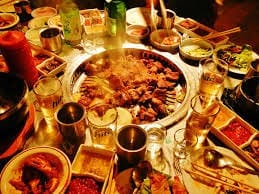
The table looked a bit like a war zone, always full.
It is quite a task for the waitress to put it all down the integrated barbecue, the many bowls with side dishes,
bowls with peppers, garlic and lettuce leaves, the bottles and cans, the bowls with rice, the plates, sticks and napkins.
And off course Kimchi.
We enjoyed it well. Kim Young Soo signalled.
He walked to the counter to pay. Two other men fought. The Soju tasted good, its warmth spreading through me,
but it carried with it a familiar ache, like an old song I had forgotten but could never quite let go.
The fight was not about who should pay. It was not about the money, but something deeper—perhaps a sense of duty, or pride,
rooted in traditions I could barely grasp. Here, even the smallest gestures seemed to carry the weight of a lifetime.
Their voices rose, not in anger, but in fierce determination—each insisting on their right to bear the burden.
Outside, the police occupied the street, their smiles strangely out of place in the midst of such rigid control.
The waiting began—cars stopped, drivers submitted, blowing into breathalysers with a resignation that felt heavier than the night itself.
The boss lit a cigarette and again coffee was served from the restaurant. Jay looked disappointed, his eyes distant,
as if the long drive to Seoul wasn’t just about distance, but about returning to a silence he wasn’t ready to face.
I started to walk. The rest had to wait, well into the night if necessary, until the police had had enough.
In the Gumeonggage, the local shop, I grabbed some bottles of Soju,
a few packs of cigarettes, and some biscuits. The seventy-year-old woman behind the counter smiled as I handed her my purse,
trusting her without question. Perhaps it was the simplicity of the exchange—something clean, something untainted by the complexities
of the outside world—that made me feel at ease.
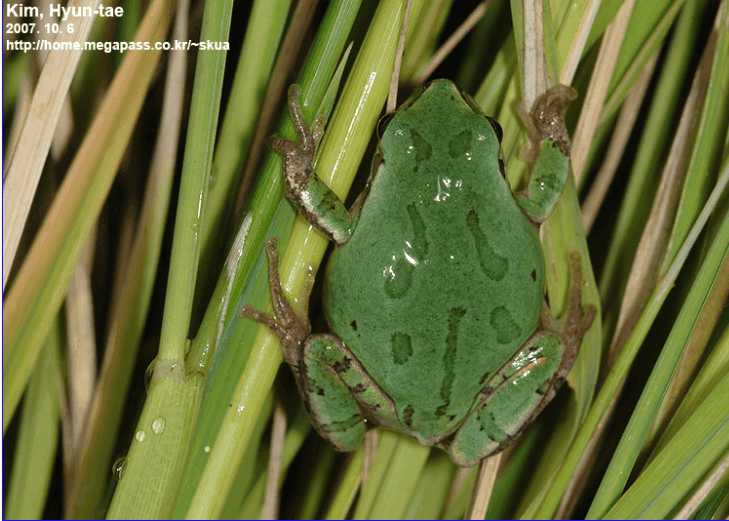
Protected tree frog, Korean melancholic sounds
It is quiet on the Baedagol gill. The dinner is still buzzing in my head.
Even though I was not always involved in the conversation, it remains overwhelming.
They are energetic people those Koreans.
Save haven
When they drink, they remind me of my hometown buddies the Rotterdammers—direct, inflammable, and unafraid to roll up their sleeves.
But the similarities end there. Seniority is everything here. It’s a hierarchy that’s ingrained in every gesture, every conversation.
I keep hammering it into my head, yet it still feels foreign, heavy. In the Netherlands, we walk beside each other.
Here, we walk in a line—always behind or ahead, never side by side.
Jetlag has a hold on me, pulling me into a fog I can’t quite shake. Even the Soju can’t dull the edge.
Sleep, I’ve decided, is an overrated luxury. Only old generals die in bed, after all.
Time slips through my fingers here in Korea, faster than I can catch it.
In Rotterdam, I’ll sink into the culture shock like a stone into deep water.
But here, it’s the cicada that keeps me on the surface, restless, always awake.
In addition to the cicada, there’s another troublemaker—the male Suweon tree frog, whistling his high, desperate call into the night.
Only eight hundred of them left, they say, trapped between two rivers, clinging to their patch of land. His whistle echoes, unanswered.
It’s a fight for survival, for recognition. Just like the Koreans, he has finally carved out his own place, standing apart from his Japanese
and Chinese cousins. But the cost… the cost is always there, hidden under his green skin.
No Korean melancholic but coals
Originally, the tree frog sought out rice fields for its home, but those have almost all disappeared.
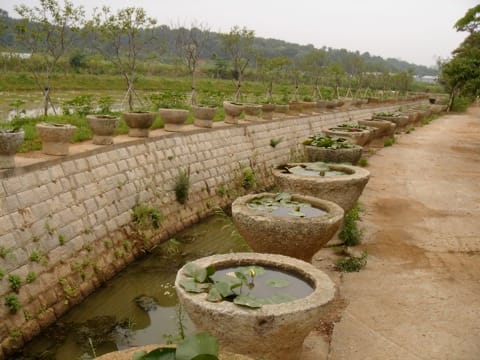
On Baedagol, however, they’ve managed to find a sanctuary in the water features, clinging to survival.
At least eight hundred tree frogs now live in the theme park alone—perhaps more.
Kim Young Soo’s dream has come true: a small piece of a lost world restored.
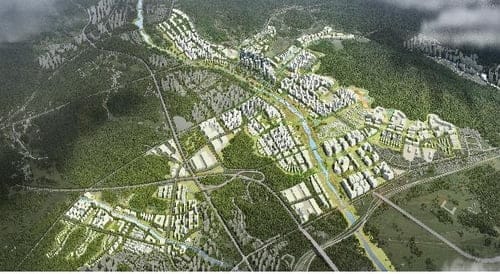
But even this refuge is fleeting. The expansion of Changneung 3 New City will soon swallow the land,
and with it, the Suweon tree frog’s fragile home. A place once reclaimed, soon to be lost again.
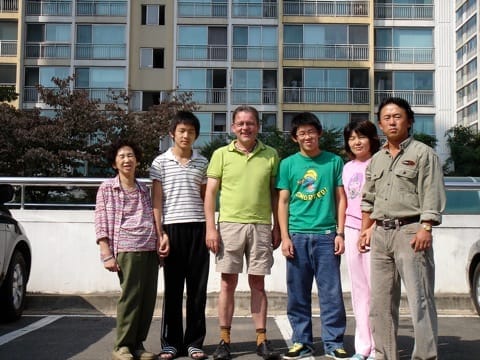
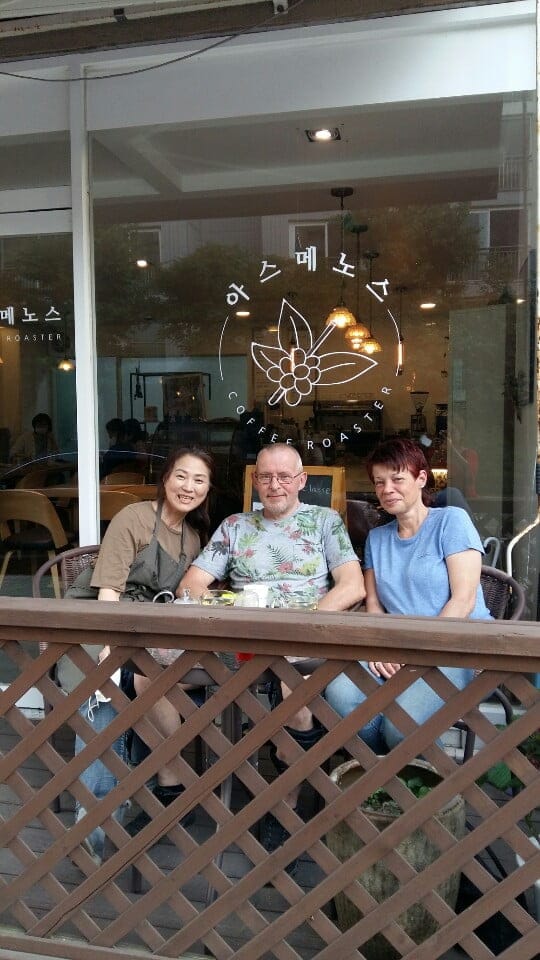
Kim Young Soo, his mother, wive, sons and the writer.
According to his younger brother, he has set himself four goals. His family had to be taken care of first.
In Korea, it always concerns the extended family. So not only wife and two children but also mother, sisters, younger brother and everything related to it.
His father died when Kim Young Soo was young and poverty was very high in underdeveloped Korea.
He took over his father’s rose nursery and sold the flowers he grew on the street. Later he discovered a way to grow roses from seed.
With that, he earned enough money to first grow lotuses and then switch to breeding ornamental carp.
His second goal was to help the Hwajeong Dong people.
Baedagol theme park is the final result of this.
His third goal was to give something back to Korea itself, to create a place where nature could find refuge again.
The Suweon tree frog, once nearly forgotten, now thrives in Baedagol, much like Kim Young Soo himself.
But even as the frogs whistle their high-pitched call, there’s a knowledge that this place, too, will be overtaken by the march of time.
Changneung 3 New City will soon rise, and with it, Baedagol’s carefully nurtured ecosystem will vanish.
For Kim, the sense of achievement is always shadowed by the looming impermanence of it all.
The Suweon tree frog, resilient and fragile at once, whistles into the night, unaware that the sanctuary it’s found in Baedagol is only temporary.
Soon, the city’s progress will sweep it away, as it has done with so much before.
The frog, much like Kim Young Soo, fights to carve out a place in a world that is constantly shifting, always moving forward, leaving only echoes of what was.
Samguk Sagi and Yusa, a Korean melancholy history
Onjo
Hwaejeong Dong is already described in the historical books Samguk Sagi and Samguk Yusa.
The first is the Chronicles of the Three Kingdoms written by Kim Busik at the behest of King In Jong and published in 1145.
Samguk Yusa is the “Memorabilia of the Three Kingdoms“.
This was written by the monk Ir Yeon and contains legends, folk tales, biographies and historical accounts.
Originally, Han Chinese settled in Hwaejong Dong, but in eighteen BC the state of Baekje or Paekche was founded. Onjo, the third son of Goguryo founder King Dongmyeong, was not allowed to succeed his father.
The father had been married before. Because of troubles he fled from Buyeo to Jolbon. He left his family behind,
so he married the daughter of a local chieftain and fathered two more sons: Onjo and Biryu.
The refugee wanted his own state and therefore founded Goguryo with its capital Sŏgyŏng modern Pyongyang.
Yuri, the son from the first marriage found out about this and was soon in the palace to claim his birthright.
With that kind of family, this is never without drama.
Onjo, seventeen years old, fled with his older brother Biryu, driven by the weight of family conflict and the desire to carve out their own place in the world.
He founded Wiryeseong present-day Seoul. Their he build an altar to honour his father.
But Biryu’s fate was less kind—he ignored his brother’s advice, ventured to the west coast, and found only saltwater and despair.
It is written in the books that he build Michuhol which is now called Incheon.
His suicide marked the end of one dream, while Onjo welcomed his brother’s followers with quiet resilience.
It was a tale as old as Korea itself—new beginnings, always born from loss.
Biryu’s death was not an isolated tragedy, but part of a longer lineage of sacrifices, each generation carrying the weight of the ones before it.
The younger brother called his state Baekje. The meaning of this name is explained differently, but I think “Hundred of houses grossed the sea” is the most beautiful.
During the reign of King Koi (243-286), the constitution was established and in 384 Marananta came from Ghandara Pakistan.
He told the then-newly installed King Chimnyu about Buddha.
Like Dryophytes suweonensis, Baekje relics are rare but of high quality.
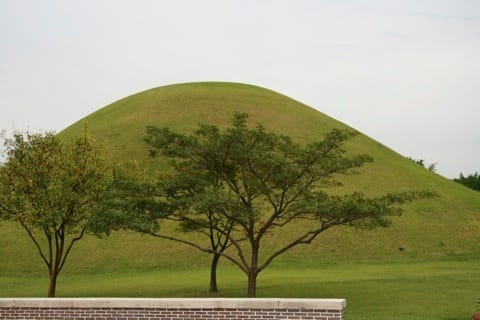
Together with younger brother and Kim Jay Ho, I visited King Muryeong’s tomb in Gongju.
According to a stone plaque, the tomb dates from 523. It was two other tombs, accidentally discovered in 1971 during drainage work.
As I stood before King Muryeong’s tomb, I couldn’t help but think of how history preserves both grandeur and fragility.
The tomb remained untouched for over 1,500 years, its treasures safe from time and thieves.
But even here, in the stillness, there’s an echo of loss—Baekje itself, once a powerful kingdom, now survives only in fragments,
in relics buried under the weight of centuries.
The tomb is still one of Korea’s greatest historical discoveries. Like the discovery of King Tutankhamun’s tomb in Egypt,
the accidental unearthing of King Muryeong’s tomb in Gongju revealed treasures untouched by time.
Both tombs had remained sealed for over a millennium, protected from thieves and degradation, preserving not only the riches of their respective monarchs,
but also the cultural grandeur of their civilizations. Where Tut’s tomb highlighted the opulence of ancient Egypt,
Muryeong’s grave opened a window into the sublime artistry of Baekje.
Geumjegwansik
Tomb robbers have not broken open its entrance for over 1,500 years. The treasures found in the tomb underlined Baekje’s sublime culture.
The Baekje people leased the tomb from the local earth spirits. It was also paid for.
Coins from the Liang dynasty were found on the stone,
proving that Baekje was influenced by that regime in China. The spirits fulfilled the contract because many royal decorations were found in the tomb.
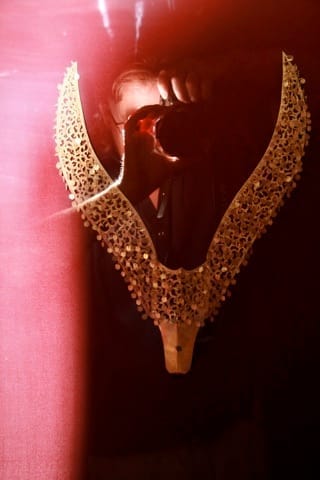
The Geumjegwansik for example. These are two gold diadems worn by Muryeong (501 – 523). They were neatly stored in a small box.
They were cut from a thin, 2-millimetre, gold plate. According to tradition, the King wore the diadems on the right and left side of his black silk headscarf.
On top of the headscarf, he wore a black cloth top hat with a gold flower pinned on the back. The diadems resemble wings,
representing the belief in rebirth in Shamanism. Gold earrings, hair pins, a bronze wine cup with dragon and lotus motifs on the lid,
jade pendants and an iron sword were also found.
Two silver bracelets have the name of the Baekje silversmith Dari
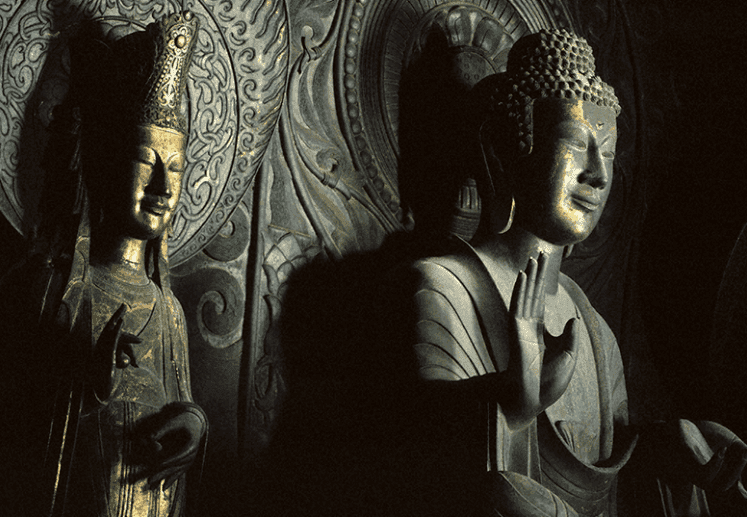
engraved next to their weight. This name can also be found on the Sakayamuni triad of the Horyuje temple in Ikaruga, Japan.
Since Monk Marananta’s mission, Buddhism had a great influence on Baekje culture. This can also be found in Muryeong’s grave.
Butt still those Shamanistic influences were found in relics, not only due to Buddhist tolerance towards local religions.
I think there is another reason.
Like the discovery of King Tutankhamun’s tomb in Egypt,
the accidental unearthing of King Muryeong’s tomb in Gongju was a revelation for Korea, offering a rare glimpse into a world long past.
Both tombs, sealed for over a millennium, protected their treasures from time and decay.
Yet while Tut’s tomb highlighted the opulence and grandeur of ancient Egypt, Muryeong’s grave opened a window into the delicate, spiritual artistry of Baekje—a culture equally as grand, but often overshadowed by its neighbors.
But even by the narrative of world history itself. While the treasures of Egypt and China are celebrated globally,
Baekje’s legacy, delicate and profound, remains known to few. And yet, in the quiet stillness of this tomb, its significance cannot be denied.
Shikibu’s Korean melancholy: mono no aware
My thoughts float to a meeting I had with Shikibu Tsuku.
During the appointment in the Kasteeltuinen Arcen,
the interplay of clouds and sunlight on the budding green seemed to mirror Shikibu’s own mood—a constant shifting between warmth and cold,
between the comfort of memories and the ache of what had been left behind. The air was crisp, carrying with it the faint smell of earth waking from its winter sleep.
Few get to witness this, as the gate remains locked early in March. Amidst the contrasting cold and warmth, between the desire for a hearth fire and yakitori.
The park lay in tranquil beauty. Shikibu, feeling the chill, folded her summer kimono thoughtfully.
She was not the elegant figure enjoying the roses but more of a contemplative, inward-looking prayer. Her monologue filled my awareness.
“Mono no aware,”
Shikibu began, “is a Japanese expression signifying the poignant beauty of things. The inevitable transience of nature makes beauty fleeting and bittersweet.
Everything that lives and even everything that exists is not eternal! You see it in Bonsai, where often a dead branch forms the essential beauty of the tree.
It’s also reflected in how we view nature and experience it. Sakura is only beautiful because it is fleeting and oh-so-perishable.
You must enjoy it immediately and to the fullest.
Mono no aware and han are different sides of the same coin. One is the acceptance of beauty in transience,
the other, a lingering sorrow from unresolved suffering. Both see the fleeting nature of existence,
but while mono no aware embraces it with quiet resignation, han carries the weight of it, refusing to let go.
I looked at Shikibu, trying to lift her spirits. “It’s difficult to stay in the Kasteeltuinen now, but let me prepare some Sake to warm your heart.”
“Ah, the change of seasons brings tears,” she said, bowing slightly toward the Sake bowl. “I am melancholic, but maybe it’s also homesickness. During the last Holland Koi Show, I gave some areas Japanese names.
The Japanese village became Nippon Mura, and the aquarium tent Suizokukan. But most often, I think of the Doeplein: Ibento Kaijo,
where I still have so much more to learn about the Nishikigoi. If ‘Mono no aware’ applies to any Japanese art form,
it’s certainly the case with the mortality of the beautiful ornamental Koi.”
Her voice grew softer, as if the weight of the words themselves carried the passage of time. “Even Nippon Mura and Ibento Kaijo will one day fade into memory, just like the fleeting beauty of the Koi we so lovingly display.
That’s the way of things, isn’t it? The more we hold on to something, the more it slips through our fingers.”
“Why so sad, Shikibu?” I tried to console her. I knew what she felt.
Anyone who has seen Spring, Summer, Fall, Winter… and Spring by Kim Ki Duk understands this well.
The young monk, dragging the millstone up the mountain, carries not only the weight of his own suffering but that of the world.
With a rope tied around his waist, he pulls the heavy stone behind him, while carrying the Geumdong Mireuk Bosal, the golden Maitreya Bodhisattva.
The burden is not merely physical; it is spiritual, a symbol of the hope for salvation amidst suffering.
Each step he takes echoes the weight of human suffering, yet the Bosal he cradles in his arms serves as a reminder of the possibility of rebirth and enlightenment.
This, too, is han—a burden passed from one generation to the next, quietly borne, yet never fully lifted.
Many Japanese purists might abhor my liberal blending of Far Eastern cultures, but my long visits to Hanguk
and conversations with many artists and scholars there convince me that “Mono no aware” can only be fully understood this way.
Mono no Aware goes hand in hand with Han
Shikibu promised one thing: One day we would sit together, listening to Jeongseon Arirang—a song steeped in the very essence of han,
each note carrying the weight of centuries of sorrow and resilience.
In Kim Young Im’s voice, I knew we would both find something of ourselves, something that had been lost and perhaps, briefly, could be reclaimed.
The movie gives you an even deeper sense of this story. You can continue reading just below.
Exploring the Cultural Interactions Between China, Korea, and Japan
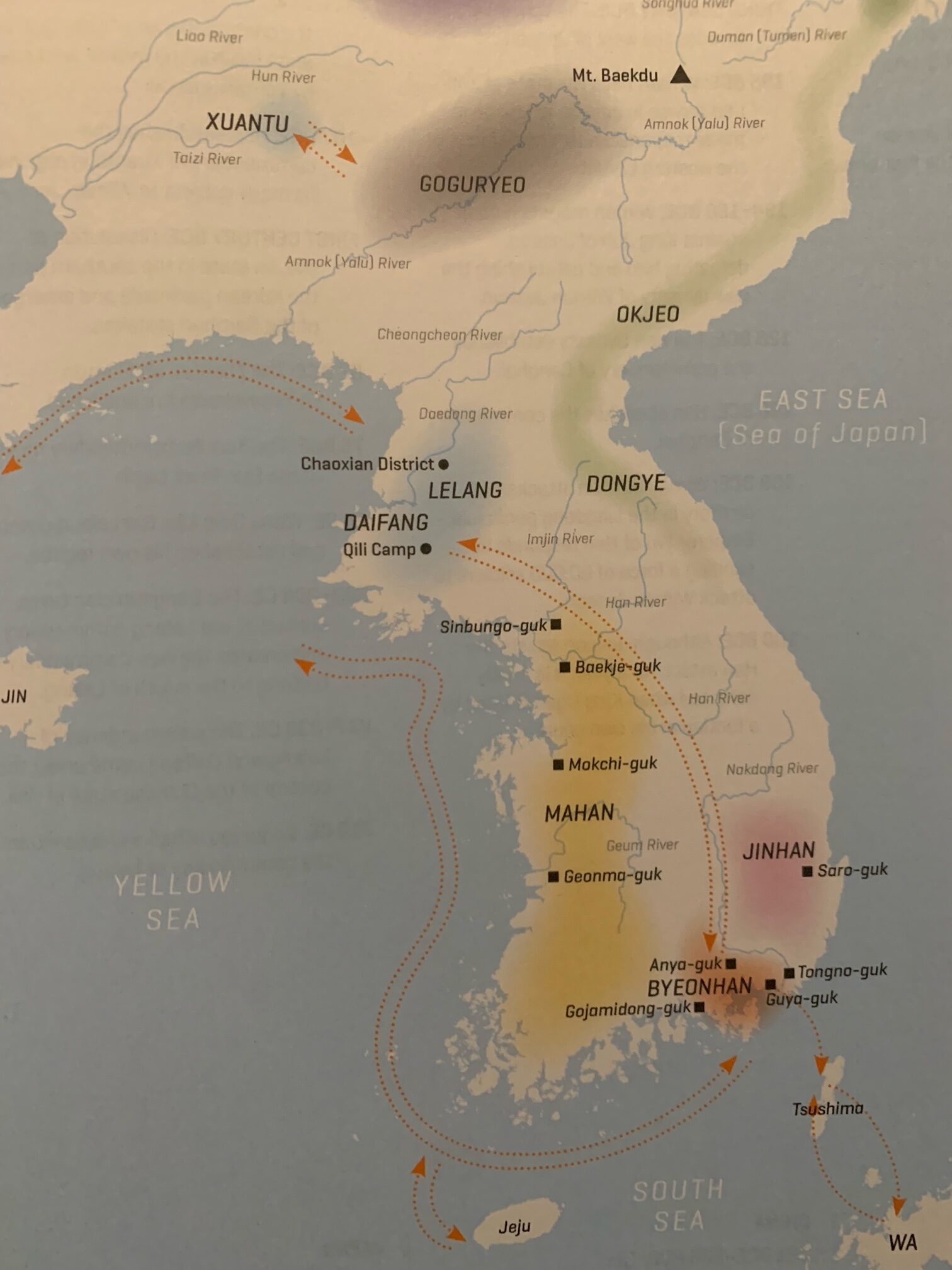
Korea’s influence on Japan was particularly significant during the Three Kingdoms period, when the Baekje kingdom played a key role in introducing Buddhism to Japan in the mid-6th century.
Alongside religion, Baekje artisans and scholars also brought advanced techniques in architecture, pottery, and metalworking, leaving a lasting imprint on early Japanese culture.
This cultural exchange helped shape the foundation of Japan’s early state, intertwining Korean expertise with native Japanese traditions to form a unique cultural identity.
Although Chinese, Korean, and Japanese cultures are interrelated, they have distinct characteristics.
China is the cultural motherland to which both Korea and Japan were indebted for centuries.
However, due to their long periods of isolation, both Korea and Japan developed unique interpretations of the philosophies and traditions imported from China.
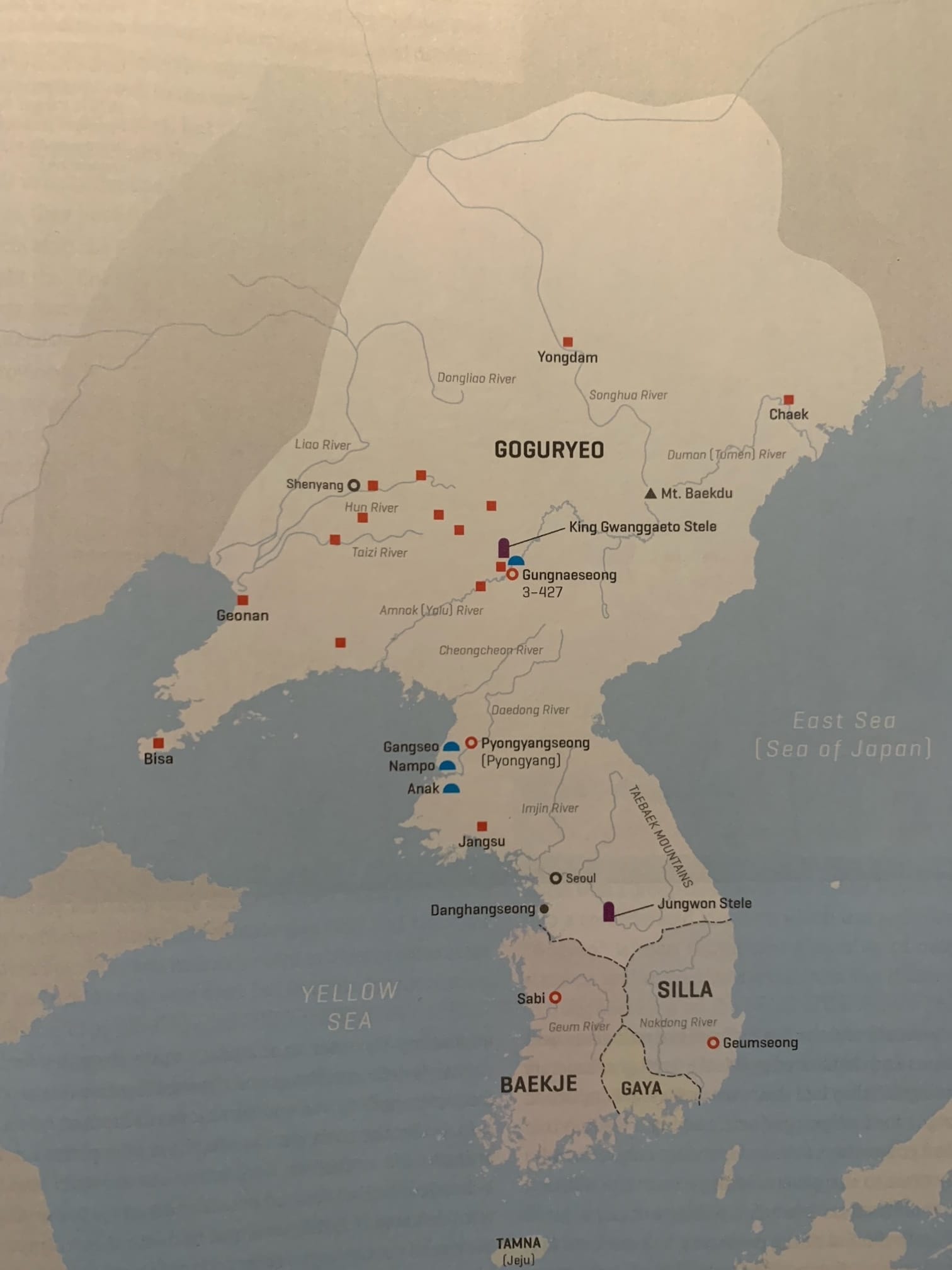
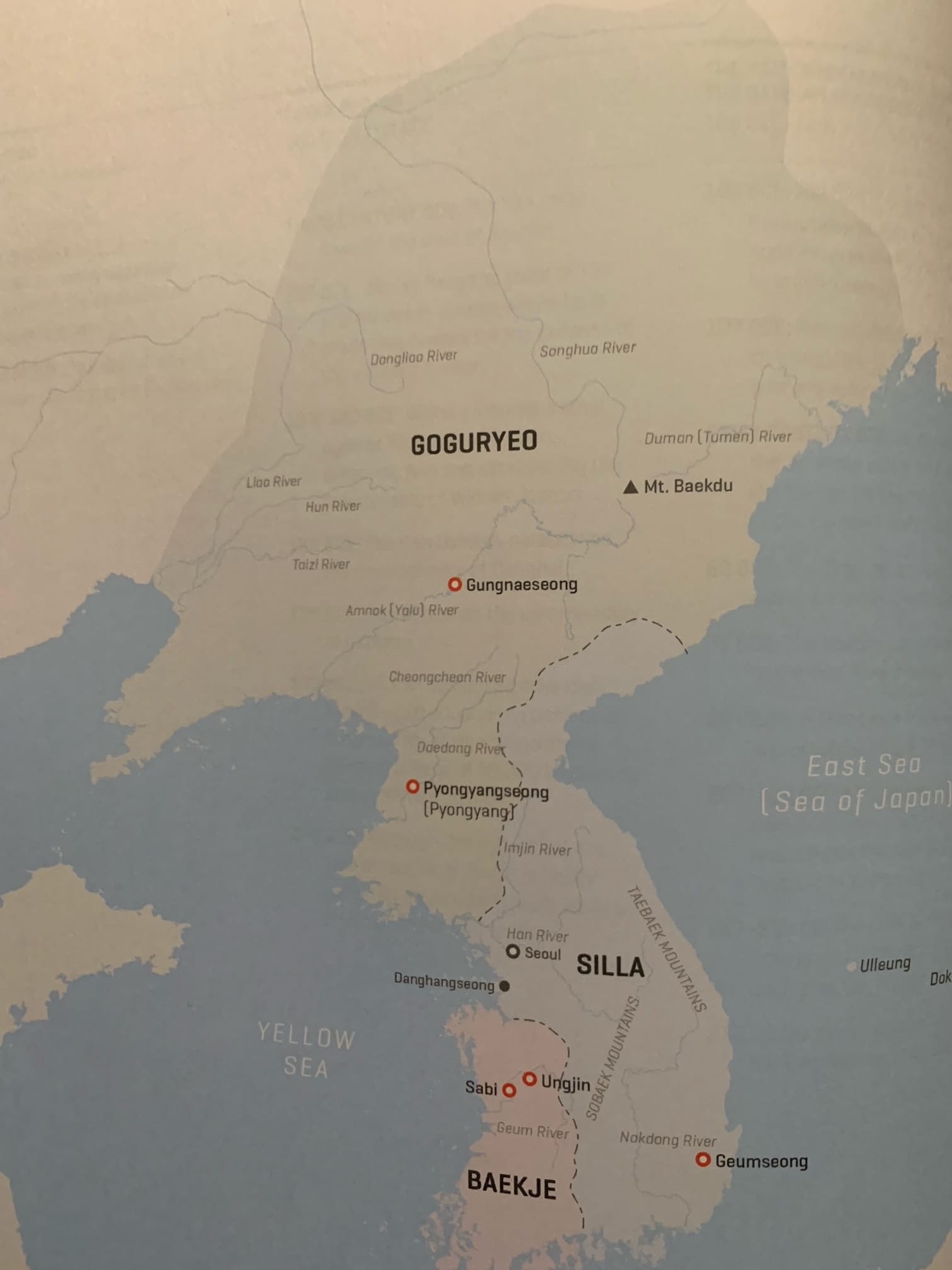
Korean History in maps Cambridge university press
3rd to 4th. century 6th century mid 6th century
What about Korean Melancholy the North
But what about the brothers and sisters behind the barbed wire in the North? Would they bend along or practice with rockets?
The mountains also observed the all-dominant Kim family. The regime, with all its cruelty, propaganda for domestic or foreign use,
the Gulag system, and starvation, does not escape the attention of the almighty. The regime, the dictator, could not provide the altars with food and drinks.
I realise that the Soju bottle is empty. Walking across the parking lot, I see the car that passed me just now.
The driver gets out and bends. He introduces himself as Oh Yang Chon and hands over his ticket. Police!
There are stories that touch me because they are woven into the very fabric of tradition, community, and compassion. And then there is Chuseok, the Korean harvest festival, which brings together all those layers of culture in one deep breath, emanating from its core. But it becomes even richer when I combine it with a philosophical concept that was revealed to me. The concept of Jijang’s Fractal, as I will detail in my book The Koreans and I emerged from deep reflection on compassion and interconnection Its roots in my reflection on Buddhism and religion in general: Jijang’s Fractal.
A Dol-tap (돌탑) is a traditional Korean stone tower, typically made by carefully stacking stones. These towers are often found along mountain trails or near temples and are built by people as symbols of wishes, prayers, or respect for nature and spirits. The act of stacking stones in a Dol-tap represents a personal offering or a desire for good fortune and harmony.
Chuseok tradition is about more than just family; it is about reverence, a sense of community, and the realization that every small action reverberates throughout the larger whole. This is where Jijang’s Fractal shines – my concept that embodies infinite interconnection and compassion, inspired by the bodhisattva Jijang Bosal and the mathematical idea of fractals. Jijang’s Fractal symbolizes how every action, no matter how small, multiplies infinitely and echoes through the community and the universe. During the Korean harvest festival, the network of compassion becomes especially strong. Read about how Jijang’s fractal came to me now.
The Story of Chuseok and the Stone Tower
In a small mountain village, far from the splendor of the Manwoldae Palace in Gaegyeong (now Kaesong), a family lived high in the mountains. Their name has long been forgotten. They had no rice, no wine, no offerings to present to their ancestors during Chuseok. Yet, they felt that unbreakable connection. They knew that even without material wealth, their actions would speak.
The mother of the family, a woman of great wisdom and gentle hands, decided to offer no material sacrifice but rather one of labor and service. The day before Chuseok, the family descended to her birth village. Along the way, they carefully collected the most beautiful stones. On the village square, near the village altar and the guarding **Changseung**, they washed their precious finds. With these self-gathered offerings, they created a small shrine. Every carefully placed stone became part of a modest tower – a small monument, but one full of meaning.
When the village elders saw this, they were initially saddened. They saw it as a sign of the family’s poverty. But when they looked closer, they saw the care with which the stones had been chosen and stacked, and they realized its significance. This was not a sign of poverty but a testament to their unbreakable spirit. The family may not have had material means, but their dedication to their ancestors and their community was deep and strong.
The village elders were so moved by this gesture that they honored the family by organizing a feast for them. The whole village came together, and for one day, wealth and poverty were forgotten. They shared everything they had, and the small stone tower became the center of their celebration. That Chuseok was not only a tribute to the ancestors but also a symbol of the strength of community, independence, and filial piety, even in the hardest of times.
Compassion and community in Korea’s Chuseok tradition
The Stream is where it begins, with that first act of reverence, like placing the first stone in the tower. The stream flows gently, and just as the stream grows, so does compassion.
Each stone stood for more than just a simple act. It was part of a larger pattern, the connected flow of Jijang’s compassion. Just as Jijang Bosal promises to leave no soul behind, no matter how small or lost, this family showed that even the smallest actions resonate within the larger community. That day, their tower became a symbol of connection – a monument to their ancestors but also to the community itself.
Just as a stream begins with a single drop and eventually flows into the sea, the family’s gesture started small, but it grew, it flowed, and it connected them to something greater. From a small gesture to a powerful ritual, every part of nature seemed to reflect this message.
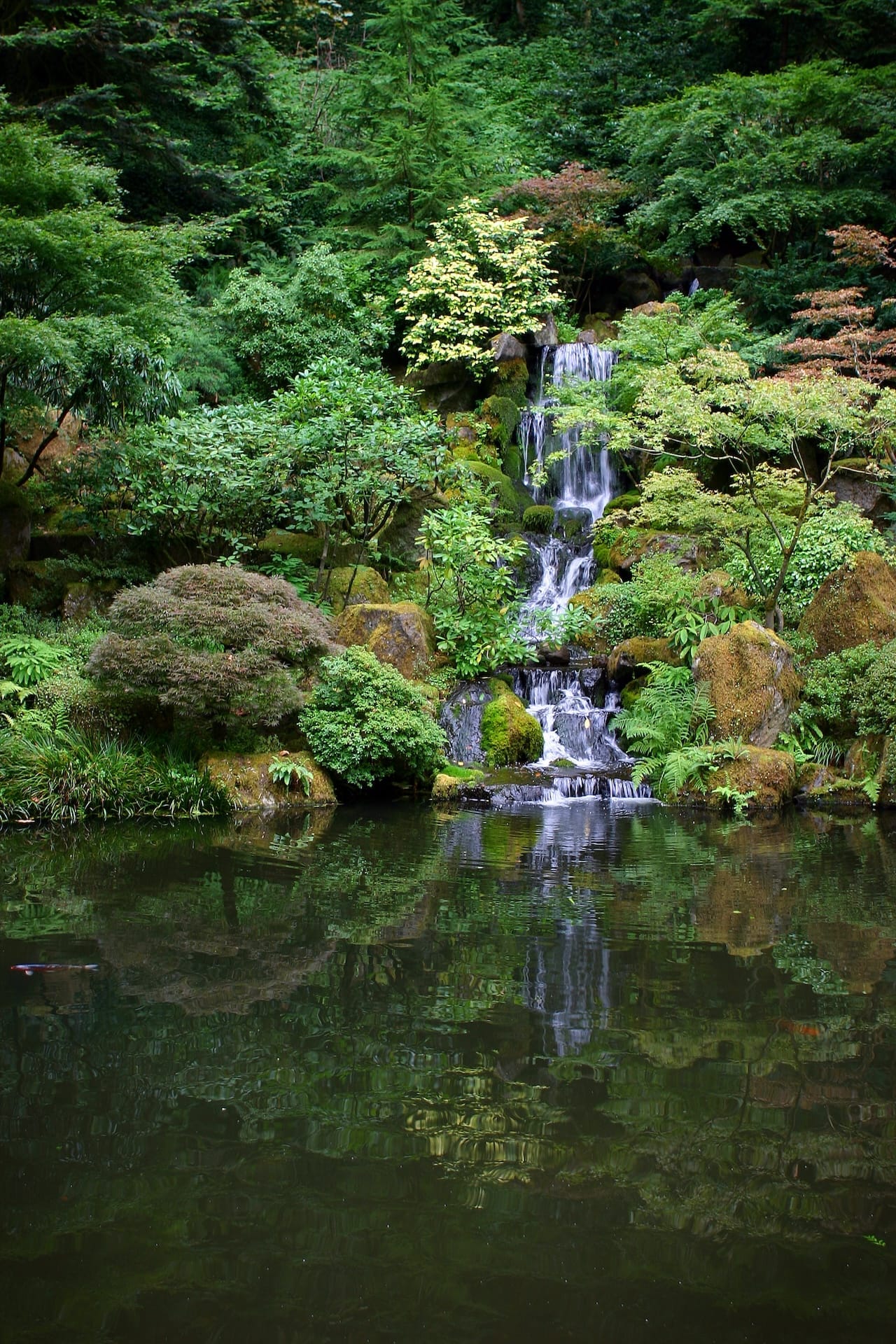
The Waterfall represents the intensity of the gesture, the power of action. Once compassion is set in motion, it gains strength, just as the waterfall thunders down, drenching its surroundings in water.
In the story of the family who, despite their poverty, built a stone tower as a tribute to their ancestors during Chuseok, you can see the echo of **Jijang’s Fractal**. As in the formula:
\[ f(v) = \sum_{w \in V} f(w) \]
where each value is influenced by all others, each stone in that tower becomes part of a greater pattern of reverence and community. And just like in:
the family’s gesture reaches its deepest power as it repeats, multiplies, and grows into a symbolic whole that touches the community and extends beyond their individual acts.
My Writing as a Contribution to the Flow
The River is the next phase, where connection broadens and flows more calmly yet deeply. Here, we see the maturity of the acts of compassion. The river continues to flow, nourishing the community, just as the river embraces the earth.
Reflecting on this story, Chuseok tradition, and the concept of Jijang’s Fractal, I also see my own writings as a small contribution to this flow. Just as every small gesture connects us to something greater, my words, too, aim to be part of that larger network of compassion and connection. Each story, each thought, each sentence I write is like a small stone added to the tower – a humble offering, yet part of the infinite pattern of connection that we all create together. I feel one with Indra’s net.
The Wish of Jijang’s Fractal, it’s Chuseok tradition
Based on this thought, I share a Chuseok wish, something that goes beyond the moment and resonates with the essence of Jijang’s Fractal:
May this Chuseok remind us of the power of small deeds. Just as a stream begins with a single drop, our gestures of love and reverence contribute to the infinite connection of our community and ancestors. Let us cherish every stone, every action, as part of a greater whole, and remember that in every simple act lies an endless pattern of compassion.”
With Jijang’s Fractal in mind, Chuseok tradition reminds us that our smallest actions form part of a larger whole. It is a celebration of connection, not only with the past but also with the future and with each other. Every stone in the tower, every fractal in the river, every drop in the sea – everything is part of the same eternal network. Every action, every stone, every step is part of the eternal flow of water. Jijang’s Fractal shows us that what starts small can multiply into something infinite.
The Sea, finally, symbolizes the ultimate destination: infinite connection. Just as the sea never stops, every act of compassion echoes endlessly through time and space.
After you have bowed to those dear to you, take a moment to enjoy what has been offered to them. When you pour Makgeolli or Soju:
Geonbae 건배 – and drink one for me. It brings me joy to know that the infinite pattern of Jijang’s Fractal in Korea will continue, as the remaining food is shared with those in need.
I wish you a very pleasant Chuseok 2024. Should you wish to delve deeper into my work, please do not hesitate to do so promptly.
Mudang and Korean Shamanism — A Deep Dive with Mugungwha Mudang Bosal
Korean shamanism, often called Muism, is one of the oldest spiritual traditions of Korea.
It combines ritual performances, spirit mediation, ancestral worship, healing practices, and communication with gods and spirits.
At the center of many of these traditions stands the mudang: the Korean shaman who mediates between the visible and invisible worlds.
This Mantifang guide brings together historical background, cultural explanation, and the personal practice of Mugungwha Mudang Bosal.
It is written as a calm introduction to Korean shamanism and Mudang traditions, not as folklore spectacle, but as a living spiritual current within Korean culture.
What Is a Mudang?
A mudang is a Korean shaman, spirit medium, ritual specialist, and mediator between human beings and the world of gods, ancestors, and spirits.
In Korean shamanism, the mudang may perform rituals for healing, protection, ancestral appeasement, fortune, transition, or the resolution of misfortune.
These rituals are often known as gut, and may include music, dance, prayer, offerings, costume, ritual speech, and spirit communication.
The word mudang is often translated as “Korean shaman,” but the role is more specific than that simple translation suggests.
A mudang is not only someone who believes in spirits.
She, or in some cases he, carries ritual responsibility.
The mudang stands at the threshold between community, family memory, suffering, illness, inherited tension, and the invisible forces that Korean tradition understands as active in human life.
Korean Shamanism: A Deep Dive with Mugungwha Mudang Bosal
Korean shamanism, often called Muism, is one of the oldest spiritual traditions of Korea.
It combines ritual performances, spirit mediation, and ancestral worship, and has influenced Korean culture from the Three Kingdoms period to modern Korea.
The Origins of Korean Shamanism
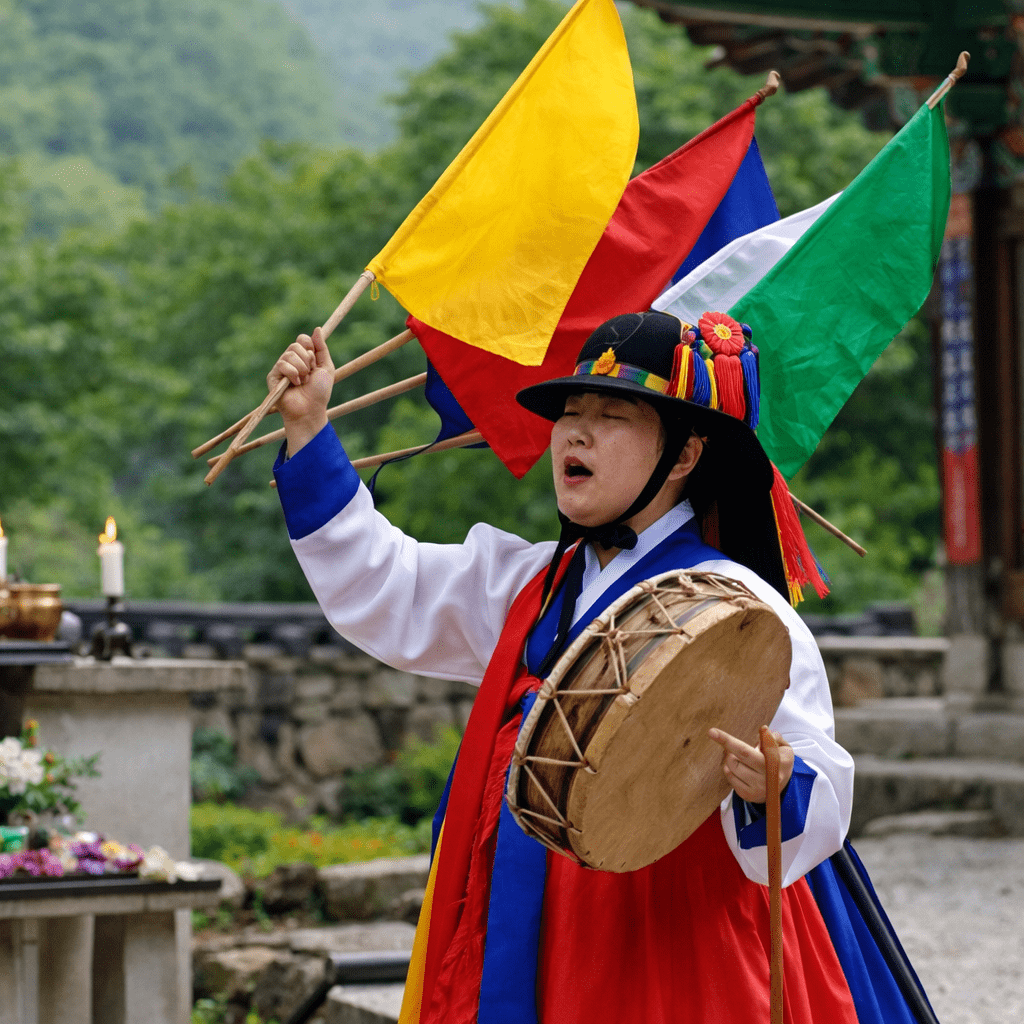
A mudang performing a traditional gut ritual in Korean shamanism, a spiritual practice that predates Buddhism and Confucianism on the Korean peninsula.
Korean shamanism, often referred to as Muism, predates the introduction of Buddhism and Confucianism to the Korean peninsula.
Archaeological and historical evidence suggests that early forms of shamanistic belief were already present during prehistoric tribal societies.
These traditions were closely connected to nature, ancestral spirits, and local mountain deities.
During the period of the Three Kingdoms of Korea,
shamanistic practices coexisted with the newly introduced Buddhist traditions.
Royal courts often relied on ritual specialists to perform ceremonies meant to protect the kingdom and ensure prosperity.
Even during the strongly Confucian Joseon dynasty,
shamanistic rituals continued among the population.
Many Koreans consulted shamans for healing rituals, spirit mediation, or guidance during periods of misfortune.
This long continuity is important. Korean shamanism did not disappear when Buddhism arrived, and it did not vanish when Confucian order became dominant.
Instead, it moved through households, villages, women’s ritual knowledge, local shrines, mountain beliefs, family crisis, and private need.
For that reason, the mudang remains one of the most revealing figures in Korean spiritual culture.
Mudang performing a traditional gut ritual in Korean shamanism, using ritual fan and ceremonial cloths.
It is a deeply rooted spiritual practice that has shaped the cultural and religious landscape of Korea for over 5,000 years.
It is more than just a religion; it is a way of life that fosters harmony with nature, personal empowerment, and spiritual enlightenment. Mudang Traditions are a significant aspect of mudang rituals focusing specifically on the practices and rituals performed by Mudang (shaman-priests), who serve as intermediaries between the human and spiritual worlds.
In this article, Mugungwha Mudang Bosal offers an intimate insight into her daily practice, sharing the profound connections she has with the gods, spirits, and traditions that define her role as a Mudang.
The name Mugungwha also carries a Korean cultural resonance.
The mugunghwa, or Rose of Sharon, is widely associated with Korean endurance and national symbolism.
In the context of this page, the name quietly connects personal spiritual practice with a broader Korean cultural field.
The Shamanic Life: Gods, Traditions, and Spiritual Responsibilities
The Daily Practice
In the daily life of a Mudang, every action is deeply intertwined with the gods she serves.
Mugungwha Mudang Bosal begins her day with ritualistic bows and offerings, connecting with the gods that guide her. Every Mudang has a distinct pantheon of gods and spirits that guide their rituals and daily life.
Each god in her pantheon has a distinct personality, and their interactions with her shape her shamanic duties.
From the War Gods, known for their strength and retribution, to the gentle yet firm Fairy Goddess, each deity plays a crucial role in her spiritual practice, which is central to Hanguk Shamanism and Mudang Traditions.
This daily discipline is one of the least understood aspects of Korean shamanism.
A mudang is often seen publicly during a gut ritual, but the visible ceremony is only one part of the work.
Behind the ritual stands a continuous relationship with spirits, gods, ancestors, sacred images, offerings, dreams, warnings, bodily sensations, and inherited obligations.
The mudang’s life is therefore not limited to performance.
It is a lived pattern of attention.
Korean Shamanism vs. Mudang Traditions
Understanding the Difference
The Muga-ism is overarching spiritual system in Korea, encompassing a wide range of beliefs and practices that connect the human world with the spiritual realm.
It includes various rituals, ceremonies, and traditions that honor the gods, spirits, and ancestors.
Korean Shamanism can be practiced by anyone who follows its principles, regardless of their specific role within the community.
Mudang Traditions, on the other hand, refer specifically to the practices, rituals, and responsibilities of the Mudang, who are shaman-priests.
Mudang undergo extensive training, often marked by spirit sickness, and serve as intermediaries between the gods and people.
They perform rituals such as the gut (ceremony) to communicate with spirits, offer guidance, and provide healing.
While It is a broader concept, Mudang Traditions are a specialized, priestly path within this system, requiring direct interactions with the divine and a life dedicated to spiritual service.
This distinction helps readers understand why “Korean shamanism” and “mudang” should not be treated as identical terms.
Korean shamanism refers to the broader spiritual field.
Mudang traditions refer to the embodied, trained, and ritually responsible path of the Korean shaman.
The mudang stands inside the tradition, but also gives it a human face, a voice, and a public ritual form.
The Pantheon of Gods and Spirits
Channeling the Divine
Mugungwha Bosal’s pantheon is vast, with gods representing everything from the natural world to specific human experiences. Ecstatic shamanism involves directly channeling and communicating with gods and spirits without entering a trance.
During rituals, she channels these gods, communicating directly with them to gain insight and guidance.
Her gods range from the Mountain God, who embodies stoicism, to the playful Child Gods, who bring fortune and teach her the ways of ritual dance.
Each deity adds a layer of complexity and responsibility to her life as a Mudang, further enriching the practice of Shamanism and Mudang Traditions.
In Korean shamanism, spirits and gods are not always abstract ideas.
They can be experienced as presences with character, temperament, memory, demand, and symbolic force.
Mountain spirits, ancestral spirits, child spirits, military spirits, household spirits, and protective deities may all appear within the mudang’s ritual universe.
This gives Korean shamanism a layered quality: intimate and cosmic, domestic and theatrical, personal and communal at the same time.
Spiritual Challenges and the Mudang’s Journey
Spirit Sickness and Healing
A traditional altar used in Korean shamanism rituals, with offerings, candles and images of protective spirits used by a mudang during a gut ceremony.
Becoming a Mudang is not a choice; it is a calling, often marked by intense suffering known as “spirit sickness.” The journey to becoming a Mudang often begins with “spirit sickness,” a physical and mental calling from the spirit world.
For Mugungwha Bosal, this manifested as physical ailments and vivid premonitions, experiences that led her to her initiation as a Mudang.
Even after initiation, the connection with the gods requires constant attention, and new gods bring new challenges, often leading to overwhelming emotions and physical sensations—a crucial aspect of Hanguk Shamanism and Mudang Traditions.
Spirit sickness is one of the most important ideas in the study of Korean mudang traditions.
It describes a crisis in which ordinary life becomes disrupted by illness, dreams, visions, misfortune, emotional pressure, or inexplicable suffering.
Within the shamanic framework, such a crisis may be understood as a sign that the person is being called by spirits.
Initiation does not simply remove the suffering.
It reorganizes it into ritual responsibility.
Gut Ritual: Music, Dance, Offerings, and Mediation
A gut is one of the central ritual forms of Korean shamanism.
It may be performed for healing, blessing, ancestral peace, protection, prosperity, purification, or the release of spiritual disturbance.
A gut ritual can include percussion, song, dance, costume changes, food offerings, spoken invocations, spirit messages, and moments of emotional intensity.
The mudang does not simply “perform” the ritual as theater.
She mediates.
She listens, calls, invites, appeases, negotiates, consoles, and sometimes confronts.
The ritual space becomes a crossing point between the family, the ancestors, the living community, and the spirits who are believed to influence the present.
For outsiders, the movement and music of a gut may seem dramatic.
For participants, however, the ritual often has a practical purpose.
It gives form to grief, fear, illness, transition, conflict, or inherited sorrow.
It allows the invisible to be addressed through visible action.
Renewal and Responsibility
The Importance of Rituals
As an ecstatic shaman, Mugungwha Bosal’s life is a constant cycle of renewal and responsibility. Rituals like initiation and renewal ceremonies are crucial for maintaining the Mudang’s connection with the gods.
These rituals not only establish and maintain the connection with the gods but also allow the Mudang to recharge their spiritual energy, honor the deities, and ensure the gods’ guidance and protection in their daily lives.
This cyclical process is central to Korean spiritual lineage and Mudang Traditions.
Renewal matters because the relationship between mudang and spirits is not static.
It must be maintained.
Offerings, bows, songs, ritual preparation, shrine care, and ceremonial obligations all form part of this continuity.
The mudang’s authority is therefore not only inherited or initiated.
It is repeatedly confirmed through practice.
Women, Mediation, and Social Memory
Many mudang in Korea have historically been women.
This gives Korean shamanism a distinctive social importance.
In a society strongly shaped by Confucian hierarchy, the mudang offered another kind of voice: emotional, ritual, bodily, and often female.
Through the mudang, grief could speak, family tension could be named, ancestors could be addressed, and suffering could be given a ritual form.
This does not mean that Korean shamanism should be reduced to gender alone.
But the role of women in mudang traditions is essential for understanding how Korean spiritual life survived outside official doctrine.
The mudang often carried forms of memory that were not always preserved in state records, elite literature, or formal religious institutions.
Connecting with Heritage and the Future of Korean Shamanism
Preserving and Sharing Traditions
Mugungwha Bosal is hopeful for the future of Korean spirit mediumshipand Mudang Traditions, especially within the Korean diaspora, who often struggle to connect with their cultural heritage. Mugungwha Bosal blends traditional shamanic practices with modern life, making them accessible for today’s world.
By sharing her experiences and practices, she aims to bring these ancient traditions to a broader audience.
She is committed to setting up natural shrines in the mountains and by the sea, where anyone can connect with the gods and seek spiritual guidance.
In the diaspora, Korean shamanism can become more than a ritual system.
It can become a way of recovering language, ancestry, memory, and spiritual belonging.
For people separated from Korea by migration, adoption, family history, or cultural distance, the mudang may appear as a figure of reconnection.
She does not only look backward.
She helps ancestral presence enter the present.
Korean Shamanism in Modern Korea
Korean shamanism is still practiced today, although its public status has changed across time.
Modern Korea contains Buddhism, Christianity, Confucian inheritance, secular life, popular culture, technology, and folk practice at the same time.
Within that complex field, mudang continue to perform rituals, offer consultations, maintain shrines, and preserve ritual knowledge.
At times, Korean shamanism has been dismissed as superstition.
At other times, it has been studied as heritage, performance, women’s religion, anthropology, folk culture, and living spirituality.
Mantifang approaches it as a serious cultural tradition that deserves careful language.
It should neither be romanticized nor ridiculed.
It should be understood as part of Korea’s deep religious and emotional landscape.
Mudang, Buddhism, and the Jijang Fractal
Korean shamanism and Korean Buddhism are distinct traditions, yet in lived Korean culture they have often existed near each other.
Mountain spirits, temple landscapes, ancestral concern, death rituals, compassion, and protection all create zones where traditions may touch without becoming the same.
This is one reason Mantifang sometimes places Korean shamanism beside Buddhist and literary material.
The Jijang Fractal Book Hub offers a wider spiritual and literary framework for these crossings.
It does not turn mudang traditions into Buddhism.
Instead, it helps readers see how Korean spiritual life often moves through thresholds: between life and death, family and ancestor, visible and invisible, suffering and responsibility.
Explore More: Holy Korean and Tibetan Transitions
For a deeper understanding of how Korean healing ritualsand Mudang Traditions intersect with other spiritual practices, such as Tibetan traditions, explore our story on Holy Korean and Tibetan Transitions.
This piece delves into the spiritual transitions and connections between these rich traditions.
Questions and Answers about Korean Shamanism and Mudang
What is Korean Shamanism?
Korean shamanism, often called Muism, is one of the oldest spiritual traditions of Korea.
It centers around rituals performed by shamans, known as mudang, who communicate with spirits to heal, guide, or resolve misfortune.
What is a Mudang?
A mudang is a Korean shaman who performs rituals called gut.
During these ceremonies the mudang mediates between the human world and the spirit world through music, dance, and prayer.
Is a mudang the same as a shaman?
A mudang is often translated as a Korean shaman, but the term is culturally specific.
A mudang carries ritual duties within Korean shamanism and may serve gods, spirits, ancestors, families, and communities through ceremony and mediation.
What is a gut ritual?
A gut is a Korean shamanic ritual performed by a mudang.
It may include music, dance, offerings, costume, prayer, spirit communication, and ritual speech.
Gut rituals are performed for healing, protection, blessing, ancestral peace, or the resolution of misfortune.
How old is Korean shamanism?
Korean shamanism predates Buddhism and Confucianism in Korea and has roots stretching back thousands of years, possibly to prehistoric tribal belief systems.
Is Korean shamanism still practiced today?
Yes. Although Korea is now largely secular and influenced by Buddhism and Christianity, shamanistic rituals are still performed, especially for healing, fortune telling, ancestral guidance, and spiritual protection.
What role did shamanism play in Korean history?
Shamanism shaped early Korean religious life and influenced royal rituals, folk traditions, local spiritual practices, and household responses to illness or misfortune.
Even during the Confucian Joseon dynasty, many shamanistic beliefs continued among the population.
What is spirit sickness?
Spirit sickness refers to the suffering, illness, visions, dreams, or emotional crisis that may mark the calling of a future mudang.
Within Korean shamanism, such suffering can be understood as a summons from the spirit world that must be answered through initiation and ritual responsibility.
Why are mudang important in Korean culture?
Mudang are important because they preserve a living ritual language for grief, illness, ancestry, protection, and transition.
They show how Korean culture has long understood the relationship between human life, family memory, nature, spirits, and the unseen world.
Changneung 3 New City is driving growth and development in Korea, impacting communities like Baedagol Theme Park and Goyang Koi Farm. In The Koreans and I you can read: As I softly chant ‘Na-mu Ji-jang Bul,’ I let the words guide my steps along Baedagol-gil, the path running alongside the Seongsaheon River. The river, now a small stream, burbles quietly below me, its sound almost drowned out by the symphony of Cicadas. Each step feels like a journey between worlds, much like the river, which swells during the monsoon only to retreat into a quiet stream under the summer sun. It makes me a little bit sad that all this will change. Read more about how it was in The Koreans and I.
The Geological Foundation of Korea
Baedagol theme park, backed by the Seoul mountains and the new peace road.
Korea, a beautiful peninsula located almost like a bridge between China and Japan, has a geological history that dates back to the Precambrian era. The peninsula is composed of ancient granite and gneiss rocks, interspersed with volcanic rocks, mainly in the south and on the Jeju Islands. The mountains, such as the Taebaek mountain range running from north to south, form the backbone of Korea’s landscape. These mountains have played a crucial role in shaping the climate, water sources, and agricultural possibilities in Korea.
The rich river deltas, such as those of the Han River, have produced fertile soils perfect for agriculture. The western and southern coastal areas, where rivers flow into the Yellow Sea, are particularly fertile and have attracted large populations throughout history.
From Traditional Agriculture to the Division of North and South
Agriculture in Korea has a long history, beginning with rice cultivation likely introduced during the Neolithic period. Over the centuries, Korea developed into a society heavily dependent on rice farming, as well as other crops like barley, wheat, and soybeans. Agricultural methods were refined, using irrigation and terracing, especially in the mountainous regions.
Backyard Baedagol.
Growing for Kimchi
Sokkanaegi namu lost?
During the Joseon Dynasty (1392-1910), agriculture was the backbone of the economy, and the government promoted the development of rice fields and irrigation systems. This period also saw the spread of Confucian ideals, which valued land use and agricultural productivity as central principles.
After the Japanese occupation (1910-1945) and the subsequent Korean War (1950-1953), the peninsula was divided into North and South Korea. This division led to different agricultural strategies: North Korea, with its mountainous terrain, focused more on collectivist agriculture, while South Korea, with its fertile valleys and access to the sea, underwent agricultural modernization, supported by the Green Revolution and technological innovations.
Urbanization and Modernization to the Present Day
Enjoying a cup of coffee or tea after a leisurely stroll.
In the second half of the 20th century, South Korea underwent rapid industrialization and urbanization. The migration of populations from rural areas to cities was immense. Cities like Seoul, Busan, and Incheon grew into metropolises, driven by a booming economy centered on technology, the automotive industry, and international trade.
Urbanization brought challenges, such as the loss of agricultural land and environmental issues. In recent decades, the South Korean government has tried to balance urban growth with environmental preservation. This has led to plans like the development of new cities, including Changneung 3 New City, to alleviate pressure on existing urban centers.
The Koreans’ deep respect for the environment is evident in their cultural practices, as seen in their traditional gardening methods. For example, in Korean Gardening: The Gods Are Praised, we see how gardens are designed not just for aesthetic beauty but as sacred spaces that honor the gods and nature. This cultural respect for the environment gives me confidence that Changneung 3 New City will be developed with the same attention to natural beauty and environmental care. Although, of course, it can’t quite compare to Rotterdam—said with a smile.
The Impact of Changneung 3 New City Relocation on Baedagol Theme Park and Goyang Koi Farm
Little neighbourhood shrine
One of the most recent examples of this urbanization is the development of Changneung 3 New City, an ambitious expansion of the urban areas around Seoul. This project is designed to accommodate the growing population and stimulate economic activities. However, this expansion also affects existing communities and businesses.
Baedagol Theme Park and Goyang Koi Farm are two such locations impacted by the development of Changneung 3 New City relocation. Both businesses have deep roots in the local community and are well-known attractions for both residents and tourists. Unfortunately, due to the plans for the new city, these businesses are forced to relocate to new sites.
Baedagol Theme Park, known for its educational and recreational activities that highlight Korean culture and nature, will have to find a new location to continue its mission. Goyang Koi Farm, a place where koi enthusiasts gather to admire and breed these beautiful fish, will also need to seek a new home where it can continue its tradition.
Read More About The Koreans and Their Environment:
Korean Nature is Unique – Discover the unique aspects of Korean nature and how they have been shaped over time.
Odors Give Way to Fragrance in 19th Century – A fascinating look at how scents and odors changed in 19th-century Korean gardens. Beautiful odors
Korean Gardening: The Gods Are Praised – Explore how Korean gardening traditions honor the gods and hold deep cultural significance. The gods are praised.
Korea’s geological foundation has laid the groundwork for a rich agricultural tradition that has contributed to the development of the country over the centuries. Rapid urbanization in modern times has led to new opportunities but also challenges for existing communities. The Changneung 3 New City relocation and the forced relocation of Baedagol Theme Park and Goyang Koi Farm are examples of the ongoing balance Korea must strike between progress and preserving its cultural and natural heritage.
TWICE the first Korean girl group to acieve the milestone of reaching over 200 million views on YouTube
Hallyu: the Korean Wave refers to the worldwide popularity of South Korean culture, which has been growing since the mid-1990s. Initially fueled by the success of South Korean TV dramas and pop music in countries like China and Japan, Hallyu has since become a global trend, influencing various aspects of popular culture.
Here are the seven reasons for the global rise of K-Culture Boom: The Korean Wave:
Addictive K-Dramas: Captivating storylines and high-quality production have attracted a global audience, from romance to thrillers.
K-Pop Sensation: With energetic performances, catchy music, and charismatic idols, K-pop groups like BTS and BLACKPINK have built massive international fanbases.
Unique Fashion and Beauty: Korean fashion and beauty products, such as K-beauty routines, are beloved worldwide for their innovation and style.
Digital Accessibility: Platforms like YouTube and social media make it easy to access and enjoy Korean content, leading to its global spread.
Cultural Diversity: Korean culture offers a fresh and diverse perspective on storytelling and traditions that resonate with people from various cultures.
Strong Fan Support: The dedication of global fanbases, like BTS’s ARMY and BLACKPINK’s BLINK, has propelled Korean Cultural Wave to unprecedented heights.
International Recognition: Success stories like the Oscar-winning film Parasite have put Korean media on the world map, driving further interest in other aspects of the culture.
The Early Days of K-Wave: Korean Dramas Captivate Asia
The term Hallyu: the Korean Wave first gained traction in 1997 when the TV drama What Is Love aired on China Central Television (CCTV). Ranking second in China’s all-time imported video content, this drama marked the beginning of the Korean Wave’s influence across Asia.
Silla ceramic warrior
On this site, Mantifang’s Hugo J. Smal provides information that helps you navigate Korean Culture Explosion the Korean wave. Explore his insights on Korean dramas, the cuisine of the Korean kitchen, and, of course, the renowned ingredient Kimchi. Remember to try the recipe, and enjoy the food served in exquisite Korean ceramics. The Korean Mudang is still very important in Korea. Read about the adventures of Mugungwha Mudang Bosal
We have also discovered valuable insights from other authors regarding the influence of Confucianism on contemporary Korea, the origins of Korean pop culture, and the unique relationship between theNetherlands and Korea and the influences that the Dutch had on the Korean language.
Goyang Koi Farm: The New Face of Korea’s Global Influence
At Goyang Koi Farm, we are proud to contribute to Hallyu: the Korean Wave by introducing Korean Fancy Carp, or K-Carp. These stunning fish, known as Ing-eo (잉어) in Korea, embody the values of strength, perseverance, and longevity. As the Korean Wave continues to spread through K-pop and K-dramas, we invite you to experience the Korean Koi Wave at Goyang Koi Farm.
The Expansion of Hallyu: The Global Reach of Korean Pop Culture
From the mid-2000s to the early 2010s, the Korean Wave expanded its influence with the rise of idol groups like Big Bang, Girls’ Generation, and Kara. These groups played a significant role in taking the Korean Wave beyond Asia, gaining a substantial following in Latin America, the Middle East, and other regions.
Beyond Entertainment: Hallyu’s Impact on Global Culture
Since the 2010s, Korean Craze: has broadened its reach beyond TV dramas and music to include traditional culture, food, literature, and language. The global appeal of Korean culture has been further amplified by online platforms like YouTube and social media, creating a diverse and enthusiastic international fanbase.
Hallyu in Cinema: The Impact of Parasite
[embedyt] https://www.youtube.com/watch?v=5xH0HfJHsaY[/embedyt]
The influence of K-Wave reached new heights in 2020 when the film Parasite won four major awards at the 92nd Academy Awards, including Best Picture and Best Director. This achievement underscored the growing global recognition of Korean cinema as a vital part of the Korean Wave. The Arthdal chronicles are one of Hugo’s favorites. Read his comment on Dangun and The Arthdal Chronicles
Stay Updated on Hallyu
Follow us on Facebook for the latest updates on Korean Culture Explosion and other exciting trends in Korean culture. Dive deeper into Korean culture with our social media.
AI writing vs human creativity: from battle cry to partnership
AI writing vs human creativity is no longer just a debate but a working method. A few years ago we framed it as a duel—robots versus authors. Today I use AI as a useful assistant that sharpens prose, flags errors, and frees attention for the real work: meaning, memory, rhythm. The human side—doubt, experience, imagination—remains indispensable. This piece shows, in practice, how AI writing vs human creativity becomes collaboration without losing a writer’s voice.
My path through AI writing vs human creativity
My little creative corner.
When AI entered the literary domain, I buried myself in my autobiographical thriller The Jijang Fractal Not because a book makes me rich—few authors live on royalties—but because a life wants to be told. If anyone can generate text with a click, what is a story worth? The answer for me: the personal—fear, courage, an awkward silence—cannot be lived by a machine on my behalf. That’s the human half of AI writing vs human creativity.
Speed versus depth
Take something ordinary: an article about water quality. I read, compare sources, draft notes; two days later a first sentence forms. Another day of cutting and breathing—and the story lands. AI can produce a tidy outline in seconds. But the human delay—the search for tone, the friction of a paragraph—that’s depth. Here the limit of AI writing vs human creativity appears: a model can structure, not live. It doesn’t feel a cold wind on deck; it doesn’t carry thirst that feeds a metaphor.
“We are the freeloaders, the last people who are not servants, with Baal and Karamazov in our midst. What is a poem worth: four shirts, a loaf of bread, half a cow? We do not make goods but gifts.”
That line sticks. A story like To Jangbong-do: Good at Boats grows out of lived time: the smell of salt, a smoke shared with a boy, the thud of the hull. Algorithms can mimic such a scene, but not carry it. My non-journalistic pieces therefore remain gifts—free to take on Mantifang. In the conversation on AI writing vs human creativity, that is my anchor: AI can do a lot, but it cannot give what it never experienced.
Resistance and embrace: The Jijang Fractal
The Jijang Fractal is my resistance—not against technology, but against the idea that technology can replay my life. At the same time I embrace AI as an editor. I use ChatGPT as a proofreader: it watches coherence, points at sloppiness, and removes noise from sentences. It doesn’t argue; it advises. I decide. In this balance, AI writing vs human creativity stays honest: the memoir remains human, the polishing may be technical.
AI helps with fine tuning
For a non-native English writer that help is gold. AI notices what I overlook—but it doesn’t feel what I feel. The core stays intact: I write, AI assists. Readers should recognize this division of roles: AI writing vs human creativity works when the machine assists and the human makes meaning.
Cannot: carry a childhood memory; taste shame; choose a moral stance; pace a silence in a paragraph; make a scene tremble with lived time.
That distinction isn’t a threat; it’s a relief. It means I can spend energy on story, rhythm, composition—and ask the assistant to handle the heavy technical lifting. Outsource everything to AI and you get text with no origin. Refuse everything and you miss sharp tools. Between those extremes grows the craft that AI writing vs human creativity now demands.
Publishing in chapters
I publish The Jijang Fractal chapter by chapter on Mantifang. Each part appears when it’s ready: raw enough to live, careful enough to last. Readers return, respond, and move along with me. AI helps with this cadence—not by dictating sentences, but by removing restlessness. Progress is visible; the voice stays my own. This is my practical answer to AI writing vs human creativity: iterative writing with a sober assistant at my elbow.
AI writing vs human creativity: where we are now
The question “who wins?” is outdated. A better one is: how do we work together? I trust experience, observation, and ethics; I use AI for speed, consistency, and suggestions. Algorithms propel; the author steers. Literature remains a human practice—with modern tools. If you read my work—from poems to The Jijang Fractal —you may notice that an assistant helped. But the pulse of the text, that slow thinking heart, beats on its own.
Conclusion: choose your role, choose your tools
If there’s one lesson from AI writing vs human creativity it is this: don’t let the tool become the author. Use AI without losing your voice. Choose your tempo, your tone, your truth—and employ technology where it makes you sharper. That’s what I do, and I invite you to read along, respond, and keep the conversation open. Writing is not a race against machines; it is the sharing of life—with good tools within reach.
Will AI writers eventually be exposed?
Most AI-generated writing does not fail because it is incorrect. It fails
because it lacks origin. Over time, texts without lived reference become
interchangeable: consistent, coherent, and increasingly anonymous.
This does not mean that writers who use AI will disappear. It means that
writing without presence, without place, and without responsibility
gradually loses credibility. The question shifts from “Is this well written?”
to “Where does this come from?”
No. Originality is not determined by the tools used, but by the source of
experience. When AI assists with editing or structure while the writer
remains responsible for meaning, voice, and presence, originality is preserved.
Can AI ever replace human writers?
AI can reproduce patterns, styles, and arguments, but it cannot replace
lived experience. Writing that matters over time depends on place, memory,
moral choice, and responsibility — all of which remain human.
How should writers work with AI today?
As with any tool: deliberately. AI is effective for polishing, checking,
and accelerating technical tasks. The writer decides what is said, why it
matters, and when silence is more truthful than explanation.