Hallyu: The Korean Wave – A Global Cultural Phenomenon

Hallyu (Korean Wave)
TWICE the first Korean girl group to acieve the milestone of reaching over 200 million views on YouTube

Hallyu: the Korean Wave refers to the worldwide popularity of South Korean culture, which has been growing since the mid-1990s. Initially fueled by the success of South Korean TV dramas and pop music in countries like China and Japan, Hallyu has since become a global trend, influencing various aspects of popular culture.

Here are the seven reasons for the global rise of K-Culture Boom: The Korean Wave:

  1. Addictive K-Dramas: Captivating storylines and high-quality production have attracted a global audience, from romance to thrillers.
  2. K-Pop Sensation: With energetic performances, catchy music, and charismatic idols, K-pop groups like BTS and BLACKPINK have built massive international fanbases.
  3. Unique Fashion and Beauty: Korean fashion and beauty products, such as K-beauty routines, are beloved worldwide for their innovation and style.
  4. Digital Accessibility: Platforms like YouTube and social media make it easy to access and enjoy Korean content, leading to its global spread.
  5. Cultural Diversity: Korean culture offers a fresh and diverse perspective on storytelling and traditions that resonate with people from various cultures.
  6. Strong Fan Support: The dedication of global fanbases, like BTS’s ARMY and BLACKPINK’s BLINK, has propelled Korean Cultural Wave to unprecedented heights.
  7. International Recognition: Success stories like the Oscar-winning film Parasite have put Korean media on the world map, driving further interest in other aspects of the culture.

The Early Days of K-Wave: Korean Dramas Captivate Asia

The term Hallyu: the Korean Wave first gained traction in 1997 when the TV drama What Is Love aired on China Central Television (CCTV). Ranking second in China’s all-time imported video content, this drama marked the beginning of the Korean Wave’s influence across Asia.

Korean history
Silla ceramic warrior

On this site, Mantifang’s Hugo J. Smal provides information that helps you navigate Korean Culture Explosion the Korean wave. Explore his insights on Korean dramas, the cuisine of the Korean kitchen, and, of course, the renowned ingredient Kimchi. Remember to try the recipe, and enjoy the food served in exquisite Korean ceramics. The Korean Mudang is still very important in Korea. Read about the adventures of Mugungwha Mudang Bosal

We have also discovered valuable insights from other authors regarding the influence of Confucianism on contemporary Korea, the origins of Korean pop culture, and the unique relationship between theNetherlands and Korea and the influences that the Dutch had on the Korean language.

Goyang Koi Farm: The New Face of Korea’s Global Influence

Goyang KoiAt Goyang Koi Farm, we are proud to contribute to Hallyu: the Korean Wave by introducing Korean Fancy Carp, or K-Carp. These stunning fish, known as Ing-eo (잉어) in Korea, embody the values of strength, perseverance, and longevity. As the Korean Wave continues to spread through K-pop and K-dramas, we invite you to experience the Korean Koi Wave at Goyang Koi Farm.

The Expansion of Hallyu: The Global Reach of Korean Pop Culture

From the mid-2000s to the early 2010s, the Korean Wave expanded its influence with the rise of idol groups like Big Bang, Girls’ Generation, and Kara. These groups played a significant role in taking the Korean Wave beyond Asia, gaining a substantial following in Latin America, the Middle East, and other regions.

Beyond Entertainment: Hallyu’s Impact on Global Culture

Arthdal cronicals
 

Since the 2010s, Korean Craze:  has broadened its reach beyond TV dramas and music to include traditional culture, food, literature, and language. The global appeal of Korean culture has been further amplified by online platforms like YouTube and social media, creating a diverse and enthusiastic international fanbase.

Hallyu in Cinema: The Impact of Parasite

[embedyt] https://www.youtube.com/watch?v=5xH0HfJHsaY[/embedyt] The influence of K-Wave reached new heights in 2020 when the film Parasite won four major awards at the 92nd Academy Awards, including Best Picture and Best Director. This achievement underscored the growing global recognition of Korean cinema as a vital part of the Korean Wave. The Arthdal chronicles are one of Hugo’s favorites. Read his comment on Dangun and The Arthdal ​​Chronicles

Stay Updated on Hallyu
Follow us on Facebook for the latest updates on Korean Culture Explosion and other exciting trends in Korean culture. Dive deeper into Korean culture with our social media.

Goyang neighbourhood explorations


Chapter 3: The Jijang Fractal

Written by Hugo J. Smal

This chapter of Goyang neighbourhood tracks a lived contrast: Rotterdam directness against Korean relational form, individual impulse against collective role, speech against context. It circles through neighbourhood, stream, memory, ritual, food, shame, and vision, not as separate topics but as one field of experience. Confucian social roles, Korean kibun and nunchi, and the unfolding logic of The Jijang Fractal are tested in body-language, hierarchy, table manners, and misread moments. The narrative descends into a darker textual intrusion, where voice, violence, and fractured identity pressure the narrator’s own reflections. Out of this tension, the fractal intuition reappears: not invented, but encountered.

[Internal link placeholder: Chapter 2] |
[Internal link placeholder: The Jijang Fractal hub] |
[Internal link placeholder: Korean kibun and nunchi]

Rotterdam and Goyang: Two Communication Worlds in Goyang neighbourhood

From Rotterdam to a Goyang neighbourhood

During my explorations of the Goyang neighbourhood, I came to understand that communication in Korea involves much more than just words and sentences. The context, the speaker, and the way something is expressed are all crucial. To truly grasp the meaning, one must read between the lines. Coming from Rotterdam, where people are straightforward and open-hearted, I noticed the contrast. In the Netherlands, directness is valued, and stepping outside the lines isn’t frowned upon. In fact, it’s often seen as a sign of creativity and initiative.

Goyang neighbourhood

Losing face isn’t much of a problem for me. In my country, people quickly forgive a mistake or a blunder. Just be honest! You don’t make a career without making mistakes. But in Korea, things are different. The deeply crying Koi breeder showed me that.

Confucian Pillars, Kibun, and Selfhood in Goyang neighbourhood

Pillars in Goyang neighbourhood

Pride also has a different connotation here. I feel proud when Feyenoord becomes champion, but a Korean feels pride when he fulfills the five Confucian relationships (Oryun). Confucius, Mencius, Yi Hwang (Toe gye), and Yi I (Yul gok) remain the pillars of Korean culture. These scholars outline the relationships between parents and children, elder and younger siblings, husband and wife, friends, and ruler and subject. In each relationship, Koreans follow a specific role pattern.

Parents owe their children education, care, and moral development. In return, children owe their parents obedience, respect, and care. They look after them when they can no longer work, and they pray and make offerings at their graves. These rules form the foundation for all other relationships and the social structure as a whole.

According to Confucian philosophy, when the Korean soccer team wins, it’s considered a victory for the entire community. The triumph of the Korean people is more significant than that of the players on the field. The collective is far more dominant than the individual who scores.

We also interpret the concept of Kibun, which encompasses feeling, mind, and mood, quite differently. We Dutchmen tend to be overly sensitive and are certainly not inclined to discuss our inner thoughts and feelings. However, in the land of the Mudang, the seunim, the Neo-Confucian scholar, and even the Christian priest, feeling, mind, and mood hold great significance. Dive into the concept of Kibun or Nunchi

But expressing individuality isn’t highly appreciated. We certainly don’t discuss it as some do in Bloodhounds by Kim Ju-wan. We also need our personal space. “Don’t stand so close to me!” I survive Korea with The Fragrance of the Mantifang by Wu Cheng’en in mind.

“Watching the chess game, I cut through the rotten,

Felling trees, ding ding,

Strolling at the edge of the cloud and the mouth of the valley.

I sell firewood to buy wine,

Cackling with laughter and perfectly happy.

I pillow myself on a pine root, looking at the moon.

When I wake up it is light.

Recognizing the old forest,

I scale cliffs and cross ridges,

Cutting down withered creepers with my axe.

When I’ve gathered a basketful,

I walk down to the market with a song,

And trade it for three pints of rice.

Nobody else competes with me,

So prices are stable.

I don’t speculate or try sharp practice,

Couldn’t care less what people think of me,

Calmly lengthening my days.

The people I meet

Are Taoists and Immortals,

Sitting quietly and expounding the Yellow Court.”

I try to act Korean. It doesn’t work. Our cultures are too different, too opposite. When I try to use Nunchi, I only make mistakes. I don’t just want to master the language. Although? Am I forced to use Nunchi because I don’t know the language? I survive by being myself. Most Koreans forgive a lot.

Contemplating Goyang Neighbourhoods

At the Stream: Reflection and Recall in Goyang neighbourhood

Goyang Neighbourhood
Jijang at Bogwan Sa

As these thoughts weigh on my mind, I climb down the embankment towards the now gently babbling Goyang Seongsaheon stream. Of course, it’s dangerous. But the Soju makes me fearless, and sometimes you just have to do things. Amidst the lush vegetation, a stone invites me to sit. I take off my shoes and let the coolness wash over me as I rest my feet in the sparkling water.

The Budeul’s (부들) tails stand still. Rubiela Lobelia Cardinalis (루비엘라) proudly displays her red flowers. The Mulchucho (물수초) is the only thing that moves with the flow of the water. I sink into deep reflection, recalling a climbing experience I wrote about in my twenties.

Larghetto in the Goyang Neighbourhoods

Why was I so drawn to that one spot on the beautiful island of Crete? How did the small white church come to dominate my entire vacation? It sat high on the mountain behind Hera Village, a villa town on the Gulf of Mirrabellou, halfway between Agios Nikolaos and Elounda.

I had visited Knossos, where the discovery of a five-thousand-year-old civilization—one that would eventually culminate in the Greeks—was overshadowed by the crowds of noisy tourists. Even though prayers were no longer said in the temple, it still felt like sacrilege.

In this way, my vacation was largely a failure. I hadn’t found what I was looking for, though I didn’t even know what I was seeking. Some primordial feeling? The relationship between body and clay that had inspired Van Gogh to paint and Beethoven to compose? It was all approached the wrong way. Excursions don’t lead to the discovery of feelings.

Two days before the return trip, I decided to climb up. There was no path leading to that church. Well, I would just see how it went. My way started straight up, through bushes full of sharp thorns. The result: bloody scratches on my legs. But the only thing that mattered was the goal.

After half an hour, I found a barely passable path that led me to an olive grove. Now, only the blazing sun and the stone walls remained to be overcome. Anyway, after two and a half hours, I made it to the top.

The church was disappointing, but what I saw beyond it exceeded all expectations. On the other side of the mountain was a vast valley, covered with bushes that stood apart in a strange, almost deliberate manner. Ruins, low, sunken houses, lay scattered on the slope opposite me. I could no longer stand; my legs gave way under the purity of this place. My breath caught, sweat ran down my back. The violin concerto swelled in my head. It felt as though the valley was flooded with these gentle sounds. Or was it the other way around? Was my head filled with the composition of this valley? Unconsciously, I folded my hands and whispered:

“You who are, help me.
For my ignorance is too great, my feelings too overwhelming, to comprehend you.
You who are, help me.”

Tears streamed down my face. To die here with this feeling, so powerful and all-encompassing. This valley is sacred. My thoughts drifted back to the distant and cold Netherlands. Did I really have to go back there? That place could never touch me again, not after this revelation.

Completely dazed, I began the descent, quickly losing my way. After hours of stumbling, climbing back up, sometimes teetering on the edge of death, I found myself miles away, down towards Elounda.

What did it matter? I had become millions richer. That little church had saved my vacation. It had used its pull to teach me a firework of emotions. Since then, Larghetto and Rondo Allegro have remained my most beloved pieces of music. But it’s still a struggle.

Back to the River

Goyang neighbourhood Big dipper sky

“You who are, help me.” This theme would continue to dominate my life. The earth has always appeared to me as a planet in need of help. Too much dull, exhausting misery, both large and small. Here, on this stone by the babbling water, it feels right, but I know that the world around me keeps turning. I sink further into an even deeper reflection—or should I call it meditation?

The stars of the Big Dipper began to dance. Each star, a king, sung about in the Muga as guardians of the cosmic order. Suddenly, an extra star appeared, brighter than the rest, joining the constellation as the “King of Kings”—Jijang’s’s fractal, a manifestation of ultimate wisdom and power, surpassing the seven kings. This new star seemed to become the center of the constellation, a divine presence guiding the Buddhas and preserving the harmony of the universe. Read about the Muga

Pulsating before my eyes, it formed the King of Kings within the constellation. This almighty light suddenly transformed into

Goyang Neighbourhood
f(v) = \sum_{w \in V} f(w)
Goyang Neighbourhood
f^\infty(v) = \lim_{n \to \infty} \sum_{w \in V} f^n(w)

The, to me, unreadable formulas continued to rotate before my mind’s eye, occasionally interspersed with the beautiful image of a white Lotus. Softly, the almighty Om Mani Padme Hum flowed with the babbling river. Amazed, I crossed my legs and surrendered.

The stone beneath me turned icy cold. The plants became still, and the stream resumed its gentle flow. It flowed towards the Han River, past Ganghwa-do, into a world that continued to turn on its own. I wasn’t afraid, only slightly unsettled. Was it the Soju, or perhaps that violent email? Somehow, the mathematical formulas gave me enough strength to climb back up the embankment. I must interpret them, but because they filled me with compassion, I collectively named them Jijang’s Fractal.

Dinner, Bae Jong-Ok, and the Fracturing Voice in Goyang neighbourhood

Goyang Neighbourhood dinner

A few years ago, it was hard to find a European breakfast. I prefer to start my day with some bread, cheese, and peanut butter—just simple, hearty food that fills the stomach. The locals, on the other hand, eat the food prepared the night before. The dishes are delicious, but the spices are too strong for me in the morning. So, bread it must be—no Kimchi for me at breakfast.

Goyang neighbourhood
Quick dinner. in Goyang Neighboarhood image

One day, after shopping at the Lotte supermarket, I went to a Pojangmacha on Chungjang-ro for some beer and chicken. The National Korean soccer team was playing on the widescreen television. A group of Korean gentlemen was talking and cheering loudly. They were watching the game and enjoying Chimac—chicken and maekjju. I love that word. Just hearing it gives beer a flavor. The more you drink, the better it sounds.

I ordered my dinner and noticed the men watching me. It’s always awkward eating alone, especially in Korea. The youngest one at their table walked over to me with a bottle of soju and some glasses. He poured me a glass, which I drank, then returned the favor.

“Americano?” he asked. “No, no, from the Netherlands,” I replied. Judging by his expression, he didn’t quite understand. But when I said “Hidonggu,” he got it. His friends cheered and chanted the name of the most popular coach. Only the oldest man at the table didn’t join in.

I returned to my spicy and very tasty chicken. The group grew louder and louder, with the old man commanding the most attention. I don’t think he was older than me—just the top dog barking. He was the boss, though I doubt he was top-rank. That’s why I called him Cha-jang.

You might wonder how many men would choose to watch a soccer game with their family or friends instead of doing unpaid overtime. But not Cha-jang. He was wasted, drunk as a skunk.

Bae Jong-Ok wrote:

“I went from hand to hand until I eventually didn’t come back, not to the people, nor myself. What happened while I was gone? They didn’t tell me either. The fools, the idiots, the beasts were too busy shaming me. The shame became so great that my body rebelled.

I could hardly eat; there wasn’t much either. Some bowls of rice. On the days when I had enough energy to go outside, I picked Nokdu. It’s edible when cooked. The soybeans were for you. There wasn’t much meat in Amsil. There was more fish, but that was for Kim’s Yang Bang. You ate that with your friends, the party spies, and made fun of me when I looked too hungry.

In the corner of the room, I heard you all bragging and babbling. And you, Mom, had the loudest mouth, screaming above everybody. You were so happy that Dad had found eternal work in camp 15, Yodok in South Hamgyong, about halfway towards the heavenly lake on Baekdu San. ‘Too far to walk for him and me,’ was pretty much your motto, and your buddies shouted it loudly with you.

One evening, the conversations were more poisoned vomit than drunken wisdom. We heard the neighbor at the front door. Obu, the fisherman, asked for forgiveness for the late disturbance. Rubbing his hands and bowing, he told us that the wind, the dirty east wind, had prevented the boat from arriving on time. Your screaming, your friends laughing, and Obu’s humiliation went through marrow and bone. Obu was used to it.

Exhausted, I watched as you took over the fish and showed it to your friends. Brazenly, you held a wriggling one in front of Obu’s mouth. ‘Bite, bastard, bite,’ you screamed. ‘I don’t want to take everything from you. But that idiot over there,’ you said, pointing at me, ‘isn’t going to cook one for you.’ He had no choice but to place his teeth on the scales and tear off a large piece of flesh. Your entourage laughed, clapped, and bowed several times.

I understand why you have so much power. Dad regularly went deep into the mountains. He brewed Soju, which he sold to your friends. Of course, he kept enough behind to get drunk every night. One of your friends disagreed and drunkenly betrayed the lucrative mountain brewery to the ministry. He was arrested and disappeared to number 15.

You and your friends missed the alcohol and blamed the traitor. He disappeared during a hiking tour. ‘He went that way,’ you said, looking innocent to the guide. Your friends found a new bush distillery. You enjoyed the drink because the traitor was never found again.

Obu had mackerel with him for the barbecue and sogarli for the maeuntang. He bowed constantly, asked for forgiveness again, and held out his hand for his money. ‘No,’ you slurred. ‘You get nothing! The fish aren’t cleaned, so this bitch has to do it. I’m so hungry that I can’t defecate, and your dawdling has only made it worse. Get lost, bastard!’

It was unbelievable how quickly the drunken fossils chased after Obu. But they came back again. Suddenly there were side dishes, spices, and all that other stuff needed for a festive feast. Party members can get it with some effort. But fish? A bacchanal of Godeungu-gui and sogarli? I don’t know, Mother, what you had to do for all that.

Of course, the ships are checked upon arrival. Obu counted because many already tried to swim across the Hankang to Paju. The fish are also taken off the boat by party officials. Hence, you don’t just get fish on your table easily, being a single woman with a man in prison. But your body wasn’t holy when Dad was still at home either. Not that he had much trouble with that. As long as there was Soju.

I was still the only one able to cut the fish. Exhausted, I put the barbecue in front of the open window. Mother liked it when the neighbors could enjoy it too. I cut open the mackerel and pressed the tasty flesh onto the grill. Fifteen minutes, and the pigs could go to the trough. The maeuntang would take much longer. I saw those drunken heads, and I was sure; they wouldn’t enjoy it tonight.

You tried to rush me along. First, you cursed! I was no longer impressed by that. The emptiness had taken possession of me. My mind was like trampled water lily ground. The stench of loneliness not only filled my nose. My heart also felt like an abandoned fish factory. The hope of even a bite now seemed like a tucked-away treasure. You and your guests enjoyed it well enough. That others—Obu, neighbors who would certainly smell the fish, and I—didn’t taste it made the meal tastier for you.

A squid crawled between the dying fish. You grabbed the beast and stretched it out. You twisted it tightly around your roughly carved chopsticks. Your most prominent guest, the mayor, watched intently. I crawled back into the corner of the room. You licked at the moving flesh and babbled unintelligible words. He and the other men became horny—hot in a drunken, nowhere-leading way.

You pulled me up and put me in the middle of the room. You, Mother, forced me to sing a Mudang song. I felt empty, exhausted, and at the mercy of beasts that would tear me apart.

“Here ye, here ye, one and all! The Ritual of Princess A-Wang and Yõ-Yõng is about to be held.” I shuddered. “Today, at this time, I begin this song: No mean song this.” I replaced the drums and flute with my hands clapping. “’Tis the song of Sakayamuni’s blessing, and the God Chesok.”

That was the last you heard from me. When I regained consciousness, I saw you in a pool of blood in my corner of the room. Your drunken friends were still drinking. They babbled and sang around the barbecue and enjoyed the mackerel. They had long since forgotten what had happened. I fled outside.

Yes, I went from hand to hand until I eventually didn’t come back. Not to those beasts and not to myself. I don’t know what happened while I was gone. They didn’t tell me either. The fools, the idiots, the beasts were too busy shaming me. The shame became so great that my body rebelled. I got lost in myself.

But I remembered the dream and that his thousand-times-thousand-year reign had begun. He knew that henceforth, goodness would be repaid with evil. That his anger would not be matched. He was the devil and sought silence. The goodness had to be silenced forever, the stinking lie exposed.

Goyang neighboorhood
Indra’s net image taking over?

Aftertone: Sadness, Detachment, and Given Form in Goyang neighbourhood

Reflecting Goyang Neighbourhoods

I didn’t enjoy my meal anymore. Why am I getting these emails? Is it a joke? Or is someone just making up a story? They should send it to a publisher instead. The words left me feeling sad.

I paid for my food and bowed to the office men. Cha-jang still looked angry. When I went outside, I saw a woman who was about to enter. So I opened the door and let her pass. She looked a bit haughty. Then it struck me—most Korean men aren’t that polite to women. Lancelot is not in the Korean mindset.

The words from Bae Jong-Ok lingered in my mind, echoing in the hollow spaces left by years of isolation. Could it be that the darkness she described was not so different from my own? As I stepped outside, the cool night air hit me, and I felt a strange sense of detachment, as though the world around me was losing its form, dissolving into the fractals of my thoughts.

I did not invent Jijang’s fractal; it was given to me. I simply stumbled upon it. Naturally, I hope it will fulfill its purpose.

“`

Korean Kitchen

written by Hugo J. Smal

Korean kitchen: food not trying is not living!

My personal experience with Korean dining illustrates this perfectly: The table resembled a scene of post-war Korea—an area of chaos. Dinner at this restaurant is always a bustling affair. The integrated barbecue, countless trays of side dishes, peppers, garlic, salad leaves, bottles, tins, rice, plates, chopsticks, and napkins—it’s always a challenge for the waitstaff to arrange everything on the table. We had thoroughly enjoyed the meal, and it showed. Kim Young Soo signaled that our dining experience had come to an end and went to the counter to pay. Nearby, two men were engaged in a spirited argument, clearly fueled by Soju. Interestingly, the disagreement wasn’t over who should pay, but rather who wanted to pay. Discover more about my Korean adventures.

Fermentation: A Cornerstone of Korean Cuisine

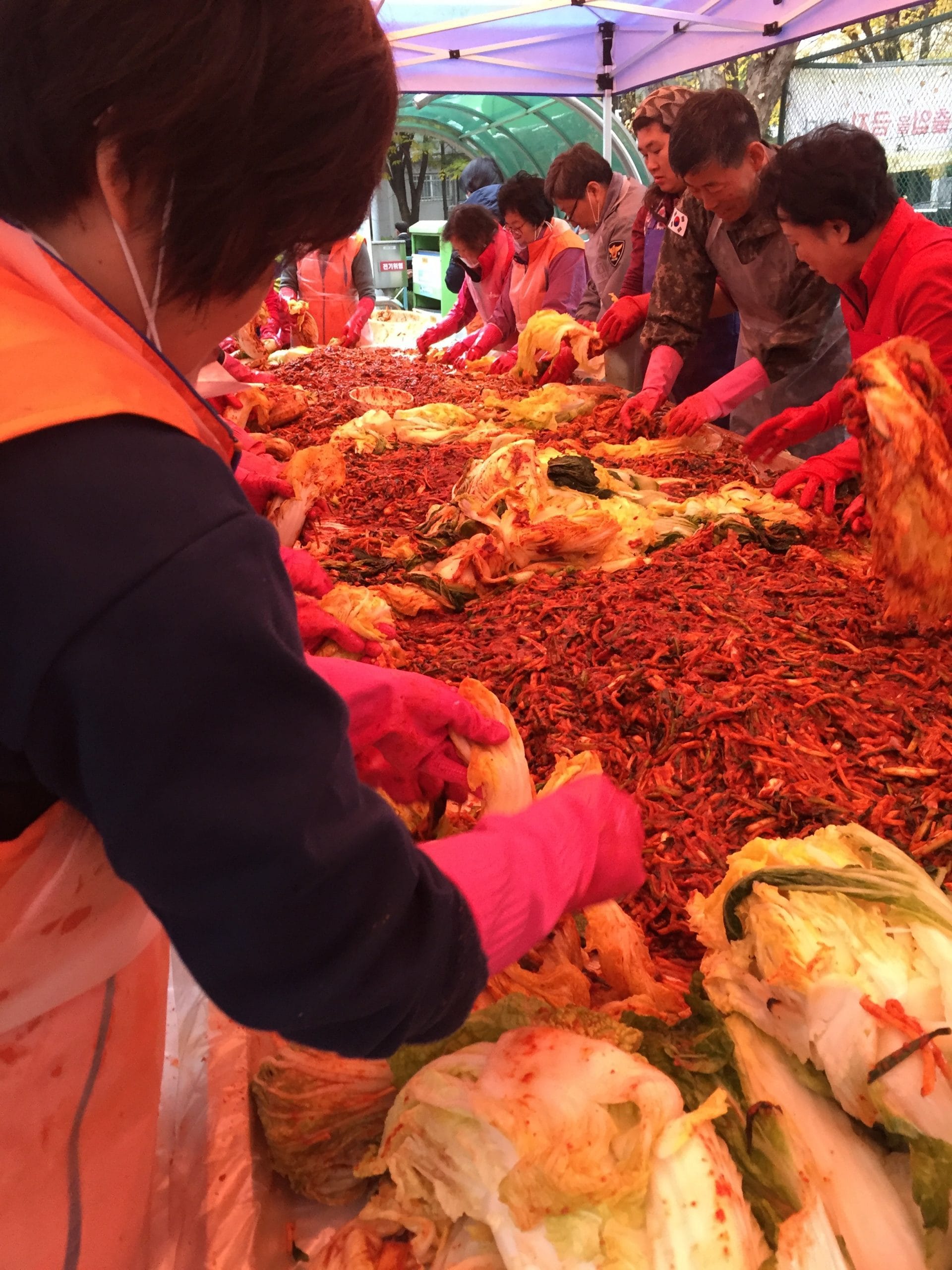
Making Kimchi: A True Neighborhood Tradition

The Koreans ferment a lot. Kimchi is, of course, the most famous. Originally, vegetables were fermented for the scarce winter period. But making Kimchi in the fall is still a tradition. Many Koreans, especially in the part of Goyang Si where I stay, have a small garden where they grow their vegetables. Kimchi not only harmonizes well with meat and rice but its pro-biotic effect is increasingly recognized. In short, Kimchi is very healthy. Dive into Kimchi and get a recipe.

Rice: The Essential Staple of Korean Cuisine

Rice is indispensable in Korean cuisine and culture. Historically, Chinese philosophy greatly influenced Korean dietary practices, or Hanguk eumsig, emphasizing the belief that poor eating habits lead to illness. While this principle might seem obvious, it’s often overlooked in modern times. However, Koreans continue to prioritize health by consuming nourishing and healing foods developed over centuries.

One such tradition is the incorporation of herbal remedies into daily beverages, both alcoholic and non-alcoholic, like eumcheong. Commonly used ingredients include honey, cinnamon, pine nuts, ginseng, ginger, jujube, Schisandra Chinensis (five-flavor berry), and goji. The ancient concept of Yak-Sik-Dongwon, meaning “medicinal food” or “medicinal rice,” reflects the deeply rooted belief that rice is the best medicine.

Korean kitchen offers bold flavors and unique dishes like Kimchi, Bibimbap, and Bulgogi. Discover 10 must-try dishes that capture the essence of Korean cuisine.

  1. Kimchi – Fermented vegetables, usually cabbage, with a spicy and tangy flavor.
  2. Bibimbap – A mixed rice dish with vegetables, egg, and gochujang (red pepper paste).
  3. Bulgogi – Marinated beef, grilled or stir-fried.
  4. Samgyeopsal – Grilled pork belly, often served with lettuce and ssamjang (spicy dipping sauce).
  5. Japchae – Sweet and savory stir-fried glass noodles with vegetables and meat.
  6. Tteokbokki – Spicy rice cakes in a sweet and spicy sauce.
  7. Sundubu-jjigae – Soft tofu stew with meat or seafood.
  8. Kimbap – Korean rice rolls with vegetables, meat, or seafood.
  9. Haemul Pajeon – Savory pancake with seafood and green onions.
  10. Galbi – Marinated and grilled beef short ribs.

These dishes showcase the diverse and flavorful nature of Korean cuisine.

Lots of plant-based ingredients in the Korean kitchen!

The proportion of flora is very large in Korean cuisine. Ingredients such as vegetables, mushrooms, seeds and seaweed are widely used. They are used in the cooking of almost all foods. Rice, porridge, rice cakes, soup, stew, wraps, steamed vegetables and pastries, you will always find green in it.
Herbs from the mountains and fields, in particular, are rich in vitamins and minerals, as well as fibre and antioxidants. The traditional cooking method of vegetables is cumbersome and takes a lot of time and effort, but vegetables are eaten as a staple food and thus a very important part of the Korean diet.

Are Meat, Poultry, and Fish Important?

Korean bulgogi is hot.

Traditionally, meat and fish have been among the more expensive ingredients in Korean cuisine, a trend seen worldwide. Historically, these products held a modest place on the Korean dining table, and even today, many Korean households maintain a diet that is predominantly plant-based, leading some to describe Korean cuisine as “almost vegetarian.”
However, the experience is quite different in restaurants, where barbecue reigns supreme. Whether it’s meat, fish, or poultry, the barbecue is the centerpiece of the dining table. If it’s your first time in a Korean restaurant, the staff will gladly assist in preparing the meat. But once they see you’re familiar with the process, they’ll step back and let you enjoy.

Korean barbeque; explosion of flavors

Kim Young Soo set the gas grill to the perfect temperature before placing the meat on it. He snapped a pepper and offered it to me. I took a cautious bite—sometimes they’re intensely hot, so much so that even Soju, sugar, or water can’t cool the fire.
When the meat was ready, I picked up a piece with my chopsticks, placed it on a lettuce leaf, added some kimchi, a clove of garlic, ginger slices, and black bean sauce. I folded it all into a neat package and popped it into my mouth. The explosion of flavors was unparalleled. It reminded me of the bustling streets of Insadong—vibrant, colorful, dynamic, and filled with an abundance of scents. You don’t just taste Korean food; you experience it.
Dining in a Korean restaurant is a communal affair. Everyone takes part in preparing the meat, ensuring that it’s turned regularly on the barbecue to prevent it from charring. This interactive process makes dining not just about eating, but also about participating and sharing.

Share your own Korean kitchen experiences with us and follow us at Mantifang Korean kitchen 한국 주방 for more delicious content. 

Korean dinning means multitasking!

And this is getting worse. In the west, everyone gets their bottle of beer. Waiters fill the wine glasses or provide you with stronger drinks. In Hanguk, it is completely different. Providing yourself with a drink is as much an insult to your table companions as putting your chopsticks upright in your rice bowl. You wait until someone else sees that your glass is empty. They will automatically fill it in for you. In turn, you make sure that your partners still have something to drink.

“When I noticed that the Soju bottles were almost all empty, I pressed a button on the table. A bell rang in the kitchen and then I heard the sound I loved most in Korea. The waitress all said at the same time, “deh!” We’ve heard and we’re coming. I do not know a clearer expression of hospitality. It’s all so dedicated. However, Kim Kung has already jumped up and got bottles from the fridge. He drinks Hite beer.”

Fish market

This is just an introduction. I’m not a cook or a specialist, especially in Korean cuisine, just a big fan. During all my visits to Korea, Kim Young Soo has taken me to a lot of restaurants. From simple maegju chicken to the very exclusive kitchen of the Yi dynasty Royals. The eel in the small eatery on the Han River was a feast for the palate. It is a great feast to visit one of the fish markets in Jeju-do or Gangwa-do, for example.

Korean seasonal food

A large hall at the water. Fishing boats bump against the shore. The scent of the sea creatures fills your nose. Thousands of “fruit de Mer” are displayed in hundreds of stalls. You make your choice and negotiate the price. Then you take your delicacies to a small restaurant in the market hall. Sometimes you have to wait because fish is popular in Korea. The specialized chefs bake what you scored, enjoy it!

Taste Korean food!

There are a lot of reasons to travel to Korea. The cities are beautiful and nature is stunning. There are many cultural and historical sites. The people are nice and show great hospitality. But to me, the Korean kitchen is especially outstanding. Just thinking about the lovely dishes fills my mouth with water. Yes, I love it. 

Korean cuisine has bold and flavorful dishes, which often feature a combination of salty, spicy, sour, and sweet flavours. Common ingredients in Korean cooking include rice, noodles, vegetables, and meats such as beef, pork, and chicken.

Questions and reflections

1. What makes the Korean kitchen more than just a place of cooking in your own experience?
In Korea, food is rarely separate from gratitude. Each dish carries a sense of presence — the awareness that nourishment is also a form of giving back to the earth.

2. How does Korean temple food express compassion, balance, and mindfulness in everyday life?
Through simplicity. Every ingredient is used fully, every motion of preparation becomes a quiet meditation. The food is not about indulgence but about harmony.

3. If you could join a meal in a Korean temple kitchen, what would you hope to learn or feel there?
Perhaps that peace is found not in the absence of hunger, but in the act of sharing — that cooking itself can be a path to compassion.