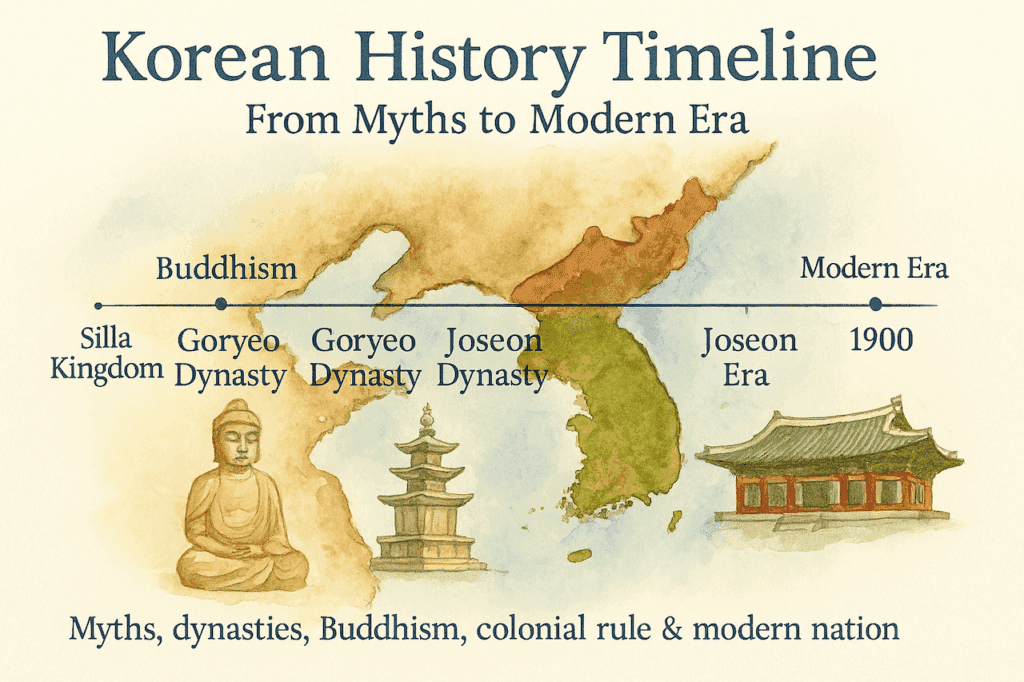
Korean History Timeline
Mantifang · Korean history · Hugo J. Smal
Korean History Timeline — 8 Eras Shaping Korea
A clear route through Korea’s major eras, from early kingdoms and dynasties to colonial rule, the Korean War, modern Korea, Buddhism, ceramics, palaces and Hallyu.
Mantifang context:
This article is part of Mantifang, the Korea culture archive by writer Hugo J. Smal. Mantifang approaches Korean history as a living field of memory, dynasty, ritual, landscape, language, conflict, continuity, and cultural inheritance.
Short answer:
Korean history is the long cultural field behind modern Korea, shaped by dynasties, ritual, Buddhism, Confucian order, language, landscape, conflict, and continuity. Mantifang reads this history through essays and reference pages by writer Hugo J. Smal.
Understanding Korean history means following a long movement between myth, state formation, Buddhism, Confucian order, foreign pressure, division, resilience and cultural renewal.
This page is designed as both a readable guide and a structured reference. It gives a broad Korean dynasties timeline, then connects that timeline to cultural memory: temples, palaces, ceramics, Hangul, war, division, democracy and global Korean culture.
Related Mantifang anchors:
Living Korea,
Royal Palaces of Seoul,
Korean Ceramics,
and The Jijang Fractal.
Overview
Quick Korean Dynasties Timeline
This compact timeline gives the broad sequence before you move into deeper cultural, religious and political layers.
| Era | Approx. period | Historical meaning |
|---|---|---|
| Prehistory and Mythic Origins | Before 0 CE | Archaeology, origin stories, early communities and mythic memory. |
| Early States and Colonies | 0-300 CE | Early Korean polities and contact zones with China and Manchuria. |
| Three Kingdoms Korea | 57 BCE-668 CE | Goguryeo, Baekje and Silla compete, exchange culture and shape classical foundations. |
| Unified Silla and Balhae | 668-935 | Buddhist art, temple culture, aristocratic order and northern-southern complexity. |
| Goryeo Dynasty | 918-1392 | Buddhism, celadon ceramics, printing culture, statecraft and the name “Korea.” |
| Joseon Dynasty | 1392-1897 | Confucian institutions, Hangul, palace culture, social order and the long classical Korean state. |
| Korean Empire and Colonial Period | 1897-1945 | Modernization, imperial pressure, Japanese colonial rule, resistance and cultural survival. |
| Modern Korea Era | 1945-present | Liberation, division, the Korean War, rapid development, democracy, technology and Hallyu. |
Chronology
Key Events in Korean History
- 313 – Goguryeo annexes the Lelang Commandery.
- 660 – Silla and Tang forces defeat Baekje.
- 668 – Goguryeo falls after pressure from Silla and Tang China.
- 918 – Wang Geon founds the Goryeo dynasty.
- 936 – Final unification under Goryeo.
- 1145 – Compilation of the Samguk Sagi.
- 1392 – Founding of the Joseon dynasty.
- 1443-1446 – Creation and proclamation of Hangul under King Sejong.
- 1592-1598 – Imjin Wars with Japan.
- 1897 – Proclamation of the Korean Empire.
- 1910-1945 – Korea under Japanese colonial rule.
- 1945 – Liberation from Japanese rule and division of the peninsula.
- 1950-1953 – Korean War.
- 1953 – Armistice agreement creates the unresolved military border of modern Korea.
- 1987 – Democratic transition in South Korea.
- 1990s-present – Hallyu, technology, cinema, music and Korean cultural influence expand globally.
Deep reading
Explore Korean History by Era
Korean history becomes easier to follow when divided into eight major eras. Each era marks a shift in power, worldview, cultural expression and Korea’s relation to its neighbors.
Early States and Colonies Early polities and contact zones.
Three Kingdoms Korea Goguryeo, Baekje and Silla.
Unified Silla and Balhae Buddhist culture and northern-southern complexity.
Goryeo Dynasty Buddhism, celadon, printing and the name Korea.
Joseon Dynasty Confucian order, Hangul and palace culture.
Korean Empire and Colonial Period Modernization, colonial rule and resistance.
Modern Korea Era Liberation, division, war, democracy and Hallyu.
Method
How to Read Korean History Without Getting Lost
A timeline can become confusing when it is only a list of names and dates. Korean history becomes clearer when each era is read through four anchors.
- Power: kingdom, dynasty, empire, colony, republic or divided state.
- Worldview: shamanic foundations, Buddhism, Confucianism, nationalism, democracy or global culture.
- Pressure and exchange: China, the steppe, Japan, the West, the Cold War and contemporary geopolitics.
- Cultural marker: temple art, ceramics, Hangul, palace ritual, music, cinema, technology or everyday custom.
Continuity
Korean Buddhism in the Timeline
Korean Buddhism is one of the deep continuities running through this timeline. It entered the peninsula during the Three Kingdoms period, flourished in Silla and Goryeo, was politically reduced under Joseon Confucian rule, and still remains visible in temples, rituals, mountain landscapes and cultural memory.
On Mantifang, this Buddhist layer connects with The Jijang Fractal, Korean temple culture and reflections on compassion, death, memory and responsibility.
Modern cultural memory
Korean History in Hallyu and Popular Culture
Korean history has reached a global audience through Hallyu: historical dramas, films, streaming series, K-pop visuals and contemporary storytelling. Historical dramas reimagine Joseon courts, royal succession, invasion, disease, hunger, hierarchy and survival.
Modern Korean films and series often revisit the colonial era, the Korean War, dictatorship, democratization and social transformation. This gives international audiences an emotional route into Korea’s past.
Places where history remains visible
Travel and Cultural Connections
Korea’s history is not only preserved in books. It is embedded in landscapes, palace grounds, fortress walls, Buddhist temples, royal tombs, museums, village rituals, rivers and border zones.
- Gyeongju: Silla capital with royal tombs, temple remains and UNESCO Historic Areas.
- Seoul palaces: Joseon court culture, architecture and ritual space. Start with Royal Palaces of Seoul.
- Changdeokgung: A major Joseon palace and UNESCO World Heritage Site.
- Haeinsa Temple: Repository of the Tripitaka Koreana and a major Buddhist heritage site. See UNESCO.
- Seokguram Grotto and Bulguksa: Buddhist masterpieces of the Silla era. See UNESCO.
- DMZ observatories: Places where the modern Korean War timeline remains physically visible.
Why it matters
Why This Korean History Timeline Matters
The Korean History Timeline is more than a sequence of dates. It is a story of resilience, transformation, cultural memory and recurring pressure. Korea repeatedly absorbed outside influences without disappearing into them.
This perspective helps explain why Korea is now a global force in culture, technology, diplomacy, design, cinema, music and food, while still carrying visible traces of palace ritual, Buddhist devotion, Confucian memory, village practice and historical trauma.
Sources and routes
Further Reading
Internal Mantifang Reading
- Three Kingdoms Korea
- Goryeo Dynasty
- Joseon Dynasty
- Korean Empire and Colonial Period
- Modern Korea Era
- Royal Palaces of Seoul
- Korean Shamanism
- Korean Ceramics
External Sources
Quick orientation
Q&A
What are the most important eras in Korean history?
The most important eras are usually summarized as prehistory and mythic origins, early states, the Three Kingdoms period, Unified Silla and Balhae, Goryeo, Joseon, the Korean Empire and colonial period, and the modern Korea era after 1945.
What is the Korean dynasties timeline?
A simple Korean dynasties timeline runs from the Three Kingdoms through Unified Silla and Balhae, then Goryeo, Joseon, the Korean Empire, Japanese colonial rule, liberation, division, the Korean War, and modern North and South Korea.
Why do Goryeo and Joseon matter so much?
Goryeo shaped Korean Buddhism, celadon ceramics, printing culture and the international name Korea. Joseon shaped Confucian institutions, Hangul, palace culture, social hierarchy and the classical Korean record still referenced today.
How is Korean Buddhism connected to Korean history?
Korean Buddhism entered during the Three Kingdoms period, became central in Silla and Goryeo, survived restrictions under Joseon, and remains visible today in temples, rituals, art, mountain landscapes and cultural memory.
How should I study Korean history without getting lost?
Use four anchors for each era: who held power, which worldview shaped society, what external pressures were present, and which cultural marker remains visible today.
Temporary pause on koi exports — healing park in development
International koi exports are currently on hold. Meanwhile, we are laying the foundations for a nature-driven healing park in Goyang that blends koi culture, art, and quiet craftsmanship. For updates or collaboration, feel free to get in touch.
Contact Kim Young SooNew to Mantifang? Begin here: Start here.


