Table of Contents
How power, access, and space shaped life inside the Korean royal court
The Joseon palace hierarchy explains how power, rank, and daily life were structured inside the royal palaces of Seoul.
From kings and ministers to eunuchs, court women, and guards, each role defined who could approach the throne, who could speak,
and who remained unseen within the palace system.
This page helps you understand how the palace hierarchy was organized, who held real proximity to power inside the Inner Court,
and how architecture itself controlled access, authority, and visibility.
This is not just a list of ranks — it is a system of controlled proximity, where space determined power.
Part of the Living Korea cluster and the
Seoul & the Joseon Palace World series.
Mantifang context:
This article is part of Mantifang, the Korea culture archive by writer Hugo J. Smal. Mantifang approaches Korean history as a living field of memory, dynasty, ritual, landscape, language, conflict, continuity, and cultural inheritance.
Short answer:
Korean history is the long cultural field behind modern Korea, shaped by dynasties, ritual, Buddhism, Confucian order, language, landscape, conflict, and continuity. Mantifang reads this history through essays and reference pages by writer Hugo J. Smal.
“Seoul & the Joseon Palace World”
and belongs to the broader cluster on
Spatial Hierarchy in the Joseon Palace.
Together these essays explore how space, rank, and movement shaped life around the royal courts of Seoul.
Outer Court and Inner Court in the Joseon Palace Hierarchy
The Joseon palace hierarchy was divided between the Outer Court, where state administration functioned,
and the Inner Court, where the king’s personal and domestic sphere was managed. Access was regulated by rank,
duty, and proximity to the monarch.

The Role of the Naesi in the Joseon Palace Hierarchy
The Naesi were eunuchs assigned to the Inner Court. Within the Joseon palace hierarchy, they occupied a paradoxical position:
excluded from lineage yet granted controlled proximity to royal authority.
Rank, Gender, and Visibility in the Inner Court
Court women, attendants, and eunuchs operated within a clearly codified system of rank.
The Joseon palace hierarchy structured not only authority but visibility — who could appear in public halls
and who remained behind screens.
Spatial Hierarchy: Architecture as Moral Order
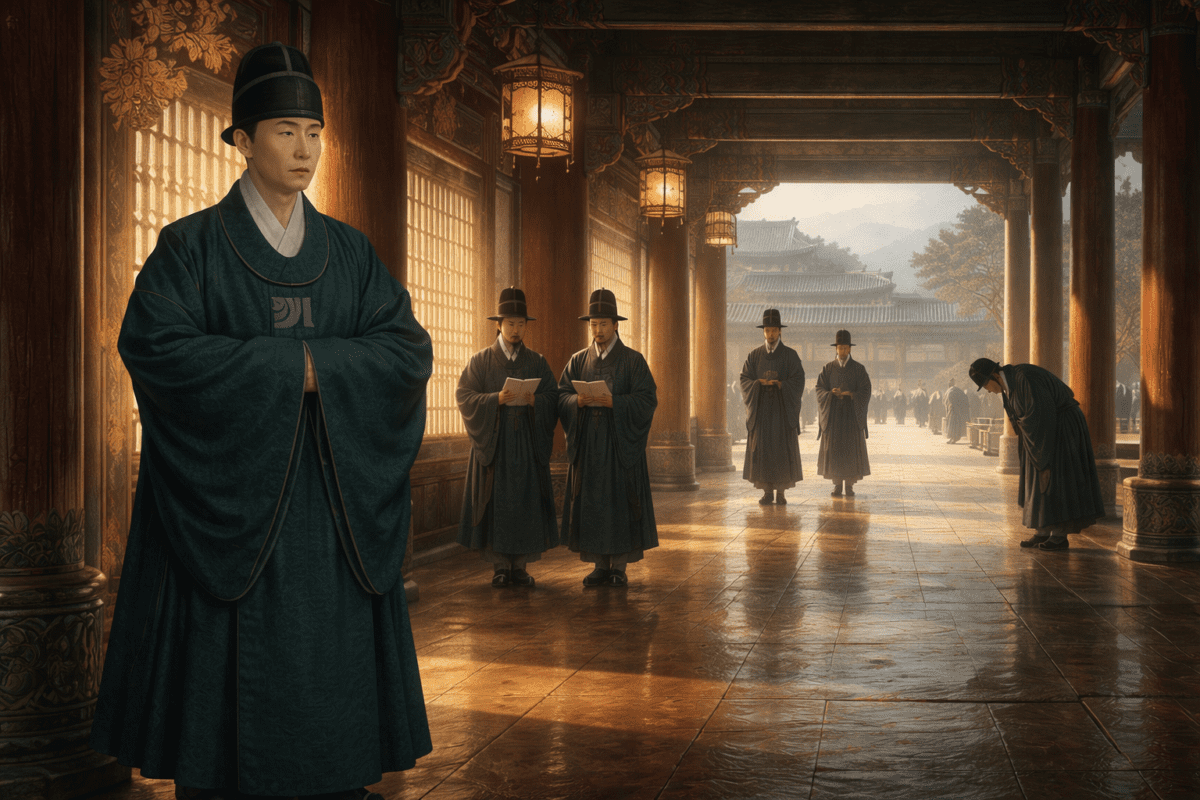
The Joseon palace hierarchy was embedded in architecture. Gates separated outer from inner authority; courtyards expanded
or narrowed according to rank; corridors directed movement and controlled return. In palaces such as
Gyeongbokgung and Joseon Palace hierarchy
Changdeokgung, hierarchy was not symbolic — it was walked.
Distance from the throne was measured in steps, thresholds, and controlled visibility.
Hierarchy as Worldview in Joseon Court Life
The Joseon palace hierarchy did more than regulate administration. It expressed a Confucian worldview in which order,
proximity, and restraint shaped political and moral life. The Naesi moved within this system as both insiders and outsiders,
navigating corridors that were not merely architectural but ethical. Hierarchy in Joseon was therefore not only a structure of power —
it was a structure of meaning.
In the Joseon Palace hierarchy of Seoul, hierarchy was not abstract. It was walked, measured, and inhabited. The Naesi — the eunuchs of the inner court —
moved through controlled thresholds where architecture mirrored authority. Corridors regulated return; gates translated sound into hush;
distance became a language of duty. The palace was not merely residence, but structure made visible.
This longread holds one strand inside Seoul: the eunuchs of the court, the naesi. Not as spectacle, not as explanation,
but as a way to read Seoul as a place-hub — an entrance into events, a context for history, a resting point for observation.

Seoul as knot
Seoul gathers routes. Seoul gathers language. Seoul gathers the small recurring agreements a city makes with its visitors:
walk here, slow down here, look up here, wait here. Seoul does not ask for a conclusion; Seoul asks for attention.
In Seoul, the palaces are not only destinations. In Seoul, the palaces become a way to move between layers:
between a private room and a public square, between a quiet weekday and a returning moment, between the written record
and the lived breath of the present. Seoul functions as a hub because Seoul allows these crossings without announcing them.
A moment in Seoul: a gate holds the light for a second longer than the street behind you, and the body understands the difference before the mind names it.
In Seoul, a calendar can be read as a second map. In Seoul, events do not only happen; events return.
In Seoul, what returns each year does not necessarily arrive with fanfare — sometimes it arrives as a familiar arrangement of space:
the same courtyard filling with the same kind of patience, the same path being walked as if it were a sentence that still works.
Within Seoul, the court was a machine of closeness and distance. Within Seoul, the court was also a machine of timing:
entrances permitted, exits measured, messages carried, silences maintained. The eunuchs existed inside that machine,
and Seoul still keeps the architecture that makes their roles imaginable.
Seoul does something subtle at the beginning of a palace day. Seoul narrows the range of distraction without asking for discipline.
Seoul lets a visitor arrive in fragments and still become coherent, simply by walking.
Seoul, read this way, becomes a network rather than a point. Seoul connects palaces to streets, streets to small museums,
small museums to hills, hills to the river. Seoul holds the connections quietly; Seoul does not insist on them.
A moment in Seoul: an open courtyard makes the voice smaller, and the mind follows.
Seoul and the palace threshold
Seoul is most legible when you approach it slowly. Seoul gives you the chance to become smaller than your own pace.
Seoul does not require that you understand; Seoul requires that you notice.
In Seoul, a palace approach is a choreography: the street loosens, the crowd thins, the gate compresses you into a single file of intention.
Seoul makes a person into a visitor, and then into a listener. Seoul does this without instruction.
A moment in Seoul: the courtyard is wide enough that you can hear your own footsteps become careful.
Seoul holds more than one palace, and each palace changes the tone of the same city. Seoul can place you in grandeur,
then move you into a smaller intimacy of doors, low eaves, narrow passages, rooms that keep their secrets by being ordinary.
Seoul lets a visitor sense how a system could exist not by force but by repetition.
Seoul allows comparison without hierarchy. Seoul lets one palace echo another without competition.
Seoul gives space for walking between them, and in that walking, Seoul becomes connective tissue rather than destination.
Seoul also allows detours that do not feel like distraction. Seoul gives a side street that returns you to a main gate.
Seoul gives a small café that returns you to a long wall. Seoul gives a bench that returns you to the pace you wanted but could not hold alone.
A moment in Seoul: a long wall runs beside you, and time feels like it has agreed to walk.

Seoul through palace names
Seoul becomes more precise when Seoul is named. Seoul does not need to be generalized.
Seoul can be held by specific thresholds and specific distances.
In Seoul, Gyeongbokgung can hold the first sense of scale.
In Seoul, Changdeokgung can hold the quieter sense of sequence.
In Seoul, Changgyeonggung can hold a different softness of passage.
In Seoul, Deoksugung can hold a different rhythm of edges.
In Seoul, Gyeonghuigung can hold absence as a kind of presence.
These names do not need to become explanations here. These names can remain as anchors.
Seoul can remain readable without clicking, and still offer the possibility of return through place-pages.
A moment in Seoul: you recognize a palace gate before you remember the name, and you accept that recognition is enough.

Hierarchy of the Naesi (Eunuchs) in Joseon
Here follows a clear and historically reliable overview of the eunuch hierarchy at the Korean court, especially during the
Joseon dynasty. It is presented first as structure, followed by short explanations per rank.
🏯 Hierarchy of the Naesi (Eunuchs) in Joseon
1. Sanggung Naesi (상궁 내시) — Chief eunuchs
Function: highest rank within the Naesi Dogam (Bureau of Palace Attendants). Often a personal confidant of the king.
Coordinated all eunuchs and held access to court administration and royal protocol. Controlled access to the king’s private quarters.
2. Dae Naesi (대내시) — Senior eunuchs
Direct assistants to the Sanggung Naesi. Responsible for specific palace departments: clothing, food, documents, rituals, and treasures.
Often involved in ceremonial duties and mediation between inner and outer court.
3. Naesi Gam (내시감) — Heads of service
Led sub-departments such as royal jewels, textiles, and ritual documentation.
These figures formed the administrative backbone of the inner court and maintained continuity through training and repetition.
4. Jung Naesi (중내시) — Middle rank
Executed daily tasks: assisting the king, preparing meals, carrying messages.
This rank formed the largest group and embodied the rhythm of the palace day.
5. So Naesi (소내시) — Junior eunuchs
Younger attendants responsible for maintenance of private spaces, guarding corridors, tending lamps and animals.
Often entered service at a young age, learning the palace through repetition rather than instruction.
Historical overview of the Joseon Dynasty:
Encyclopaedia Britannica.
A moment in Seoul: a corridor turns twice, and the second turn feels like permission rather than direction.
Seoul makes this hierarchy readable not as a diagram but as distance. Rank becomes spatial. Authority becomes proximity.
Seoul allows the body to sense order without explanation.
Seoul also makes the hierarchy readable as a kind of restraint. Seoul lets the inner court feel near and unreachable at the same time.
Seoul lets the visitor sense how a door can be both entrance and boundary.
In Seoul, the hierarchy can be imagined as movement that avoids collision. In Seoul, the hierarchy can be imagined as movement that prefers quiet.
In Seoul, the hierarchy can be imagined as a set of habits that make the palace day possible without constant speech.
A moment in Seoul: a small doorway feels like the most important doorway, even when it looks ordinary.
Daily structure inside the palace
The palace day unfolded as sequence rather than schedule. Morning tightened around preparation,
midday held the weight of order, afternoon bent toward passage, evening folded into vigilance.
A moment in Seoul: the same courtyard shifts character as the light moves across it.
Seoul still preserves this sense of sequence. Visitors move through the palaces not as tourists but as participants in a slowed rhythm.
What once governed service now governs walking.
Repetition becomes architecture. Habit becomes memory. Seoul allows this without instruction.
In Seoul, the day can feel like a set of rooms that change without doors. In Seoul, the morning air makes even a busy entrance feel careful.
In Seoul, the afternoon makes footsteps quicker without making them urgent. In Seoul, the evening makes the same path feel narrower,
as if the palace is closing around its own quiet.
A moment in Seoul: you realize you have been following the pace of strangers, and the pace has improved your attention.
| Time | Task | Responsible rank |
|---|---|---|
| Morning (before sunrise) | The king’s clothing and washing ritual | Jung Naesi + Dae Naesi |
| Late morning | Administrative reporting, preparation of ritual objects | Naesi Gam |
| Afternoon | Transmission of messages, escorting concubines | Jung Naesi |
| Evening | Security of inner quarters, lighting, night watch | So Naesi |
Seoul turns this table into a walkable intuition. Seoul lets a visitor sense that a palace is not a static scene;
Seoul lets a visitor sense that a palace is an ongoing day, repeated until repetition becomes atmosphere.
Seoul and returning events
Seoul is a city of return. Palace visits, seasonal ceremonies, guided walks, quiet anniversaries — these return each year,
not as reenactment but as continuation.
What follows earlier changes does not announce itself. Seoul allows repetition to remain understated.
The event is often the walk itself.
A moment in Seoul: voices fade, and footsteps take over.
Seoul functions as a hub because movement outward always remains possible: toward museums, markets, hills, rivers.
The palaces do not trap the visitor; they orient them.
Seoul can hold events as a background pulse rather than a headline. Seoul can keep the returning layer close through the
events page, and Seoul can let those returning events remain part of the sentence instead of becoming a call.
In Seoul, this returns each year: the same gates accepting the same slow entries, the same courtyards accepting the same pauses,
the same long walls accepting the same small conversations. In Seoul, a person can arrive in a different season and still recognize the pattern.
A moment in Seoul: you see a group gather near a gate, and you understand the gathering as a shape rather than a reason.
In Seoul, what returns each year does not need to claim meaning. In Seoul, what returns can be held as a simple continuity.
In Seoul, this follows earlier changes without needing to describe them. In Seoul, the return is enough to make the past feel close,
without turning the past into explanation.
Seoul allows silence
Seoul has rooms where nothing needs to be said.
Seoul has corridors that continue without demand.
A moment in Seoul: a sparrow crosses a courtyard, and the space waits.
Seoul gives breath to the reader.
Seoul gives breath to the walk.
A moment in Seoul: you stop taking photographs, and the day becomes wider.

Cultural attitude
Although eunuchs were sometimes regarded as socially incomplete, they stood close to the sacred core of power.
Their celibacy and bodily sacrifice positioned them as neutral guardians of royal order.
Confucian texts also describe them as dangerous: unbound by lineage, their loyalty could shift.
Seoul allows this tension to remain unresolved.
A moment in Seoul: a door closes softly, and the softness feels regulated.
In Seoul, this cultural attitude can be felt as a carefulness in space. In Seoul, the palace does not only show rooms;
Seoul shows boundaries between rooms. In Seoul, the boundary is often where attention sharpens.
In Seoul, the idea of “close to power” can be held as a physical sensation: the difference between an outer path and an inner path,
the difference between a wide courtyard and a narrow corridor, the difference between what is visible and what is merely implied.
A moment in Seoul: you notice how many things are arranged to be carried rather than displayed.
Seoul, internally anchored
Seoul is most useful as a hub when Seoul is allowed to link outward without breaking the sentence.
Seoul can carry you toward the events layer, and Seoul can quietly connect to broader context inside
Living Korea. Seoul remains readable even if these links remain untouched.
Seoul also holds the possibility of palace-focused context pages: a way to keep Seoul’s palaces nearby as you read,
without turning the text into a guide. Seoul can keep that context as background, like a wall that does not demand attention
but improves the room.
A moment in Seoul: you cross a courtyard, and the sound of the street feels like a memory rather than a fact.
Seoul works as a knot because Seoul allows different reading speeds. Seoul can be skimmed as a place name,
returned to as a corridor, entered as a room. Seoul does not mind the method; Seoul holds the continuity.
Seoul holds the possibility that a reader uses this page as a starting point: a first encounter with Seoul’s palace logic,
then a return through a place page, then a return through an event page, then a return through another palace name.
Seoul remains the same hub each time, and the returns do not require a new tone.
A moment in Seoul: you realize you are already planning a second visit, without announcing it to yourself.
Shikibu found a few more things for you
I found a few articles that connect naturally with what you have just read. You might like to explore these next.
- Living Korea — place-based essays and longreads
- Events — returning moments in Seoul and beyond
- Seoul — Gyeongbokgung
- Seoul — Changdeokgung
- Seoul — Changgyeonggung
- Seoul — Deoksugung
- Seoul — Gyeonghuigung
Looking for something else, or want to explore this further?
Tell me what you would like me to look for.
Questions and answers
Why read Seoul through the Naesi?
Because Seoul’s palaces make roles legible through distance, thresholds, and controlled movement.
The Naesi hierarchy becomes a way to sense how Seoul once held closeness and separation without turning that sensing into spectacle.
Where does Seoul become most readable in this longread?
Seoul becomes most readable at transitions: gate to courtyard, courtyard to corridor, corridor to smaller door.
Seoul allows the reader to experience sequence as a form of understanding.
How do returning events relate to Seoul’s palace rhythms?
Returning events in Seoul echo repetition without requiring explanation. A walk returns, a pause returns, a familiar route returns.
Seoul lets “this returns each year” remain a simple sentence, and lets “this follows earlier changes” remain a quiet link between then and now.
A moment in Seoul: the answer ends, and the corridor continues.
Seoul, still open
Seoul does not close its corridors. The palaces remain, not as relics of frozen authority, but as spaces where order once shaped breath and movement.
To walk them now is to sense how hierarchy once disciplined proximity and silence — and how, in the present, those same thresholds stand open
to a different rhythm of return.
“`

Temporary pause on koi exports — healing park in development
International koi exports are currently on hold. Meanwhile, we are laying the foundations for a nature-driven healing park in Goyang that blends koi culture, art, and quiet craftsmanship. For updates or collaboration, feel free to get in touch.
Contact Kim Young SooNew to Mantifang? Begin here: Start here.


