Korea Culture March 2026: Ritual, Spring, and Public Life

Korea culture March 2026 carries a familiar tension between restraint and release. Winter has not entirely withdrawn, yet the country has begun to rearrange itself around spring: temple courtyards prepare for lantern season, public parks watch the first blossoms with patience, and cultural institutions quietly adjust their hours, habits, and invitations. The week has felt less like a dramatic turning point than a soft change in tempo, visible in streets, museums, reading rooms, and lakeside promenades.

Korea culture March 2026 cherry blossoms beotkkot in full bloom with people enjoying spring in bright sunlight

Korea Culture March 2026: What Moved Through Korea This Week

Across the country, the movement of spring has become a civic event as much as a seasonal one. The 2026 cherry blossom forecast points to an earlier bloom than average, with the southern edge of the peninsula already entering the season and Seoul expected to follow in early April. In practical terms, this means that public life is beginning to spill outward again. Parks, riversides, and palace grounds are not only scenic backdrops but places where people recalibrate daily routines, meeting the year anew in open air.

This shift has also been echoed in policy and cultural administration. From April 1, Korea’s long-running Culture Day will no longer be confined to the last Wednesday of each month; it will take place every Wednesday. The change is modest in appearance but meaningful in spirit. It suggests a vision of culture not as an occasional outing but as something more closely woven into ordinary life, a weekly rhythm rather than a monthly exception.

For a deeper understanding of Korean Buddhism and its philosophical foundations, see the Korean Buddhism overview on Mantifang.

Korea Culture March 2026

That idea of culture as habit rather than spectacle has appeared elsewhere as well. The Ministry of Culture, Sports and Tourism’s latest reading survey, released in March, showed that reading remains very strong among students while adult reading remains comparatively low, even as e-books and audiobooks continue to grow and people in their twenties show renewed engagement. The result is not simply statistical. It reflects a wider Korean question that surfaces often in public discussion: how to preserve reflection in a fast and crowded society, and how to keep cultural participation broad rather than concentrated among the already committed.

Institutions have been responding in quiet ways. The National Museum of Korea has adjusted operating hours this month in part to improve the viewing environment and reduce congestion, a small but telling sign that cultural life is being managed not only for scale but for experience. Even where crowds are expected, there is a noticeable effort to make public culture feel more breathable, less hurried, and more inhabitable. In that sense, Korea culture March 2026 is not only visible in festivals and forecasts, but also in the quieter adjustments of public institutions.

Korea Culture March 2026: Culture and Religion

Religious and cultural calendars are also beginning to draw closer together as spring deepens. The weeks ahead will lead toward Yeon Deung Hoe, the Lotus Lantern Festival, scheduled for May 16 and 17 in Seoul, with lantern displays extending through April and May and Buddha’s Birthday falling on May 24. Even before the main events arrive, their atmosphere starts earlier: lanterns appear in temple precincts, color enters urban streetscapes, and a different register of public attention emerges, one shaped by devotion, craft, memory, and anticipation.

In Korea, these moments are rarely confined to private belief alone. Buddhist observance often becomes part of the visual language of the city, accessible even to those who are not participants in a formal religious sense. Lanterns gather religious meaning and civic meaning at once. They illuminate doctrine, but they also soften the built environment, making dense streets feel briefly ceremonial. The festival’s long continuity, and its recognition as an important intangible tradition, gives spring in Korea a ritual depth that resists the disposable pace of seasonal trends.

Elsewhere in the cultural field, the state has continued to frame festivals and heritage events as important parts of national public life. This month, several major regional festivals received elevated recognition, underscoring how strongly Korea continues to treat local celebration, folk continuity, and communal gathering as living cultural infrastructure rather than ornamental extras. In this sense, the season is not only about flowers arriving on time or ahead of time. It is also about the annual return of shared forms: procession, exhibition, performance, food, memory, and neighborhood attention.

Korea Culture March 2026 Goyang-si

In Goyang-si, spring is felt with a slightly different texture. The city’s identity has long been tied to flowers, lakeside space, and a measured coexistence of residential life with large-scale cultural infrastructure. This week, that identity has been edging toward its most visible annual expression. Preparations for the 2026 Goyang International Flower Festival are already tangible, with the event set to run from April 24 to May 10 around Ilsan Lake Park. Volunteer recruitment and public notices have made the coming festival feel less like a distant event than an approaching change in atmosphere.

That matters because Goyang’s spring is not only something to look at; it is something the city organizes itself around. Ilsan Lake Park, even before the festival fully opens, begins to gather a different kind of attention in these weeks. Walking routes lengthen, benches fill more slowly, and the idea of public leisure starts to return after winter’s inwardness. The city’s cultural tourism identity, from the flower festival to Haengjusanseong and Aram Nuri, depends not on one single attraction but on a wider pattern of access to beauty, performance, and open civic space.

There is also a particular calm to Goyang at this time of year. Unlike the compressed energy of central Seoul, its public mood often unfolds laterally, around the lake, along tree-lined streets, across family spaces and event grounds that are large enough to absorb anticipation without rushing it. If Seoul’s spring can feel like a surge, Goyang’s often feels like a broadening.

Korea Culture March 2026: Looking Ahead

The next several days will likely make Korea’s seasonal transition more visible. As blossoms move northward and fuller color begins to arrive in central regions, public spaces will become more densely inhabited, especially where water, palace walls, temple grounds, and neighborhood parks converge. With weekly Culture Day beginning on April 1, Wednesdays may also take on a new practical meaning for museum-going, performances, and midweek visits that once required more planning.

Beyond the immediate bloom season, the horizon is already marked by deeper spring observances. Lantern displays will continue to gather momentum ahead of Yeon Deung Hoe in May, and Goyang’s flower festival will soon turn local preparation into full public display. The shape of the coming days, then, is not only festive. It is cumulative. Korea appears to be entering one of its recurring periods when ritual, weather, heritage, and ordinary movement begin to overlap more visibly in public space.

A moment in Korea:

At the edge of evening, the air is still cool enough to keep coats on, but not tightly fastened. A few early blossoms catch the last light above a walking path, temple lantern frames wait to be filled, and somewhere near a station exit a group pauses without hurrying on. Spring has not fully arrived, but it has become audible.

Korea Culture March 2026: Q&A

  • Why does late March feel so significant in Korea?
    Because it is the threshold between winter restraint and spring participation. Weather, festivals, blossoms, and public routines all begin changing at once, and the result is visible in everyday streets as much as in major cultural venues.
  • How does religion appear in public life during this season?
    Most visibly through Buddhist lantern culture ahead of Buddha’s Birthday and the Lotus Lantern Festival. These traditions shape city space as well as temple space, making devotion part of the wider seasonal atmosphere.
  • Why is Goyang-si important in a weekly cultural reading of Korea?
    Because Goyang shows how local identity in Korea is built through parks, festivals, family-scale public space, and repeat seasonal gatherings. Its spring flower calendar offers a clear example of culture as something lived collectively, not only consumed.
  • What does Korea culture March 2026 reveal most clearly?
    It reveals how seasonal change in Korea is never only about weather. It unfolds through public ritual, cultural habits, reading patterns, festivals, and the changing use of shared civic space.

Further Reading

External Further Reading

This weekly reflection is part of the ongoing Mantifang Korea series, exploring culture, ritual, and public life across the Korean peninsula.

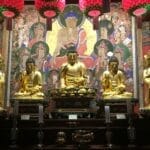
Korean History Timeline: From Gojoseon to the Modern Korean State

korean history timeline,hanguk history timeline,history of korea,korean dynasties timeline,three kingdoms korea,unified silla balhae,goryeo dynasty,joseon dynasty,korean empire colonial period,modern korea era,korean war timeline,korean buddhism history,korean unesco sites,korean cultural heritage,hallyu and korean history

Korean History Timeline — 8 Epic Eras Shaping Its Legacy

Plan your trip to Korea and deepen your understanding of its past. This timeline connects mythic origins, royal dynasties, Buddhism, colonial upheaval, and today’s modern nation — with quick links to UNESCO sites, museums, and scholarly sources.

Understanding the Hanguk History Timeline is essential for anyone interested in the cultural heritage of Korea. From archaeology to architecture, and from dynastic power struggles to modern diplomacy, this overview offers a gateway into Korea’s rich and layered past.

Each period reveals how Korea adapted to challenges, absorbed influences, and developed a distinct identity that continues to resonate worldwide.

Related Mantifang anchors: The Jijang Fractal Book Hub · Living Korea · Living Words.

Jijang Fractal — eyes as symbol of compassion, Korean aging society
Korean Buddhism has long held a deep resonance within its history. Read about the Jijang Fractal discovered by Hugo J. Smal.

Highlights from the dataset

  • 0Korea: Birth of Jesus Christ, used as a global chronology marker.
  • 313Korea: Goguryeo annexes the Lelang Commandery (context).
  • 612East Asia: Silla–Tang forces defeat Baekje.
  • 936Korea: Final unification under Goryeo.
  • 1145Korea: Compilation of the Samguk Sagi, Korea’s oldest historical text.
  • 1597Korea: Siege of Ulsan during the Imjin Wars with Japan (context).
  • 1864Korea: Gojong ascends the throne, with Daewongun as regent.
  • 1915Korea: Japan issues the “Twenty-One Demands,” reshaping East Asian geopolitics (context).
  • 1953Korea: The Korean War ends with the armistice agreement.
  • 1994Korea: Kim Jong Il takes control of North Korea after Kim Il-Sung’s death.

Travel & Cultural Connections

Korea’s history is not only preserved in books but also embedded in its landscapes and monuments. Travelers can experience history by walking the palace grounds, hiking ancient fortress walls, and meditating in centuries-old Buddhist temples.

  • Gyeongju: Silla capital with royal tombs and UNESCO Historic Areas.
  • Seoul — Gyeongbokgung & Changdeokgung: Joseon palaces, UNESCO listed.
  • Haeinsa Temple: Repository of the Tripitaka Koreana UNESCO.
  • Seokguram Grotto & Bulguksa: Buddhist masterpieces of the Silla era UNESCO.
  • DMZ observatories: Learn modern history along the DMZ.

Explore this Korea history timeline by chapter

To make this overview easier to navigate, the content is divided into eight distinct eras. Each era marks a turning point: from the mythical foundations of Korea to the challenges of the colonial period, and the division of the peninsula after the War.

Korea Timeline in Popular Hallyu Culture

Beyond textbooks, history has reached a global audience through the Korean Wave, or Hallyu.
Historical dramas like Jewel in the Palace (Dae Jang Geum), Moon Embracing the Sun, and Kingdom
vividly reimagine the grandeur of Joseon courts, the struggles of royal succession, and even the terrors of invasion.
These series have introduced millions of viewers to Korea’s traditions, costumes, and values.

Modern films and TV series often revisit the colonial era or the War, exploring themes of resistance, survival,
and national identity. The blending of entertainment with history allows international audiences to connect emotionally
with Korea’s past, sparking curiosity to visit historical sites in person. For K-pop fans, music videos and stage
performances sometimes reference traditional motifs, showing how heritage continues to inspire creativity today.

Why This timeline matters

The Hanguk History Timeline is more than a sequence of dates — it is a story of resilience, transformation, and creativity.
By exploring the flow of events, visitors gain insight into how Korea became a nation that balances rapid modernization
with deep respect for tradition. This perspective helps explain why Korea is now a leader in global culture, technology,
and diplomacy, while never losing sight of its roots.

Today, this history overview also serves as a bridge between the past and present.
It helps travelers understand why UNESCO sites are more than tourist attractions,
why K-dramas often revisit dynasties, and why traditions remain visible in food, art, and daily life.
For students, fans of Hallyu, or curious explorers, this timeline offers context that makes modern Korea’s global presence even more meaningful.

Further Reading

Q&A — Korean History Timeline

Q1. What are the most important Korea history eras?

A clear “core Korean History Timeline” often starts with the Three Kingdoms period (Goguryeo, Baekje, Silla), then Unified Silla,
followed by Goryeo and Joseon. From there, the modern era is usually summarized as Japanese colonial rule,
liberation, the Korean War, and the Republic of Korea’s rapid post-war development.

Q2. Why do Goryeo and Joseon matter so much in Korean history?

Goryeo shaped a long-lasting cultural identity through Buddhism, statecraft, and international exchange, while Joseon
defined Korea’s classical institutions, Confucian social order, and much of the historical record that people still
reference today. Together they explain many “deep structures” behind language, ethics, art, and daily customs.

Q3. How should I read a Korean history timeline without getting lost in names and dates?

Use a small set of anchors: (1) who held power (kingdom/dynasty), (2) the dominant worldview (Buddhism/Confucianism),
(3) external pressure or exchange (China, steppe, Japan, the West), and (4) one signature cultural marker per era
(for example: temple culture, ceramics, Hangul, court rituals, or modern industry). This turns the timeline into a
story you can follow.

© Mantifang — Timeline project.

“`

Unified Silla Balhae Korea (668–926)

Unified Silla & Balhae (668–926)

Unified Silla Balhae Korea pairs Unified Silla’s unification and cultural “golden age” with Balhae, a northern state rooted in Goguryeo traditions. Together they shaped early-medieval government, Buddhism, art, and maritime exchange across East Asia.

7 key highlights

  1. 668: Silla, allied with Tang, defeats Goguryeo and unifies most of the peninsula.
  2. 698: A northern successor state is founded by Dae Joyeong in former Goguryeo heartlands.
  3. 8th c.: Gyeongju becomes a planned capital; court ranks, education, and provincial governance stabilise the realm.
  4. 751: Bulguksa and Seokguram mark a high point in architecture and devotion.
  5. 828: Admiral Jang Bogo establishes Cheonghaejin (Wando), protecting sea lanes to Tang China and Japan.
  6. 8th–9th c.: The northern state expands diplomatically and economically with grid-planned cities and multi-ethnic administration.
  7. 926: Khitan Liao conquest reshapes northern geopolitics; within a decade Goryeo replaces late Silla (935–936).

Politics & court culture

From Gyeongju, rulers consolidated power through aristocratic lineages, provincial officials, and legal registers. Diplomatic ritual with Tang, ranked attire, and examinations structured court life. Poetry, banquets, and music signalled prestige, while provincial festivals tied local elites to the centre.

The capital’s layout linked palaces, temple districts, artisan quarters, and markets along broad avenues—continental models adapted in stone and timber to local taste.

Buddhism, temples & art

Royal patronage underpinned monasteries as schools, libraries, and hostels for envoys. At Bulguksa stone terraces and bridges lead to wooden halls; at Seokguram a sculpted Buddha and bodhisattvas embody faith and engineering. Gilt-bronze images, reliquaries, and pagodas show mature workshops across the temple network.

Motifs—lotus, guardians, apsaras—travelled with scriptures and artisans, embedding broad Buddhist ideas in local craft traditions.

Maritime trade & routes

Yellow Sea and East China Sea ports moved ceramics, textiles, metals, and aromatics. Monks and merchants shared routes and letters of introduction, while Cheonghaejin acted as a protected entrepôt to deter piracy and standardise dues, linking markets to Tang cities and Japan’s courts.

Inland roads channelled grain taxes and craft goods between provincial storehouses and the capital, integrating countryside and court economy.

Balhae in the north

Successor to northern Goguryeo, the state governed a diverse population across Manchuria and the northeast. Capitals shifted to control resources and corridors; palaces and temples echoed continental prototypes while expressing regional identities. Ongoing archaeology continues to refine this picture.

Diplomatically active, the polity exchanged embassies with Tang and Japan and traded furs, ginseng, and horses, until Khitan expansion redrew northern frontiers.

Legacy of Unified Silla Balhae Korea

Lasting signatures include monumentally planned temples, refined court etiquette, Buddhist scholarship, and a maritime outlook. Southern unity and northern networks together set the stage for Goryeo’s innovations in printing, statecraft, and celadon.

Continue the story in the next chapter: Goryeo (918–1392). For site context, see UNESCO — Gyeongju Historic Areas and the Cultural Heritage Administration.

FAQ

When did the period begin?
In 668, after a Tang-allied force defeated Goguryeo and unified most of the peninsula.
What was the northern state and where was it based?
A successor to Goguryeo (from 698) ruling Manchuria and the northeast until 926.
Why is this era significant?
It set political and cultural foundations for medieval Korea, pairing southern unity with northern networks that anticipated Goryeo’s rise.

Further reading

© Mantifang — Timeline project.

Goryeo Dynasty History | Mantifang


Goryeo Dynasty (918–1392)

Goryeo Dynasty (918–1392) forged Korea’s medieval identity—renowned for celadon, early printing including the Tripitaka Koreana, vibrant Buddhism, and resilient statecraft.

Cultural Achievements of the Goryeo Dynasty

  • Foundation (918) — Wang Geon unites the Later Three Kingdoms and founds the realm with its capital at Gaegyeong (Gaeseong).
  • State Buddhism — Monastic patronage shapes kingship, art, and diplomacy, blending Seon (Zen) with scholastic traditions.
  • Printing Revolution — Advances in woodblock and early movable metal type; the monumental Tripitaka Koreana (13th c.).
  • Korean Celadon — Jade-sheen glazes and sanggam inlay reach global renown; kilns flourish in Gangjin and Buan.
  • Maritime Trade — Networks link Song China, Japan, and beyond; ceramics, books, and textiles circulate across East Asia.
  • Resilience & Reform — Khitan, Jurchen, and Mongol pressures spur administrative, military, and diplomatic change.

Politics and Society

The dynasty emerged from civil war yet established a durable bureaucracy anchored in aristocratic lineages and examinations. Kings balanced powerful clans and religious institutions, while provincial officials managed taxation and corvée. Land policy and military reform recurred, especially after invasions exposed fiscal and logistical weaknesses.

Urban life centered on Gaegyeong’s markets, monasteries, and government courts. In the countryside, farmers cultivated paddies and dry fields; taxes in grain, cloth, and labor sustained the state. Merchants and craft guilds expanded with maritime exchange, even as elites debated the ethics of commerce within Buddhist and Confucian frameworks.

when the buddha fell,I woke up.
Front hall icon group at Bogwangsa (Korea), frontal view.
Read all about this magnificent temple.

Religion and Buddhism

Monastic patronage shaped ritual, public works, and aesthetics. Seon meditation lineages coexisted with scholastic schools; lay devotion flourished through icon painting, reliquaries, and pilgrimage. Compassion ethics underpinned relief projects during famine and war, while estates managed lands, libraries, and workshops.

The carving of the Tripitaka Koreana—over 80,000 woodblocks—sought spiritual protection and codified the canon with extraordinary accuracy. Alongside experiments with movable metal type, these feats mark a milestone in world book history.

Jijang Fractal — eyes as symbol of compassion, Korean aging society
Discover the meaning behind the Jijang Fractal — A Korean Journey of Compassion → Explore Hugo J Smals thought

Korean Celadon and arts.

Potters perfected the translucent jade-green glaze that became a hallmark of the era. The sanggam inlay technique—filling carved motifs with white and black slips—produced elegant vessels, pillows, and incense burners. Court workshops created Buddhist bronzes, lacquerware with mother-of-pearl, and silk textiles, while painters rendered gentle landscapes and devotional icons.

Signature jade-green celadon with sanggam inlay, emblematic of the period’s artistry.

Printing and Knowledge Networks

Scholars, monks, and artisans collaborated in scriptoria producing sutras, law codes, calendars, and medical texts. Vast woodblock libraries and early metal movable type spread knowledge across monasteries and foreign courts. Exchange with Song China introduced ideas in science and navigation; diplomatic missions gifted books and ceramics, reinforcing prestige.

War, Trade, and Resilience

Geopolitically, the kingdom navigated Khitan Liao, Jurchen Jin, and Mongol empires. Fortifications, riverine defenses, and coastal fleets protected key corridors. After Mongol incursions in the 13th century, royal marriages and vassalage obligations reoriented diplomacy, yet cultural production endured. Maritime trade—ceramics, paper, and ginseng—sustained urban markets and craft specialization.

Legacy and Popular Culture

The Goryeo Dynasty bequeathed institutions, artistry, and texts that inform Korean identity. Celadon aesthetics influenced later Joseon porcelain; printing techniques foreshadowed modern publishing. In public memory, kings, monks, and artisans appear in museums and curricula. Contemporary media—historical novels and dramas—extend this legacy, introducing the era’s aesthetics and ethical dilemmas to global audiences.

Historically, the realm’s conclusion set the stage for reformist currents and the rise of the Joseon Dynasty. For the broader arc, see the earlier Three Kingdoms period, whose regional dynamics framed Goryeo’s emergence.

Korean autobiographical thriller
Where shamanism and Buddhism blends together. Korean and Tibetan traditions.

FAQ — Key Points

What defines this era? A synthesis of Buddhist statecraft, maritime trade, refined celadon artistry, and innovations in printing, highlighted by the Tripitaka Koreana.

Why is it important globally? Early large-scale printing, advanced ceramic technologies, and cross-cultural exchange across East Asia.

Dataset access

Download the datasets:

  • Download Korea.csv
  • Download Timeline.csv

Use these files to sort, filter, or build your own visualisations. Cite Mantifang if you reuse the data.

Further reading

© Mantifang — Timeline project.

Jijang fractal – Letter to the Sangha

To the Sangha — Near and Far, Past and Present

This personal letter reflects on a spiritual journey through Korean Buddhist imagery, the figure of Jijang Bosal, and the moral implications of the fractal as presence. It links Eastern and Western thought (Buddha, Jung, Sartre) and proposes a compassionate model of reality. A meditative offering, not a doctrine.

So this is what Jijang’s Fractal and I ask of you: Stay — with what is not resolved, not named, not escaped. Let this presence shape how you listen, how you walk, how you witness. Because what is truly witnessed, no longer needs to be denied. And what is no longer denied, begins to heal — in you, in others, in the world.

Hugo J. Smal
15 juli 2025

To the Sangha — near and far, past and present

This is not a canonical sūtra. But it was written as one might write a sūtra: in silence, in vow, and in offering.

Writing about Bogwangsa Pilgrimage to Bogwangsa in Five (and One) Stories turned out to be more than a journey through Buddhist icons. It became an inner path toward insight. A ritual. A practice of silence and reflection. A prolonged meditation on what I now call the Jijang Fractal. It urged me to stop. To be still. To listen.

“With my head directed toward Buddhahood, and my heart committed to the liberation of others…”

This is the vow I intend to live by in the two decades I may still be given. But to walk such a path requires realignment — of mind, of body, of spirit. That is why I turn to Akasagarbha (허공장보살, Heogongjang Bosal), often referred to as Jijang’s twin brother. His name means “Womb of Space” or “Essence of the Ether.” He is the protector of wisdom, creativity, and inner expansion — the vast silence in which compassion becomes possible.

Letter to the Sangha
Heogongjang Bosal

Heogongjang Bosal opens the kosmos in which the Jijang Fractal — and my vow — may unfold. That kosmos includes my own body and mind. In recognition of this, I admitted myself for a short stay in Zuyderland Hospital to have my medications recalibrated. Diabetes type 2 and high blood pressure forced me to radically change my diet: no sugar, no salt, no fat. Fortunately, Korean cuisine has always taught me that pleasure does not depend on these ingredients. There are other ways.

I am sixty-seven years old now. I want to give myself twenty more years — to be with the Buddha, and to help others. Concretely, that means focusing on the children and grandchildren of my beloved Mickey Paulssen. The world in which they must build their lives is one of crisis and fracture — ecological, social, spiritual. A world that often feels like a hell, pierced only now and then by slivers of sunlight. I ask Heogongjang Bosal to help shape that field. And I invite Jijang to guide me in carrying his Fractal into the world.

A Poetic Beginning

I wrote the following poem when I was about twenty. My literature teacher, Paula Gomes, once remarked that by writing it, I had already found her — the voice, the ground, perhaps even myself. But I disagreed. To me, the poem didn’t offer resolution. It pointed. It called. It gave not an answer, but a task.

You search for words, for years
Of simply growing older
Always vague and afraid

Yes — back then, I was indeed searching for words. Words that might help me understand the world, and plant my feet a little more firmly on the earth. Jung, Sartre, de Beauvoir: these were the thinkers I turned to for inspiration. I also immersed myself in Eastern philosophy, but could not truly grasp it. My mind — my rational understanding — was not yet capable of feeling it. Looking back, I now realize how often I must have needed Heogongjang Bosal to help me lay a deeper, inner path. Perhaps now, with the Jijang Fractal, I have finally found the words.

Three Voices: Sartre, Jung and the Buddha

Interpretation of the Poem by Three Voices

LineSartreJungBuddha
You search for wordsExistence precedes essence — freedom requires choice.Call of the Self — the process of individuation begins.Clinging to concepts — tanha obscures insight.
For years of simply growing olderAbsurdity of time — facticity without higher meaning.The ego ages, the Wise Old Man archetype ripens.Anicca (impermanence), dukkha (suffering).
Always vague and afraidOntological angst — fear before radical freedom.Encounter with the Shadow — unconscious material rises.Avidya — ignorance just before awakening.

Letter to the Sangha

Jean Paul Sartre would probably read the poem as follows:

“You search for words”
For Sartre, there is no pre-given essence. Existence precedes essence. You are — and only through choice do you define yourself. To search for words is to face the responsibility of becoming, without blueprint or certainty.

“For years of simply growing older”
Time is absurd. Sartre would see this as the human being caught in facticity — you age, your body changes, and you must relate to this without any higher justification. You become, but to what end?

“Always vague and afraid”
This fear (angoisse) is existential: it arises when one confronts the abyss of radical freedom. Every choice is both liberating and paralyzing. “Vague and afraid” is not weakness — it is authenticity, if you dare to move through it.

Sartre would read the poem as an expression of the human being in rebellious freedom — condemned to be free, in a world that offers no meaning except what you create.

Letter to the SanghaCarl Gustaf Jung might interpret the poem differently:

“You search for words”
This speaks to the archetype of the Self — the center of psychic totality, the goal of individuation. “Becoming” is the process by which one gradually grows into oneself, as an acorn becomes an oak. For Jung, it is an unfolding already seeded within you.

“For years of simply growing older”
Time here is lived by the ego — the personality navigating the world. Aging brings not only decay, but ripening. The archetype of the wise old man becomes present — the one who knows that to age is to die and to deepen.

“Always vague and afraid”
Here appears the Shadow: the parts of ourselves that we cannot name, that evade us, yet influence us deeply. Vague is the unknown unconscious. Fear is the ego’s response when nearing its edge.

Jung would see the poem as the voice of a young ego sensing the call of the Self, but not yet able to hear it clearly — caught between light and shadow, time and destiny.

GautamaThe Gautama Buddha would likely say:

“You search for words”
This is the human tendency to cling to concepts, categories, and language — a form of tanha (craving). The Buddha might remind us that insight arises not from speech, but from silence and direct experience. Words can become an obstacle when we mistake them for truth. They are a form of dukkha — the hunger for meaning in a world that is ultimately formless.

“For years of simply growing older”

This line recalls the three marks of existence: Anicca (impermanence), Dukkha (unsatisfactoriness), and Anatta (non-self).

Aging reveals suffering and impermanence. It was this insight — seeing the old man, the sick, the dead — that launched Siddhartha’s path.

“Always vague and afraid”
These are symptoms of avidya — ignorance of the true nature of reality. For the Buddha, fear is not sin; it is the stage before wisdom (prajñā). Fear is the inner resistance to letting go of “I.”

He might see my poem as a reflection of suffering born from ego-clinging — a natural condition before awakening. The way forward lies not in more words, but in unfolding. In loosening. In seeing.

Of course, none of them ever read this poem. Their interpretations are, at best, imagined. And yet: where Sartre condemns us to freedom, Jung maps a deeper psyche, and the Buddha offers the path of cessation — I now sense how these three once-parallel voices begin to converge.

Nearly fifty years later, while trying to open the gates of Bogwangsa with my words, a path revealed itself — one I had long sensed, but never seen clearly. In retrospect, I see how these thinkers shaped me. This constellation of ideas is what I now share with you.

Jijang FractalJijang as Bridge Between Three Traditions
  • Sartre: Freedom, radical responsibility, no essence — Jijang honors freedom but redirects it toward presence.
  • Jung: Shadow, Self, individuation — Jijang appears when the ego dissolves and integration begins.
  • Buddha: Emptiness, interdependence, compassion — Jijang embodies in relational suffering.

Jijang does not choose between these three voices —
He absorbs, connects, and dwells at the intersection.
His Fractal includes them all.

The Discovery of Jijang

Years ago, during a visit to Insadong — the famous artists’ district in Seoul — I discovered a small copper statue in a cluttered cabinet against a wall. It was Ksitigarbha Bodhisattva Mahasattva.

Of course, I had never heard of him. But after some research, I learned that this bodhisattva descends into the hell realms that people pass through on the path to awakening. In Korea, he is known as Jijang Bosal. He goes down not to judge — but to help. His vow speaks to the vastness of his compassion:

The Four Great Vows
Sentient beings are without end — I vow to liberate them all.
Suffering is infinite — I vow to understand it fully.
The Dharma has countless forms — I vow to learn them all.
The path of the Buddha is unsurpassed — I vow to realize it completely.

The Four Vows Interpreted Through the Fractal

  • 1. Sentient beings are without endf∞(v) includes all — no one is separate, no suffering isolated.
  • 2. Suffering is infinite → Compassion repeats across time — fⁿ(w) is shared and carried.
  • 3. The Dharma has countless forms → The network V reflects infinite expressions of awakening.
  • 4. The Buddha’s path is unsurpassed → Each iteration moves toward integration — as practice.

Through the Fractal, the Vows Are Not Ideals Above Us

they are movements within us, unfolding endlessly.

To be awakened is to see through the illusion —

the illusion of distance, of hierarchy, of otherness.

The icons in the temples are not distant figures,

but reflections of the possible.

They do not ask for worship,

but for recognition.

These are not gods,

but inner forms —

embodied insights that remind us

of who we can become at our deepest.

Jijang is not a savior outside of me,

but a personification of an inner power:

the willingness to descend into suffering,

into darkness —

and remain there until light returns.

Until light shows itself in the other.

And in me.

Jijang as Inner Guide

Gradually, I began to realize: Jijang, this bodhisattva who enters the deepest shadows, was not just a statue. He was an invitation. An inner form that appears when the ego loses its grip — when we no longer strive upward, but dare to stay where it hurts. In this, I recognized what Jung called the encounter with the Shadow: those parts of ourselves we have hidden or denied for years, until they return, not as enemies, but as guides.

Jijang is such a guide.
Born from darkness,
Not to banish it,
But to inhabit it — with compassion.

A figure of the Self,
Not one who ascends,
But one who descends.

Jung would have seen Jijang as an archetype — an image emerging from the collective unconscious, not meant to be worshipped, but integrated. And perhaps it is precisely there — in surrender to what is, to what Jung calls the Self and Buddhists call suchness — that emptiness no longer feels threatening. It simply is.

And you are allowed to be in it.

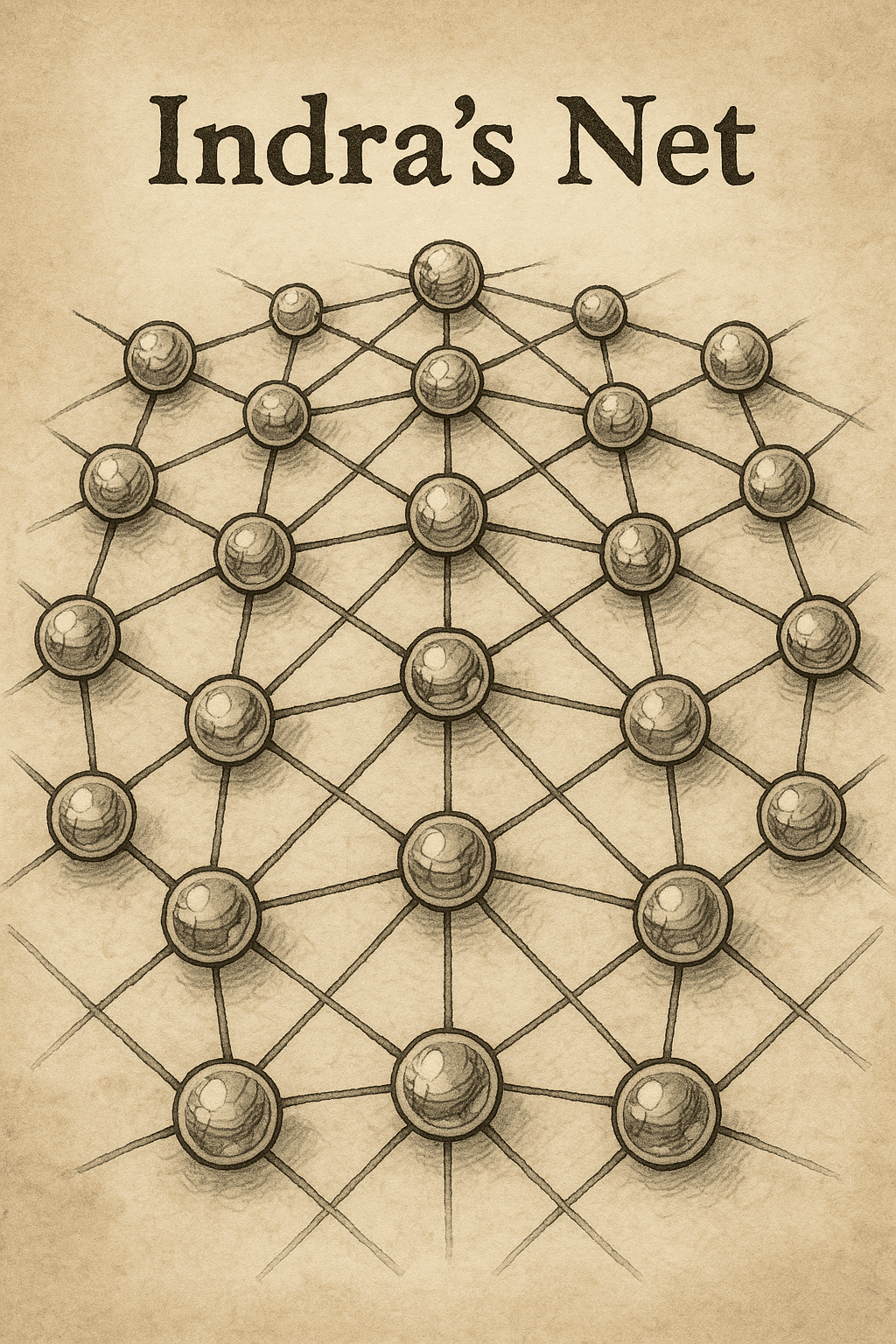
Jijang’s Fractal within Indra’s Net

Indra's netIndra’s Net — a concept from ancient Indian cosmology — describes the universe as an endless web of connections, where each node reflects all others. Nothing exists in isolation; every point carries the imprint of the whole.

Jijang’s Fractal takes this one step further. It suggests not just reflection, but transformation:

  • Each node w emits influence — over time: fⁿ(w)
  • Each node v receives the sum of those influences: f∞(v)
  • The process never ends — karma becomes iteration, not fate

This is Indra’s Net as a living, moral system — dynamic, infinite, and tender with memory.

The Emergence of the Fractal

And then the fractal appeared:

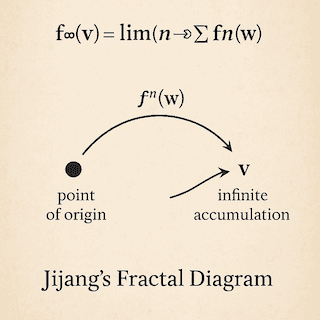
f∞(v) = lim(n→∞) Ʃ(w∈V) fⁿ(w)

Jijang Fractal Diagram

This diagram illustrates how Jijang’s Fractal works: w is a point of origin — a being who makes a choice. fⁿ(w) is that influence repeated over time. v is a being who receives those influences. f∞(v) is the infinite accumulation — not as fate, but as potential. The model shows karma not as punishment, but as pattern — a dynamic field of memory, influence and presence.

And the stories I had begun writing about Bogwangsa. What started as a stray thought, a scrap of dream, became a formula. And what looked like a formula turned out to be a bridge — between East and West. Between self and other. Between thought and silence.

It started with a simple question: what if the mind is not only shaped by what I choose, but also by what others have chosen — and continue to choose? What if memory, pain, compassion, and forgiveness are not isolated events, but repeated patterns? What if that repetition — like in a fractal — does not flatten meaning, but deepens it?

That’s how Jijang’s Fractal was born. A formula in which every choice made by every being leaves a trace. Something that returns. Something that accumulates — infinitely.

How Jijang’s Fractal Operates

  1. A being (w) makes a choice — an action, a word, a silence.
  2. That choice reverberates over time: fⁿ(w).
  3. Other beings (v) receive these accumulated influences.
  4. Jijang remains present in the field of these influences — not to judge, but to accompany.
  5. Over infinite iterations, f∞(v) emerges — not as fixed fate, but as potential for insight, compassion, awakening.

This is karma as pattern — not punishment. This is Jijang’s work: staying where memory accumulates, until a being is ready to see clearly.

But this fractal is not a prison. The symbol f∞(v) contains — infinity. And in my experience, in all I saw, thought, wrote and withheld about Jijang Bosal, it became clear: this infinity is not abstract. It is a presence. A person. It is what Jijang is.

Jijang’s Fractal as Bridge Between Hinayana and Mahayana

Jijang’s Fractal shows that the path of individual liberation (Hinayana) and the path of universal compassion (Mahayana) are not separate roads — they meet, and even strengthen one another.

In Hinayana, the individual is central: v is the point of consciousness, the person responsible for their own choices. Here, freedom is personal — and liberation is pursued through insight, discipline, and moral clarity.

In Mahayana, the network is central: all beings are interconnected through causes, memories, and intentions. Here, freedom is relational — and liberation arises from compassion for all sentient life.

The Fractal unites both:

f∞(v) = lim(n→∞) Ʃ(w∈V) fⁿ(w)

The individual v is not awakened in isolation, but through the influence of the network. And the network is not just abstract kindness, but the sum of real, repeated choices — including your own.

Jijang’s Fractal becomes a living crossroads: of personal responsibility and collective influence, of moral action and formless emptiness, of Hinayana and Mahayana. Not as compromise — but as the very pivot of the Dharma wheel.

Bohyeon Bosal: The One Who Opens the Field

But as always: Jijang does not appear alone.

Before he descends, before he settles into the depth, before he unfolds his across the field of suffering — there must be space.

Not the space of stone, but the space of intention. A space without judgment. A space that says: yes, this too may hurt.

That space is opened by another: Heogongjang Bosal.

He is no preacher. He does not hover above suffering. He makes no promises he cannot carry. He embodies the promise — the action, the presence, the embodiment of compassion.

If Jijang is the one who dwells in Jiok — not as a distant hell, but as the lived reality of suffering, of clinging — as the Buddha taught, shadow — as Jung revealed, and disconnection — as Sartre exposed.

Then Bohyeon Bosal is the one who builds the temple without walls. He opens the field.

He says:

Let this be the place where Jijang remains.
Let this be the place where nothing is hidden.
Let this be the place where truth may repeat itself —
without becoming shame.

Bohyeon Bosal is the stillness before Jijang arrives. The breath before the first tear. The moral space in which Jijang does not drown — but works.

And so I understand now: Jijang is , but Bohyeon Bosal is the 0 in which infinity may appear.

Emptiness Before Form

In Korean spirituality — as in its architecture — creating a space before the form is not incidental. It is essential. The field must be opened before the structure may arise.

Because Jijang is the one who remains. In Jiok. At the crossroads. In the hell realms — not as punishment, but as promise. He is the limit. He is . He is the hand that keeps touching everything — without holding on to anything.

Then I began to see: this fractal is not just a mathematical model. It is a moral space. A spiritual map. A bridge between Sartre and the Buddha. For in the West, we believe in choice. In freedom. In responsibility. While in the East, the focus lies on emptiness, interdependence, and the dissolution of self.

But in Jijang’s Fractal, all comes together. Here, freedom is not detachment — but connection. Emptiness is not disappearance — but passage. And Jijang, as , stands precisely at the crossroads. In the silence between ‘I’ and ‘not-I.’ Between karma and liberation. Between story and stillness.

A Return to Bogwangsa

So I began to look back at my time in Bogwangsa. Not as memory — but as repetition. What returned? Which choice, which word, which look from another kept echoing in me? Which Jijang stood still — and watched me without judgment?

That’s the hard part. Not because it is complex. But because it is intimate. Because it is real. And because it requires me not only to look at the light — but also at the crossroads within myself. The place where Jijang’s hand rests. The place where the story begins again.

When the Image Breaks

Just as Wonhyo drank from foul water in the cave — mistaking it for something pure until daylight revealed its true nature — his awakening came not through doctrine, but through the body. Through shock. Through immediacy. He saw that it was not the water that changed, but his perception of it. And in that moment, something irreversible shifted.

Moments like these still happen — not within the structures of temples or texts, but in the messiness of real life. They arrive uninvited, without explanation, and often without language.

I once witnessed something similar, though quieter. Novi was barely one year old. In our little garden stood a small stone Buddha. One day, with the open curiosity only a child that age can have, she reached out and struck it. Not in anger — there was no malice, only movement. The statue fell. The head broke off.

There was no lesson. No explanation. Only stillness.

And yet that moment stayed with me.

Not because of the broken stone, but because of what it revealed in me.

What was it I had placed in that garden?

What image was I clinging to?

What part of me was decapitated when the Buddha fell?

Sometimes the world doesn’t whisper its teachings.

Sometimes, a child’s hand becomes the finger pointing at the moon.

It is in such small ruptures that the Dharma sometimes reveals itself.

Wonhyo – The Laugh and the Bridge

And then there is Wonhyo.

He, who drank water from a skull — and laughed. Because what first seemed impure turned sacred the moment perception shifted. That moment became his awakening: the realization that truth is not bound to form — but to experience.

Wonhyo, the monk who stopped traveling, because he understood that the journey took place within. The philosopher who worked to bring together the many Buddhist schools of Korea — not to oppose them, but to place them side by side. He did not wish to absolutize the sutras, but to integrate them. He became a bridge.

And that is what I hope to become.

Not to explain Korean Buddhism, but to make it touchable. Not to convert the West, but to offer it a hook — a pattern, a fractal, on which thoughts, feelings, stories, and experiences may rest.

Jijang’s Fractal is my way of saying: You are not alone. Not in your choices, not in your suffering, not in your freedom.

Just as with Wonhyo, I believe that truth is not possession — but movement. Not a system — but a current. Not an endpoint — but a crossroads.

The questions raised here are not new. They echo earlier reflections on mind and perception, explored in figures such as Wonhyo.

You decide what you see.
You decide what you carry.
You decide what you pass on.

And that is freedom. And that is responsibility. And that is the spirit of Jijang. And that is my mission.

If this speaks to you — if you recognize yourself in this field of influences — know this: the door is open. Jijang’s Fractal is not mine — it is ours.

And it lives in anyone who dares to stay where it is dark, until the light reveals itself.

“With my head directed toward Buddhahood, and my heart committed to the liberation of others…”

In Closing

This letter is written in trust — not in persuasion, but in resonance.

To those who recognize something of themselves in these words, I offer an invitation: not to agree, but to enter into dialogue.

Not to resolve, but to listen.

Not to be right, but to respond.

To every member of the Sangha — monastic or lay, Korean or not, spiritually rooted or still searching — I pose this question:

What is your response to these times?

If something in this work has stirred you — whether with recognition or resistance — don’t hesitate to reach out.

Not to me as a person, but to that which transcends us, and yet binds us together.

If you feel this letter may speak to others as well,

sharing it is deeply appreciated.

In presence, in vow,

Hugo J. Smal

This reflection is part of the Bogwangsa Series on Mantifang.com — written as both offering and inquiry.

Further Reading

Questions and Answers

1. What is the central theme of this letter to the Sangha?

The letter reflects on a personal journey through Korean Buddhist imagery, Jijang Bosal, and the moral implications of the Jijang Fractal as a model of presence, compassion, and responsibility.

2. How does the Jijang Fractal connect Eastern and Western thought?

The text weaves together ideas from Buddha, Jung, and Sartre, showing how freedom, shadow work, and compassion converge within the fractal as a shared field of influence and moral presence.

3. Why is Heogongjang Bosal important in this reflection?

Heogongjang Bosal represents the “space before the form” — the inner field in which transformation becomes possible. He opens the kosmos in which the Jijang Fractal unfolds.

4. What role does Jijang Bosal play in the author’s spiritual framework?

Jijang Bosal is seen as an inner guide who descends into suffering with compassion. His presence represents infinite accompaniment rather than judgment, forming the core of the Jijang Fractal.

5. How does the author describe the purpose of writing this letter?

The letter is framed not as doctrine but as an offering — an invitation to stay with what is unresolved, to witness reality with compassion, and to enter into dialogue rather than seek conclusions.

The philosophical roots of this work can be traced, in part, to figures such as Wonhyo, whose reflections on mind and perception continue to echo across time.

Bogwangsa Temple and great Royal Legends

by Hugo J. Smal
images: Mickey Paulssen

Back to Bogwangsa

Part 1 Part 2 Part 3 Part 4

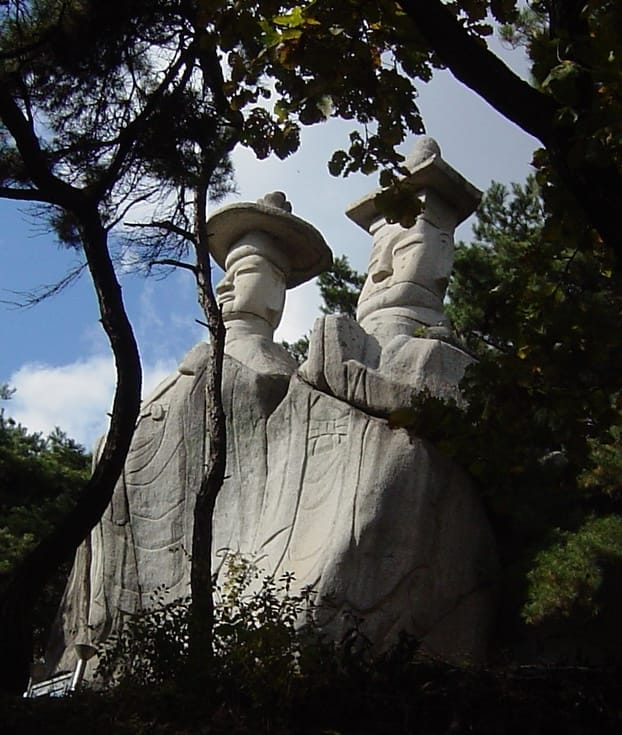
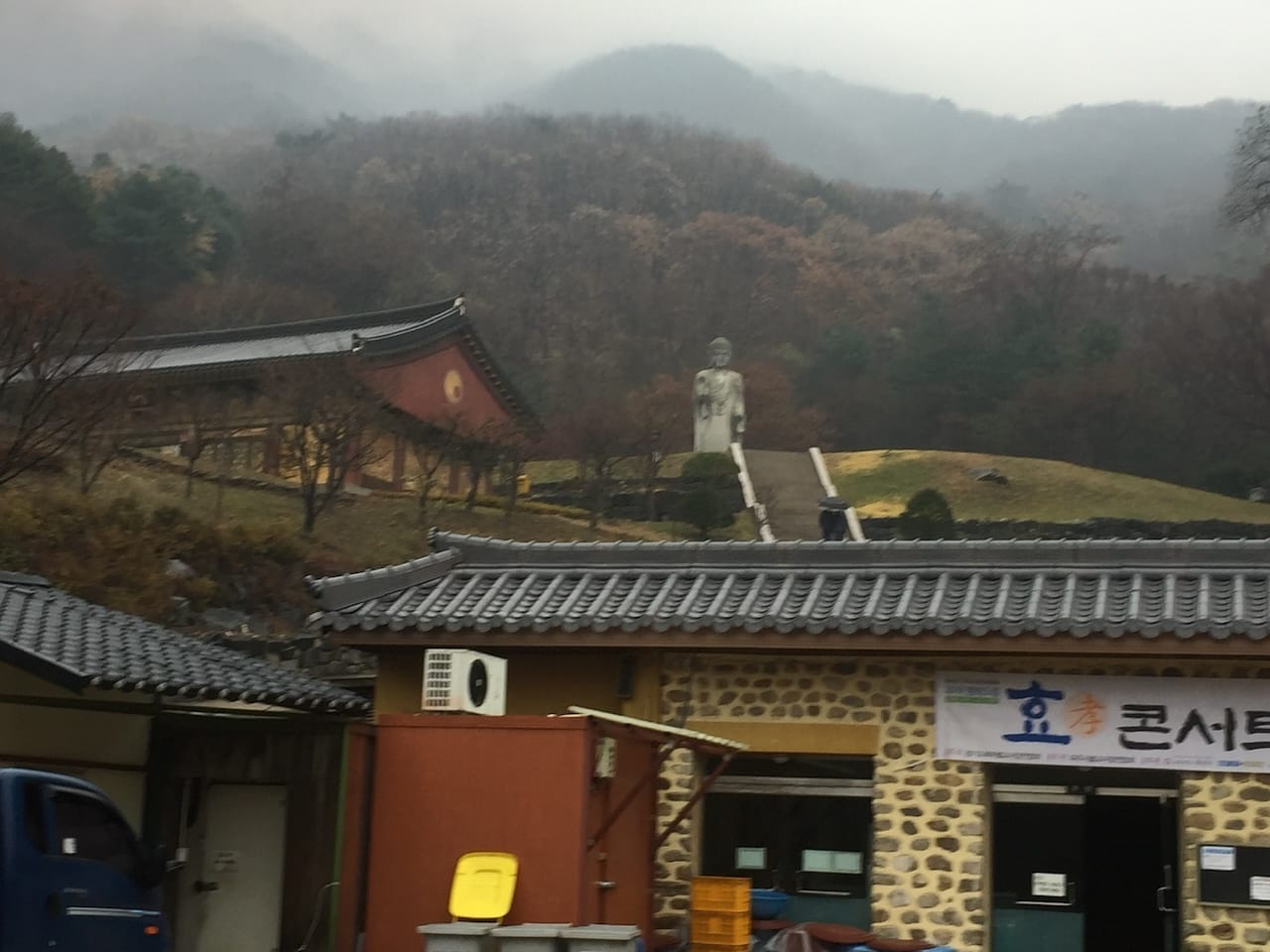
Years ago, I first visited Bogwangsa Temple. Back then, I even climbed up to the large statue of Jijang-bosal. Today, his distant gaze is enough to greet me. I also visited the Yongmi-ri Maaebul at that time—two stone-carved Buddha statues high up on the mountainside. They are said to protect the land, especially the royal family.

Bogwangsa Temple
Two Standing Yongmi Rock Buddhas

These figures are known as the “Two Standing Rock Buddhas of Yongmi-ri” (용미리 마애이불입상). Designated as Korean Treasure No. 93, they are considered significant examples of Goryeo dynasty Buddhist art. Their small stone hats are designed to shield them from the rain.

Legend of the Princess and the Monks at Bogwangsa Temple

According to a Goryeo-era tradition (918–1392), there once was a royal princess who could not bear children. One night, two enlightened monks appeared to her in a dream and said:
“We live among the rocks on the southern slope of Mount Jangjisan. We are hungry. Please feed us.”

Goryeo Dynasty Overview

The princess told her dream to the king, who dispatched attendants to the location mentioned. There, they found two large rocks standing side by side. Suddenly, the monks appeared again and instructed the men to carve statues from the stones. From the left rock, Mireuk-bul—the Buddha of the Future—was carved. From the right, Mireuk-bosal—the Bodhisattva of the Future. A little boy Dongja is standing between them.

The monks promised that anyone who prayed to these images would have their wishes granted, especially those seeking children or healing. After the statues were completed, a temple was built at the site. That same year, Prince Hansan was born.

Royal Dedication: King Sejo and Queen Jeonghui at Bogwangsa Temple

In 1995, inscriptions were discovered on the stone-carved figures at Yongmi-ri, dating back to 1471 during the Joseon dynasty. These inscriptions suggest that the statues were created in honor of King Sejo (r. 1455–1468) and his consort, Queen Jeonghui. According to this interpretation, the left figure with the round hat represents King Sejo as Mireuk-bul (the Buddha of the Future), while the right figure with the square hat represents Queen Jeonghui as Mireuk-bosal (the Bodhisattva of the Future).

One of the inscriptions reads:
“In the future, the great saint Mireuk-bul, Great King Sejo, will be reborn in the Pure Land.”

Although this theory remains unconfirmed, it highlights the profound spiritual and royal significance of these Buddhist statues.

The Shadow of Gounsa Temple: A Spiritual Loss for Korean Buddhism

Bogwangsa Temple
2 suspects in massive Gyeongsang wildfires to be handed over to prosecution early May. Korea Herald

While writing about Bogwangsa Temple, I received heartbreaking news: the centuries-old Gounsa Temple in Gyeongsangbuk-do had been largely destroyed by fire. Founded in 681 by the eminent monk Uisang—a fellow traveler of Wonhyo and founder of the Korean Hwaeom school—Gounsa belonged to the Jogye Order and was revered for its profound silence, spiritual discipline, and an imposing gilded Buddha statue that proved too heavy to rescue.

The loss was far more than physical. For Korean Buddhism, it marked a spiritual wound—a break in a lineage that had been cherished for centuries through prayer and devotion.

Bodhisattva Francis: A Buddhist Tribute to the Pope in Korea

Bogwangsa templeAround the same time, I was deeply moved by the death of Pope Francis. The Jogye Order, Korea’s largest Buddhist monastic order, released an official statement. Venerable Jinwoo, its leader, expressed condolences and described the Pope as a “true compassionate bodhisattva.” He praised the Pope’s dedication to vulnerable groups and his respect for other religions. Jinwoo also recalled the Pope’s historic 2014 visit to South Korea, during which he sought spiritual connection with leaders of the Jogye Order and other faiths.

Coincidence, perhaps—but it felt like more. While violence continued in Gaza and Ukraine, Korea lost a spiritual monument. And while world leaders like Putin, Trump, and Xi Jinping played games of ego and power, a true follower of Francis of Assisi departed this world.

Francis of Assisi (1181/82–1226), the Italian Catholic saint and founder of the Franciscan Order, was renowned for his radical poverty, love of nature, and deep compassion for all living beings. He saw God in everything and everyone, preached peace, humility, and simplicity, and became the patron saint of animals and the environment. His influence transcends religious boundaries and continues to inspire spiritual seekers around the world.

Sacred Juniper Tree at Bogwangsa Temple: A Royal Memorial

juniper tree sways solemnly

An ancient juniper tree sways solemnly in the rain. According to local tradition, the tree was planted by King Yeongjo of the Joseon dynasty (r. 1724–1776) in memory of his mother, Sukbin Choe, a royal concubine of King Sukjong. The tree stands beside Eosil-gak Hall, a memorial space that enshrines the spirit tablet of Sukbin Choe.

In Korean culture, such a tree symbolizes the connection between heaven and earth. It acts as a bridge between the spiritual and the material realms. The presence of this tree enhances the sacred atmosphere of the temple and reminds visitors of the deep spiritual traditions that are revered here.
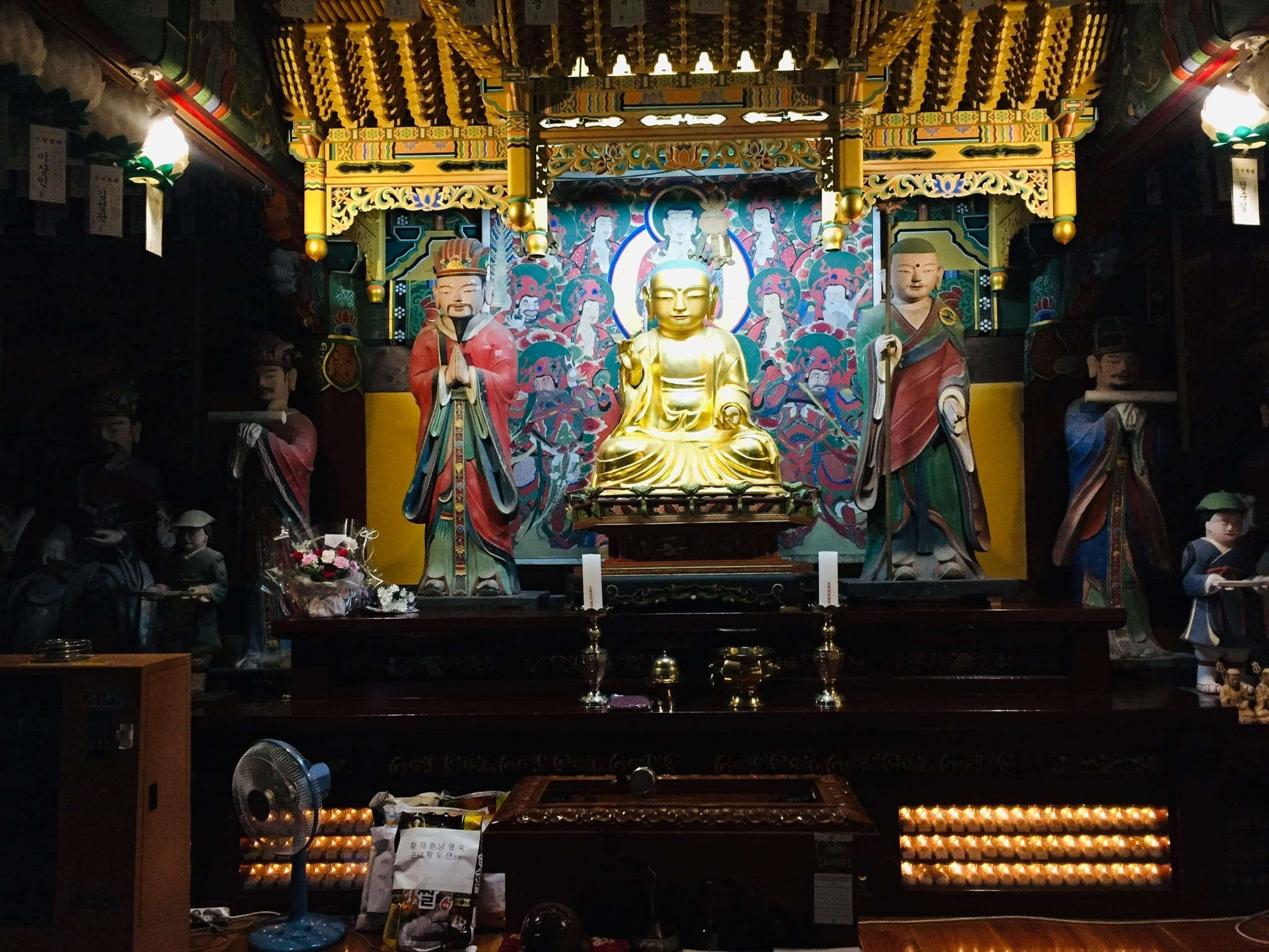
Yeonggakjeon Memorial Hall at Bogwangsa Temple

Yeonggakjeon
This modest yet solemn shrine, known as Yeonggakjeon (영각전), serves as a sacred space for honoring the deceased. Visitors place small Buddha statues bearing name plaques inside, seeking spiritual merit and remembrance through light, prayer, and compassion.

At Bogwangsa Temple, the memorial space where small Buddha statues are enshrined is called Yeonggakjeon (영각전). This hall is dedicated to the deceased and serves as a sacred place for prayers and ceremonies for their souls. Visitors place small Buddha statues with name plaques to honor loved ones and accumulate spiritual merit.

The illuminated statues symbolize wisdom, enlightenment, and the presence of Buddha. The unlit golden Buddhas on the right side likely serve as personal or family memorials. Donating such a statue is considered an act of compassion—a source of merit and spiritual blessing.

Although such halls are often named Jijang-jeon (지장전), in reference to Jijang-bosal (Ksitigarbha), the protector of souls in the afterlife, this space at Bogwangsa specifically bears the name Yeonggakjeon.

Chilseongak and the Seven-Star Ritual in Korean Temple Tradition

Chilseong Taenghwa in Chilseonggak
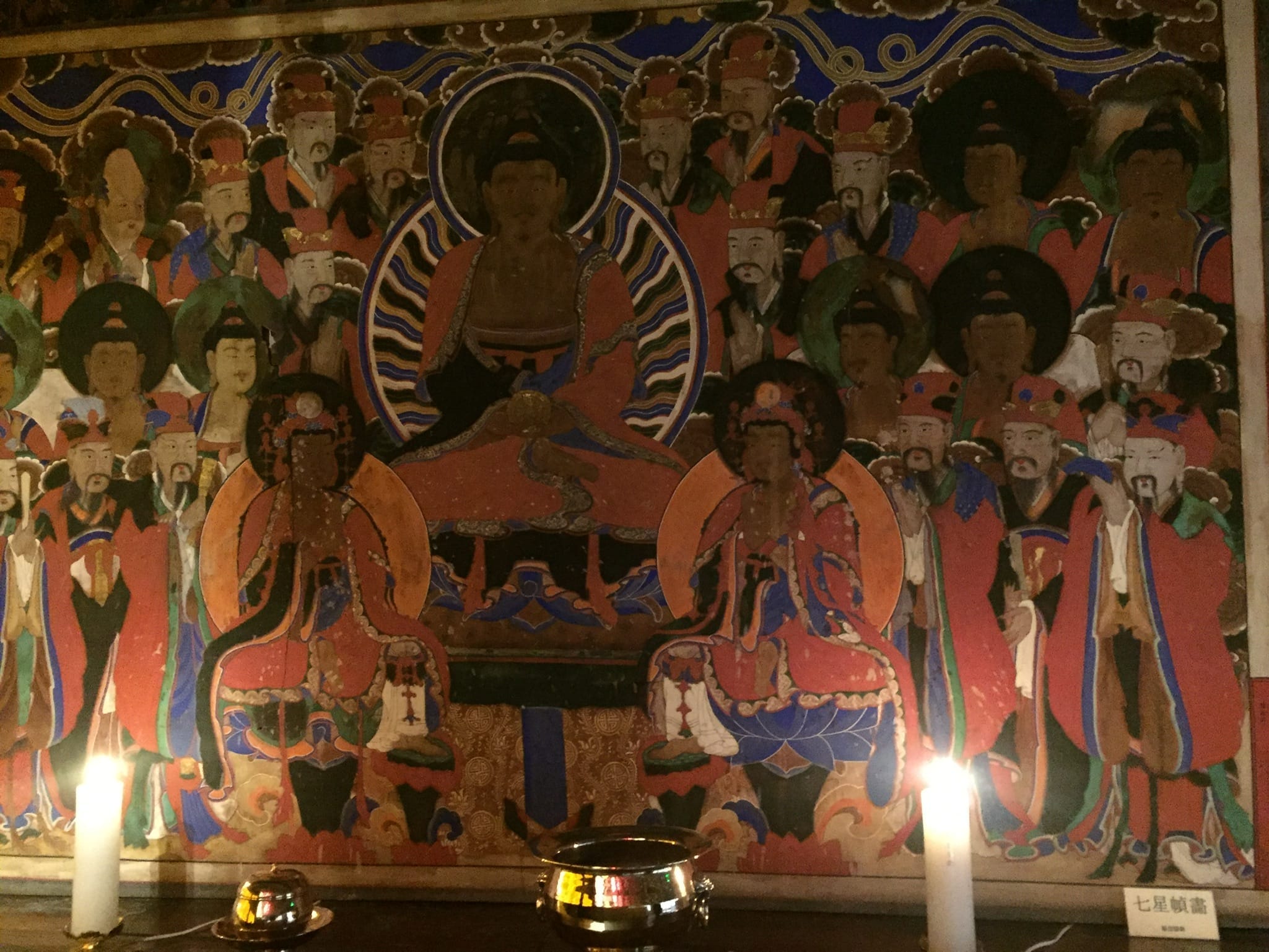
Depiction of the Seven Stars (Chilseong), celestial guardians of fate and longevity, central to rituals for protection and cosmic harmony.

The Chilseongjae is a ritual dedicated to the Seven Stars (Chilseong, 칠성), celestial beings that hold deep symbolic meaning in Korean Buddhist and folk tradition. In Korean cosmology, the Seven Stars represent:

  • Longevity and health

  • Wisdom and spiritual protection

  • Karma and destiny

  • Leadership and cosmic order

In temple paintings, Chilseong is often depicted as seven celestial kings beneath a starry sky. Surrounding scenes illustrate prayer, transition, purification, and rebirth. This Chilseongak is really a beauty of Korean Buddhist art. For me, these Seven Stars are inseparably linked to the Jijang Fractal—a spiritual structure of interconnection, transformation, and inner truth.

Bulhwa and the Jijang Taenghwa: Visual Dharma in Yeonggakjeon

Jijang Taenghwa
Ritual painting of Jijang-bosal with underworld scenes and the Ten Kings of Judgment, used in ancestral rites for guiding departed souls.

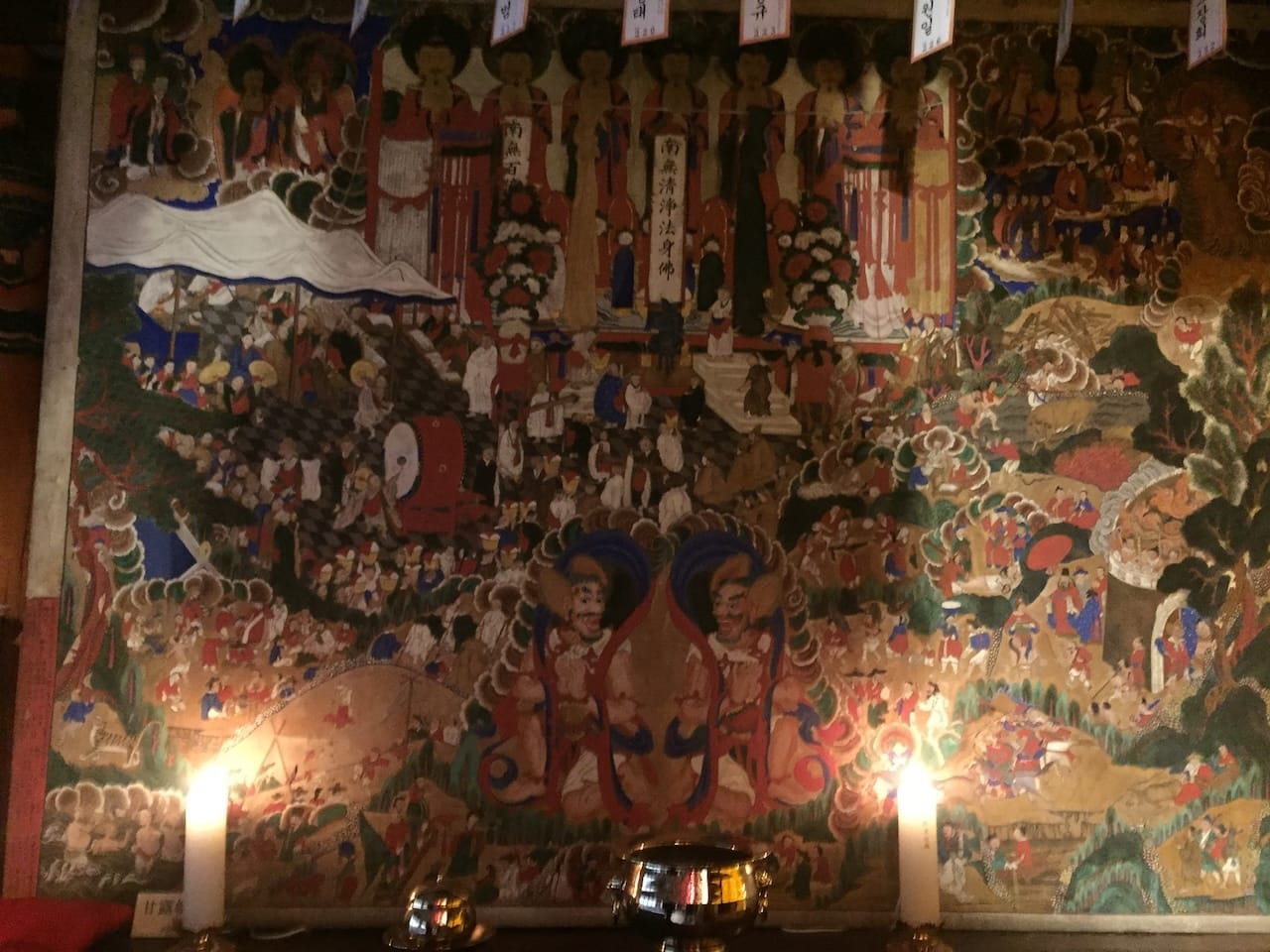
Inside the Yeonggakjeon, a sacred painting known as a Taenghwa (hanging scroll) depicts Jijang-bosal (지장보살, Ksitigarbha), the bodhisattva who vows to save beings from hell. Flanking him on the left and right are likely celestial kings or spiritual guardians. Below them appear officials and warriors, most likely the Siwang, the Ten Kings of the Underworld, who preside over the fates of the dead.

The use of red and blue colors in the painting symbolizes vital energy and purification. The space is adorned with glowing lotus lanterns, each bearing a name tag dedicated to a deceased loved one—offering light, remembrance, and spiritual merit.

Beyond the Fractal: A Dream of Silence with Jijang and Avalokiteśvara

Sitting before the Jijang Taenghwa, lost in reflection, I recalled another dream:

A veil of mist cloaked the mountain’s peak. Jijang-bosal and Avalokiteśvara stood side by side.
There were no calculations. No formulas. No fractals.
Only breath.

“Today we don’t speak of the fractal, said Jijang.
“What we seek cannot be calculated, but must be felt,” answered Gwanseum-bosal.
“Wonhyo called it ‘saek’—color, yet not color. A projection of the mind.”

At their feet grew flowers of thought, pulsing with hues. A white bird fluttered past.
Then the mist returned.
No conclusion. Just a silent affirmation.

The Tea Ceremony with Head Priest Hye Sung: Wonhyo, Descartes, and the Mind

We were invited by Head Priest Hye Sung. He poured tea—slowly, deliberately, each motion attuned to his breath.

Then came the question that lingered:
“Why is Descartes world-famous, and Wonhyo unknown?”

The answer came to me later. In the West, Buddha often appears as a garden ornament—placed beside koi ponds as a symbol of peace or decorative spirituality. Few there have experienced the profound support Korean Buddhism offers. Wonhyo brought that support to the people.

Descartes centered the act of thinking—“Cogito, ergo sum”—I think, therefore I am.
Nietzsche shattered that certainty by declaring God dead.
Sartre confronted us with radical freedom and existential emptiness.
But centuries earlier, Wonhyo had already understood that all phenomena arise from the mind—projections of our inner state.

His pursuit of harmonization found little global resonance—not only because Korea lacked colonial power, but also because it deliberately closed itself off from the outside world.

It’s not just a story of cultural imperialism or wall-building over bridge-building—it’s about a deeper spiritual and intellectual alienation from human potential.

And I, I choose my own path.

Jijang
The writer’s personal Jijang-bosal, with the dorye placed in front
This bronze statue of Jijang-bosal (Ksitigarbha) holds his iconic staff of guidance, while the dorye—symbol of compassionate awakening—rests below, embodying a private link between remembrance and resolve.

Jijang’s Fractal as a Rule for Living: Conscious Action as Sacred Math

“I think, do good, and thereby I add.”

This phrase captures the heart of Jijang’s Fractal: every conscious act, every gesture of compassion, becomes a contribution to a greater whole. Each moment of thought and ethical action increases the total sum—just as in the recursive expression:

f(v) = ∑ f(w)
 and in the long term:
f^∞(v) = lim(n→∞) ∑ f^n(w)

Like a fractal, this moral model suggests that goodness expands outward—layer by layer, influence by influence. It is a mathematical metaphor for karma, interbeing, and the sacred geometry of intention.

Building Bridges, Not Walls: Compassion as the Core of Fractal Living

This rule for living forms a bridge between the abstract concept that appeared to me and the tangible realities of daily life. It offers grounding in times of confusion—a moral compass in a world that often feels fragmented.

But the opposite is also true. Thought without compassion leads to alienation. Action without reflection can cause harm. Compassion is what makes the difference.

Still, I choose my own path.
I think, therefore I am. God is not dead.
And my freedom gives me the space to build bridges instead of walls.

Ecce Homo“Behold the man”, as Nietzsche phrased his search for authenticity.

Waking in Color: The Gate Has Already Opened

Chilseonggak
Yeonggakjeon (left) and Chilseonggak (right) Two ritual halls at Bogwangsa: one honoring ancestral spirits (Yeonggakjeon), the other dedicated to the celestial Seven Stars (Chilseonggak).

I sat on the bench in front of the Yeonggakjeon. The sun hesitated, breaking through. In my hand lay a pebble. It changed color—blue. Gray. Pink. White.

The fractal was still present, but far in the background. What remained was an echo:
“All appearances are states of mind. All colors, projections of the spirit.”

I looked at the wall of the temple.
There she stood. She said nothing. A nod. A color. A condition.
No forgiveness. No judgment. Only the realization:
the gate is already open.

As we left Bogwangsa, I looked once more at the statue of Jijang-bosal. His gaze felt different.
Perhaps there is no border between North and South—only mist.
Perhaps no barrier between what we see and what we know—only the choice to walk through the gate.

Bogwangsa templeMoments later, we saw a familiar woman in the temple’s kitchen.
The same woman from the Baedagol Theme Park. A nod. A flash of recognition. Some paths cross without coincidence. Perhaps she always lived in both worlds. Perhaps there is no divide between temple and park. No present. No past.

“With my head directed toward Buddhahood, and my heart committed to the liberation of others…”

I cross the bridge. The bridge between the outer world and the stillness within me— the stillness where I know my awakening resides.

I invite you to follow me Hugo J. Smal  , Jijang’s fractal or Spiritual East Asia

[embedyt] https://www.youtube.com/watch?v=XSADLoDDOew[/embedyt]

Disclaimer:

I’ve done my utmost to describe the icons, halls, and rituals of Bogwangsa with care and accuracy. Still, any misidentifications or symbolic misreadings are entirely my own. Should you spot any such errors, your insight is warmly welcome. But above all, I hope what resonates is the spirit of the story—the atmosphere it conjures, the openness it invites, and the sincerity with which it was written.

— Hugo J. Smal

Bogwangsa temple Korea: The Dream, the Mountain, and the Fractal of Compassion

Bogwangsa Temple Korea 3

By: Hugo J. Smal
Images: Mickey Paulssen

Part 1
Part 2
Part 3
Part 4

A Compass, Not a Correction

In the days after publishing part one and two about the Bogwangsa temple and its profound symbolism, I received a message from Venerable Lee Kong, a monk of the Jogye Order. His words weren’t a correction, but something subtler—something that felt more like a compass than a commentary:

“With my head directed toward Buddhahood, and my heart committed to the liberation of others…”

Bogwangsa Temple Korea
Though this moktak does not belong to Venerable Lee Kong, his chant carries the same steady rhythm—clear, grounding, inescapably present. It echoes not just through the hall, but through the silence within.

His voice, though distant, arrived with a quiet clarity. It wasn’t about verifying details—it was about staying aligned. Aligned with the Dharma, with sincerity, with compassion.

He resides in Haeryongsa, a small hermitage resting at the base of Seongbulsan, one of the outer ridges of Mount Biseulsan. It sits just beyond the edge of the city—close enough to be reached, yet far enough to breathe. He serves as a meditation guide, quietly offering practices that range from yoga to qi-gong to traditional Buddhist meditation. He resides in a small hermitage, where simplicity and silence form the ground for inner work. Though the place is modest, its spirit is vast.

He also serves Venerable Beopta, the revered josil (senior meditation teacher) at Eunhaesa, one of the main temples of the Jogye Order, nestled in the mountains of Palgongsan. His path has not been bound by one lineage alone—he also spent many years practicing alongside Thai monks, deepening his perspective through both Mahāyāna and Theravāda traditions.

A Dream of Alignment

Perhaps it was his voice. Or the quiet weight of the teachings that I carried with me into the mist of Bogwangsa temple. But somewhere in that mist, the dream returns—softly, without demand.

I see myself again, seated in the open square in Seoul, between two titans of Korean memory: Admiral Yi Sun-sin, standing in unwavering readiness, and King Sejong, seated in quiet contemplation. One defends with the sword. The other teaches with words. And between them—on a simple mat, Jijang-bosal and Gwanseum-bosal share a bowl of tea. No doctrine. No ceremony. Just presence. Just listening. It wasn’t a dream of meaning.

Bogwangsa Temple Korea

It was a dream of alignment.

Bogwangsa temple Korea
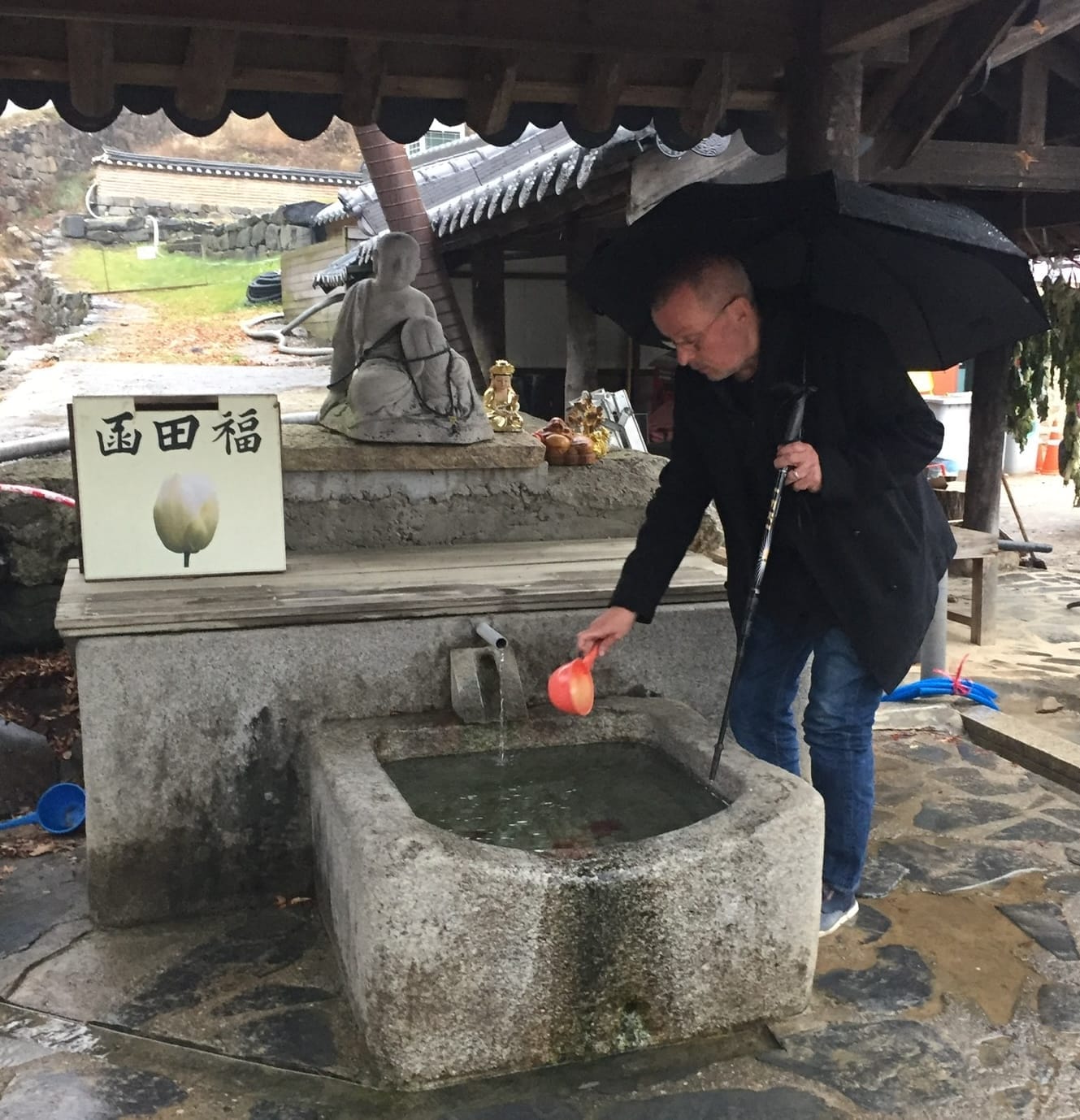
The writer at the spring near the entrance of Bogwangsa temple, I pause beneath the drizzle to draw water. Behind me, the sign reads 圃田福 — Bojeon Bok — a phrase that translates as “blessing of the field” or “prosperity from the garden.”

And still, the sky over Goryeongsan hangs grey and damp. Yet I feel thirsty—not only spiritually, but physically too. What I saw in the main hall didn’t just move me emotionally—it touched something in my body as well. A sensation I know all too well: tight, burning nerves, and a mouth as dry as the ashes of incense. Thankfully, near the entrance, I remember a spring. From it, I draw water—renewing both body and spirit.

Wontongjeon and Fractal Compassion

The Wontongjeon (원통전) and the Fractal Compassion of Gwanseum-bosal

Bogwangsa Korean temple
Gwanseum-bosal in Full Presence
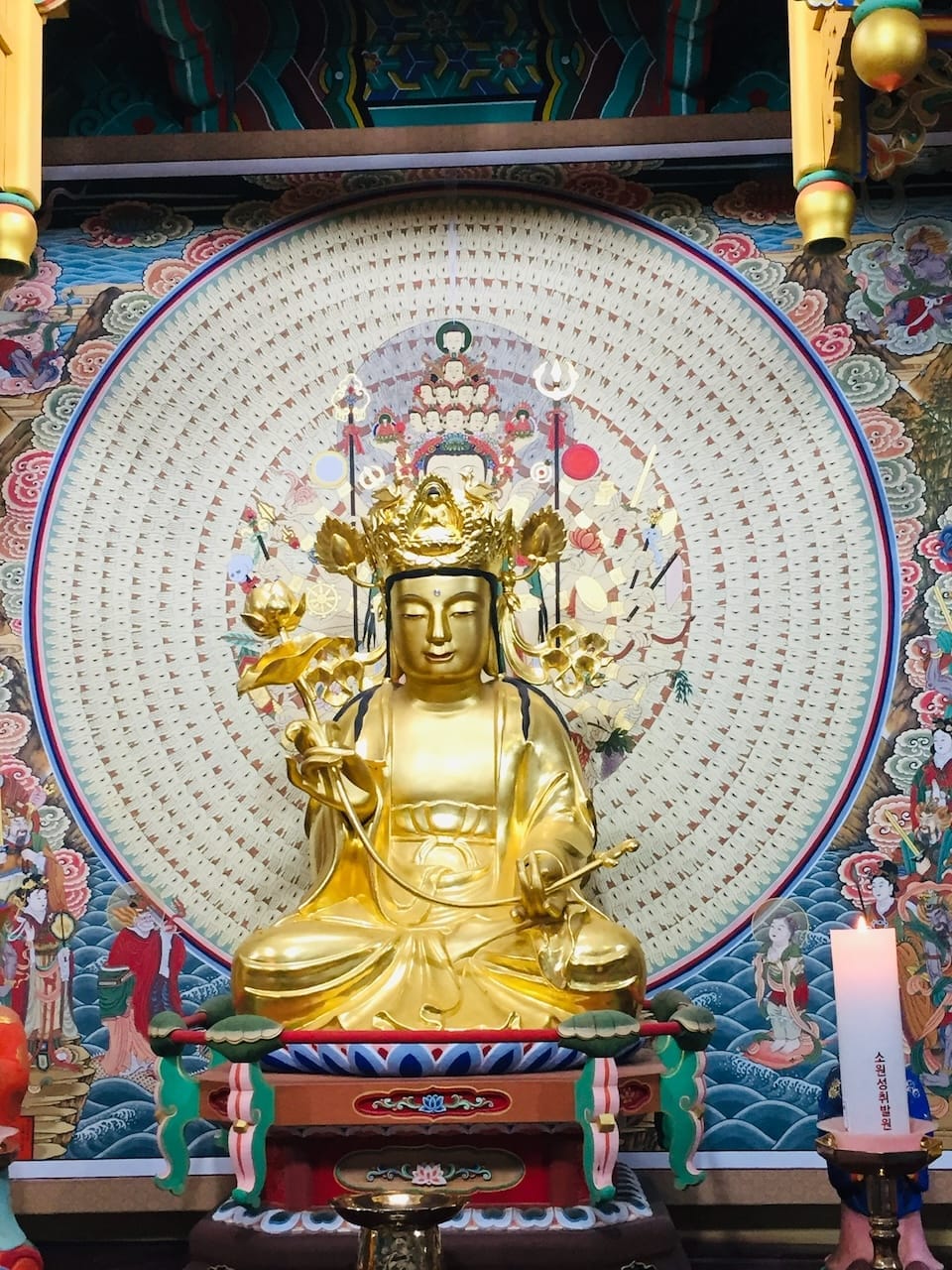
This full view of Gwanseum-bosal at Bogwangsa temple Korea reveals her surrounded by a mandala of a thousand compassionate hands and eyes. Every detail—from the golden lotus to the crowned head of Amitabha—embodies the essence of spiritual heritage in Asia. A visual hymn to Buddhist symbolism and fractal compassion.

At the core of the Bogwangsa temple, the Wontongjeon glows with quiet grace. The Wontongjeon (원통전) is dedicated to Avalokiteshvara Bodhisattva—Gwanseum-bosal (관세음보살), the bodhisattva of compassion. The term Wontong means “universally penetrating” or “all-encompassing illumination,” reflecting Avalokiteshvara’s ability to hear and respond to the cries of suffering souls across all realms.

This image of Gwanseum-bosal is not merely a religious icon, but a profound visual expression of the fractal nature of compassion, awareness, and interconnection. Both the physical representation and the symbolic backdrop situate her within a cosmic field—one where every sorrow is seen, every soul heard.

She is, after all, the Bodhisattva Who Always Listens.

In her thousand-armed form, she reaches in all directions, responding to every call. Her presence in Bogwangsa suggests compassion not merely as emotion, but as a cosmic principle—woven into the fabric of transition, of life and death. Though this temple is primarily dedicated to Jijang-bosal, Avalokiteshvara stands here as the embodiment of universal receptivity—a listener beyond the boundary of self. Together, they form a sacred symmetry: one leads, the other listens.

Shared Compassion at Bogwangsa Temple Korea

Bogwansa temple Korea
The Golden Lotus of Bogwangsa Temple Korea
Held with both hands, the golden lotus symbolizes shared compassion. Not merely offered, but uplifted together—between bodhisattva and seeker, between wisdom and action. A gesture deeply rooted in Buddhist symbolism.

What strikes me most is how Gwanseum-bosal does not simply hold the golden lotus—she supports it. Her left hand lifts it gently from below, as if to say: compassion is not only offered; it is also carried together. Her gesture suggests that compassion is a partnership—between bodhisattva and seeker, between wisdom and action.

Amitabha’s Crown and the Depth of Buddhist Symbolism at Bogwangsa Temple Korea

Bogwangsa Temple Korea
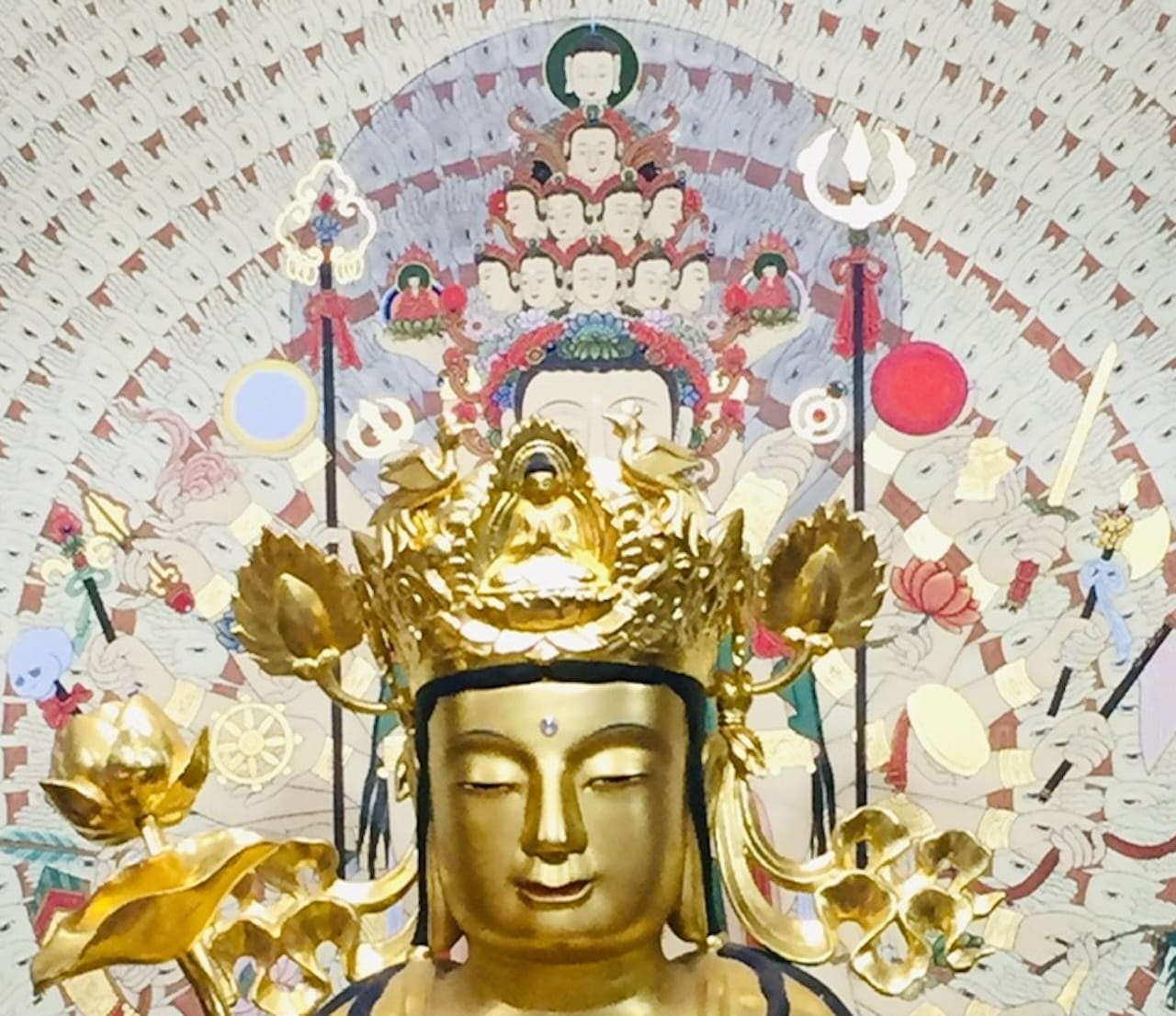
Crown of the Compassionate One The crown of Gwanseum-bosal at Bogwangsa temple Korea radiates symbolic depth. At its center sits Amitabha Buddha, linking her to the Western Pure Land—a key element in spiritual heritage Asia. The crown unites earthly compassion with celestial guidance.

Her crown is richly adorned and bears the image of Amitabha Buddha, a reflection of her spiritual origin and goal: the Western Pure Land of Liberation. Her face, radiant and serene, eyes half-closed, speaks of an inner peace that remains steadfast even in the face of cosmic sorrow. She seems to gaze both inward and outward at once. And I can’t help but wonder—what is it she sees?

Tea and Truth

Tea and Truth: A Spiritual Dialogue in Bogwangsa Temple Korea

And then I remember what they were saying. Not in words alone, but in the weight behind them. The tea, the silence, the question that still echoes.

In that dream—so vivid it feels like memory I found myself back in the spiritual quietude of Bogwangsa temple, where dreams and doctrine gently dissolve.

Jijang-bosal takes a sip of tea and turns to Gwanseum-bosal: “You listen to the voices of those who suffer in this world.

I guide those who search for their way after death. And yet, their burdens return again and again. How do we help them let go?”

Gwanseum-bosal smiles softly, her hands circling the warm cup. “Suffering is like this tea,” she says. “Warm. Bitter. But fleeting. Its taste does not stay. Still, many cling to it as if it were eternal.”

Jijang-bosal nods. “I show them the path, but many fear to take it. They fear what they must leave behind, or what awaits beyond. But in truth…”

Gwanseum-bosal finishes the thought: “…there is nothing to hold on to.” Jijang-bosal watches the steam rising from his cup. “Exactly. Just as tea was once water and will soon return to vapor, so are we always in motion. Suffering is not something to carry —but something to let flow.”

She lifts her cup one last time. “And when they realize this, there will be nothing left to release.” The tea is gone. The cups are placed down. No longer full. But not empty either.

The Thousand Eyes of Avalokiteshvara and Buddhist Symbolism

Bogwangsa Temple Korea
Fractal Hands of Compassion
A close-up from Bogwangsa temple Korea, this sea of hands evokes the thousand-armed Gwanseum-bosal—each gesture a vow to listen, to heal, and to uphold the temple’s Buddhist symbolism in endless compassion.

Each hand is a vow. To see suffering—not in the abstract, but in the detail of every trembling soul. To reach out—not just from afar, but here, now, in the intimacy of shared breath.

A thousand hands. A thousand eyes. Not to overwhelm, but to reflect: compassion, too, is fractal. It repeats, not for redundancy, but for presence. And in that repetition, I find something: She does not need to move. The eyes move for her. She does not need to touch. The hands have already begun. And I—still, small, silent—am seen.

Sansin and the Arhats

Gwanseum and Mary: Shared Devotion in the Spiritual Heritage of Asia

Of course, Gwanseum reminds me of Mary. Back home, I had seen people weep before her statue, just as visitors here whisper their grief to Gwanseum. The devotion feels nearly identical. Surrounded by flowers, candlelight, and prayers, both embody the archetype of compassion.

I have no doubt this comparison will be met without resistance. Korean Buddhism is profoundly inclusive—after all, even Sansin, the shamanic mountain spirit, has found his place on temple grounds.

The main altar left me with a sense of reverence, a humble awe before Seokgamoni-bul and his companions. But when I bowed before Gwanseum, I felt something warmer. She is, indeed, like a loving mother. What hasn’t changed is the weather. The sky still weeps its soft drizzle. Thankfully, in the Sansingak (산신각), it is dry.

The Spirit of the Mountain: Sansin in His Pavilion

Bogwangsa Temple Korea
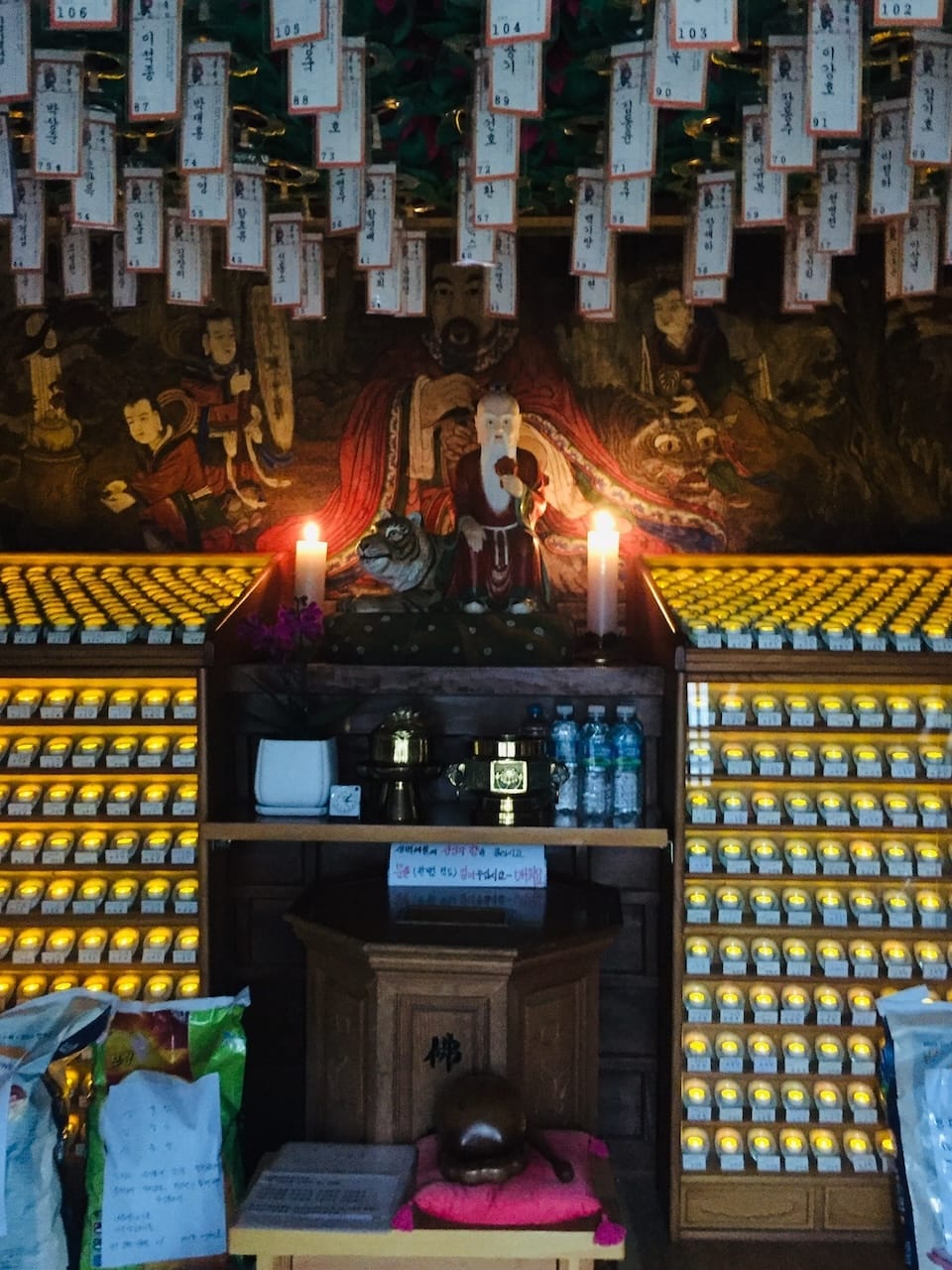
Sansin at Bogwangsa Temple Korea. Surrounded by offerings and lanterns, the mountain spirit Sansin sits with his tiger—honored in quiet rituals that reflect Korea’s rich spiritual heritage in Asia.

This is the pavilion dedicated to Sansin (산신), the mountain spirit of Korea. The space is intimate, almost humble in its simplicity. At its center sits Sansin himself—an elderly man with a long white beard, clothed in traditional Korean garments. By his side rests his tiger, a powerful symbol of protection and a link to the wildness of nature. Behind them, painted on the taenghwa, Sansin appears again—this time surrounded by attendants and mountain spirits, guardians of his mysterious domain.

Though Sansin’s roots lie in Korea’s shamanistic past, his worship is fully woven into the fabric of Korean Buddhism, especially in temples nestled deep in the mountains.

The Meaning of Sansin

Sansin is revered as the protector of wisdom, a guardian of health, and a granter of long life. He embodies the raw force of nature and the spiritual energy that flows through Korea’s mountainous landscapes. His role as a guardian of temples built on powerful geomantic sites—like Bogwangsa—is deeply respected.

Rituals and Reverence

Monks and visitors alike bring offerings of rice, fruit, water, or wine to Sansin. Their prayers seek protection, well-being, fertility, or success in spiritual practice. These rituals often lean toward the shamanic—more personal than ceremonial—but they live in quiet harmony with the Seon Buddhist traditions of Bogwangsa.

The Sansingak is more than a side building; it is a threshold. A place where nature, spirit, and humanity meet. It reminds me of the strength of the mountains, of unseen protectors who guard the sacred, and of the beautiful entanglement of shamanism and Buddhism in Korean culture.

In the quiet power of Sansin’s presence, I recognize echoes of another sacred encounter—one where Korean reverence and Tibetan ritual once converged. That story, too, continues in Holy Korean and Tibetan Transitions.

Guardians of the Dharma: The Arhats in the Nahan-jeon of Bogwangsa

Bogwangsa Temple Korea
Arhats at Bogwangsa Temple Korea
These serene figures represent enlightened disciples of the Buddha, quietly guarding the Dharma in the sacred stillness of Bogwangsa temple Korea.

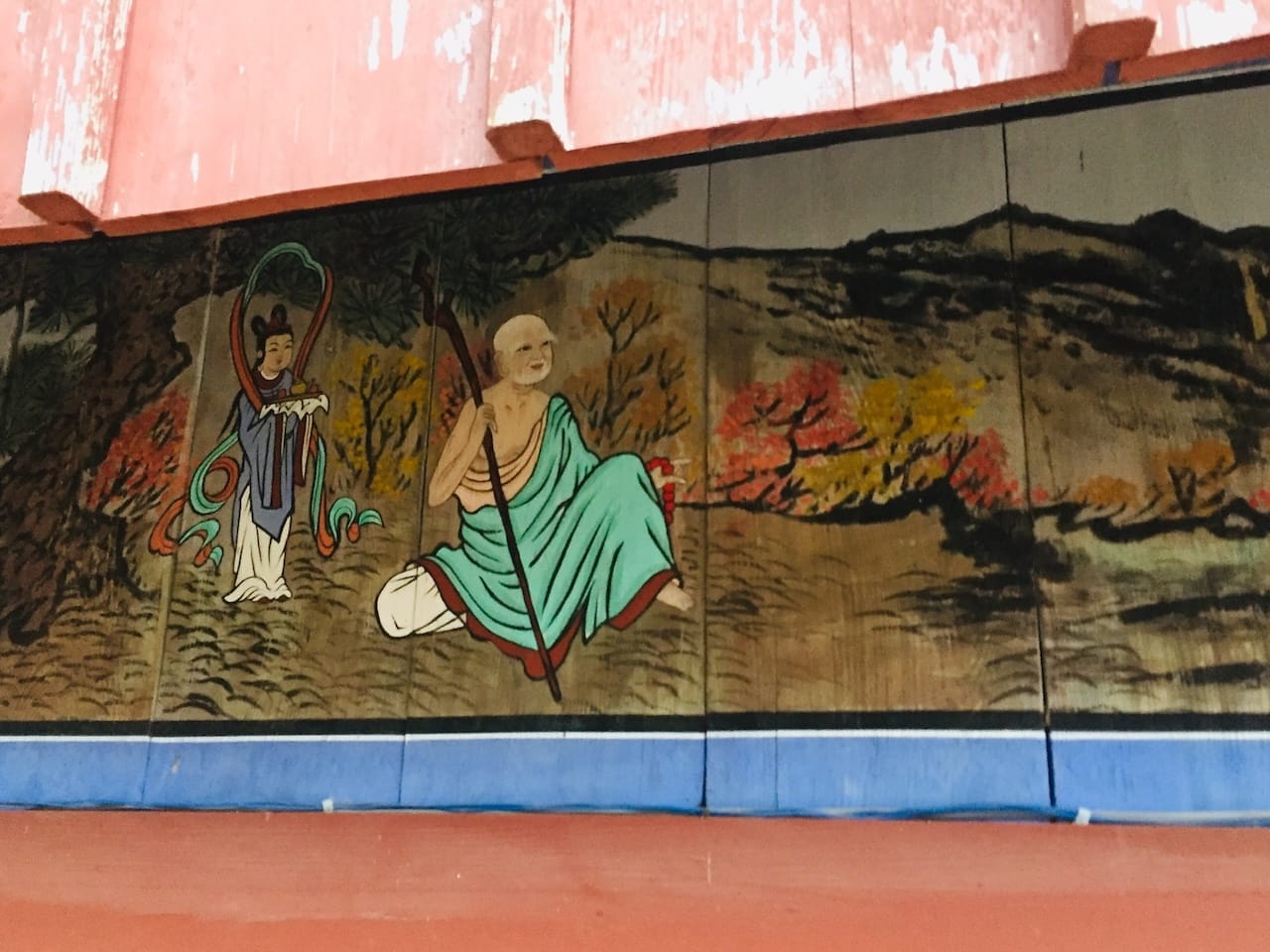
Deep within the Bogwangsa temple complex, nestled among ancient trees and mist-laden hills, lies the Nahan-jeon (나한전, Hall of the Arhats). This sacred space is dedicated to the enlightened disciples of the Buddha, known in Korean as Nahan (나한), or Arhats.

The Nahan-jeon radiates an atmosphere of deep contemplation. Upon entering, I am greeted by a row of serene icons, each seated on a vibrant, lotus-shaped cushion. Their faces—pale and tranquil—appear timeless, almost human, as if they embody silence itself. Clad in simple monk’s robes, their hands rest gently in their laps or fold softly into mudras. Behind them stretch richly decorated murals, filled with scenes of the Buddha’s teachings and spiritual journeys through distant lands and mystical realms.

In Korean temples, Arhats are often depicted as a group of sixteen or eighteen figures (십육나한 / 십팔나한, Sibyuk Nahan / Sibpal Nahan), each with unique expressions, gestures, and spiritual attributes. Some hold scrolls or malas (prayer beads), others a staff or symbolic objects like bowls or dragon pearls. Though they have attained enlightenment, they remain in the world—as guardians of the Dharma and protectors of the temple.

The most recognized among them is Pindola Bhāradvāja (빈두로 바라문, Binduro Baramun), often identified by his long eyebrows—a mark of deep wisdom. Challenged by the Buddha to demonstrate his spiritual powers, he became known as the Arhat who endures as long as the Dharma endures. Another highly regarded figure is Kāśyapa (가섭, Gaseop), protector of esoteric teachings and keeper of profound meditative practices.

In Bogwangsa’s Nahan-jeon, time seems to stand still. The soft glow of candlelight reflects in the polished eyes of the Arhats, while the air is thick with the scent of incense. Here, monks and visitors meditate and offer homage, seeking to awaken the Arhats’ wisdom and resolve within themselves.

As I leave the hall, a quiet sense of peace lingers. The Arhats remain unmoved on their cushions, keeping watch over the Dharma, ready to welcome the next traveler in search of awakening.

Nearby stands the Jijangjeon, a hall dedicated to Jijang-bosal (Ksitigarbha Bodhisattva, 지장보살), the bodhisattva of the afterlife and protector of souls in the underworld. People often pray here for the deceased, asking for their safe passage and favorable rebirth. Positioned closer to the entrance, it lies lower in elevation—closer to the earth, and thus to the realm of the dead.

Closing Vow

The air outside the hall is still damp, heavy with the scent of pine and mist. Somewhere behind me, the incense still burns. But I carry a different kind of smoke now—one that rises inward.

I think of the hands that reach. The eyes that see. The tiger beside the mountain god. And the Arhats at Bogwangsa Temple Korea who watch in silence, not because they demand anything, but because they already understand. And then I remember what they were saying.

Not in words alone, but in the weight behind them. The tea, the silence, the question that still echoes.

In that dream — so vivid it feels like memory — Jijang-bosal takes a sip of tea and turns to Gwanseum-bosal:

“You listen to the voices of those who suffer in this world. I guide those who search for their way after death. And yet, their burdens return again and again. How do we help them let go?”

Gwanseum-bosal smiles softly, her hands circling the warm cup. “Suffering is like this tea,” she says. “Warm. Bitter. But fleeting. Its taste does not stay. Still, many cling to it as if it were eternal.”

Jijang-bosal nods. “I show them the path, but many fear to take it. They fear what they must leave behind,

or what awaits beyond. But in truth…”

Gwanseum-bosal finishes the thought: “…there is nothing to hold on to.” Jijang-bosal watches the steam rising from his cup. “Exactly. Just as tea was once water and will soon return to vapor, so are we always in motion. Suffering is not something to carry — but something to let flow.”

She lifts her cup one last time. “And when they realize this, there will be nothing left to release.” The tea is gone. The cups are placed down. No longer full. But not empty either.

In the soft rain outside the Bogwangsa temple, I bow— not because I am close to enlightenment, but because I understand, now more than ever, that the path itself is sacred.

The great wheel turns. Not away from me, but with me. And I, still shaped by longing and learning, am not ready to leave it behind. But I can walk it with care.

With my head directed toward Buddhahood, and my heart committed to the liberation of others. Not as a destination — but as a vow.

I invite you to follow me Hugo J. Smal, Jijang’s fractal or Spiritual East Asia

Disclaimer

I’ve done my utmost to describe the icons, halls, and rituals of Bogwangsa Temple Korea with care and accuracy. Still, any misidentifications or symbolic misreadings are entirely my own. Should you spot any such errors, your insight is warmly welcome. But above all, I hope what resonates is the spirit of the story—the atmosphere it conjures, the openness it invites, and the sincerity with which it was written.

— Hugo J. Smal

“`

The Five Icons of Bogwangsa and the Fractal of Compassion

Five Icons of Bogwangsa: A Sacred Assembly

by Hugo J. Smal
images Mickey Paulssen

Part 1
Part 2
Part 3
Part 4

Five Icons of Bogwangsa: A Sacred Assembly

There is a second altar in the main hall of Bogwangsa. It houses a group of five major Buddhist icons:

bogwangsa, gwangsum-bosal, Shakamuni Buddha
Five beings in stillness. Five manifestations of being. In the center, Seokgamoni-bul holds the earth with a single touch. Around him, compassion, healing, insight, and radiant light take form. This altar is not a display—it is a mirror.

At the center sits Shakyamuni Buddha (석가모니불, Seokgamoni-bul), the historical Buddha Siddhartha Gautama, who attained enlightenment and shared the Dharma. He is seated in the Bhumisparsha Mudra—his right hand gently touches the earth, a gesture that symbolizes his awakening under the Bodhi tree. His face is calm, his eyes half-closed in deep meditation.

To his left sits Amitabha Buddha (아미타불, Amita-bul), the Buddha of Infinite Light who rules over the Western Pure Land (Sukhavati). His right hand is raised in the Vitarka Mudra, a gesture of teaching and wisdom.

A compelling example of the Amitabha Triad in Korean Buddhist art is preserved in the Cleveland Museum of Art.

Healing and Ignorance: A Moment Before Shakyamuni Buddha

To the right of Shakyamuni is Medicine Buddha (약사여래, Yaksa Yeorae), also known as Bhaisajyaguru—a figure of healing and spiritual wellness. He is venerated in Mahayana Buddhism as a protector against both physical and mental suffering. Often depicted with a medicine pot or healing fruit in his hand, he symbolizes the promise to cure all beings of the ailments that arise from ignorance.

My state of mind makes me realize that Medicine Buddha is not merely a healing guide, but a mirror—an icon that reveals suffering, including my own, as a result of ignorance. Not just mental, but also physical. An ignorance that is not guilty, but formative. And perhaps healing begins there: in recognizing what I do not yet understand.

A notable example of a Korean Medicine Buddha can be found in the collection of the Museum of Fine Arts, Boston.

bogwangsa, gwangsum-bosal, Shakamuni Buddha
Eyes half closed, as if watching both this world and the next. The right hand calls the earth to witness. The left offers no command—only openness. I did not speak, but he heard me.

👉 first part of our Bogwangsa journey

The Listening Presence of Gwanseum-bosal

The Listening Presence of Gwanseum-bosal

On the outer left side stands Avalokiteshvara (관세음보살, Gwanseum-bosal), the Bodhisattva of Compassion—one of the most revered figures in Mahayana Buddhism, known for listening to the cries of all sentient beings. Avalokiteshvara can appear in various forms and genders, and is often depicted holding a lotus or a flask of holy water, radiating peaceful grace.

The Metropolitan Museum of Art holds a renowned 14th-century depiction of Water-Moon Avalokiteshvara, embodying the grace and serenity of this bodhisattva.

On the far right: Mahasthamaprapta (대세지보살, Daeseji-bosal), the Bodhisattva of Great Wisdom. A key figure in the Amitabha Triad, he embodies the spiritual strength and insight that lead toward liberation. Where Avalokiteshvara expresses compassion, Mahasthamaprapta represents the power of awareness and wisdom. He is often shown holding a lotus or a vessel, calm and resolute.

Between Wisdom and Compassion: Bogwangsa’s Fivefold Vision

bogwangsa, gwangsum-bosal, Shakamuni Buddha
I sat here, unsure if I belonged. But the silence did not ask for credentials. Only presence. Only breath. A place for stillness, no matter who you are.

The icons deeply move me. Their golden bodies, contemplative faces, and the exuberance of color seem to take hold of my soul. I don’t know if it is allowed, but I sit down in front of the altar and try to become one with my surroundings. I smell the rising smoke from the incense burners—like prayers drifting toward the spiritual world.

No… I’m not sure if I am allowed to sit there, or if it’s even presumptuous of me. But I do it with respect and dedication to the Buddhas and bodhisattvas. Jijang may not be present on this altar, but perhaps he rides on the curling smoke.

As part of the larger narrative “The Jijang Fractal,” this exploration weaves together place, memory, and spiritual inquiry. 👉 The Jijang Fractal – book hub

Murals, Memory, and Dialogue

The Murals Behind Shakyamuni: Visions of Bogwangsa

Behind the figures is a vivid thangka-like mural. I believe it shows Shakyamuni Buddha surrounded by bodhisattvas and celestial beings.
I say believe, because as someone raised in the Catholic tradition, distinguishing these figures is not always easy. Where I make mistakes, I hope to be gently corrected—and forgiven.

The central figure appears to be an exalted form of Shakyamuni, seated within a golden halo. Around him are disciples, bodhisattvas, and guardian deities, symbolic of his teachings. The painting is rendered in bright reds, blues, and golds—hallmarks of Korean Buddhist art.

The boy from Rotterdam still feels the pull of Catholic iconography. I remember watching the smoke rise as the Requiem by Verdi filled the church. I was part of the boys’ choir then—allowed to sing along, even if I barely understood what we sang.

And yet, I remember the moment my heart hesitated: my fingers tapping my chest as I whispered, “Lord, I am not worthy that you should enter under my roof, but only say the word and I shall be healed.”

Here, in the hall of Siddhartha, I realize: while Jesus invites the heart to open, the Buddha invites the mind to become still. They do not cancel each other out.

They coexist—just like the icons on this mural.

Where the Ceiling Whispers Prayer

Above the altar hang lotus lanterns (Yeondeung, 연등), each bearing a name or prayer. They symbolize enlightenment and spiritual protection. In the background I discern rows of small golden Buddha statues—likely dedicated by pilgrims or families in memory of deceased loved ones.

When the Icons Mirror Us: Insight at Bogwangsa

bogwangsa, gwangsum-bosal, Shakamuni Buddha
From this angle, I see their profiles—thoughtful, grounded, listening. Their hands speak, though they never move. What would I say, if I could answer them?
bogwangsa, gwangsum-bosal, Shakamuni Buddha
From the side, they look like a river of gold. Each one turned just slightly, as if in conversation with the other. This is not hierarchy. It’s harmony.

In that silence, a dream returns.

Once again, I find myself seated in the plaza in Seoul, between two giants of Korean history: Admiral Yi Sun-sin, who protected the people with his sword, and King Sejong, who enlightened them with his words. One stands, unwavering. The other sits, immersed in thought. Between them, on a simple mat, Jijang-bosal and Gwanseum-bosal share a cup of tea.

And so the conversation begins.

Jijang-bosal takes a sip and looks at Gwanseum-bosal.

“You listen to the cries of those who suffer in this world. I guide those who seek their way beyond it. And still, their sorrows return. How can we help them let go?”

Gwanseum-bosal smiles and gently turns her teacup.

“Suffering is like this tea. Warm, bitter, but fleeting. The taste does not remain. Yet many cling to it, as if it were eternal.”

Jijang-bosal nods.

“I show them the path, but few dare to walk it. They fear what they must leave behind—or what awaits them. But in truth…” Gwanseum-bosal finishes his thought: “…there is nothing to hold on to.”
Jijang-bosal watches the steam rise from his cup.
“Exactly. Just as tea was once water and will soon evaporate again, so are we always in motion. Suffering is not something to carry—but to let flow.”

Gwanseum-bosal lifts her cup.

“And when they realize that, there will be nothing left to release.”
The tea is gone. The cups are placed down. No longer full—but not empty either.

The city fades. The dream dissolves. What remains is the scent of incense, the shadow of Jijang, and the realization that none of the icons here stand alone. They mirror each other. They mirror us.

I look once more at the altar. Perhaps it’s not what I’ve seen that matters, but what it has stirred within me. Just as the Jijang fractal reveals itself when attention meets surrender, insight too does not grow from certainty, but from stillness.

But this temple holds more layers. Beyond this hall lie other spaces, other voices, other rituals. The story does not end here. It deepens.

I rise. The air is still. My footsteps echo softly on the stone floor, as if the temple itself says: you’re not finished yet.

Meditation and Closing

Meditation in Five Lines

Where Siddhartha teaches,

Amita does not receive.

Yet in my mind, Yaksa Yeorae heals.

Gwanseum-bosal’s compassion becomes possible

Only when I, for myself,

Complete Daeseji-bosal’s wisdom

And carry forth Jijang’s fractal.

As I leave the hall, the echo of the icons still resonates—not as doctrine, but as presence. They are not answers, but companions. And though this altar offered a deep and quiet wisdom, I know that Bogwangsa has not yet spoken its last.

There are other halls to enter. Other guardians to meet. Other silences to sit with.

In the next part of this journey, I return to the temple grounds—with eyes attuned to detail, and a heart still learning how to bow.

I invite you to follow me Hugo J. Smal, Jijang’s fractal or Spiritual East Asia

Disclaimer:

I’ve done my utmost to describe the icons, halls, and rituals of Bogwangsa with care and accuracy. Still, any misidentifications or symbolic misreadings are entirely my own. Should you spot any such errors, your insight is warmly welcome. But above all, I hope what resonates is the spirit of the story—the atmosphere it conjures, the openness it invites, and the sincerity with which it was written.

— Hugo J. Smal

“`

Bogwangsa Temple During the Pandemic: Lost in Stillness

by: Hugo J. Smal
images: Mickey Paulssen

Part 1 Part 2 Part 3 Part 4

Cities closed their gates.

People disappeared behind doors. Newspapers spoke of rising death tolls, collapsing markets, and borders that refused to open. COVID-19 had the world in a grip no one could fully understand—except those who lived through it. And us? Mickey and I were stuck in South Korea.

Well, stuck? Maybe not in the way most would imagine. Kim Young Soo, president of Baedagol Theme Park and Goyang Koi Farm, had made sure we had a place to stay. Above the closed Baedagol Museum, he had arranged a small apartment for us. The park’s gates remained shut to the outside world, but we were free to wander the gardens. In a time when most people were confined to their living rooms, that felt like a gift.

Bogwansa 보광사Still, something felt missing. Perhaps it was the awareness that the world was in crisis—that one could be safe, yet still trapped in an invisible structure. Or maybe it was a longing for something deeper than mere comfort.

Kim Jae Ho, our friend and translator, saw it. Perhaps he saw it before we did. One day, he suggested we visit Bogwangsa(보광사), a temple nestled deep in the hills of Paju. Kim Young Soo, as always, arranged everything. It began on August 1, 2019—under the stars of Goyang, when a pattern quietly took shape: the Jijang fractal. I did not know then that the world was also shifting, that a hidden storm—later known as COVID-19—was already forming.

The date was December 1, 2019.

That day, the temple gate would open for us. That day, the Jijang fractal would no longer reside only in my thoughts—but take on a tangible form.

🔹 More on the Origins of the Jijang Fractal

The Jijang fractal first revealed itself to me during walks through Goyang. In a seemingly ordinary neighborhood, something extraordinary appeared. You can read the full experience and explanation in my reflection: 👉 Neighbourhood & Jijang fractal

The Road to Stillness

The rain gently tapped against the car windows as we wound our way through the mountains of Paju. The Imjin River flowed sullen and grey. We had left early, hoping to catch a glimpse of North Korea from the nearby observatory, but the mist had erased the horizon. What we expected to see—a border, a divide, a clear contrast—had vanished into a haze of gray tones. Disappointed, Kim Jae Ho restarted the car and turned into the mountains.

The road to Bogwangsa Temple was short. Gradually, the landscape shifted; buildings gave way to forest and near silence. And then, even before we reached the temple grounds, he appeared: Jijang-bosal—immovable—standing on a pedestal as if he himself were a gateway to another reality. His gaze rested far into the distance, yet felt deeply fixed on us. Behind him rose Goryeongsan (고령산), a 436-meter-high mountain, and Gamaksan, reaching up to 675 meters. Along with the Imjingang River, they form a harmonious geomantic configuration believed to enhance the spiritual energy of Bogwangsa. For me, it turned out to be the perfect place for contemplation.

Bogwangsa Temple – Description and Layout

A large signboard near the entrance shows a detailed map of Bogwangsa. Mounted within a traditional wooden structure topped by a black-tiled roof, the board offers visitors an overview of the temple layout—including major halls, pathways, and natural features. The entire complex is surrounded by forested hills, amplifying its serene and spiritual atmosphere.


Bogwangsa temple map

Click to enlarge the Bogwangsa Temple map

Main Structures of Bogwangsa Temple:

1️⃣ Daeungbojeon (대웅보전) – Main Buddha Hall
2️⃣ Eosil-gak (어실각) – Eosil Pavilion
3️⃣ Wontongjeon (원통전) – Wontong Hall
4️⃣ Eungjinjeon (응진전) – Hall of Arhats
5️⃣ Sansingak (산신각) – Pavilion for the Mountain Spirit
6️⃣ Jijangjeon (지장전) – Hall of Jijang-bosal, Bodhisattva of the Afterlife
7️⃣ Manseru (만세루) – Manse Pavilion
8️⃣ Huwon (후원) – Rear Garden
9️⃣ Jonggak (종각) – Bell Pavilion
🔟 Suguam (수구암) – Sugu Hermitage
1️⃣1️⃣ Seokbuljeon (석불전) – Hall of the Stone Buddha
1️⃣2️⃣ Iljumun (일주문) – Main Temple Gate
1️⃣3️⃣ Seolbeopjeon (설법전) – Hall of Dharma Teachings
1️⃣4️⃣ Yeonggakjeon (영각전) – Hall of Ancestral Spirits

… 

Bogwansa (보광사) and Doseon Guksa

Bogwansa temple was founded in 894 CE by the renowned monk Doseon Guksa, under the order of Queen Jinseong during the Silla period. At that time, it was considered a hidden national treasure and one of the six grand temples north of the Hangang River.

Doseon Guksa (827–898) was a prominent Korean Buddhist monk and geomancer. He is often associated with the introduction and development of pungsu-jiri (풍수지리), the Korean adaptation of feng shui. 

At the age of 15, Doseon entered monastic life and began his studies at Hwaeomsa Temple in Gurye County. His dedication and intellect quickly earned him recognition. Around 850, he traveled to Tang China to further immerse himself in esoteric Buddhist and Taoist teachings, including astronomy, astrology, and geomancy. After returning to Korea, Doseon journeyed across the peninsula, studying how geographical features influenced human life. He adapted Chinese feng shui principles to the Korean context, emphasizing the harmonious relationship between humans and nature. His approach, known as bibo-pungsu-jiri, focused on enhancing positive energies through the strategic placement of cities, temples, and other structures. His expertise in geomancy made him a valued advisor. He is credited with the establishment of approximately 70 temples and monasteries, including Bogwangsa Temple in Paju. 

[embedyt] https://www.youtube.com/watch?v=ZwugtMqHnK8[/embedyt]

During the Imjin War (1592–1598), Bogwangsa was destroyed but was rebuilt in 1622 by monks Seolmi and Deogin. Since then, the temple has undergone various renovations to preserve its historical and cultural significance.  A notable feature of Bogwangsa is the large Buddha statue, known as the ‘Hoeguk Dae Bul.’ Standing as a guardian of compassion and transition, the grand stone Jijang-bosal is visible from afar. His presence is more than symbolic; in his majesty and serenity, he embodies the character of a Hoeguk Dae Bul—a ‘Great Buddha who saves the nation.’ Not only does he welcome visitors, but he also marks a threshold: between the mundane and the sacred, between the known and the karmically unknown. As a guide for souls and protector of the land, he unites individual and collective salvation.

Bogwangsa
A misty morning at Bogwangsa Temple. In the foreground stands a small red pavilion, possibly the Sansingak, nestled just before the sacred 300-year-old juniper tree. Behind it, traditional temple halls emerge through the autumn trees, embraced by the quiet slopes of Goryeongsan. The scene breathes stillness, reverence, and geomantic harmony.

The temple also houses nine cultural properties, including the historic ‘Daeungbojeon’ (the main hall) and a 300-year-old juniper tree. According to tradition, this tree was planted by King Yeongjo in honor of the spirit of his mother, Sukbin Choi. 

Bogwangsa and Jogye Order

Bogwangsa is managed by monks of the Jogye Order, the largest sect within Korean Buddhism. Unlike, for example, the Tibetan Buddhist tradition, where the Tibetan Book of the Dead (Bardo Thödol, 바르도 퇴돌) plays a central role, the Jogye Order follows the Seon tradition. They strive for direct enlightenment through meditation and direct experience of the true nature of the mind, beyond concepts and illusions. The emphasis is on releasing attachment to a ‘fixed’ death experience—the idea that death is an absolute, unchanging process—and instead, the transition is seen as a fluid, karmic manifestation dependent on one’s state of consciousness and actions in life. In Korean Buddhism, a Jijangjae (지장재) is often performed at death, a ritual dedicated to Jijang-bosal (Ksitigarbha Bodhisattva), who assists souls in safely navigating the afterlife.

intriguing tension

So within the temple exists an intriguing tension, though not necessarily a contradiction. Bogwangsa does indeed belong to the Jogye Order and follows the Seon (Zen) Buddhist tradition, where enlightenment through meditation is central. At the same time, Bogwangsa is devoted to Jijang-bosal (Ksitigarbha), who is precisely the guide through the Bardo—the intermediate state after death.

How can this be reconciled?

🔹 Seon Buddhism and Meditation as the Core of the Jogye Order

•The Jogye Order primarily focuses on direct experience and meditation (Seon).

•Its ultimate goal is enlightenment here and now, without reliance on external forces or intermediary states.

🔹 The Role of Jijang-bosal in Temples Like Bogwangsa

•Jijang-bosal is the savior of souls in the Bardo, helping them toward enlightenment or reincarnation.

•This parallels the Tibetan Bardo Thödol (Tibetan Book of the Dead), where a guide is essential for the transition into a new state of existence.

•This suggests that Bogwangsa is not solely focused on direct enlightenment, but also on guiding souls after death.

Bridging Seon and Jijang-bosal

Bogwangsa’s emphasis on Jijang-bosal points to a pragmatic approach to enlightenment:

🔹 For the living: Seon meditation is highlighted as the path to enlightenment during life.

🔹 For the dead: Jijang-bosal plays a role for those who missed the chance for enlightenment and are now in the Bardo.

🔹 Rituals like Sasipgujae (the 49-day mourning ceremony) help guide souls toward eventual liberation.

In essence, Bogwangsa fulfills a spiritual need that the pure Seon tradition does not always address explicitly: the care for the dead and the ancestors. This is not unique—many Korean Seon temples include shamanistic and Mahayana elements to fulfill broader religious and cultural needs.

A Quiet Moment in the Hall of Jijang

Painting of the heavenly court where souls are judged, featuring prominent figures in red robes. One of the Siwang (Ten Kings of the Underworld) paintings inside the Jijangjeon Hall.

I don’t remember how long I sat there. Maybe it was just a few minutes. Maybe half a lifetime. The air inside the hall was still, carried by incense and expectation. Jijang-bosal did not look at me, and yet it felt as if I had already been seen.

I am not a Buddhist. I was raised Catholic. Images, rituals, prayer—they are familiar to me. But what does a European mind, shaped by grace and sin, do in a hall devoted to karma and rebirth?

And yet, in this silence, I understood that the question wasn’t whether I believed in the Bardo, but whether I had ever dared to admit that I was in it. Not after my death, but now. In transition. Between knowing and unknowing. Between control and surrender.

Jijang-bosal offers no dogma, no judgment. He doesn’t extend his staff to condemn, but to guide. He doesn’t judge my origin, only my willingness to let go. To find trust in transitions instead of fear.

Perhaps that’s what the temple gave me. Not conversion, not an answer, but a calm. A deep knowing that when the time comes, even a soul shaped at the foot of a cross can find its path with the help of a bodhisattva with golden eyes.

Because if the Bardo is a space between, then Jijang is not the owner of that space. He is its guide. And guides don’t demand. They wait. Until you ask: may I come with you?

The Daeungbojeon – The Heart of the Temple

Passing through the main gate, we entered the temple grounds. The rain had ceased, leaving the scent of wet wood and lingering incense in the air. Before us stood the Daeungbojeon (대웅보전, Great Hero Hall), the spiritual center of Bogwangsa.

Bogwangsa TempleAt the center, Shakyamuni Buddha (석가모니불, Seokgamoni-bul) sits in the lotus position. His serene face exudes a peaceful expression, surrounded by a halo symbolizing enlightenment and spiritual power. To his left stands, I believe, one of the Four Heavenly Kings (사천왕, Sacheonwang), respectfully folding his hands in protection of the Buddha and the Dharma. To the right stands Jijang-bosal (Kṣitigarbha, 지장보살), the bodhisattva of the afterlife.

Jijang-bosal’s staff (Shakujō, 석장) symbolizes his role as a guide for souls in the Bardo, with the sound of its rings awakening them and leading them toward enlightenment. The six rings represent the Six Realms of Existence, while the staff itself embodies Jijang-bosal’s determination and dedication. In Bogwangsa’s Jijangjeon, the staff signifies spiritual protection and guidance, especially in rituals like the 49-day transition ceremony (Sasipgujae). 

Bogwangsa Tmple 보광사
Detailed depiction of four of the Ten Kings seated in formal posture, inside a decoratively painted hall. Symbols of justice and karmic balance are visible

Also present at the altar are the Siwang (십왕), the Ten Kings of the Underworld, suggesting that this hall is dedicated not only to enlightenment (Shakyamuni) and meditation but also serves as a space for transitional rituals. The combination of the Buddha, protectors, and underworld icons makes this altar a significant intersection between enlightenment, protection, and the karmic cycle of rebirth. The Ten Kings of the Underworld are symbolic judges, each representing a stage of the soul’s journey, assessing the karma of the deceased and determining their next destination in the cycle of rebirth.

This altar thus forms the spiritual heart of Bogwangsa, where both monks and visitors come together to meditate, pray, and pay respects to the forces that influence both this life and the next.

As I turned away from the main altar—its presence still lingering in the incense-thick air—my eyes were drawn upward. Not to a specific icon, but to the silent gaze of many. Eyes carved in patience, cast in compassion, painted in timeless serenity.They didn’t demand belief. They didn’t offer escape. They simply were. In that moment, I felt a shift—not in my faith, but in my understanding.

Bogwangsa temple 보광사
A detailed painted scene depicting the great Korean monk Wonhyo, accompanied by a celestial figure. This imagery reflects his journey inward—a spiritual awakening that transcended dogma, pointing to the living heart of the Dharma. Davin A. Mason kindly told me that it is not Wonhyo. It is Dokseong.Thanks for your kindness.

“The substance of Mahāyāna is truly calm and immensely profound,” wrote Wonhyo, the great Korean monk, in his commentary on The Awakening of Faith in Mahāyāna. He pointed not to dogma, but to experience—to the still and boundless heart of the Dharma itself. Perhaps that was what had watched me all along.Not a deity. Not an idea. But the path itself: not built of words, but of insight. The Dharma—not as scripture, but as living truth. A calm that opens, a depth that listens. Between stone and silence, between breath and blessing. And so I turned, ready to meet what waited behind the second altar.

As I turned from the main altar—its silence still echoing in my breath—I didn’t know another presence awaited me. Tucked just behind the Hall’s center, shrouded in shadows and time, stood a second altar.

What secrets did it hold? What story would unfold there?Next: The Second Altar – Between Earth and Afterlife 🕊️ Coming soon on Mantifang

I invite you to follow me Hugo J. Smal  , Jijang’s fractal or Spiritual East Asia 

Disclaimer: While every effort has been made to accurately describe and name the icons, halls, and rituals within Bogwangsa, it’s possible that some inaccuracies remain. If you notice any errors in naming or placement, please feel free to let me know. More than correctness, however, what matters most to me is the feeling the story evokes—its atmosphere, its intention, and its sincerity. Hugo J. Smal