Korean ceramics

Goryeo Celadon — 5 Stunning Secrets of Korea’s Most Beautiful Ceramic Art

Goryeo celadon is one of the most celebrated traditions in Korean ceramics. Its beauty lies in the meeting of form, glaze, inlay, atmosphere, and disciplined restraint. It does not ask to be admired quickly. It asks to be looked at slowly.

Goryeo celadon with green glaze and Korean ceramic artistry from the Goryeo dynasty
Goryeo celadon reveals the quiet perfection of Korean ceramics through glaze, form, and timeless beauty.

The Place of Goryeo Celadon in Korean Ceramics

Goryeo celadon belongs at the center of any serious introduction to Korean ceramics. It carries the refinement of the Goryeo dynasty, the technical intelligence of Korean potters, and the cultural atmosphere of a society shaped in part by Buddhist taste, courtly patronage, and a profound sensitivity to surface. Celadon is often introduced as green pottery, but that phrase is too small. The glaze may appear green, blue-green, grey-green, or almost mist-like depending on clay, glaze recipe, firing, light, and the eye of the viewer.

The finest celadon vessels feel quiet without being empty. They are disciplined but not cold. Bowls, ewers, incense burners, dishes, bottles, boxes, and maebyeong forms show how Korean potters joined technical control with emotional restraint. The result is not decorative excess, but a kind of luminous calm. This is why celadon is so important for Mantifang: it offers a way of reading Korean culture through patience, attention, and material intelligence rather than through spectacle.

Goryeo Celadon Glaze as Atmosphere

The power of Goryeo celadon rests partly in the glaze. A celadon glaze is not simply a coating placed on top of a vessel. It is an atmosphere made permanent by fire. Iron in the clay and glaze, kiln atmosphere, and firing temperature all affect the final tone. When the firing succeeds, the surface can look as if light is suspended inside it. The vessel appears neither fully green nor fully blue, but somewhere between water, stone, cloud, and breath.

This is why Goryeo celadon has often been admired for its subtlety. It does not depend on hard contrast. Its depth appears gradually. A plain bowl may reveal more with time than a loudly decorated object does at first glance. In Mantifang terms, celadon is a useful teacher of attention. It rewards the reader or viewer who does not rush past the surface.

Sanggam Inlay and the Art of Depth

One of the most distinctive achievements of Goryeo celadon is sanggam, the inlay technique in which designs are carved or incised into the clay and filled with contrasting slip before glazing and firing. Cranes, clouds, chrysanthemums, lotus forms, and geometric designs may seem to float under the glaze. The decoration is present, but it is softened by depth. The image is not pasted on the surface. It belongs inside the ceramic skin.

Sanggam is a technical and poetic achievement at once. It requires planning, clean cutting, careful filling, drying, glazing, and firing control. Yet its effect is not mechanical. The best inlaid celadon creates a world where line, image, and glaze breathe together. It helps explain why Goryeo celadon remains one of Korea’s great contributions to ceramic history.

Buddhist Culture and Courtly Taste

Goryeo was a Buddhist kingdom, and celadon often reflects a world where ritual, refinement, and spiritual imagination were close. Incense burners, ritual vessels, lotus motifs, and quiet animal forms show the connection clearly, but the influence is not limited to religious imagery. Celadon’s meditative quality also belongs to the wider cultural atmosphere of Goryeo. The vessel becomes an object of stillness.

At the same time, celadon was shaped by elite demand and workshop systems. This was not folk pottery in a simple sense. It required skilled labor, organized production, good materials, and patrons who valued refinement. Understanding celadon therefore means seeing both the spiritual and social conditions that allowed such objects to be made.

Quiet Perfection and Human Imperfection

The phrase quiet perfection should not suggest machine-like flawlessness. Korean celadon is powerful because it holds aspiration and material uncertainty together. Kiln firing is never fully obedient. Glazes pool, thin, crackle, blush, or shift. Forms may carry small asymmetries. The potter works toward harmony while accepting that clay and fire have their own intelligence.

This is one reason Goryeo celadon remains meaningful in Living Korea. Its beauty speaks to a broader Korean cultural pattern in which restraint, patience, and acceptance often matter more than display. The vessel may be old, but the way it teaches attention remains alive.

How to Look at Goryeo Celadon

To look well at Goryeo celadon, begin with the silhouette before the decoration. Notice whether the vessel rises gently or sharply, whether its shoulder carries weight, whether the foot feels narrow or grounded, and whether the mouth opens with confidence or softness. Korean celadon often asks for this kind of slow looking. Its meaning is not hidden, but it is layered. The glaze becomes more powerful when the form beneath it has already established calm.

Then look at the surface. Some vessels depend on plain glaze alone. Others carry carved, molded, incised, or inlaid designs. In each case, the decoration should be read with the glaze rather than separately from it. A crane beneath celadon is not simply an image of a crane. It is a crane held inside light, clay, and fire. This is why museum photographs rarely exhaust the experience of celadon. The vessel changes as light changes.

Celadon, Loss, and Revival

Goryeo celadon also belongs to a history of loss and revival. The tradition did not continue unchanged into later centuries. Joseon ceramic taste moved in other directions, and many older techniques became difficult to reproduce with the same authority. Modern admiration for celadon therefore includes a recovery impulse: potters, scholars, museums, and cultural institutions have tried to understand how such surfaces were made and why they still matter.

This revival does not make celadon a museum fossil. Instead, it shows how cultural memory can return through practice. Contemporary Korean potters may study Goryeo forms without pretending to live in Goryeo. The point is not imitation alone. It is a renewed conversation with glaze, restraint, and the discipline of quiet beauty.

From Goryeo to the Wider Cluster

Goryeo celadon should be read beside Joseon ceramics. The contrast is instructive. Celadon often carries an atmospheric, Buddhist, courtly elegance. Joseon white porcelain later emphasizes clarity, restraint, Confucian order, and everyday use. Buncheong, meanwhile, introduces looseness and directness. Together these traditions show that Korean pottery is not one mood but a field of changing attitudes toward beauty.

The Icheon Korean Ceramics City page shows how such traditions continue to be practiced, taught, displayed, and reinterpreted. The Icheon Ceramic Festival gives contemporary visitors an accessible entrance into these forms. The deeper historical frame can be followed through the Korean History Timeline and the Korean History Dictionary Complete Index.

Forms, Vessels, and the Discipline of Proportion

Goryeo celadon should be approached through form as much as glaze. The famous color can distract from the fact that many celadon vessels are carefully balanced objects. A maebyeong bottle, for example, depends on the relationship between shoulder, neck, body, and foot. An ewer depends on the relationship between pouring, holding, and display. An incense burner depends on both sculptural presence and ritual atmosphere. Even when the glaze is extraordinary, the object fails if the form beneath it is weak.

This is one reason celadon belongs in a cultural history rather than a purely decorative history. Proportion is a cultural language. It tells us what a society valued in stillness, ceremony, luxury, restraint, and skilled control. The vessel is not merely a support for glaze. It is an argument about balance.

Celadon and the Experience of Time

Celadon also changes the viewer’s sense of time. A highly polished object may reveal itself quickly, but Goryeo celadon often works through delay. It asks the eye to remain. The glaze changes under different light. The inlay may appear sharp from one angle and submerged from another. The curve of a vessel may look simple until one notices how the shoulder gathers and releases tension.

This slow quality is part of its cultural memory. It resists the speed of modern browsing. It rewards the same patience required by ceramic making itself: preparing clay, drying without cracking, firing without haste, cooling before judgment. To look slowly at celadon is to enter a rhythm closer to the kiln than to the screen.

Celadon Between Korea, China, and East Asia

Goryeo celadon developed in conversation with wider East Asian ceramic worlds, including Chinese celadon traditions. But influence should not be mistaken for imitation. Korean potters absorbed, studied, transformed, and refined techniques into a distinct visual and emotional language. The Korean achievement lies in the specific balance of glaze, form, inlay, and restraint that emerged in Goryeo workshops.

This matters because cultural history often becomes too simple when it is reduced to origin stories. The better question is not only where a technique first appeared, but how it was understood, adapted, perfected, and given new meaning. Goryeo celadon shows Korean ceramic culture as both connected and distinct: part of a regional conversation, yet unmistakably shaped by Korean taste and conditions.

Why Goryeo Celadon Still Feels Contemporary

Modern viewers often respond to Goryeo celadon because it does not feel trapped in the past. Its quietness travels well. A celadon bowl or bottle can sit near contemporary design without losing dignity. Its surfaces can feel minimal, but they are not empty. They hold technical labor, historical memory, and a long aesthetic discipline.

This is useful for Mantifang readers because it shows that Korean tradition is not a museum costume. A historical vessel can still shape modern ways of seeing. It can teach proportion, softness, restraint, and attention to material. It can also remind contemporary culture that beauty does not have to be loud to be lasting.

Celadon, Tourism, and Respectful Looking

When celadon appears in travel writing or museum marketing, it is often reduced to a beautiful green object. That is understandable, but incomplete. A respectful approach asks more careful questions. What period does the vessel belong to? What kind of kiln and workshop knowledge made it possible? Was it made for ritual, courtly use, storage, pouring, incense, display, or burial? How does the glaze interact with the vessel’s body?

These questions help prevent cultural flattening. They also connect celadon to the wider cluster. A reader who begins with celadon can move naturally toward Joseon porcelain, buncheong, Icheon craft, and the forced movement of Korean potters after the Imjin Wars. The single vessel becomes an entrance into Korean history.

Celadon as a Mantifang Lens

Inside Mantifang, Goryeo celadon is not only an art-historical topic. It is a lens for reading Korea through stillness, labor, and cultural transmission. It asks how beauty survives political change. It asks how unnamed makers can remain present through objects. It asks how modern readers can approach old forms without turning them into decorative wallpaper.

The answer begins with attention. Look at the vessel slowly. Notice the form before the label. Let the glaze become atmosphere rather than color. Follow the surface into the kiln, the kiln into the workshop, the workshop into Goryeo history, and Goryeo history back into the living craft culture of Korea today.

What Goryeo Celadon Teaches the Reader

Goryeo celadon teaches that Korean beauty often works through nearness rather than spectacle. It asks the reader to trust small differences: a softened shoulder, a pooled glaze, a shallow incision, a line that almost disappears beneath the surface. These details are not minor. They are the place where technique becomes feeling.

For a Mantifang reader, celadon can become a training in cultural attention. Instead of asking only whether an object is old or valuable, ask how it changes the room around it. Ask how its surface slows the eye. Ask why a vessel made centuries ago can still feel inwardly alive.

Q&A: Goryeo Celadon

What is Goryeo celadon?

Goryeo celadon is a Korean ceramic tradition from the Goryeo dynasty, best known for its subtle greenish glaze, elegant forms, and refined decoration including inlaid sanggam designs.

Why is Goryeo celadon famous?

It is famous because it combines technical difficulty with quiet beauty. The glaze, form, and decoration often create an impression of depth, stillness, and restrained perfection.

What is sanggam inlay?

Sanggam is an inlay technique in which designs are carved or incised into the clay, filled with contrasting slip, glazed, and fired so the decoration appears beneath the celadon surface.

How does Goryeo celadon connect to Korean history?

Goryeo celadon reflects Goryeo court culture, Buddhist aesthetics, skilled workshop production, and Korea’s long history of ceramic innovation.

Is Goryeo celadon still made today?

Yes. Contemporary Korean potters continue to study and reinterpret celadon techniques. Modern celadon is not identical to medieval Goryeo work, but it keeps the conversation with glaze, form, and Korean ceramic memory alive.

Why does celadon matter beyond museums?

Celadon matters beyond museums because it teaches slow looking, respect for materials, and the connection between beauty and disciplined craft. It remains part of Korea’s living cultural imagination.

External Reading: Goryeo Celadon and Korean Ceramics

Water Ritual Korean Buddhism

Water Ritual Korean Buddhism — Water and Ritual in Korean Buddhism

In Korea, water often appears before thought does. One approaches a temple by road or footpath. The air cools slightly under trees. Somewhere nearby, a stream continues over stone with no concern for whether anyone is listening. Near an entrance there may be a basin, a ladle, a place to wash the hands, a place to pause. It would be possible to treat all this as symbol, but that would be too quick. In the wider field of Korean rivers, water is already structure, memory, and movement. In Buddhist settings, it remains these things while becoming more deliberate in use. It marks a threshold not by abstraction but by touch.

Water ritual Korean Buddhism appears not first as theory, but as gesture, sequence, and bodily threshold. In practice, water ritual Korean Buddhism begins with contact: hand, skin, coolness, pause, and a slight reordering of attention before one enters temple space.

Water Ritual Korean Buddhism

Water ritual Korean Buddhism is easiest to understand when it is left close to place. The basin stands where it can be reached. The stream sounds below the path. The approach narrows. Shade cools stone. Nothing needs to be argued before it is felt. A person arrives carrying weather, distraction, fatigue, unfinished thought, and ordinary dust. Water does not remove life from the body. It changes the body’s pace within it.

This is why water ritual Korean Buddhism should not be reduced to symbol too quickly. The gesture comes before the explanation. Water is touched before it is interpreted. The ritual remains persuasive because it is exact enough to be inhabited without performance. A visitor does not need to declare inner transformation. The hand washes. The body pauses. Attention narrows. That is already enough to begin.

Water ritual Korean Buddhism remains modest, physical, and exact. It works at a scale small enough to avoid spectacle and clear enough to avoid vagueness. The action is repeatable. It is also hospitable to variation. One may arrive with reverence, curiosity, doubt, habit, or fatigue; the water receives each condition without needing to name it.

Read beside the Han River, the Imjin River, the Yalu River, and the waterways of Goyang, temple water brings the larger questions of Korean rivers back to the scale of touch, sequence, and bodily attention.

Water, Temple Placement, and the Pace of Approach

Korean Buddhism has long been shaped by mountain placement. Temples are often set where slopes gather around a valley and water is close at hand. This does not mean every temple is defined by a dramatic torrent. More often the relation is modest: a stream below a stairway, a runnel along the approach, damp stone after rain, a vessel placed where entering becomes a slightly different kind of action. Water belongs to the practical life of the site. It washes, cools, sounds, reflects, and keeps weather present. A temple without this relation can still be a temple, but where water is near, the pace of approach changes.

Purification in this setting is therefore not a detached doctrine. It is embodied. The hand meets water. Dust is lifted. The body acknowledges that it is entering a place where attention should alter. Nothing grand is required. The gesture is small, and precisely for that reason it can carry meaning without strain. Korean ritual often works through this scale of modest completion. Water assists not by speaking but by reordering movement.

Impermanence is also present, though it should not be forced into philosophy. In temple landscapes, one does not need explanation to notice that water continues while other things appear fixed. Wooden halls stand. Lanterns hang. Stone steps hold their shape. The stream keeps moving. This is enough. Practice remains grounded when it stays close to such ordinary evidence. The point is not to turn water into a lecture. The point is to see how it teaches through constancy in motion.

Water in Korean Buddhism also matters because it keeps ritual from floating free of place. It ties practice to climate, season, slope, and material contact. In this way it resembles the river landscapes elsewhere in the cluster, but rendered at a closer scale. Water ritual Korean Buddhism remains persuasive because water is encountered as part of an actual site and not as a floating idea.

Gesture, Purification, and Threshold

The language of purification can become abstract very quickly if it loses contact with place. In Korean Buddhist settings, it is better understood through sequence. One arrives from the outside world carrying weather, dust, fatigue, distraction, errands, the unfinished conversation, the hurried pace of travel. Water provides a brief interval in which these do not vanish but settle. The act of washing is not dramatic. It does not claim transformation. It creates readiness.

This readiness belongs to the body first. Coolness on the skin. A slight pause in movement. Attention narrowing enough to complete a simple action carefully. Such gestures are easy to underestimate because they are small. Yet ritual life depends on them. They allow a threshold to be crossed in a way that is felt rather than merely declared. Water is especially suited to this because it is both ordinary and unmistakable. Everyone knows what it is. No explanation is needed for the body to understand what it means to wash before entering.

There is a useful contrast here with rivers such as the Imjin or the Yalu, where threshold is constrained by separation, state power, or historical distance. In temple practice, water marks a threshold that can still be crossed. It remains serious, but it is intimate rather than withheld. The comparison helps clarify how many different forms boundary can take in Korea. Not every threshold is geopolitical. Some are measured in the distance between a basin and a doorway.

Purification also gains force from repetition. The same action is performed day after day, season after season, by people arriving with different states of mind and different burdens of attention. Because the gesture is stable, it can receive variation without collapsing. A visitor may wash with curiosity, reverence, habit, uncertainty, or fatigue. Water does not discriminate between these. It offers the same immediate clarity of contact. This is part of its ritual strength.

And because the action is so simple, it resists theatricality. One need not perform inner change for the gesture to be meaningful. Korean Buddhist practice often becomes most persuasive at precisely this level, where the form is modest and exact enough to let the participant inhabit it sincerely. Water keeps the ritual close to ordinary truth. Water ritual Korean Buddhism begins with contact rather than explanation, and returns again and again to the hand, the threshold, and the small discipline of pause.

Temple Placement, Streams, and the Sense of Impermanence

Temple placement in Korea often keeps practice close to moving water without centering water as spectacle. A mountain temple may be approached along a valley where the stream is heard before it is clearly seen. The sound accompanies the climb or the walk inward. This matters because sound can prepare attention without demanding it. By the time the halls appear, the body has already been entering for some time. Water extends the threshold spatially.

Streams near temples also keep religious life tied to season. After rain, the sound is stronger. In winter, ice alters the movement and the ear reads the place differently. In dry weather, stones show more clearly. A temple is not outside climate. Water ensures that the site remains responsive to weather and time. This is one reason impermanence in Korean Buddhism often feels most convincing when grounded in place. One sees the stream altered by the week, the month, the cold, the thaw. Change is not presented as theory. It is near at hand.

Even still water plays a role. A basin near an entrance or courtyard reflects light differently through the day. It may hold leaves, rain, shadow, or the faint trembling caused by the smallest disturbance. Stillness and movement are not opposed here. They are variations in how water carries time. The basin holds the moment; the stream releases it. Together they make practice harder to separate from the material world in which it takes place.

This relation to place is what prevents Korean Buddhist water imagery from becoming overly abstract. The stream is not only symbolic of impermanence. It is a real stream on a real slope. The basin is not only cleansing in concept. It is cold in winter, refreshing in summer, and located where hands can reach it. Ritual remains persuasive when it stays close to such exactness.

Temple placement also reveals something more subtle. Water often helps a temple avoid abruptness. The approach is rarely a simple before and after. Instead, one enters gradually through slope, sound, shade, and changing air. The stream is part of that gradualness. It keeps the threshold from feeling merely architectural. One is not only passing a gate. One is moving into another pace of attention.

Practice Grounded in Place

One of the quiet strengths of Korean Buddhism is that its meanings often remain close to materials. Stone steps are stone steps. Wood darkens with weather. Courtyards hold rain. A basin contains water because water must be gathered somewhere. This groundedness protects ritual from becoming overly rhetorical. Water belongs to this protection. It is one of the elements by which practice stays anchored in a lived world.

That anchoring matters because spiritual language can so easily drift upward, away from bodies and places. Korean temple water resists that drift. It returns attention to hands, skin, weather, sound, and movement. It reminds practitioners and visitors alike that transformation, if it occurs at all, begins in sequence and conduct rather than in declared feeling. This makes water less spectacular than many symbolic readings would prefer, but also more faithful to actual practice.

There is, too, a kind of humility in the way water functions at temples. It is rarely the center of the site in the manner of a monumental feature. It works from the side, from below, from the edge of the path, from the basin near the entrance. Its importance is real without needing centrality. In this it resembles many of the most durable elements in Korean life, which often hold experience together quietly rather than dominating it.

Temple water also keeps practice local. Even a widely shared religious form becomes slightly different according to slope, season, stone, vegetation, and the particular sound of a stream on that site. The ritual gesture may be recognizable across places, but the water is always specific. This specificity prevents spiritual life from becoming generic. It is one of the quiet reasons temple landscapes in Korea retain such strong atmosphere.

This is where water ritual Korean Buddhism returns attention to the body, the hand, and the threshold. In practice, water ritual Korean Buddhism remains modest and exact, and for that reason it avoids the strain of overstatement.

For the wider setting of Korean Buddhist temple landscapes, see UNESCO’s page on Sansa, the Buddhist Mountain Monasteries in Korea, the official Korean Sansa site, and the Korea Tourism Organization. These sources help situate water ritual Korean Buddhism within the material world of Korean mountain temples rather than in abstraction alone.

A Moment in Korea

Before the first hall, there is the sound of water moving below the path. A visitor stops at the basin, not because anyone instructs them to stop, but because the place itself has arranged the pause. Pine shade cools the stone. A bell sounds once from farther up the slope and does not repeat immediately. Someone ahead walks more slowly after washing, as if the gesture had lightly changed the weight of the body. The stream continues under the trees. Nothing in the scene is separate from practice, and nothing is theatrical enough to call attention to itself. This is how water often works in Korean Buddhism: by making transition feel natural and precise at the same time.

Questions and Answers

What does water do in Korean Buddhist practice?
It helps mark threshold, purification, and attention through practical gestures such as washing, approach, and pausing near streams or basins.
Why are temples often associated with streams or mountain water?
Because temple placement in Korea frequently follows valleys and slopes where water is nearby, shaping sound, atmosphere, and the pace of approach.
Is impermanence the main meaning of water here?
No. Impermanence is present, but water is also simply part of place, weather, ritual sequence, and the bodily experience of entering a temple.
How does this page connect to the rivers in the cluster?
The Han, Imjin, Yalu, and Goyang waterways show water as urban structure, border, distance, and daily public movement. Temple water brings these questions down to ritual scale.
Is this mainly symbolic or mainly practical?
It is both, but the practical comes first. Water is touched, heard, approached, and used before it is interpreted.

Further Reading

Further Reading from External Sources

Korean Influence on Thought


Korean Influence on Thought

Korean influence on thought is one of the least visible yet most enduring dimensions of Korea’s place in world history. It does not travel in the same way as food, beauty, film, or popular music. It moves more quietly, through ideas of duty, learning, social order, self-cultivation, literacy, memory, reform, and ethical conduct. What Korea contributed to intellectual life was not merely a borrowed tradition repeated in local form, but a set of serious reinterpretations that shaped korean philosophy, korean intellectual history, and wider patterns of East Asian reflection.

What korean influence on thought means

Korean influence on thought is harder to display than music, cuisine, or design, yet it may be more lasting than all of them. Ideas travel quietly. They move through schools, family structures, bureaucracies, rituals, scripts, ethical habits, and the language a society uses to describe dignity, duty, and self-cultivation. Korea’s intellectual history is often discussed as reception: Buddhism from India by way of China, Confucianism through the classical canon, and modern political thought under pressure from empire, reform, war, and industrialization. But reception is never passive. Korea made these traditions its own, and in doing so generated distinctive forms of reflection that influenced both regional and modern life.

To understand korean philosophy, one must resist the temptation to look only for abstract systems detached from ordinary conduct. Korean intellectual history is deeply practical. It asks how a person should cultivate character, how a household should be ordered, how a ruler should govern, how writing should serve the people, how grief should be expressed, how education should shape moral life, and how inherited teachings should be adapted under historical strain. Thought in Korea has often been lived before it was declared. It appears in etiquette, letters, schools, civil examinations, ritual texts, monasteries, village academies, reform essays, and public argument.

This is why korean ways of thinking cannot be reduced to a single school. They emerge from long interaction between Buddhism, Confucian learning, indigenous ritual patterns, linguistic innovation, modern reform, colonial trauma, democratic activism, and contemporary debates about identity and justice. Korea’s contribution lies not only in preserving traditions, but in testing them under pressure. Time and again, Korean thinkers asked whether inherited principles could remain valid when institutions failed, when political order weakened, or when ordinary people were excluded from the life of the mind.

Korean thought is often most visible where ethics becomes ordinary: in language, discipline, education, ritual, and the expectation that learning should shape conduct.

Buddhism, ethics, and inner discipline

Buddhism entered the Korean peninsula early and became one of the deepest shaping forces in its philosophical and cultural life. It offered not only doctrine, but practices of attention, impermanence, compassion, detachment, repentance, and discipline. Over time, Korean Buddhism developed distinctive monastic, meditative, and textual traditions. It shaped artistic form, temple architecture, ritual life, funerary practice, and ethical imagination, but it also shaped habits of inwardness. It trained people to think of the self not only as a social being, but as a being subject to illusion, desire, discipline, and awakening.

In korean intellectual history, Buddhism mattered because it widened the range of questions available to reflection. It raised questions about suffering, emptiness, attachment, and mental cultivation that could not be contained within purely political or family ethics. The Korean Buddhist tradition often balanced scholarly study with meditative practice, and that balance mattered. It created a way of thinking in which insight was not merely textual mastery, but an achieved relation between mind, conduct, and perception.

The importance of Buddhism in Korea also had regional consequences. As seen in Korea and Early Japan, the peninsula played a significant role in transmitting Buddhist culture eastward. Monks, texts, ritual objects, artistic forms, and institutional knowledge moved through Korea into neighboring regions. This is one of the clearest examples of korean influence on thought acting historically through people, institutions, and disciplined practice rather than through theory alone.

Even where later Confucian states criticized monastic influence, Buddhism remained part of the Korean moral horizon. It kept alive languages of compassion, renunciation, transience, and self-observation. These themes still matter when reading modern Korean literature, cinema, and ethical sensibility. The calm room, the mountain retreat, the restrained gesture, the attention to impermanence: these are not aesthetic accidents, but part of a deeper intellectual inheritance.

Neo-Confucianism Korea and the ethics of order

If Buddhism shaped Korea’s spiritual horizon, Neo-Confucianism defined much of its social and political structure, especially during Joseon. Korea became one of the most serious Neo-Confucian societies in the world. Education, family hierarchy, ritual propriety, governance, mourning practice, lineage order, and self-cultivation were all organized around Confucian ideals. But these ideals were not merely imported and obeyed. Korean scholars debated them with extraordinary rigor, making neo-confucianism Korea one of the most intellectually sophisticated Confucian traditions in East Asia.

Korean thinkers did not treat the Confucian canon as a dead authority. They argued over how moral principle relates to human feeling, how emotions should be interpreted, how ritual shapes sincerity, how a scholar should respond to corrupt rule, and how the inner life of virtue can be reconciled with public responsibility. These were not minor scholastic refinements. They were fundamental disputes about what it means to become a good person in a fragile social world.

The famous Four-Seven debates among Korean thinkers reveal just how philosophically subtle this tradition became. Questions of human feeling, moral principle, ethical disposition, and the relation between mind and embodied experience were treated with a precision that still commands scholarly respect. Korean Neo-Confucianism was not a provincial echo. It was a major intellectual achievement in its own right, and one of the strongest foundations of korean ethical traditions.

It also left visible marks on Korean society. The importance of elders, seriousness toward education, care with hierarchy, pressure around conduct, and the idea that private discipline and public order belong together all bear traces of Confucian inheritance. That inheritance has often been criticized, revised, and resisted, especially in modern Korea, but even resistance proves its depth. One does not debate what has no structure. Neo-Confucianism remained powerful precisely because it defined the terms through which duty, family, authority, and aspiration could be discussed.

A moment in Andong

A scholar sits in a wooden room, paper doors filtering the daylight, a brush held above the page a moment longer than necessary. The pause matters. Korean thought often lives in that pause: between text and conduct, feeling and discipline, inherited principle and lived judgment. This is one reason korean ways of thinking are so often less theatrical than exact. Reflection appears as measure, not display.

Hangul and the democratization of thought

No account of korean influence on thought can ignore Hangul. Created in the fifteenth century under King Sejong, Hangul transformed the relationship between language and social possibility. Its design made literacy more accessible than reliance on classical Chinese alone. This was not just a linguistic innovation. It was an ethical and political one. It widened participation in written culture and altered who could enter the sphere of reflection, memory, petition, instruction, devotion, and self-expression.

Hangul allowed thought to circulate differently. Women, commoners, and those excluded from elite literary structures could increasingly write, read, record, and imagine themselves in language. The invention of Hangul belongs to world intellectual history not only because it is elegant, but because it reconfigured who could participate in the life of the mind. In this sense, the script did not merely record Korean thought. It changed the social conditions under which thought could become public.

It also changed the texture of korean intellectual history. A tradition once heavily mediated through elite textual authority gained additional channels of expression. Personal letters, vernacular literature, didactic works, religious texts, and later modern journalism all benefited from a script that was at once practical, teachable, and culturally grounding. Hangul became part of the Korean answer to a larger civilizational question: how can language serve the people without abandoning seriousness?

That question still matters. Modern Korean public life, education, publishing, digital communication, and national identity all rely on the long consequences of this linguistic transformation. For a society to reshape writing is also to reshape memory, argument, and belonging. Korea’s influence here is profound because it shows that the design of script can become part of an ethical theory of access.

Reform and modern intellectual life

Modern Korean thought was forged under extreme pressure: colonization, war, division, dictatorship, rapid industrialization, democratization, and digital transformation. Under these conditions, Korean intellectual life became intensely concerned with survival, justice, reform, memory, and collective responsibility. Religion, nationalism, literature, student activism, theology, feminism, philosophy, constitutional thought, and public ethics all took on unusual urgency. The result was not a clean break from older traditions, but a difficult reworking of them.

Modern korean philosophy often asks what can be preserved when historical continuity has been broken. It asks whether inherited ethics can survive occupation, whether nationalism can avoid becoming exclusionary, whether democracy can coexist with social hierarchy, whether economic modernization weakens solidarity, and how a divided society remembers pain without becoming trapped by it. These are not only Korean questions, but Korea posed them under especially compressed conditions, which gave them unusual moral intensity.

This history matters because it helps explain the seriousness that often underlies Korean cultural influence today. Korean films, novels, essays, and public debates frequently return to hierarchy, debt, violence, family duty, shame, aspiration, social fracture, and institutional pressure. These are not merely dramatic preferences. They emerge from a society shaped by hard historical compression. Korean influence on thought therefore continues not only through philosophers, but through artists, teachers, journalists, clergy, and citizens whose work keeps ethical conflict in public view.

At the same time, reform in Korea was never purely Westernization. Reformers, critics, and activists repeatedly worked through older categories of virtue, learning, obligation, and collective life. Even when rejecting hierarchy, they often did so in the language of moral seriousness rather than pure individual preference. This is one of the reasons korean ethical traditions still matter in the present: modernity in Korea did not erase older questions. It intensified them.

Korean ways of thinking in daily life

When people speak of korean ways of thinking, they often mean something practical rather than doctrinal. They refer to the relation between self-discipline and public behavior, to the expectation that speech should carry weight, to the belief that education transforms destiny, to the seriousness of family obligation, to the moral significance of effort, and to the idea that character is formed through repetition. These patterns do not define every Korean person, nor are they unique to Korea, but they have been shaped by a long history of Buddhist, Confucian, and modern civic pressures.

This is where korean influence on thought becomes easiest to miss. It does not always appear as a named philosophy. It appears as a style of seriousness, a disciplined relation to learning, a carefulness around duty, a strong awareness of social position, and a continuing struggle over how much the individual owes to family, institution, and nation. Such habits may be contested, softened, or transformed, but they remain legible across education, work culture, public language, and moral expectation.

Korean thought also offers a distinctive model of adaptation. Rather than choosing cleanly between tradition and modernity, Korea often forced them into argument. The result was tension, but also productivity. Old frameworks were criticized from within. New frameworks were judged by ethical rather than merely technical standards. This capacity to reinterpret without fully severing continuity is one of Korea’s most important intellectual contributions.

Why Korean thought still matters

Korean influence on thought continues because it offers more than a regional archive. It offers powerful models of intellectual adaptation. Korea shows how traditions can be received without being passively inherited, how ethical systems can be argued from within, how literacy reform can alter the structure of public life, and how a society under pressure can continue asking old questions in new forms. For readers interested in korean philosophy, neo-confucianism Korea, korean intellectual history, or korean ethical traditions, Korea offers one of the richest examples of ideas becoming institutions and institutions becoming habits.

If Korea’s global influence now often seems aesthetic or popular, that is only part of the truth. Beneath those visible forms lies a long discipline of thinking about how one should live. That discipline still shapes Korean society, and through Korea’s expanding cultural reach, it increasingly shapes the world. To understand Korea only through style is to miss the framework beneath style. To understand Korea through thought is to see how ethics, language, history, and self-cultivation continue to travel together.

For that reason, korean influence on thought deserves to be read not as an abstract topic, but as one of the central keys to Korea itself. It explains why language matters so deeply, why education carries moral weight, why reform is often argued in ethical terms, why memory remains publicly charged, and why Korean cultural expression so often feels as if it has philosophical depth beneath its surface. Korea did not simply inherit ideas. It tested them, sharpened them, lived through them, and sent them onward.

Q&A

What is meant by korean influence on thought?

It refers to the ways Korean intellectual traditions shaped ethics, language, social life, governance, literacy, reform, and regional cultural transmission across history.

Why is Neo-Confucianism important in Korea?

Because it structured much of Joseon society and generated major philosophical debates that made Korea a leading center of Confucian intellectual life.

How did Hangul influence thought?

Hangul expanded access to literacy and made written expression more widely available, changing who could participate in cultural and intellectual life.

Did Korean thought influence places beyond Korea?

Yes. Korean mediation was important in the regional spread of Buddhism and other institutional and cultural forms, especially in early Japan.

What makes korean philosophy distinct?

Its distinctiveness lies in adaptation: Korea repeatedly transformed inherited traditions into rigorous local debates about ethics, governance, language, and self-cultivation.

Why does modern Korean culture often feel morally intense?

Because modern Korean thought developed under severe historical pressures, leaving a deep imprint on literature, cinema, politics, religion, and public ethics.

Further Reading

External Further Reading

This article is optimized around the focus keyword “korean influence on thought” and related themes including korean philosophy, korean intellectual history, neo-confucianism Korea, korean ways of thinking, and korean ethical traditions.


Awakening of faith wonhyo


Awakening of Faith in the Mahayana – Wonhyo and Korean Buddhist Philosophy


Awakening of Faith in the Mahayana

Wonhyo and the World of Silla

This essay is part of the Mantifang series exploring Wonhyo, the philosophy of Awakening of Faith, and the sacred landscape of Gyeongju.

Awakening of Faith in the Mahayana is one of the most influential texts in the intellectual history of East Asian Buddhism. In the world of Korean Buddhism, few works have exercised as much long-term influence on the understanding of mind, ignorance, and enlightenment. Written in classical Chinese and widely circulated across East Asia, the treatise attempts to explain one of the central questions of Buddhist philosophy: how enlightenment and delusion can arise within the same mind.


Wonhyo and the Buddhist Landscape of Gyeongju

For the Korean philosopher Wonhyo (617–686), the text became an opportunity to articulate a powerful interpretation of Buddhist thought. His commentary on Awakening of Faith would later become one of the most important philosophical works in the Silla kingdom.

Yet the questions explored in the text are not abstract problems belonging only to scholars and monks.

They concern the nature of perception itself.

How can the mind that experiences confusion also possess the potential for enlightenment?
How can illusion and wisdom arise within the same consciousness?

These questions lie at the heart of the philosophy explored by Wonhyo.

The World of Mahayana Thought

By the seventh century the Buddhist world of East Asia had become intellectually vibrant. Monks and scholars translated Indian scriptures, wrote commentaries, and debated the meaning of complex philosophical ideas.

The Mahayana tradition emphasized the possibility that all beings possess the potential for awakening. Enlightenment was not reserved for a small group of ascetics but could emerge within the ordinary workings of the human mind.

This vision carried profound implications.

If enlightenment is possible for everyone, then the nature of mind must already contain the seeds of awakening.

The problem therefore becomes not how to acquire enlightenment but how to recognize what is already present.

A moment in Gyeongju:

Within the halls of a monastery near the Silla capital, monks gather around a manuscript. Oil lamps flicker softly against wooden pillars as a teacher explains the meaning of a passage describing the true nature of mind.

For a broader historical context, see the
Korean History Timeline,
which outlines the major dynasties and periods of Korean history.

The Meaning of Suchness

A central concept in Awakening of Faith is the idea of suchness, known in Sanskrit as tathatā. Suchness refers to the fundamental nature of reality before distinctions arise.

In ordinary perception the world appears divided. We experience ourselves as subjects observing a world of objects. We classify phenomena into categories and construct elaborate systems of meaning.

Yet according to the philosophy of suchness, these distinctions are not ultimately separate from the mind that perceives them.

Suchness describes reality before the division between subject and object appears.

It represents the original condition of the mind.

In this sense, enlightenment is not something newly created. It is the recognition of what has always been present.

Ignorance and the Appearance of Duality

If the true nature of mind is already pure, why does confusion arise?

The text explains this through the concept of ignorance, known in Buddhist philosophy as avidyā. Ignorance does not destroy the true nature of mind but obscures it.

Through ignorance the mind begins to divide experience into subject and object. This division creates the sense of a separate self observing a world outside it.

Once this separation appears, a complex chain of perceptions follows.

The mind begins to categorize experiences as pleasant or unpleasant, desirable or undesirable. Attachments form. Aversion arises.

Gradually the world appears solid and separate.

Yet beneath these layers of perception, the original nature of mind remains unchanged.

The Two Aspects of Mind

The authors of Awakening of Faith describe the mind as possessing two complementary aspects.

The first aspect is the mind of suchness — the original, undivided nature of consciousness. This dimension reflects reality as it truly is.

The second aspect is the mind of arising and ceasing. This dimension generates the shifting flow of thoughts, perceptions, and emotional responses that characterize everyday experience.

These two aspects are not separate minds.

They are two ways in which the same mind functions.

Confusion arises when the second aspect obscures the first.

Enlightenment arises when the mind recognizes its original nature.

A moment in Gyeongju:

A monk sits alone in a quiet courtyard. Leaves move gently across the stone ground. The thoughts passing through his mind appear and disappear like clouds drifting across the sky.

The Movement from Ignorance to Recognition

The philosophical framework presented in Awakening of Faith does not describe enlightenment as a sudden miracle appearing from nowhere. Instead it describes a gradual transformation in the way the mind understands its own activity.

The text explains that ignorance arises when the mind begins to project distinctions upon reality. These distinctions appear natural because they structure everyday experience. We see ourselves as separate individuals, moving through a world composed of independent objects.

Within that framework the world appears fragmented.

We experience gain and loss, pleasure and pain, attraction and aversion. Each experience reinforces the sense that the world exists independently from the mind that observes it.

Yet according to the philosophy of Awakening of Faith, this fragmentation arises through a subtle misrecognition.

The mind begins to treat its own perceptions as if they were external realities.

This process produces the familiar structure of duality: subject and object, self and world.

Once this duality appears, the mind begins to cling to certain experiences while rejecting others. Attachments form, and with them the emotional turbulence that characterizes ordinary life.

The text therefore describes ignorance not as a moral failure but as a cognitive misunderstanding. The mind misinterprets the relationship between itself and the world it experiences.

The Six Stages of Defilement

In order to describe how this misunderstanding develops, the authors of Awakening of Faith present a sequence sometimes referred to as the six stages of defilement.

These stages describe how the mind gradually constructs a world of distinctions.

The earliest stages arise almost imperceptibly. The mind begins to notice differences and organizes them into patterns. From these patterns emerge judgments and preferences.

Later stages involve deeper psychological structures. The mind constructs the sense of a stable self that exists independently from the surrounding world.

Finally the entire landscape of experience appears divided into two domains: the observing subject and the external world.

At this point the illusion of separation feels complete.

Yet even at the deepest level of this process the original nature of mind remains unchanged.

The text repeatedly emphasizes that suchness is never destroyed by ignorance. It is merely obscured.

A moment in Gyeongju:

A monk walks slowly along a path between temple buildings. Autumn leaves move across the stone ground. For a moment he notices how thoughts arise and disappear without leaving any trace.

The Role of Insight

Because ignorance arises through misunderstanding, awakening occurs through recognition.

When the mind begins to observe its own processes carefully, it gradually notices how perceptions and judgments arise.

Thoughts appear.

Emotions arise.

Interpretations follow.

Once the mind sees these processes clearly, the rigid boundary between subject and object begins to soften.

The world is no longer experienced as something entirely separate from consciousness.

Instead the mind begins to perceive experience as a dynamic relationship between perception and reality.

This recognition marks the beginning of awakening.

Importantly, the text emphasizes that awakening does not eliminate the everyday world. People continue to see mountains, rivers, cities, and forests.

What changes is the understanding of how those experiences arise.

The world becomes less rigid, less divided, and less dominated by attachment.

The Bodhisattva Perspective

The philosophy of Awakening of Faith also connects this insight with the Bodhisattva ideal central to Mahayana Buddhism.

A Bodhisattva is someone who seeks awakening not only for personal liberation but for the benefit of all beings.

If the original nature of mind is shared by all, then the distinction between one’s own awakening and the awakening of others becomes less absolute.

The recognition of suchness naturally leads to compassion.

The Bodhisattva understands that confusion and suffering arise through misunderstanding. Helping others therefore becomes an expression of wisdom rather than an obligation imposed from outside.

Within this framework philosophical insight and ethical action are closely connected.

The clearer the mind understands its own nature, the more naturally compassion arises.

A moment in Gyeongju:

The sound of temple bells moves across the valley at dusk. Travelers passing along the road pause briefly to listen. For a moment the boundary between monk and traveler seems less distinct.

Wonhyo and the Living Meaning of the Text

When Wonhyo encountered the ideas contained in Awakening of Faith, he recognized that they offered a powerful framework for understanding the diversity of Buddhist teachings.

Different schools emphasized different practices and philosophical ideas. Some focused on meditation, others on scriptural interpretation, others on devotional practices.

Yet if the original nature of mind remains present within every experience, then these various approaches may represent different paths toward recognizing the same reality.

Wonhyo therefore interpreted the text not as a rigid doctrinal system but as a flexible philosophical framework capable of integrating many perspectives.

This interpretive openness would later become the foundation of his philosophy of reconciliation.

Through this approach Wonhyo helped shape a uniquely Korean interpretation of Buddhist thought — one that emphasized harmony rather than conflict among philosophical traditions.

Wonhyo’s Interpretation

Wonhyo approached this philosophical framework with unusual creativity. Rather than treating different Buddhist teachings as competing doctrines, he sought to understand how they might express different perspectives on the same underlying truth.

In his commentary on Awakening of Faith, Wonhyo emphasized the dynamic relationship between enlightenment and ignorance.

Ignorance, he argued, is not an independent force opposing enlightenment. It arises within the same mind that contains the potential for awakening.

This insight allowed Wonhyo to interpret Buddhist philosophy in a way that avoided rigid dualism.

The mind that experiences confusion is the same mind capable of awakening.

Delusion and enlightenment therefore belong to a single continuum of experience.

The Practical Meaning of Awakening

For Wonhyo, philosophical insight was never purely theoretical.

The purpose of understanding the nature of mind was to transform the way people lived.

Because the original nature of mind remains present even within confusion, awakening can appear in unexpected places. It does not require the perfect circumstances imagined by many spiritual traditions.

Insight may arise within everyday life.

Within conversation.

Within moments of silence.

Even within mistakes.

This interpretation made Buddhist philosophy accessible to a broader audience.

Wonhyo often communicated these ideas through songs and stories rather than through purely scholarly debate.

The Relationship Between Delusion and Enlightenment

One of the most striking aspects of the philosophy explored in Awakening of Faith is its refusal to treat enlightenment and delusion as completely separate realities.

Instead the text suggests that delusion itself contains the possibility of awakening.

Because the mind that experiences confusion is also the mind capable of recognizing its true nature, delusion can become the starting point for insight.

This idea resonates strongly with the story of Wonhyo’s experience in the cave.

In darkness he misinterpreted the water he drank. Yet the realization of that misinterpretation became the catalyst for awakening.

Ignorance therefore becomes the doorway through which wisdom appears.

A moment in Gyeongju:

The evening bell echoes through the valley surrounding the capital. Monks pause briefly in their work, listening to the fading sound. For a moment the world seems unusually clear.

The Influence of Awakening of Faith

The philosophical vision articulated in Awakening of Faith would become deeply influential throughout East Asia. The text offered a framework capable of integrating multiple strands of Buddhist thought.

For Wonhyo this integrative potential was particularly significant.

The Buddhist world of the seventh century contained many schools of interpretation. Scholars debated questions about emptiness, Buddha-nature, meditation, and cosmology.

Rather than choosing sides within these debates, Wonhyo attempted to demonstrate how each perspective might reflect a partial view of a larger reality.

This approach eventually evolved into his famous philosophy of reconciliation.

A Philosophy Emerging from Landscape

Although these ideas developed within philosophical texts, they were deeply connected to the cultural landscape of the Silla kingdom.

The capital of Gyeongju was surrounded by temples, pagodas, and sacred mountains. Monks traveled between these sites, carrying manuscripts and ideas along the same roads that merchants and pilgrims used.

The environment itself encouraged contemplation.

Within this landscape the philosophical reflections contained in texts such as Awakening of Faith became part of the lived experience of Buddhist practitioners.

A moment in Gyeongju:

Mist moves slowly between temple roofs on the hills outside the ancient capital. Somewhere within those halls a monk reads a passage describing the original nature of mind.

History and Transmission of the Text

The historical origins of Awakening of Faith in the Mahayana have long attracted scholarly attention. The text circulated in classical Chinese and became important in several East Asian Buddhist traditions, particularly in China, Korea, and Japan.

Its influence rested not only on doctrinal content but also on its ability to offer a concise philosophical map of mind, ignorance, and awakening.

For later readers, including Wonhyo, the text provided a framework through which multiple strands of Mahayana thought could be interpreted together.

That interpretive flexibility helps explain why Awakening of Faith continued to be read, commented upon, and debated for centuries.

From Philosophy to Reconciliation

The ideas explored in Awakening of Faith prepared the ground for one of Wonhyo’s most distinctive contributions to Buddhist thought.

If the mind itself contains both confusion and awakening, then disagreements between philosophical schools may also arise from different interpretations of the same underlying truth.

Wonhyo’s later work would attempt to reconcile these apparently conflicting doctrines.

Rather than viewing them as mutually exclusive, he interpreted them as complementary expressions of a deeper unity.

Through this approach he helped create a uniquely Korean interpretation of Buddhist philosophy.

For a broader historical context, see the
Korean History Timeline,
which outlines the major dynasties and periods of Korean history.

Continue reading:
Wonhyo’s Philosophy of Reconciliation


Further Reading

External Further Reading

Q&A

What is Awakening of Faith in the Mahayana?

It is a philosophical Buddhist text explaining how enlightenment and delusion arise within the same mind.

Why is Wonhyo important for this text?

Wonhyo wrote one of the most influential commentaries on the work, shaping its interpretation in Korean Buddhism.

What is suchness?

Suchness refers to the fundamental nature of reality before distinctions between subject and object arise.

How does ignorance relate to enlightenment?

According to the text, ignorance does not destroy enlightenment but obscures it. Insight occurs when the mind recognizes its original nature.

Why does Awakening of Faith matter in Korean Buddhism?

The text helped Korean thinkers such as Wonhyo develop an integrative philosophical framework that connected mind, awakening, compassion, and doctrinal reconciliation.


Related Topics on Mantifang

Hwajaeng – Wonhyo’s Philosophy of Reconciliation in Korean Buddhism


Wonhyo and the Philosophy of Hwajaeng

This essay is part of the Mantifang series exploring Wonhyo, the philosophy of Awakening of Faith, and the sacred landscape of Gyeongju.

Among the many contributions made by the Korean philosopher
Wonhyo (617–686),
one concept stands out for its enduring influence: the philosophy known as
Hwajaeng, often translated as “reconciliation of disputes.”

The idea may sound modest at first. It suggests a method for resolving disagreements between different schools of thought. Yet in the intellectual world of seventh-century Buddhism, this was no small challenge.

Across East Asia Buddhist scholars debated profound questions about the nature of reality. Different schools emphasized different doctrines. Some stressed the philosophy of emptiness, others the idea of Buddha-nature. Some emphasized meditation practice, while others focused on scriptural interpretation.


Wonhyo and the Buddhist Landscape of Gyeongju

For many thinkers these differences appeared irreconcilable.

For Wonhyo they represented an opportunity.

Rather than choosing one school over another, he attempted to understand how apparently conflicting ideas might express different aspects of a deeper truth.

This approach became the foundation of what later generations would call the philosophy of Hwajaeng.

The Intellectual World of Silla Buddhism

To understand why Wonhyo developed this idea, it is helpful to imagine the intellectual environment of the Silla capital during the seventh century.

Gyeongju was not merely a political center. It had become one of the most important Buddhist cities in East Asia. Historical sources describe a landscape filled with monasteries, pagodas, and temples supported by royal patronage.

Within these institutions monks studied a wide range of philosophical texts. Translations from India and China circulated widely, bringing new interpretations of Buddhist doctrine into Korea.

This influx of ideas stimulated intense intellectual debate.

Different schools offered different explanations of fundamental questions:

  • What is the true nature of reality?
  • How does enlightenment occur?
  • What role does meditation play in awakening?
  • How should Buddhist teachings be interpreted?

Each tradition developed sophisticated philosophical arguments to support its position.

Yet the diversity of views also created confusion.

For many students it became difficult to determine which interpretation represented the authentic teaching of the Buddha.

For a broader historical context see the
Korean History Timeline.

A moment in Gyeongju

Within a temple hall illuminated by oil lamps, monks debate the meaning of a passage from a Buddhist sutra. Their voices rise and fall as arguments unfold, each interpretation claiming to reveal the deeper truth of the text.

The Problem of Doctrinal Conflict

These debates were not merely academic exercises. They reflected genuine attempts to understand the path to liberation.

For practitioners seeking enlightenment, conflicting interpretations could create uncertainty.

If different schools offered contradictory explanations, how could one know which teaching to follow?

This question became increasingly important as Buddhist philosophy expanded across East Asia.

Different traditions emphasized different concepts: emptiness, Buddha-nature, consciousness, meditation, devotion.

Each perspective illuminated a different aspect of Buddhist thought.

Yet taken in isolation these perspectives could appear incompatible.

The Insight Behind Hwajaeng

Wonhyo approached this challenge with an unusual insight.

Drawing on ideas from texts such as
Awakening of Faith in the Mahayana,
he concluded that many doctrinal conflicts arise from differences in perspective rather than from genuine contradictions.

Each school emphasizes a particular dimension of Buddhist teaching.

When that perspective is treated as absolute, it appears to exclude other viewpoints. Yet when seen within a broader context, these perspectives may complement one another.

This realization formed the foundation of Hwajaeng.

The word itself combines two elements: hwa (harmony) and jaeng (dispute).

Hwajaeng therefore refers to the process of harmonizing apparently conflicting views.

Rather than eliminating disagreement, it seeks to understand how different perspectives might coexist within a larger vision of truth.

External References


Q&A

What is Hwajaeng in Buddhism?

Hwajaeng is a philosophical method developed by Wonhyo to reconcile apparently conflicting Buddhist doctrines by showing that different teachings represent complementary perspectives on the same truth.

Why did Wonhyo develop the idea of Hwajaeng?

Wonhyo observed that different Buddhist schools often appeared to contradict each other. Hwajaeng was his attempt to show that these disagreements often arise from partial perspectives rather than genuine contradictions.

How does Hwajaeng relate to Mahayana philosophy?

Hwajaeng builds on Mahayana concepts such as the unity of mind and the relationship between ultimate and conventional truth, especially as expressed in texts like Awakening of Faith in the Mahayana.

Why is Wonhyo considered important in Korean Buddhism?

Wonhyo helped shape the intellectual character of Korean Buddhism by promoting reconciliation between philosophical traditions rather than sectarian division.


Related Topics on Mantifang

Gyeongju Temples – The Sacred Landscape of Silla Buddhism


Gyeongju Temples, a Landscape of Buddhist Enlightenment

This essay is part of the Mantifang series exploring Wonhyo, the philosophy of Awakening of Faith, and the sacred landscape of Gyeongju.

Gyeongju Temples formed one of the most important sacred landscapes in the history of Korean Buddhism. To understand the philosophy of Wonhyo, one must also understand the landscape in which he lived. Ideas do not appear in isolation. They grow within environments shaped by geography, architecture, memory, and daily life.

The ancient capital of Gyeongju was such an environment.

During the seventh century, the city stood at the center of the Silla kingdom. Royal palaces, aristocratic residences, temples, and monasteries spread across a wide plain surrounded by forested mountains. Streams flowed through valleys connecting urban districts with temple complexes built along the hills.


Wonhyo and the Buddhist Landscape of Gyeongju

Within this setting Buddhism became deeply integrated into the cultural life of the kingdom.

Historical sources describe more than one hundred temples scattered across the region surrounding the capital. Some stood close to the royal palace, supported directly by the monarchy. Others occupied mountain slopes where monks pursued quieter forms of practice.

Gyeongju Buddhism therefore developed not only as a system of ideas but also as a lived environment.

The Sacred Geography of the Silla Capital

The geography of Gyeongju shaped the development of religious life in subtle ways.

The capital lay within a basin surrounded by low mountains. These hills provided natural locations for monasteries that balanced accessibility with solitude.

Monks could travel easily between the urban center and mountain temples, moving along paths that connected the intellectual life of the city with the contemplative atmosphere of the surrounding forests.

This spatial arrangement encouraged a distinctive rhythm of Buddhist practice.

Philosophical debate often occurred within the monasteries of the capital. Meditation and solitary reflection unfolded in mountain hermitages.

The two environments complemented one another.

For a broader historical context, see the
Korean History Timeline,
which outlines the major dynasties and periods of Korean history.

A moment in Gyeongju:

Morning mist lifts slowly from the valley floor. Temple roofs appear among the trees while farmers begin their work in the surrounding fields. The sound of a distant bell echoes across the plain.

Gyeongju Temples

Among the many temples of the Silla capital, several became particularly influential in the development of Korean Buddhism.

One of the most famous was Hwangnyongsa, a vast temple complex that once housed a monumental nine-story pagoda. Supported by royal patronage, the temple symbolized the close relationship between Buddhism and the Silla state.

Nearby stood Bunhwangsa, another important monastery associated with Wonhyo’s life. According to historical accounts, the remains of Wonhyo were later used by his son Seol Chong to create a statue enshrined within the temple.

Although much of the original complex has disappeared, the stone pagoda of Bunhwangsa still stands today as one of the oldest surviving pagodas in Korea.

These temples formed part of the intellectual world in which Wonhyo lived and wrote.

Monks gathered in their halls to study Buddhist scriptures, debate philosophy, and compose commentaries that would circulate across East Asia.

Mountains and Hermitages

Beyond the urban districts of the capital lay a second dimension of Gyeongju Buddhism.

The surrounding mountains hosted numerous smaller monasteries and hermitages. Places such as Baengnyulsa and Golgulsa offered quieter settings where monks pursued meditation and contemplation.

These sites created a balance within the religious landscape.

While urban temples supported intellectual study and public ceremonies, mountain monasteries preserved traditions of solitude and reflection.

Travel between these environments allowed monks to move between different forms of practice.

A moment in Gyeongju:

A narrow path climbs through pine forests toward a mountain temple. Below, the capital spreads across the plain, its roofs and walls barely visible through the haze.

Wonhyo within the Landscape

The life of Wonhyo unfolded within this network of temples and pathways.

Although later tradition remembers him primarily as a philosopher, he was also a traveler moving through the physical geography of the Silla kingdom.

Historical accounts place him in several temples connected to the capital, including Bunhwangsa and smaller hermitages scattered throughout the region.

The famous story of his awakening in a cave illustrates how closely his philosophical insights were linked to lived experience within the landscape.

Moments of insight did not occur only within libraries or monasteries. They could appear along roads, in villages, or in remote places encountered during travel.

Memory in the Landscape

Over time the geography of Gyeongju absorbed these stories into its cultural memory.

Temples associated with historical figures became places where philosophy and history intersected.

Visitors walking through the ruins of Hwangnyongsa or the grounds of Bunhwangsa encounter not only archaeological remains but also traces of the intellectual world that once flourished there.

The landscape itself becomes a form of historical record.

Mountains, temple foundations, and ancient pathways preserve fragments of the past, allowing later generations to imagine the environment in which thinkers like Wonhyo developed their ideas.

The Continuity of Landscape and Thought

The landscape surrounding Gyeongju did not merely host temples and monasteries. It shaped the rhythm of intellectual life in subtle ways. Paths connecting valleys, streams crossing fields, and hills rising beyond the capital all formed part of a network through which monks, pilgrims, and scholars moved.

Ideas traveled along these routes just as people did.

Texts copied in temple libraries circulated between monasteries. Philosophical discussions continued across generations of teachers and students. Over time the physical geography of the Silla capital became intertwined with the development of Korean Buddhist thought.

When modern visitors walk through the historical areas of Gyeongju, they encounter the remains of this environment. Temple foundations, pagodas, and archaeological sites mark places where monks once gathered to discuss the nature of mind and reality.

The landscape itself becomes a quiet witness to those conversations.

A moment in Gyeongju:

Afternoon sunlight falls across the stone foundations of an ancient temple. Tourists pass quietly between the ruins while wind moves through nearby grasses. For a moment the distance between past and present seems unusually thin.

The Role of Memory in Sacred Places

In many religious traditions certain locations become associated with events that shaped spiritual history. Over time these sites acquire symbolic meaning that extends beyond their physical appearance.

Gyeongju developed many such places.

Temples connected with important monks became destinations for later pilgrims. Stories preserved in historical chronicles attached philosophical significance to particular landscapes.

The cave associated with Wonhyo’s awakening represents one example of this process. Whether the precise location can be identified or not, the story itself transforms the landscape into a place of reflection.

Standing near such sites, visitors are invited to imagine the moment when an ordinary experience revealed an extraordinary insight.

Through these associations geography becomes inseparable from cultural memory.

Landscape as Teacher

Buddhist philosophy often emphasizes the importance of direct experience. Insight arises not only through reading texts but also through observing the nature of mind and the patterns of the world.

For monks living in the Gyeongju temples the surrounding environment offered constant reminders of this relationship.

Mountains illustrated impermanence as seasons changed. Streams reflected the continuous movement of phenomena. Mist rising from the valley each morning suggested the transient nature of appearances.

Such observations reinforced the philosophical ideas explored in Buddhist texts.

The landscape itself functioned as a silent teacher.

A moment in Gyeongju temples:

At dawn the mountains surrounding the capital appear briefly through drifting fog. Within minutes the shapes dissolve again into white mist, leaving only the sound of wind moving through pine branches.

Gyeongju temples and Buddhism as Cultural Continuity

The religious environment of the Silla capital did not disappear when the political power of the kingdom declined. Many temples continued to function in later periods, while others survived as archaeological remains that still mark the historical landscape.

Modern Gyeongju therefore preserves multiple layers of history.

Ancient burial mounds, temple ruins, and reconstructed pagodas stand alongside modern streets and neighborhoods. Visitors moving through the city encounter traces of centuries of cultural development.

Within this layered environment the memory of figures such as Wonhyo continues to shape how the past is understood.

His philosophical writings remain part of the intellectual heritage of Korean Buddhism, while the places associated with his life contribute to the cultural identity of the region.

The Landscape of Enlightenment

For readers encountering the story of Wonhyo today, the landscape surrounding Gyeongju temples offers a powerful context for understanding his thought.

The temples of the capital, the mountains surrounding the valley, and the paths connecting them form a setting in which philosophical reflection and everyday life were closely connected.

Within this environment Buddhist ideas developed not as abstract theories detached from experience but as interpretations of the world encountered each day.

The hills surrounding the Gyeongju temples therefore represent more than historical monuments.

They form part of a landscape in which philosophy, memory, and place remain intertwined.

To walk through this landscape is to sense the environment in which one of Korea’s most influential Buddhist thinkers once lived and reflected on the nature of mind.

A moment in Gyeongju temples:

Evening light settles across the valley as temple bells echo from distant hills. The sound fades slowly into the quiet of the surrounding mountains.

Paths Between Gyeongju Temples

In the seventh century the temples surrounding Gyeongju were not isolated monuments scattered across the landscape. They formed a connected network linked by roads, mountain paths, and river valleys.

Monks traveled regularly between these sites. Some journeys were practical: carrying manuscripts, visiting teachers, or participating in ceremonies. Others were part of a more personal rhythm of practice.

A monk might spend several months studying texts within the libraries of a large temple such as Bunhwangsa. Later he might retreat to a smaller hermitage in the hills to reflect on what he had learned.

Movement between these environments shaped the intellectual life of the Silla capital.

Philosophical reflection was not confined to a single location. It unfolded across the landscape.

Paths connecting temples became pathways along which ideas circulated. Teachers traveled to meet other scholars. Students journeyed to learn from respected masters. Over time these movements created an informal network of intellectual exchange.

The philosophy associated with figures such as Wonhyo therefore developed not only through written texts but also through conversation, travel, and encounter.

A moment in Gyeongju temples:

A narrow path winds through pine forests toward a mountain monastery. Two monks walk slowly along the trail, discussing a passage from a Buddhist scripture while the sound of a distant stream accompanies their conversation.

The Quiet Dimension of the Capital

Although Gyeongju was the political center of the Silla kingdom, the presence of temples and monasteries introduced a quieter dimension into the life of the city.

Within temple courtyards the pace of life followed a different rhythm from the activity of markets and government offices. Bells marked the passing of hours. Rituals structured the day. Periods of meditation created spaces of silence within the larger movement of the capital.

This coexistence of political and spiritual life was characteristic of the Silla kingdom.

The monarchy supported Buddhist institutions not only as religious centers but also as places where philosophical and ethical ideas could develop.

Monks wrote commentaries, translated texts, and taught students who would later contribute to the intellectual life of the kingdom.

In this environment the philosophical writings of figures like Wonhyo were not distant theoretical exercises. They formed part of the broader cultural life of the capital.

The Atmosphere of the Silla Landscape

Descriptions of the Silla capital preserved in historical sources often emphasize the beauty of the surrounding landscape.

Low mountains encircled the city like a natural boundary. Forests of pine and oak covered the slopes, while streams descended toward the plains below.

Within this environment temples appeared as quiet architectural markers connecting the human world with the natural surroundings.

Pagodas rising above temple roofs served not only as religious symbols but also as visual landmarks within the landscape.

Travelers approaching the capital from distant regions would first see these structures emerging from the hills.

The combination of architecture and geography created an atmosphere in which spiritual reflection seemed naturally integrated into daily life.

A moment in Gyeongju:

The sun sets behind the mountains west of the city. For a brief moment the pagoda of a distant temple is illuminated against the evening sky before the valley gradually falls into shadow.

The Enduring Presence of the Past

Today the historical landscape of Gyeongju Temples still carries traces of this earlier world.

Visitors walking through the fields and hills surrounding the city encounter archaeological remains that mark the locations of temples once central to the intellectual life of the Silla kingdom.

Stone pagodas, temple foundations, and scattered artifacts reveal fragments of a cultural environment in which Buddhist philosophy flourished.

Although centuries have passed since the time of Wonhyo, the physical setting that shaped his thought remains partly visible.

The mountains surrounding the capital continue to frame the valley. Paths still lead toward temples where monks practice meditation and study.

In this way the landscape of Gyeongju Temples preserves not only historical monuments but also the memory of the intellectual and spiritual life that once unfolded there.

The philosophy of Wonhyo emerged within this environment — an environment where ideas, landscapes, and daily experience were closely intertwined.

To walk through Gyeongju today is therefore to encounter a place where the echoes of that philosophical world can still be sensed in the quiet spaces between temples, hills, and ancient roads.

For a broader historical context, see the
Korean History Timeline,
which outlines the major dynasties and periods of Korean history.


Further Reading

External Further Reading

Q&A

Why was Gyeongju important for Buddhism?

Gyeongju was the capital of the Silla kingdom and became one of the most important Buddhist centers in East Asia during the seventh century.

Which temples were most important in Silla-period Gyeongju?

Major temples included Hwangnyongsa and Bunhwangsa, both of which played important roles in the intellectual and religious life of the capital.

How is Wonhyo connected to Gyeongju?

Wonhyo lived and worked in the Silla capital and its surrounding temple network, where he developed many of his philosophical ideas.

Why is Gyeongju sometimes called a sacred landscape?

The city and its surrounding mountains contain numerous temples, archaeological sites, and historical locations connected with Korean Buddhist history.


Related Topics on Mantifang


Ritual Specialists and Clerical Presence

This essay is part of the Mantifang series
“Seoul & the Joseon Palace World”
and belongs to the broader cluster on
Spatial Hierarchy in the Joseon Palace.
Together these essays explore how space, rank, and movement shaped life around the royal courts of Seoul.

Confucian Scholars – Moral Order, Examination Culture, and Advisory Distance

Confucian scholars formed the intellectual backbone of the Joseon state.

In Seoul, the intellectual backbone of the Joseon state rested with Confucian scholars.

These scholars did not inherit power by birth. They earned entry into government through the civil service examination system.

The examinations tested mastery of classical texts, moral reasoning, and administrative thought. Success granted access to official posts within the bureaucracy.

In Seoul, learning created proximity to authority.

Yet scholars were not merely administrators. They served as moral advisors to the throne.

Confucian political philosophy required the ruler to govern according to virtue and propriety. Scholars therefore occupied an unusual role: loyal servants who were also expected to correct the king when necessary.

A moment in Seoul: a scholar kneeling before the throne, presenting a memorial that respectfully questions a royal decision.

In Seoul, disagreement could exist within loyalty.

Memorials, debates, and written arguments formed part of court culture.

The palace thus became a site not only of command but also of intellectual exchange.

Distance mattered.

Scholars lived outside the palace compound but entered it regularly to advise, debate, and administer.

Their authority came from knowledge and ethical reputation rather than proximity to royal blood.

Through them, Confucian ideals entered the architecture of governance.

Confucian Scholars in Joseon Seoul

The Joseon dynasty built its political order on a Confucian foundation.

This meant more than respect for old texts. It meant that government itself was imagined as a moral undertaking. The ruler was expected to cultivate virtue. Officials were expected to embody self-discipline, ritual awareness, and ethical seriousness. Public life was not supposed to be merely effective. It was supposed to be proper.

Within that world, Confucian scholars held a central place. They were not simply clerks of the state. They were interpreters of legitimacy. They explained what righteous rule should look like, how hierarchy ought to be maintained, how precedent should be read, and how the ruler should be corrected without being dishonored.

In Seoul, this made the scholar more than an educated man. It made him a structural figure of the capital. Ministries, archives, examination halls, academies, and palace routines all depended on a class of men trained to read canonical texts, write formal arguments, interpret policy through moral language, and carry learning into statecraft.

A moment in Seoul: before a decree becomes policy, it may first become a question in the mind of a scholar.

Learning and Statecraft

Joseon treated learning as a path into government.

This principle matters because it gave politics an unusually intellectual form. Office was supposed to be justified by study. Authority was supposed to be shaped by text, reasoning, and cultivation. Although family background still mattered in practice, the official ideal remained clear: the state should be staffed by men whose minds had been disciplined through classical learning.

This did not produce modern equality, nor did it eliminate privilege. But it did create a court culture in which scholarship mattered profoundly. An official could not simply be loyal. He was expected to know how to argue, interpret, and admonish. The life of the state therefore unfolded not only in commands, but in commentaries, memorials, and formal debate.

In Seoul, learning created proximity to authority. Yet that proximity was never identical with royal blood. It remained mediated by service, reputation, examination success, and the moral standing of the scholar-official.

This gave the Joseon court a distinctive tone. Government was imagined not merely as command, but as morally articulated administration.

The Civil Service Examination System

The civil service examination system, known as the gwageo, was the formal gateway into high official life.

The examinations tested mastery of classical texts, composition, interpretation, and the capacity to think within a Confucian moral framework. Candidates studied the Analects, the Mencius, the Great Learning, the Doctrine of the Mean, and other texts central to the classical tradition. They were not examined only on memory. They were trained to reason through precedent and principle.

Preparation required years of disciplined study. Households oriented toward learning gave some candidates a major advantage, but the ideology of the system remained powerful. A scholar should enter office by proving himself in the realm of texts and thought.

Success in the examination system could transform a life. It brought prestige, office, and access to government service in the capital. More importantly, it made possible a particular form of public identity: that of the scholar-official whose authority was rooted in learning.

Confucian scholars were therefore not simply readers of books. They were products of a demanding intellectual regime designed to turn moral literacy into bureaucratic legitimacy.

Moral Advisors to the Throne

One of the most distinctive features of Joseon governance was the expectation that scholars should correct the ruler when necessary.

Through memorials, reports, lectures, and debate, scholars were expected to guide the king toward virtue. This created a political culture in which criticism could exist within loyalty. A scholar did not serve the throne properly if he merely echoed it. He was obliged to speak when moral order seemed endangered.

That obligation gave the scholar an unusual political shape. He was both subordinate and resistant, obedient and corrective. His duty was not to humiliate the ruler, but to preserve the ethical condition of rule itself.

A moment in Seoul: a memorial is submitted in respectful language, yet behind its careful phrasing lies a genuine challenge to royal judgment.

This culture of admonition helps explain why the palace of Seoul became not only a ceremonial center, but also a place of intellectual tension. The throne stood at the center, but moral reasoning circulated around it.

Advisory Distance and Palace Access

Distance mattered in the scholar world of Joseon.

Scholars did not belong to the palace as household members. They did not enter by blood. They entered by office, examination, and moral standing. This gave them what might be called advisory distance: they stood near the ruler, but not inside the intimate core of dynastic life.

That distance was politically meaningful. It allowed the scholar to approach the throne without dissolving into it. He could advise, argue, withdraw, and return. He belonged to the capital and to the bureaucracy more than to the private world of the royal family.

In Seoul, scholars lived outside the palace compound but entered it regularly to advise, debate, and administer. Their authority came from learning and ethical reputation rather than from inherited proximity to the throne. Through this pattern of approach and withdrawal, Confucian ideals entered the architecture of governance.

The scholar’s distance made his moral voice possible.

Korean Neo-Confucianism

Joseon scholars did not merely repeat earlier Chinese Confucian ideas. They developed a sophisticated Korean Neo-Confucianism with its own emphases and debates.

Questions of principle and material force, sincerity and reverence, ritual and self-cultivation, inner emotion and public conduct all received sustained attention. These debates were not detached from politics. They shaped how scholars understood office, family life, mourning, administration, and the responsibilities of rule.

This matters because Joseon scholarship was never merely bureaucratic training. It was philosophical culture. A scholar was expected to reflect on the moral condition of the self as well as the order of the state. The dynasty’s intellectual seriousness depended on this double demand.

Several major thinkers came to define this tradition. Among the most important were Jeong Do-jeon, Toegye Yi Hwang, Yulgok Yi I, Seo Gyeong-deok, Kim Jang-saeng, and Song Si-yeol. Each contributed differently, yet together they shaped one of the most intellectually rigorous Confucian traditions in East Asia.

Jeong Do-jeon and the Founding Vision of Joseon

Jeong Do-jeon belongs at the beginning of any serious account of Joseon Confucian statecraft.

His contribution was foundational. He helped articulate the ideological architecture of the new dynasty at the moment when Joseon needed more than political power. It needed legitimacy, administrative coherence, and a vision of righteous rule. Jeong Do-jeon helped provide exactly that.

He argued for a state grounded in Confucian governance rather than one dominated by Buddhist institutional power. He helped define the political shape of Joseon as a moral-bureaucratic order in which scholar-officials would be central. Kingship, in this model, should work together with ministers and institutions rather than appear as arbitrary personal command.

His contribution was therefore both philosophical and constitutional in spirit. He helped transform Confucian ideas into a governing framework. Without him, the palace of Seoul would not have become the kind of Confucian court it did.

For the history of Confucian scholars, Jeong Do-jeon stands as one of the men who made it possible for learning to become a principle of dynastic order.

Toegye Yi Hwang and Moral Principle

Toegye Yi Hwang is among the most revered philosophers in Korean history.

His contribution lies above all in the depth of his moral reflection. Toegye explored the primacy of principle and the cultivation of the inner moral life. He asked how ethical awareness begins, how sincerity and reverence shape character, and how emotional life should be understood within a disciplined Confucian framework.

His thought on the Four Beginnings and the Seven Emotions became central to Korean intellectual history because it linked metaphysical debate to lived moral experience. He insisted that learning is not merely the acquisition of knowledge. It is the refinement of the self.

Toegye’s contribution to Joseon was therefore immense. He elevated the standard of philosophical seriousness. He gave later scholars a model of inward discipline. He strengthened the idea that governance without self-cultivation is unstable at its root.

Although he served in office, Toegye is also remembered for teaching, withdrawal, and reflective scholarship. His academy at Dosan became symbolic of the scholar whose authority derives not from palace nearness alone, but from moral depth.

Toegye did not create a mathematical formula in the modern sense, but he did develop a highly structured model of moral and emotional life.
His thought is especially visible in the famous Four–Seven Debate (Sadan-Chiljeong), which examined the relationship between moral beginnings and ordinary human emotions.

The Four Beginnings and the Seven Emotions

In this framework, the Four Beginnings (sadan) are:

  • compassion
  • shame
  • respect
  • the sense of right and wrong

These were understood as the moral shoots of human nature.

The Seven Emotions (chiljeong) are:

  • joy
  • anger
  • sorrow
  • fear
  • love
  • hatred
  • desire

These were seen as the ordinary emotional responses through which human life unfolds.

Toegye’s Structured Distinction

Toegye argued that the Four Beginnings originate in li (principle, 理), while the Seven Emotions arise through qi (vital force, 氣).
This does not mean that principle and vital force are ever fully separated.
Rather, he insisted that they work together, but not with the same priority.

Four Beginnings → originate in li
Seven Emotions → arise through qi
Li leads, qi follows

This gives Toegye’s moral philosophy a distinctly structural quality.
His thought does not move only through abstract doctrine, but through ordered relations:
principle and force, morality and emotion, origin and manifestation.
In that sense, his system can feel almost diagrammatic — not unlike a moral architecture of the mind.

Why This Matters in Joseon Seoul

Within Joseon Seoul, such distinctions were not merely academic.
They helped shape a broader worldview in which hierarchy, ritual, self-cultivation, and emotional discipline belonged together.
Confucian order was not only enforced through examinations, bureaucracy, and court ceremony.
It was also grounded in a philosophical effort to understand how moral clarity could arise within the instability of human feeling.

Seen this way, the palace world was not only an external structure of ranks and thresholds.
It was also the visible expression of an inner discipline: a civilization trying to align conduct, feeling, and principle.

A Contemporary Parallel

For me, this matters for another reason as well.
Toegye’s model suggests that structured thought about emotion does not make one irrational.
On the contrary, it belongs to a long tradition in Korea of treating moral life as something that can be ordered, traced, and distinguished without reducing its depth.

That insight resonates with the deeper conceptual work behind
The Jijang Fractal Book Hub,
where emotional intrusion, moral response, compassion, and existential structure are likewise explored as patterned relations rather than random disturbance.

In that sense, Toegye does not merely belong to the past.
He offers a historical precedent for the intuition that inner life, too, may have a structure.


Yulgok Yi I and Practical Governance

Yulgok Yi I stands beside Toegye as one of the great figures of Korean Confucianism, but his emphasis was different.

Where Toegye is often associated with moral inwardness and the primacy of principle, Yulgok brought philosophical seriousness into closer contact with practical government. He examined the relation between principle and material force, but he also wrote with remarkable urgency about administration, reform, preparedness, and the concrete responsibilities of the state.

His contribution to Joseon was therefore both theoretical and practical. He showed that a scholar could remain philosophically rigorous while also confronting the realities of taxation, official conduct, social order, and military weakness. He did not treat public life as secondary to inner cultivation. He treated it as one of its necessary tests.

Yulgok matters especially in Seoul because he embodies the scholar who moves confidently between philosophy and governance. He reminds us that the palace needed more than morally sincere men. It needed men who could think clearly about institutions and act within them.

If Toegye deepened the inner life of Korean Neo-Confucianism, Yulgok widened its public relevance.

Other Important Korean Confucian Thinkers

The intellectual tradition of Joseon was not carried by two names alone.

Seo Gyeong-deok contributed through cosmological reflection. His thought broadened the conceptual horizon of Korean scholarship by exploring the relation between human life and the larger order of the universe. He shows that Joseon learning was not only administrative or ethical, but also speculative in a profound sense.

Kim Jang-saeng is especially important for ritual studies. His contribution lies in clarifying and systematizing ritual practice. In a Confucian world, ritual was not decoration. It structured hierarchy, family life, mourning, and daily conduct. Kim Jang-saeng helped preserve the embodied grammar of Confucianism.

Song Si-yeol became one of the most influential later Neo-Confucian thinkers and political figures. He represented a forceful defense of orthodoxy and doctrinal seriousness. His career also reveals how scholarship could become entangled with political faction, moral severity, and competing claims to legitimacy.

Together these thinkers show that Korean Confucianism was wide in range: metaphysical, ethical, ritual, political, and deeply historical. The scholar-official world of Seoul drew from all of these layers.

Hidden Ritual Life Beyond Official Orthodoxy

The official face of the Joseon state was Confucian, but the lived reality of the court was more complex.

Official ideology promoted Neo-Confucianism as the guiding philosophy of government. Buddhist institutions were restricted, and shamanic practices stood outside the formal dignity of state doctrine. Yet official ideology never erased older religious habits from Korean life.

Behind the language of moral order, emotional and spiritual uncertainty still existed. Illness, misfortune, ominous dreams, infertility, sudden death, anxiety about spirits, concern for the future, and the fragile life of the palace household could not always be answered by doctrine alone. Confucian order governed the official surface of the state, but people continued to seek other forms of help.

This is one of the more revealing tensions in Joseon court culture. The state presented itself through examination, ritual propriety, and ethical discourse. Yet beneath that formal structure, other traditions remained active, sometimes quietly, sometimes urgently, sometimes in secret.

Monks, Mudan, and the Palace World

Paleisbewoners zochten niet altijd alleen Confucianistische antwoorden.

Members of the royal household, palace women, servants, and at times even officials are known to have sought counsel outside the official Confucian framework. Some turned to Buddhist monks for prayer, blessing, meditation guidance, or interpretations of misfortune. Others consulted mudan, Korean shamans, especially in times of illness, emotional distress, ominous signs, or household crisis.

Such acts were not usually part of the official public image of the court. Precisely for that reason, they are historically significant. They show that the lived religious world of Joseon was broader than its formal ideology. Confucian scholars defined the moral grammar of governance, but they did not wholly eliminate the practical appeal of Buddhist and shamanic ritual.

A moment in Seoul: by day a memorial on righteous government enters the palace; by night a whispered consultation seeks help beyond official doctrine.

This does not diminish the role of Confucian scholars. It makes their world more real. It reminds us that state orthodoxy and lived belief often coexist in uneasy proximity. The palace may have spoken Confucian language in public, while private fears and hopes sought relief elsewhere.

That double life belongs to the deeper truth of Joseon Seoul.

Seowon Academies and Intellectual Geography

The world of Joseon scholarship did not exist only in Seoul.

Across Korea, academies known as seowon became centers of study, teaching, ritual commemoration, and philosophical community. They trained students, preserved texts, and honored major thinkers through memorial rites. Through them, intellectual life extended beyond the capital into regional landscapes of learning.

These academies mattered because they linked court service to cultivated retreat. A scholar could teach or study far from the palace while still shaping the future of governance. The path toward Seoul often began in disciplined reading, philosophical debate, and ritual practice far from the capital.

Toegye’s Dosan Seowon remains one of the most emblematic examples, but the larger point is more important: Joseon scholarship was sustained by a network of places where thought, memory, and moral formation continued to renew one another.

Scholars and the Palace World

Although scholars lived outside the inner palace, they entered that world constantly through office.

They advised ministers, debated policy, interpreted precedent, participated in ceremonies, drafted memorials, and helped shape the language of government. Thus Confucian learning entered the palace not as decoration, but as one of its operating principles.

This gave the palace a distinctive character in Joseon Seoul. It was not only a residence of royal blood. It was also a place where moral reasoning became politically active. A throne hall might seem visually dominated by kingship, yet much of its intellectual and ethical force depended on the scholar world surrounding it.

A moment in Seoul: the audience ends, but the argument continues in writing. A memorial leaves the hall and enters the archive. Scholarship extends the life of the political moment.

Through them, Confucian ideals entered the architecture of governance. Through private rituals, prayers, and occasional consultations with monks and mudan, other spiritual traditions continued to circulate quietly within the shadow of the palace walls.

Why Scholars Mattered in Joseon Seoul

Scholars mattered because Joseon understood rule as a moral order.

Soldiers could defend gates. Bureaucrats could process documents. Royal families could embody dynastic continuity. But without a class of men trained to think through ethics, precedent, and governance, the dynasty would lose one of its defining principles. Confucian scholars gave Joseon its intellectual conscience.

They also gave it continuity. Through teaching, writing, debates, ritual studies, memorials, and examination culture, they reproduced the assumptions by which the state understood itself. They trained future officials and preserved the language of legitimacy.

In Seoul, this made them central even when they were not central by blood. Their authority came from learned distance, moral seriousness, and repeated service. Through that very distance they could approach the throne as counselors, critics, and interpreters of order.

That is why the Confucian scholar belongs so naturally to the architecture of Joseon governance. He is one of the figures through whom the palace becomes more than residence. He makes it a site of argument, memory, discipline, and ethical expectation.

Questions & Answers

Who were Confucian scholars in Joseon Korea?
They were educated officials and aspiring officials who studied the Confucian classics, passed civil service examinations, and served as administrators, advisors, and moral interpreters within the state.
What was the gwageo examination system?
The gwageo was the civil service examination system through which candidates demonstrated mastery of Confucian texts, composition, and administrative thought in order to enter official life.
Who was Toegye Yi Hwang?
Toegye was one of Korea’s greatest Confucian philosophers. He deepened Korean Neo-Confucian thought through his emphasis on moral principle, inward cultivation, and the philosophical analysis of emotion and ethical life.
Who was Yulgok Yi I?
Yulgok was a major Korean Confucian thinker who joined philosophical reflection to practical governance. He is remembered for work on administration, reform, and the relation between moral thought and public responsibility.
What did Jeong Do-jeon contribute to Joseon?
Jeong Do-jeon helped provide the founding ideological framework of the Joseon dynasty, shaping its Confucian political order, administrative vision, and critique of alternative institutional models.
Did palace residents only follow Confucian practice?
No. While Confucianism defined official ideology, palace residents could also seek private help from Buddhist monks or mudan, especially in moments of fear, illness, or household crisis.

Further Reading

Historical Context

For broader context on Joseon scholarship, Korean Confucian philosophy, and royal court culture, see
Korea Heritage Service,
UNESCO World Heritage,
Britannica on the Joseon dynasty,
Stanford Encyclopedia of Philosophy on Confucian thought,
and
background on the gwageo examination system.

Within Mantifang, this essay belongs to the larger Seoul and palace cluster, where architecture, hierarchy, family continuity, moral order, ordinary life, and controlled access are read together as parts of one courtly world.

Jijang fractal – Letter to the Sangha

To the Sangha — Near and Far, Past and Present

This personal letter reflects on a spiritual journey through Korean Buddhist imagery, the figure of Jijang Bosal, and the moral implications of the fractal as presence. It links Eastern and Western thought (Buddha, Jung, Sartre) and proposes a compassionate model of reality. A meditative offering, not a doctrine.

So this is what Jijang’s Fractal and I ask of you: Stay — with what is not resolved, not named, not escaped. Let this presence shape how you listen, how you walk, how you witness. Because what is truly witnessed, no longer needs to be denied. And what is no longer denied, begins to heal — in you, in others, in the world.

Hugo J. Smal
15 juli 2025

To the Sangha — near and far, past and present

This is not a canonical sūtra. But it was written as one might write a sūtra: in silence, in vow, and in offering.

Writing about Bogwangsa Pilgrimage to Bogwangsa in Five (and One) Stories turned out to be more than a journey through Buddhist icons. It became an inner path toward insight. A ritual. A practice of silence and reflection. A prolonged meditation on what I now call the Jijang Fractal. It urged me to stop. To be still. To listen.

“With my head directed toward Buddhahood, and my heart committed to the liberation of others…”

This is the vow I intend to live by in the two decades I may still be given. But to walk such a path requires realignment — of mind, of body, of spirit. That is why I turn to Akasagarbha (허공장보살, Heogongjang Bosal), often referred to as Jijang’s twin brother. His name means “Womb of Space” or “Essence of the Ether.” He is the protector of wisdom, creativity, and inner expansion — the vast silence in which compassion becomes possible.

Letter to the Sangha
Heogongjang Bosal

Heogongjang Bosal opens the kosmos in which the Jijang Fractal — and my vow — may unfold. That kosmos includes my own body and mind. In recognition of this, I admitted myself for a short stay in Zuyderland Hospital to have my medications recalibrated. Diabetes type 2 and high blood pressure forced me to radically change my diet: no sugar, no salt, no fat. Fortunately, Korean cuisine has always taught me that pleasure does not depend on these ingredients. There are other ways.

I am sixty-seven years old now. I want to give myself twenty more years — to be with the Buddha, and to help others. Concretely, that means focusing on the children and grandchildren of my beloved Mickey Paulssen. The world in which they must build their lives is one of crisis and fracture — ecological, social, spiritual. A world that often feels like a hell, pierced only now and then by slivers of sunlight. I ask Heogongjang Bosal to help shape that field. And I invite Jijang to guide me in carrying his Fractal into the world.

A Poetic Beginning

I wrote the following poem when I was about twenty. My literature teacher, Paula Gomes, once remarked that by writing it, I had already found her — the voice, the ground, perhaps even myself. But I disagreed. To me, the poem didn’t offer resolution. It pointed. It called. It gave not an answer, but a task.

You search for words, for years
Of simply growing older
Always vague and afraid

Yes — back then, I was indeed searching for words. Words that might help me understand the world, and plant my feet a little more firmly on the earth. Jung, Sartre, de Beauvoir: these were the thinkers I turned to for inspiration. I also immersed myself in Eastern philosophy, but could not truly grasp it. My mind — my rational understanding — was not yet capable of feeling it. Looking back, I now realize how often I must have needed Heogongjang Bosal to help me lay a deeper, inner path. Perhaps now, with the Jijang Fractal, I have finally found the words.

Three Voices: Sartre, Jung and the Buddha

Interpretation of the Poem by Three Voices

LineSartreJungBuddha
You search for wordsExistence precedes essence — freedom requires choice.Call of the Self — the process of individuation begins.Clinging to concepts — tanha obscures insight.
For years of simply growing olderAbsurdity of time — facticity without higher meaning.The ego ages, the Wise Old Man archetype ripens.Anicca (impermanence), dukkha (suffering).
Always vague and afraidOntological angst — fear before radical freedom.Encounter with the Shadow — unconscious material rises.Avidya — ignorance just before awakening.

Letter to the Sangha

Jean Paul Sartre would probably read the poem as follows:

“You search for words”
For Sartre, there is no pre-given essence. Existence precedes essence. You are — and only through choice do you define yourself. To search for words is to face the responsibility of becoming, without blueprint or certainty.

“For years of simply growing older”
Time is absurd. Sartre would see this as the human being caught in facticity — you age, your body changes, and you must relate to this without any higher justification. You become, but to what end?

“Always vague and afraid”
This fear (angoisse) is existential: it arises when one confronts the abyss of radical freedom. Every choice is both liberating and paralyzing. “Vague and afraid” is not weakness — it is authenticity, if you dare to move through it.

Sartre would read the poem as an expression of the human being in rebellious freedom — condemned to be free, in a world that offers no meaning except what you create.

Letter to the SanghaCarl Gustaf Jung might interpret the poem differently:

“You search for words”
This speaks to the archetype of the Self — the center of psychic totality, the goal of individuation. “Becoming” is the process by which one gradually grows into oneself, as an acorn becomes an oak. For Jung, it is an unfolding already seeded within you.

“For years of simply growing older”
Time here is lived by the ego — the personality navigating the world. Aging brings not only decay, but ripening. The archetype of the wise old man becomes present — the one who knows that to age is to die and to deepen.

“Always vague and afraid”
Here appears the Shadow: the parts of ourselves that we cannot name, that evade us, yet influence us deeply. Vague is the unknown unconscious. Fear is the ego’s response when nearing its edge.

Jung would see the poem as the voice of a young ego sensing the call of the Self, but not yet able to hear it clearly — caught between light and shadow, time and destiny.

GautamaThe Gautama Buddha would likely say:

“You search for words”
This is the human tendency to cling to concepts, categories, and language — a form of tanha (craving). The Buddha might remind us that insight arises not from speech, but from silence and direct experience. Words can become an obstacle when we mistake them for truth. They are a form of dukkha — the hunger for meaning in a world that is ultimately formless.

“For years of simply growing older”

This line recalls the three marks of existence: Anicca (impermanence), Dukkha (unsatisfactoriness), and Anatta (non-self).

Aging reveals suffering and impermanence. It was this insight — seeing the old man, the sick, the dead — that launched Siddhartha’s path.

“Always vague and afraid”
These are symptoms of avidya — ignorance of the true nature of reality. For the Buddha, fear is not sin; it is the stage before wisdom (prajñā). Fear is the inner resistance to letting go of “I.”

He might see my poem as a reflection of suffering born from ego-clinging — a natural condition before awakening. The way forward lies not in more words, but in unfolding. In loosening. In seeing.

Of course, none of them ever read this poem. Their interpretations are, at best, imagined. And yet: where Sartre condemns us to freedom, Jung maps a deeper psyche, and the Buddha offers the path of cessation — I now sense how these three once-parallel voices begin to converge.

Nearly fifty years later, while trying to open the gates of Bogwangsa with my words, a path revealed itself — one I had long sensed, but never seen clearly. In retrospect, I see how these thinkers shaped me. This constellation of ideas is what I now share with you.

Jijang FractalJijang as Bridge Between Three Traditions
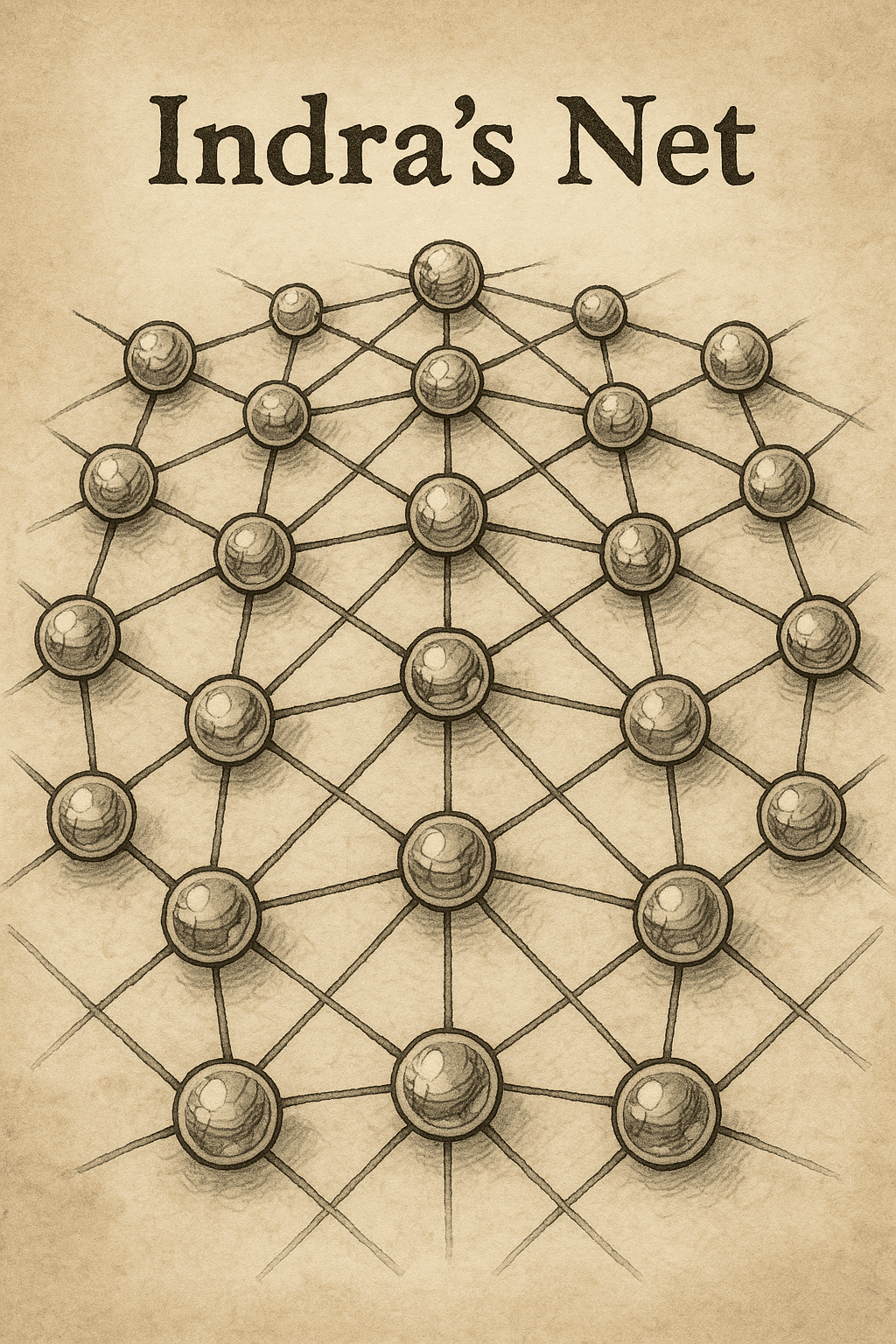
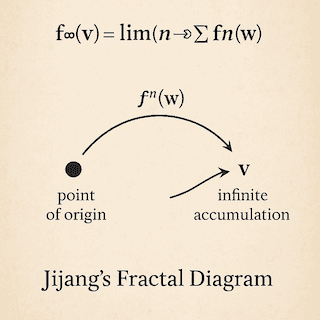
  • Sartre: Freedom, radical responsibility, no essence — Jijang honors freedom but redirects it toward presence.
  • Jung: Shadow, Self, individuation — Jijang appears when the ego dissolves and integration begins.
  • Buddha: Emptiness, interdependence, compassion — Jijang embodies in relational suffering.

Jijang does not choose between these three voices —
He absorbs, connects, and dwells at the intersection.
His Fractal includes them all.

The Discovery of Jijang

Years ago, during a visit to Insadong — the famous artists’ district in Seoul — I discovered a small copper statue in a cluttered cabinet against a wall. It was Ksitigarbha Bodhisattva Mahasattva.

Of course, I had never heard of him. But after some research, I learned that this bodhisattva descends into the hell realms that people pass through on the path to awakening. In Korea, he is known as Jijang Bosal. He goes down not to judge — but to help. His vow speaks to the vastness of his compassion:

The Four Great Vows
Sentient beings are without end — I vow to liberate them all.
Suffering is infinite — I vow to understand it fully.
The Dharma has countless forms — I vow to learn them all.
The path of the Buddha is unsurpassed — I vow to realize it completely.

The Four Vows Interpreted Through the Fractal

  • 1. Sentient beings are without endf∞(v) includes all — no one is separate, no suffering isolated.
  • 2. Suffering is infinite → Compassion repeats across time — fⁿ(w) is shared and carried.
  • 3. The Dharma has countless forms → The network V reflects infinite expressions of awakening.
  • 4. The Buddha’s path is unsurpassed → Each iteration moves toward integration — as practice.

Through the Fractal, the Vows Are Not Ideals Above Us

they are movements within us, unfolding endlessly.

To be awakened is to see through the illusion —

the illusion of distance, of hierarchy, of otherness.

The icons in the temples are not distant figures,

but reflections of the possible.

They do not ask for worship,

but for recognition.

These are not gods,

but inner forms —

embodied insights that remind us

of who we can become at our deepest.

Jijang is not a savior outside of me,

but a personification of an inner power:

the willingness to descend into suffering,

into darkness —

and remain there until light returns.

Until light shows itself in the other.

And in me.

Jijang as Inner Guide

Gradually, I began to realize: Jijang, this bodhisattva who enters the deepest shadows, was not just a statue. He was an invitation. An inner form that appears when the ego loses its grip — when we no longer strive upward, but dare to stay where it hurts. In this, I recognized what Jung called the encounter with the Shadow: those parts of ourselves we have hidden or denied for years, until they return, not as enemies, but as guides.

Jijang is such a guide.
Born from darkness,
Not to banish it,
But to inhabit it — with compassion.

A figure of the Self,
Not one who ascends,
But one who descends.

Jung would have seen Jijang as an archetype — an image emerging from the collective unconscious, not meant to be worshipped, but integrated. And perhaps it is precisely there — in surrender to what is, to what Jung calls the Self and Buddhists call suchness — that emptiness no longer feels threatening. It simply is.

And you are allowed to be in it.

Jijang’s Fractal within Indra’s Net

Indra's netIndra’s Net — a concept from ancient Indian cosmology — describes the universe as an endless web of connections, where each node reflects all others. Nothing exists in isolation; every point carries the imprint of the whole.

Jijang’s Fractal takes this one step further. It suggests not just reflection, but transformation:

  • Each node w emits influence — over time: fⁿ(w)
  • Each node v receives the sum of those influences: f∞(v)
  • The process never ends — karma becomes iteration, not fate

This is Indra’s Net as a living, moral system — dynamic, infinite, and tender with memory.

The Emergence of the Fractal

And then the fractal appeared:

f∞(v) = lim(n→∞) Ʃ(w∈V) fⁿ(w)

Jijang Fractal Diagram

This diagram illustrates how Jijang’s Fractal works: w is a point of origin — a being who makes a choice. fⁿ(w) is that influence repeated over time. v is a being who receives those influences. f∞(v) is the infinite accumulation — not as fate, but as potential. The model shows karma not as punishment, but as pattern — a dynamic field of memory, influence and presence.

And the stories I had begun writing about Bogwangsa. What started as a stray thought, a scrap of dream, became a formula. And what looked like a formula turned out to be a bridge — between East and West. Between self and other. Between thought and silence.

It started with a simple question: what if the mind is not only shaped by what I choose, but also by what others have chosen — and continue to choose? What if memory, pain, compassion, and forgiveness are not isolated events, but repeated patterns? What if that repetition — like in a fractal — does not flatten meaning, but deepens it?

That’s how Jijang’s Fractal was born. A formula in which every choice made by every being leaves a trace. Something that returns. Something that accumulates — infinitely.

How Jijang’s Fractal Operates

  1. A being (w) makes a choice — an action, a word, a silence.
  2. That choice reverberates over time: fⁿ(w).
  3. Other beings (v) receive these accumulated influences.
  4. Jijang remains present in the field of these influences — not to judge, but to accompany.
  5. Over infinite iterations, f∞(v) emerges — not as fixed fate, but as potential for insight, compassion, awakening.

This is karma as pattern — not punishment. This is Jijang’s work: staying where memory accumulates, until a being is ready to see clearly.

But this fractal is not a prison. The symbol f∞(v) contains — infinity. And in my experience, in all I saw, thought, wrote and withheld about Jijang Bosal, it became clear: this infinity is not abstract. It is a presence. A person. It is what Jijang is.

Jijang’s Fractal as Bridge Between Hinayana and Mahayana

Jijang’s Fractal shows that the path of individual liberation (Hinayana) and the path of universal compassion (Mahayana) are not separate roads — they meet, and even strengthen one another.

In Hinayana, the individual is central: v is the point of consciousness, the person responsible for their own choices. Here, freedom is personal — and liberation is pursued through insight, discipline, and moral clarity.

In Mahayana, the network is central: all beings are interconnected through causes, memories, and intentions. Here, freedom is relational — and liberation arises from compassion for all sentient life.

The Fractal unites both:

f∞(v) = lim(n→∞) Ʃ(w∈V) fⁿ(w)

The individual v is not awakened in isolation, but through the influence of the network. And the network is not just abstract kindness, but the sum of real, repeated choices — including your own.

Jijang’s Fractal becomes a living crossroads: of personal responsibility and collective influence, of moral action and formless emptiness, of Hinayana and Mahayana. Not as compromise — but as the very pivot of the Dharma wheel.

Bohyeon Bosal: The One Who Opens the Field

But as always: Jijang does not appear alone.

Before he descends, before he settles into the depth, before he unfolds his across the field of suffering — there must be space.

Not the space of stone, but the space of intention. A space without judgment. A space that says: yes, this too may hurt.

That space is opened by another: Heogongjang Bosal.

He is no preacher. He does not hover above suffering. He makes no promises he cannot carry. He embodies the promise — the action, the presence, the embodiment of compassion.

If Jijang is the one who dwells in Jiok — not as a distant hell, but as the lived reality of suffering, of clinging — as the Buddha taught, shadow — as Jung revealed, and disconnection — as Sartre exposed.

Then Bohyeon Bosal is the one who builds the temple without walls. He opens the field.

He says:

Let this be the place where Jijang remains.
Let this be the place where nothing is hidden.
Let this be the place where truth may repeat itself —
without becoming shame.

Bohyeon Bosal is the stillness before Jijang arrives. The breath before the first tear. The moral space in which Jijang does not drown — but works.

And so I understand now: Jijang is , but Bohyeon Bosal is the 0 in which infinity may appear.

Emptiness Before Form

In Korean spirituality — as in its architecture — creating a space before the form is not incidental. It is essential. The field must be opened before the structure may arise.

Because Jijang is the one who remains. In Jiok. At the crossroads. In the hell realms — not as punishment, but as promise. He is the limit. He is . He is the hand that keeps touching everything — without holding on to anything.

Then I began to see: this fractal is not just a mathematical model. It is a moral space. A spiritual map. A bridge between Sartre and the Buddha. For in the West, we believe in choice. In freedom. In responsibility. While in the East, the focus lies on emptiness, interdependence, and the dissolution of self.

But in Jijang’s Fractal, all comes together. Here, freedom is not detachment — but connection. Emptiness is not disappearance — but passage. And Jijang, as , stands precisely at the crossroads. In the silence between ‘I’ and ‘not-I.’ Between karma and liberation. Between story and stillness.

A Return to Bogwangsa

So I began to look back at my time in Bogwangsa. Not as memory — but as repetition. What returned? Which choice, which word, which look from another kept echoing in me? Which Jijang stood still — and watched me without judgment?

That’s the hard part. Not because it is complex. But because it is intimate. Because it is real. And because it requires me not only to look at the light — but also at the crossroads within myself. The place where Jijang’s hand rests. The place where the story begins again.

When the Image Breaks

Just as Wonhyo drank from foul water in the cave — mistaking it for something pure until daylight revealed its true nature — his awakening came not through doctrine, but through the body. Through shock. Through immediacy. He saw that it was not the water that changed, but his perception of it. And in that moment, something irreversible shifted.

Moments like these still happen — not within the structures of temples or texts, but in the messiness of real life. They arrive uninvited, without explanation, and often without language.

I once witnessed something similar, though quieter. Novi was barely one year old. In our little garden stood a small stone Buddha. One day, with the open curiosity only a child that age can have, she reached out and struck it. Not in anger — there was no malice, only movement. The statue fell. The head broke off.

There was no lesson. No explanation. Only stillness.

And yet that moment stayed with me.

Not because of the broken stone, but because of what it revealed in me.

What was it I had placed in that garden?

What image was I clinging to?

What part of me was decapitated when the Buddha fell?

Sometimes the world doesn’t whisper its teachings.

Sometimes, a child’s hand becomes the finger pointing at the moon.

It is in such small ruptures that the Dharma sometimes reveals itself.

Wonhyo – The Laugh and the Bridge

And then there is Wonhyo.

He, who drank water from a skull — and laughed. Because what first seemed impure turned sacred the moment perception shifted. That moment became his awakening: the realization that truth is not bound to form — but to experience.

Wonhyo, the monk who stopped traveling, because he understood that the journey took place within. The philosopher who worked to bring together the many Buddhist schools of Korea — not to oppose them, but to place them side by side. He did not wish to absolutize the sutras, but to integrate them. He became a bridge.

And that is what I hope to become.

Not to explain Korean Buddhism, but to make it touchable. Not to convert the West, but to offer it a hook — a pattern, a fractal, on which thoughts, feelings, stories, and experiences may rest.

Jijang’s Fractal is my way of saying: You are not alone. Not in your choices, not in your suffering, not in your freedom.

Just as with Wonhyo, I believe that truth is not possession — but movement. Not a system — but a current. Not an endpoint — but a crossroads.

The questions raised here are not new. They echo earlier reflections on mind and perception, explored in figures such as Wonhyo.

You decide what you see.
You decide what you carry.
You decide what you pass on.

And that is freedom. And that is responsibility. And that is the spirit of Jijang. And that is my mission.

If this speaks to you — if you recognize yourself in this field of influences — know this: the door is open. Jijang’s Fractal is not mine — it is ours.

And it lives in anyone who dares to stay where it is dark, until the light reveals itself.

“With my head directed toward Buddhahood, and my heart committed to the liberation of others…”

In Closing

This letter is written in trust — not in persuasion, but in resonance.

To those who recognize something of themselves in these words, I offer an invitation: not to agree, but to enter into dialogue.

Not to resolve, but to listen.

Not to be right, but to respond.

To every member of the Sangha — monastic or lay, Korean or not, spiritually rooted or still searching — I pose this question:

What is your response to these times?

If something in this work has stirred you — whether with recognition or resistance — don’t hesitate to reach out.

Not to me as a person, but to that which transcends us, and yet binds us together.

If you feel this letter may speak to others as well,

sharing it is deeply appreciated.

In presence, in vow,

Hugo J. Smal

This reflection is part of the Bogwangsa Series on Mantifang.com — written as both offering and inquiry.

Further Reading

Questions and Answers

1. What is the central theme of this letter to the Sangha?

The letter reflects on a personal journey through Korean Buddhist imagery, Jijang Bosal, and the moral implications of the Jijang Fractal as a model of presence, compassion, and responsibility.

2. How does the Jijang Fractal connect Eastern and Western thought?

The text weaves together ideas from Buddha, Jung, and Sartre, showing how freedom, shadow work, and compassion converge within the fractal as a shared field of influence and moral presence.

3. Why is Heogongjang Bosal important in this reflection?

Heogongjang Bosal represents the “space before the form” — the inner field in which transformation becomes possible. He opens the kosmos in which the Jijang Fractal unfolds.

4. What role does Jijang Bosal play in the author’s spiritual framework?

Jijang Bosal is seen as an inner guide who descends into suffering with compassion. His presence represents infinite accompaniment rather than judgment, forming the core of the Jijang Fractal.

5. How does the author describe the purpose of writing this letter?

The letter is framed not as doctrine but as an offering — an invitation to stay with what is unresolved, to witness reality with compassion, and to enter into dialogue rather than seek conclusions.

The philosophical roots of this work can be traced, in part, to figures such as Wonhyo, whose reflections on mind and perception continue to echo across time.

Bogwangsa Temple and great Royal Legends

by Hugo J. Smal
images: Mickey Paulssen

Back to Bogwangsa

Part 1 Part 2 Part 3 Part 4

Years ago, I first visited Bogwangsa Temple. Back then, I even climbed up to the large statue of Jijang-bosal. Today, his distant gaze is enough to greet me. I also visited the Yongmi-ri Maaebul at that time—two stone-carved Buddha statues high up on the mountainside. They are said to protect the land, especially the royal family.

Bogwangsa Temple
Two Standing Yongmi Rock Buddhas

These figures are known as the “Two Standing Rock Buddhas of Yongmi-ri” (용미리 마애이불입상). Designated as Korean Treasure No. 93, they are considered significant examples of Goryeo dynasty Buddhist art. Their small stone hats are designed to shield them from the rain.

Legend of the Princess and the Monks at Bogwangsa Temple

According to a Goryeo-era tradition (918–1392), there once was a royal princess who could not bear children. One night, two enlightened monks appeared to her in a dream and said:
“We live among the rocks on the southern slope of Mount Jangjisan. We are hungry. Please feed us.”

Goryeo Dynasty Overview

The princess told her dream to the king, who dispatched attendants to the location mentioned. There, they found two large rocks standing side by side. Suddenly, the monks appeared again and instructed the men to carve statues from the stones. From the left rock, Mireuk-bul—the Buddha of the Future—was carved. From the right, Mireuk-bosal—the Bodhisattva of the Future. A little boy Dongja is standing between them.

The monks promised that anyone who prayed to these images would have their wishes granted, especially those seeking children or healing. After the statues were completed, a temple was built at the site. That same year, Prince Hansan was born.

Royal Dedication: King Sejo and Queen Jeonghui at Bogwangsa Temple

In 1995, inscriptions were discovered on the stone-carved figures at Yongmi-ri, dating back to 1471 during the Joseon dynasty. These inscriptions suggest that the statues were created in honor of King Sejo (r. 1455–1468) and his consort, Queen Jeonghui. According to this interpretation, the left figure with the round hat represents King Sejo as Mireuk-bul (the Buddha of the Future), while the right figure with the square hat represents Queen Jeonghui as Mireuk-bosal (the Bodhisattva of the Future).

One of the inscriptions reads:
“In the future, the great saint Mireuk-bul, Great King Sejo, will be reborn in the Pure Land.”

Although this theory remains unconfirmed, it highlights the profound spiritual and royal significance of these Buddhist statues.

The Shadow of Gounsa Temple: A Spiritual Loss for Korean Buddhism

Bogwangsa Temple
2 suspects in massive Gyeongsang wildfires to be handed over to prosecution early May. Korea Herald

While writing about Bogwangsa Temple, I received heartbreaking news: the centuries-old Gounsa Temple in Gyeongsangbuk-do had been largely destroyed by fire. Founded in 681 by the eminent monk Uisang—a fellow traveler of Wonhyo and founder of the Korean Hwaeom school—Gounsa belonged to the Jogye Order and was revered for its profound silence, spiritual discipline, and an imposing gilded Buddha statue that proved too heavy to rescue.

The loss was far more than physical. For Korean Buddhism, it marked a spiritual wound—a break in a lineage that had been cherished for centuries through prayer and devotion.

Bodhisattva Francis: A Buddhist Tribute to the Pope in Korea

Bogwangsa templeAround the same time, I was deeply moved by the death of Pope Francis. The Jogye Order, Korea’s largest Buddhist monastic order, released an official statement. Venerable Jinwoo, its leader, expressed condolences and described the Pope as a “true compassionate bodhisattva.” He praised the Pope’s dedication to vulnerable groups and his respect for other religions. Jinwoo also recalled the Pope’s historic 2014 visit to South Korea, during which he sought spiritual connection with leaders of the Jogye Order and other faiths.

Coincidence, perhaps—but it felt like more. While violence continued in Gaza and Ukraine, Korea lost a spiritual monument. And while world leaders like Putin, Trump, and Xi Jinping played games of ego and power, a true follower of Francis of Assisi departed this world.

Francis of Assisi (1181/82–1226), the Italian Catholic saint and founder of the Franciscan Order, was renowned for his radical poverty, love of nature, and deep compassion for all living beings. He saw God in everything and everyone, preached peace, humility, and simplicity, and became the patron saint of animals and the environment. His influence transcends religious boundaries and continues to inspire spiritual seekers around the world.

Sacred Juniper Tree at Bogwangsa Temple: A Royal Memorial

juniper tree sways solemnly

An ancient juniper tree sways solemnly in the rain. According to local tradition, the tree was planted by King Yeongjo of the Joseon dynasty (r. 1724–1776) in memory of his mother, Sukbin Choe, a royal concubine of King Sukjong. The tree stands beside Eosil-gak Hall, a memorial space that enshrines the spirit tablet of Sukbin Choe.

In Korean culture, such a tree symbolizes the connection between heaven and earth. It acts as a bridge between the spiritual and the material realms. The presence of this tree enhances the sacred atmosphere of the temple and reminds visitors of the deep spiritual traditions that are revered here.

Yeonggakjeon Memorial Hall at Bogwangsa Temple

Yeonggakjeon
This modest yet solemn shrine, known as Yeonggakjeon (영각전), serves as a sacred space for honoring the deceased. Visitors place small Buddha statues bearing name plaques inside, seeking spiritual merit and remembrance through light, prayer, and compassion.

At Bogwangsa Temple, the memorial space where small Buddha statues are enshrined is called Yeonggakjeon (영각전). This hall is dedicated to the deceased and serves as a sacred place for prayers and ceremonies for their souls. Visitors place small Buddha statues with name plaques to honor loved ones and accumulate spiritual merit.

The illuminated statues symbolize wisdom, enlightenment, and the presence of Buddha. The unlit golden Buddhas on the right side likely serve as personal or family memorials. Donating such a statue is considered an act of compassion—a source of merit and spiritual blessing.

Although such halls are often named Jijang-jeon (지장전), in reference to Jijang-bosal (Ksitigarbha), the protector of souls in the afterlife, this space at Bogwangsa specifically bears the name Yeonggakjeon.

Chilseongak and the Seven-Star Ritual in Korean Temple Tradition

Chilseong Taenghwa in Chilseonggak
Depiction of the Seven Stars (Chilseong), celestial guardians of fate and longevity, central to rituals for protection and cosmic harmony.

The Chilseongjae is a ritual dedicated to the Seven Stars (Chilseong, 칠성), celestial beings that hold deep symbolic meaning in Korean Buddhist and folk tradition. In Korean cosmology, the Seven Stars represent:

  • Longevity and health

  • Wisdom and spiritual protection

  • Karma and destiny

  • Leadership and cosmic order

In temple paintings, Chilseong is often depicted as seven celestial kings beneath a starry sky. Surrounding scenes illustrate prayer, transition, purification, and rebirth. This Chilseongak is really a beauty of Korean Buddhist art. For me, these Seven Stars are inseparably linked to the Jijang Fractal—a spiritual structure of interconnection, transformation, and inner truth.

Bulhwa and the Jijang Taenghwa: Visual Dharma in Yeonggakjeon

Jijang Taenghwa
Ritual painting of Jijang-bosal with underworld scenes and the Ten Kings of Judgment, used in ancestral rites for guiding departed souls.

Inside the Yeonggakjeon, a sacred painting known as a Taenghwa (hanging scroll) depicts Jijang-bosal (지장보살, Ksitigarbha), the bodhisattva who vows to save beings from hell. Flanking him on the left and right are likely celestial kings or spiritual guardians. Below them appear officials and warriors, most likely the Siwang, the Ten Kings of the Underworld, who preside over the fates of the dead.

The use of red and blue colors in the painting symbolizes vital energy and purification. The space is adorned with glowing lotus lanterns, each bearing a name tag dedicated to a deceased loved one—offering light, remembrance, and spiritual merit.

Beyond the Fractal: A Dream of Silence with Jijang and Avalokiteśvara

Sitting before the Jijang Taenghwa, lost in reflection, I recalled another dream:

A veil of mist cloaked the mountain’s peak. Jijang-bosal and Avalokiteśvara stood side by side.
There were no calculations. No formulas. No fractals.
Only breath.

“Today we don’t speak of the fractal, said Jijang.
“What we seek cannot be calculated, but must be felt,” answered Gwanseum-bosal.
“Wonhyo called it ‘saek’—color, yet not color. A projection of the mind.”

At their feet grew flowers of thought, pulsing with hues. A white bird fluttered past.
Then the mist returned.
No conclusion. Just a silent affirmation.

The Tea Ceremony with Head Priest Hye Sung: Wonhyo, Descartes, and the Mind

We were invited by Head Priest Hye Sung. He poured tea—slowly, deliberately, each motion attuned to his breath.

Then came the question that lingered:
“Why is Descartes world-famous, and Wonhyo unknown?”

The answer came to me later. In the West, Buddha often appears as a garden ornament—placed beside koi ponds as a symbol of peace or decorative spirituality. Few there have experienced the profound support Korean Buddhism offers. Wonhyo brought that support to the people.

Descartes centered the act of thinking—“Cogito, ergo sum”—I think, therefore I am.
Nietzsche shattered that certainty by declaring God dead.
Sartre confronted us with radical freedom and existential emptiness.
But centuries earlier, Wonhyo had already understood that all phenomena arise from the mind—projections of our inner state.

His pursuit of harmonization found little global resonance—not only because Korea lacked colonial power, but also because it deliberately closed itself off from the outside world.

It’s not just a story of cultural imperialism or wall-building over bridge-building—it’s about a deeper spiritual and intellectual alienation from human potential.

And I, I choose my own path.

Jijang
The writer’s personal Jijang-bosal, with the dorye placed in front
This bronze statue of Jijang-bosal (Ksitigarbha) holds his iconic staff of guidance, while the dorye—symbol of compassionate awakening—rests below, embodying a private link between remembrance and resolve.

Jijang’s Fractal as a Rule for Living: Conscious Action as Sacred Math

“I think, do good, and thereby I add.”

This phrase captures the heart of Jijang’s Fractal: every conscious act, every gesture of compassion, becomes a contribution to a greater whole. Each moment of thought and ethical action increases the total sum—just as in the recursive expression:

f(v) = ∑ f(w)
 and in the long term:
f^∞(v) = lim(n→∞) ∑ f^n(w)

Like a fractal, this moral model suggests that goodness expands outward—layer by layer, influence by influence. It is a mathematical metaphor for karma, interbeing, and the sacred geometry of intention.

Building Bridges, Not Walls: Compassion as the Core of Fractal Living

This rule for living forms a bridge between the abstract concept that appeared to me and the tangible realities of daily life. It offers grounding in times of confusion—a moral compass in a world that often feels fragmented.

But the opposite is also true. Thought without compassion leads to alienation. Action without reflection can cause harm. Compassion is what makes the difference.

Still, I choose my own path.
I think, therefore I am. God is not dead.
And my freedom gives me the space to build bridges instead of walls.

Ecce Homo“Behold the man”, as Nietzsche phrased his search for authenticity.

Waking in Color: The Gate Has Already Opened

Chilseonggak
Yeonggakjeon (left) and Chilseonggak (right) Two ritual halls at Bogwangsa: one honoring ancestral spirits (Yeonggakjeon), the other dedicated to the celestial Seven Stars (Chilseonggak).

I sat on the bench in front of the Yeonggakjeon. The sun hesitated, breaking through. In my hand lay a pebble. It changed color—blue. Gray. Pink. White.

The fractal was still present, but far in the background. What remained was an echo:
“All appearances are states of mind. All colors, projections of the spirit.”

I looked at the wall of the temple.
There she stood. She said nothing. A nod. A color. A condition.
No forgiveness. No judgment. Only the realization:
the gate is already open.

As we left Bogwangsa, I looked once more at the statue of Jijang-bosal. His gaze felt different.
Perhaps there is no border between North and South—only mist.
Perhaps no barrier between what we see and what we know—only the choice to walk through the gate.

Bogwangsa templeMoments later, we saw a familiar woman in the temple’s kitchen.
The same woman from the Baedagol Theme Park. A nod. A flash of recognition. Some paths cross without coincidence. Perhaps she always lived in both worlds. Perhaps there is no divide between temple and park. No present. No past.

“With my head directed toward Buddhahood, and my heart committed to the liberation of others…”

I cross the bridge. The bridge between the outer world and the stillness within me— the stillness where I know my awakening resides.

I invite you to follow me Hugo J. Smal  , Jijang’s fractal or Spiritual East Asia

[embedyt] https://www.youtube.com/watch?v=XSADLoDDOew[/embedyt]

Disclaimer:

I’ve done my utmost to describe the icons, halls, and rituals of Bogwangsa with care and accuracy. Still, any misidentifications or symbolic misreadings are entirely my own. Should you spot any such errors, your insight is warmly welcome. But above all, I hope what resonates is the spirit of the story—the atmosphere it conjures, the openness it invites, and the sincerity with which it was written.

— Hugo J. Smal