Mantifang authority hub
Living Korea
Daily life, rivers, ritual, Seoul, food, Hallyu, memory, ceramics, influence, and the deeper structures of Korean culture.
Living Korea is the central cultural hub of Mantifang. It gathers longform essays and cultural notes about daily life in Korea, Seoul, the Joseon palace world, Korean rivers, Korean shamanism, mudang ritual, Hallyu, Korean food, seasonal traditions, ceramics, Korean influence, Confucian thought, and Korea’s wider historical connections.
This page is not built as a travel checklist. It is a cultural map. The purpose is to show how Korean life can be read through repeated patterns: how people move through cities, how rituals mark uncertainty, how rivers organize memory, how meals carry family rhythm, how popular culture translates private emotion into public form, and how older structures remain present inside modern life.
Some readers enter Korea through drama and Hallyu. Some arrive through history, Buddhism, Confucianism, palace architecture, ceramics, Korean influence, or shamanic ritual. Others begin with place: Seoul, Goyang, Paju, the Han River, the Imjin River, or the border landscape. Living Korea connects these entrances so they do not remain isolated articles. Together they form one readable landscape.
The organizing idea is simple: culture becomes visible in daily practice. It is not only found in monuments, museums, royal names, or official histories. It appears in routes, thresholds, meals, family obligations, seasonal gatherings, gestures of respect, ritual music, public space, television drama, inherited craft, cultural influence, and the quiet adjustments people make across generations.
Entry point
Start here
If you are new to Mantifang, begin with the route that feels most natural. There is no single correct order. Living Korea is designed so that a reader can enter through modern culture, historical Seoul, ritual practice, food, rivers, ceramics, Korean influence, or wider context, and still arrive inside the same larger cultural field.
If your interest is urban life, begin with Seoul and the Joseon palace world. These essays read the city through spatial order, access, hierarchy, architecture, gates, corridors, and the people who moved through them. If your interest is landscape and memory, begin with Korean rivers. Rivers show how water, borders, public space, silence, separation, and ritual thresholds shape Korean life.
If you are drawn to spiritual practice, begin with Korean shamanism and mudang traditions. These pieces approach ritual as living culture: not as folklore kept behind glass, but as a practical response to grief, illness, uncertainty, ancestors, protection, and transition. If you first encountered Korea through film, music, or drama, begin with Hallyu. Popular culture is treated here as emotional language, not as surface entertainment.
Food, ceramics, Korean influence, and seasonal traditions offer the most tangible layers. They show how repetition becomes meaning: kimchi, shared meals, Seollal, Chuseok, zodiac time, sunrise gatherings, temple visits, family return, handmade vessels, beauty culture, design habits, and the rhythm of the year. Context pieces then widen the frame through Confucianism, historical transfer, Dutch–Korean connections, and language bridges.
Joseon Palace WorldRoyal palaces, eunuchs, court women, scholars, guards, lineage, and controlled access.
Korean RiversWater, borders, public space, silence, separation, and ritual thresholds.
Korean ShamanismMudang traditions, gut ritual, invocation, protection, ancestors, and transition.
Korean CeramicsCeladon, moon jars, Icheon, pottery, craft memory, clay, fire, and living tradition.
Korean InfluenceHow Korean aesthetics, beauty, ritual, craft, design, philosophy, and cultural habits travel beyond Korea.
HallyuKorean drama, K-pop, modern storytelling, social imagination, and global resonance.
Cultural ContextConfucianism, Korean influence, ceramics, historical exchange, and Korea–Netherlands connections.
Urban structure
Seoul
Seoul is approached here not as skyline or spectacle, but as structure. The city becomes readable through gates, corridors, walls, palace grounds, markets, roads, rivers, hills, and routes of access. What matters is not only what stands in the city, but how people move through it, where they are allowed to go, where they must wait, and how power arranges distance.
The royal palaces of Seoul are central to this reading because they give physical form to hierarchy. Architecture becomes social order. A gate is never only a gate. A courtyard is never only open space. A hall is never only a building. Each element organizes visibility, approach, rank, ritual, and authority.
Modern Seoul may seem fast, vertical, and intensely contemporary, but its older spatial logic has not disappeared. It survives in ceremonial memory, in the preservation of palace grounds, in public rituals, in language, in forms of respect, and in the continued emotional weight of place. To read Seoul well is to see more than modern density. It is to notice how older systems still shape the way the city is remembered.
Major longread cluster
Seoul & the Joseon Palace World
The Seoul and Joseon Palace World cluster is one of the strongest authority clusters on Mantifang. It reads the royal palaces not only as architecture, but as a complete social environment. Kings, queens, court women, eunuchs, Confucian scholars, guards, servants, families, and officials all belong to the same system of movement, access, ritual, labor, and visibility.
This matters because palace life was not only political. It was domestic, ceremonial, bodily, emotional, and practical. It depended on hidden labor as much as royal display. It required women whose lives were shaped by seclusion and influence, scholars who carried moral authority, guards who controlled thresholds, eunuchs who moved between inner and outer zones, and families whose proximity to power became part of inherited memory.
The palace world also helps explain why Korean history cannot be reduced to rulers and dates. A dynasty is lived through rooms, clothing, household systems, examinations, written records, family obligations, ritual calendars, kitchens, gates, servants, scholars, and bodies moving through controlled space. This is why the cluster belongs inside Living Korea. It shows how historical power became daily order.
The essays are designed to be read individually, but they function together as a single topic cluster. A reader may begin with the royal palaces, continue to palace hierarchy, move inward toward women of the court, then outward toward guards, scholars, and family continuity. Together they create a compact map of the Joseon palace world in Seoul.
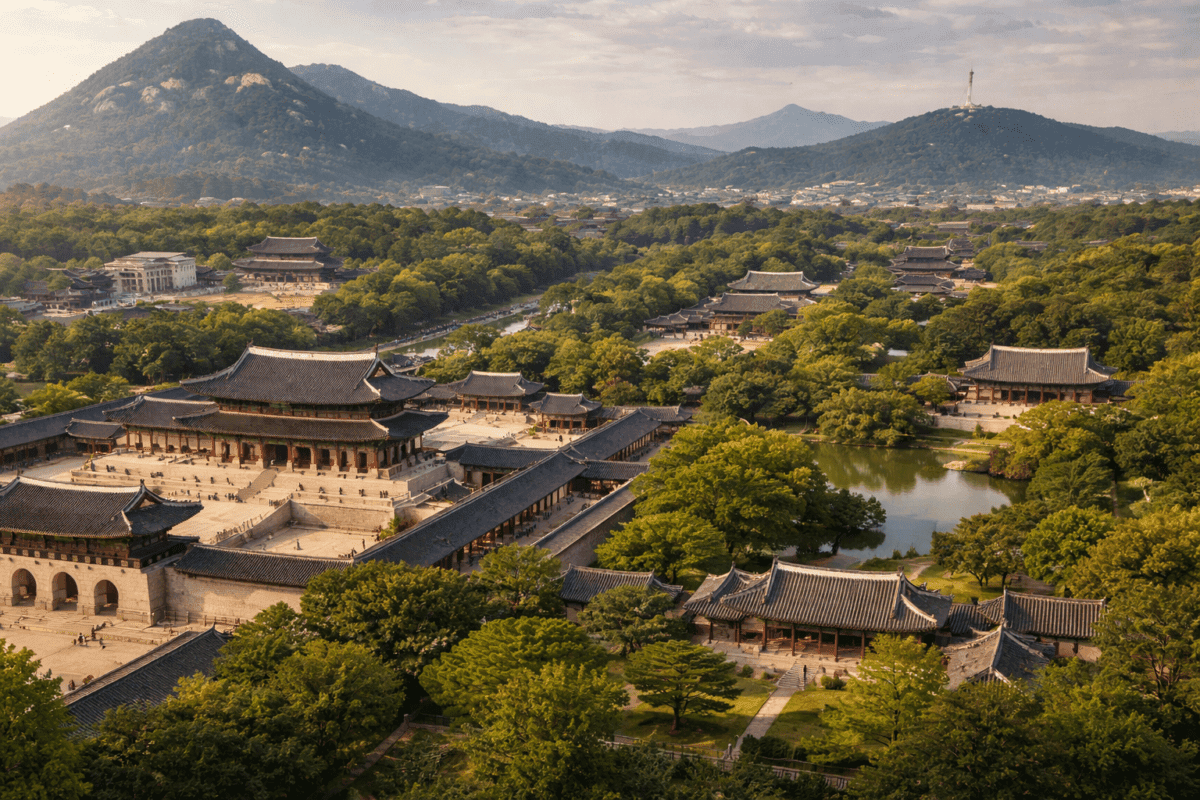
Royal Palaces of Seoul
Architecture, kingship, ritual, gardens, mountains, and the spatial language of Joseon power.
Joseon Palace Hierarchy
Access, thresholds, eunuchs, visibility, rank, and the mechanics of palace order.
Women Within the Palace
Queens, consorts, court ladies, servants, nobi, inner court influence, and hidden labor.
Confucian Scholars
Learning, moral government, examination culture, court debate, and advisory distance.
Soldiers and Guards
Gates, discipline, outer defense, controlled movement, and palace security.
The Ji Family
Lineage, service, inherited proximity to power, and family memory inside Korean history.
Water and place
Korean Rivers
Rivers in Korea are not only geography. They are lines of movement, delay, memory, division, settlement, public space, ritual meaning, and historical pressure. A river gathers the land around it. Roads follow it. Cities lean toward it. Bridges cross it, but the crossing never erases what the water continues to hold.
The Han River gives Seoul its openness and modern rhythm. It is urban, infrastructural, symbolic, and everyday. The Imjin River carries a different weight: silence, border, separation, and the unresolved memory of division. The Yalu River marks distance and power at the northern edge of Korean history. In Goyang, smaller rivers and waterways reveal local movement, public use, and ordinary continuity.
Water also belongs to ritual. In Korean Buddhism and wider religious practice, water can mark purification, offering, transition, and the border between states. This is why the Korean Rivers cluster belongs inside Living Korea. It connects landscape to daily life, public space to memory, and geography to spiritual imagination.
Living ritual
Korean Shamanism & Mudang Traditions
Korean shamanism belongs within Living Korea because it remains part of Korea’s cultural present. It is not only a historical survival, and not only a folkloric image. Mudang traditions continue to appear where people face illness, grief, family pressure, uncertainty, business openings, ancestors, bad fortune, transition, and the need for protection.
The mudang stands at a threshold. She may be honored, feared, mocked, consulted, hidden, filmed, remembered, or reinterpreted through modern life. That ambiguity is part of the tradition’s force. Korean shamanism often survives not because it is formally approved, but because people continue to need forms of address for what cannot be solved by ordinary language.
The gut ritual is especially important. It has structure, music, movement, costume, invocation, offering, negotiation, release, and return. It is not random performance. It is a ritual grammar. Through sound, gesture, and presence, the ritual opens a space where the living, the dead, the troubled, and the unseen can be addressed.
This cluster is therefore not treated as exotic spectacle. It is approached as living ritual culture. The focus is on meaning, structure, social function, and the way ritual practice remains present in Korea’s modern imagination.
Clay and living tradition
Korean Ceramics — Clay, Fire, and Living Tradition
Korean ceramics belong naturally inside Living Korea. They connect daily use, dynastic memory, festival culture, regional craft, and the quiet survival of handmade vessels. From Goryeo celadon to Joseon moon jars and the living ceramic city of Icheon, pottery shows how Korean culture remains present in clay, fire, hand, and use.
This cluster also gives Living Korea a strong material layer. A ceramic vessel can be historical, practical, ritual, domestic, beautiful, damaged, repaired, displaced, or inherited. It may belong to a palace, a kiln, a market, a tea room, a family table, or a museum case. Korean pottery therefore makes culture visible at the scale of the hand.
The ceramic route begins with the broad overview, then moves toward Goryeo celadon, Joseon white porcelain, buncheong ware, moon jars, Icheon’s living craft culture, and the difficult memory of Korean potters taken to Japan after the Imjin Wars. Together these pages turn ceramics from a decorative subject into a deep cultural pathway.
Enter the Korean Ceramics cluster →
Korean Ceramics
Celadon, Joseon porcelain, Icheon, Korean pottery traditions, and cultural memory.
Goryeo Celadon
Green glaze, sanggam inlay, Buddhist atmosphere, and quiet perfection.
Joseon Ceramics
Moon jars, buncheong ware, white porcelain, ritual order, and daily use.
Icheon Korean Ceramics City
Workshops, Cerapia, ceramic culture, public craft, and living tradition.
Icheon Ceramic Festival
Festival culture, demonstrations, exhibitions, and contemporary Korean pottery.
Korean Potters in Japan
Forced movement, Imjin War history, ceramic transmission, and cultural survival.
Cultural reach
Korean Influence — Beauty, Daily Life, and Modern Thought
Korean influence belongs inside Living Korea because culture does not stop at Korea’s borders. Korean food, skincare, drama, music, ceramics, ritual aesthetics, design habits, family structures, and moral vocabularies travel outward in visible and invisible ways. Some influences are commercial and global. Others move quietly through taste, language, posture, atmosphere, craft, and attention.
This cluster asks how Korea shapes daily life, beauty, and thought beyond the peninsula. It connects Hallyu and Korean beauty to older patterns of restraint, care, repetition, surface, and social feeling. It also connects ceramics and craft to cultural memory, showing how objects, forms, and techniques can travel across borders and centuries.
Korean influence is not treated here as a slogan. It is read as a field of transmission. A drama can carry family pressure and emotional grammar. A skincare ritual can carry ideas of surface, patience, and care. A ceramic vessel can carry technical memory. A Confucian habit can survive as a social reflex even when doctrine is no longer named. A Korean form may travel far from Korea while still holding traces of its original conditions.
Enter the Korean Influence cluster →
Korean Influence on Global Culture
Beauty, daily life, design, modern thought, and the quiet reach of Korean culture.
Hallyu: The Korean Wave
Korean drama, K-pop, film, fashion, fandom, and modern cultural imagination.
Korean Ceramics
Clay, fire, craft, cultural memory, and material influence across East Asia.
Korean Potters in Japan
Forced movement, craft transmission, war, adaptation, and ceramic influence.
Confucianism in Korea Today
Respect, hierarchy, education, family duty, and social grammar in modern Korea.
Dutch Words, Korea, and Japanese
Language crossings, historical contact, and cultural movement between regions.
Modern voice
Hallyu & Popular Culture
Hallyu is often described as the Korean Wave: K-pop, Korean drama, film, fashion, streaming success, and global fandom. On Mantifang, it is read more quietly. Hallyu is not only export culture. It is a modern voice through which Korea’s emotional and social imagination travels.
Korean drama can reveal family obligation, shame, aspiration, tenderness, social pressure, class anxiety, humor, grief, loyalty, and longing. Popular culture often says indirectly what formal language cannot easily say. It turns private emotion into shared form.
This does not mean every drama or song carries deep historical meaning. But the repeated patterns matter: the difficult parent, the burdened child, the school system, the workplace hierarchy, the fragile romance, the social debt, the house, the meal, the family gathering, the public humiliation, and the moment of recognition.
Hallyu belongs in Living Korea because it shows how modern Korea imagines itself and how the world receives that imagination.
Everyday practice
Food
Food is one of the clearest ways to read daily culture. It is repeated, shared, prepared, stored, served, offered, remembered, and expected. Korean food is not only flavor. It carries timing, patience, family order, care, thrift, generosity, season, and memory.
Kimchi is the most obvious example, but not because it is a symbol on a tourist poster. It matters because it is practice: preparation, fermentation, preservation, storage, sharing, smell, household knowledge, regional difference, and seasonal rhythm.
A table can reveal hierarchy without explaining it. Who serves, who waits, who pours, who receives, who begins, who refuses, and who insists: all of this belongs to culture. Meals carry social forms that may be older than the words used to describe them.
Rhythm of the year
Seasonal Traditions
The year is not only a sequence of dates. It is a cultural rhythm. Seollal, Chuseok, zodiac time, sunrise gatherings, temple visits, memorial rituals, family return, seasonal food, and public events all show what repeats.
Modern traditions often change in form while keeping their emotional function. A gathering may become smaller, a ritual may become symbolic, a visit may become shorter, but the underlying need remains: to return, to bless, to remember, to repair ties, to begin again.
Goyang is important in this layer because it can be read through seasonal use rather than spectacle. Public life gathers and disperses. Ground, rivers, routes, parks, fortresses, and local events become legible through repetition.
Wider frame
Context: Ideas, Ceramics, Influence, and Korea–Netherlands Links
Context pieces widen Living Korea beyond daily observation. They connect ordinary life to philosophy, diplomacy, craft history, Korean influence, Confucian order, language, war, migration, and cultural transfer.
Korean ceramics belong here because they show continuity through fragility. Clay, glaze, kiln practice, tea culture, war, displacement, and inherited technique all carry memory. The story of Korean potters in Japan after the Imjin Wars is especially important because it reveals how cultural transmission can be shaped by violence, loss, adaptation, and survival.
Korean influence also belongs here because it shows what happens when Korean forms move outward. Hallyu, beauty culture, food, design, craft, ceramics, language, and social habits do not travel as isolated trends. They carry deeper structures of care, restraint, rhythm, emotion, and collective memory.
Confucianism also belongs here, not as a dead doctrine but as a social grammar. Respect, distance, education, seniority, rank, family duty, moral language, and public behavior still carry traces of Confucian order. Even when people reject formal systems, patterns may remain in gesture, speech, expectation, and social discomfort.
Korea–Netherlands links create another layer. They show how cultural connection is often built through small crossings: diplomacy, personal memory, trade routes, language traces, publishing, gardens, ceramics, and long friendships. These links may be modest, but they are part of Mantifang’s own position: a Dutch-language and English-language cultural project looking toward Korea with patience and attention.
How to read this hub
Reading Paths Through Living Korea
Living Korea can be read in several directions. A historical reader may begin with Seoul, the royal palaces, and the Joseon palace world. A landscape reader may begin with the rivers. A spiritual reader may begin with Korean shamanism and then move toward Buddhist ritual, water, and The Jijang Fractal. A reader of modern culture may begin with Hallyu and Korean influence, then move backward toward family structure, food, hierarchy, Confucian traces, seasonal repetition, ceramics, and craft memory.
The strongest path is not necessarily chronological. Mantifang often works by resonance. A river may explain a city. A ritual may explain a drama. A palace gate may explain a family hierarchy. A bowl of kimchi may explain memory better than a timeline. A ceramic vessel may carry the history of war, repair, and cultural transmission. A beauty habit or design preference may reveal older forms of care, restraint, and social feeling.
This is why Living Korea functions as an authority hub. It does not merely list articles. It gives the reader a way to move between them. Each cluster strengthens the others. Seoul gives structure. Rivers give movement. Shamanism gives threshold. Ceramics give material memory. Korean influence gives outward reach. Hallyu gives modern voice. Food gives repetition. Seasonal traditions give time. Context gives depth.
For a wider philosophical and literary continuation, continue from this page toward The Jijang Fractal. There the cultural observations of Mantifang become part of a deeper reflection on Korea, memory, compassion, moral responsibility, and the way places continue to speak through people.
Quick orientation
Q&A
What is Living Korea?
Living Korea is Mantifang’s central hub for Korean daily life and cultural structure: Seoul, rivers, shamanism, ceramics, Korean influence, Hallyu, food, seasonal traditions, Confucian thought, and Korea’s wider historical connections.
Is Living Korea a travel guide?
No. Some essays may be useful for travelers, but the purpose is cultural reading rather than itinerary planning. The emphasis is on place, memory, ritual, social structure, craft, cultural influence, and everyday practice.
Why are Seoul palaces part of Living Korea?
Because palace life was not only political history. It was lived culture: architecture, household order, gender, labor, ritual, hierarchy, family continuity, access, and controlled movement through space.
Why are ceramics part of Living Korea?
Because Korean ceramics connect history to daily use. A bowl, moon jar, celadon vessel, or pottery shard can carry memory through clay, fire, ritual, household practice, war, craft, and living tradition.
Why is Korean influence part of Living Korea?
Because Korean culture does not remain inside Korea. Food, beauty, design, drama, ceramics, ritual forms, social habits, and emotional language travel outward. Korean influence shows how daily life, aesthetics, and thought move beyond place while still carrying cultural memory.
Why are rivers and shamanism included on the same hub?
Both reveal thresholds. Rivers mark movement, separation, borders, and public space. Shamanic ritual marks transition, uncertainty, protection, ancestors, and the crossing between visible and invisible worlds.
Where should a new reader begin?
Begin with Seoul for structure, rivers for landscape, Korean shamanism for ritual, Korean ceramics for material memory, Korean influence for cultural reach, Hallyu for modern voice, food for everyday rhythm, or context for Confucianism and historical exchange.
Beyond Mantifang
Further Reading
Official context:
Korea Tourism Organization ·
Korea.net ·
Cultural Heritage Administration
“`
Temporary pause on koi exports — healing park in development
International koi exports are currently on hold. Meanwhile, we are laying the foundations for a nature-driven healing park in Goyang that blends koi culture, art, and quiet craftsmanship. For updates or collaboration, feel free to get in touch.
Contact Kim Young SooNew to Mantifang? Begin here: Start here.
Korean History Dictionary
For Korean historical names, places, dynasties, rituals, and cultural concepts, continue to the
Korean History Dictionary Complete Index.


