This Week in Korea – After the First Rush of Blossom Season

This week in Korea unfolds in the afterglow of blossom season’s first surge. Petals are already beginning to drift, cultural rhythm is settling into a new weekly pattern, lantern season is gathering quietly, and Goyang-si is moving toward its broader phase of spring. The country is no longer in the first burst of bloom, but in a gentler interval where public life remains open, observant, and slow enough to notice what comes next.

This Week in Korea  After the First Rush of Blossom Season

This week in Korea has unfolded in the afterglow of blossom season’s first surge. According to the official 2026 VISITKOREA cherry blossom forecast, Seoul’s blossoms were expected to open on April 3, 2026, with peak bloom around April 10. That timing matters now because mid-April is when the atmosphere begins to change. What had only just arrived turns quickly toward drift and dispersal. Petals gather in gutters, on stone paths, beside benches, and along lake edges. The city does not lose spring; it simply becomes less declarative about it.

The social effect is subtle but familiar. Roads, streamsides, and neighborhood slopes that briefly drew concentrated attention begin to soften into ordinary use again, though not entirely. People still linger after work. Public parks retain a slight festival mood even without formal programming. The seasonal image remains visible, but it no longer commands the same urgency. Korea’s blossom culture has always depended on this short transition between appearance and fading. Part of its meaning lies not only in beauty, but in the speed with which that beauty changes the texture of everyday space. 

That transition also helps explain why spring, this Week in Korea often feels most legible in public rather than private terms. It is not simply that flowers bloom. It is that bloom reorganizes movement. Streets become briefly slower. Walks lengthen. Historic and civic spaces feel more permeable. This is the kind of seasonal shift Mantifang has often traced through its writing on living Korea, where atmosphere and public habit reveal more than spectacle alone.

Wednesdays and the Normalization of Culture

Alongside this seasonal softening, this Week in Korea a quieter structural change is still settling into view. The Ministry of Culture, Sports and Tourism announced on April 2, 2026 that Culture Day now takes place every Wednesday, beginning from April 1, rather than only on the last Wednesday of each month. The practical implications are modest on paper, but the social meaning is wider. It reflects a desire to move cultural access away from the logic of rarity and toward the rhythm of ordinary weekly life.

That matters in Korea, where schedules are often dense and cultural participation can easily become concentrated in weekends, holidays, or exceptional outings. A Wednesday museum visit, film screening, or performance discount does not transform civic life overnight, but it does shift the imagination of what counts as normal time for culture. Public culture becomes less event-like and more recurrent. It moves closer to routine.

The week therefore carries two linked signals at once. Seasonal beauty is fading into a calmer register, and cultural policy is trying to establish repeated access instead of isolated peaks. Together they suggest a version of spring public life in which attention is distributed more gently across time rather than concentrated only in dramatic moments.

The weekly rhythm is part of a longer continuity. If you wish to support the writing that sustains it, you can do so here: Support the Writing.

Lanterns Before the Crowd

The religious calendar is beginning to gather force in a similarly gradual way. The 2026 Lotus Lantern Festival still lies ahead, with its main public events set for May 16 and 17 and Buddha’s Birthday Dharma ceremonies on May 24. Yet the season has already begun. Official festival scheduling lists traditional lantern exhibitions across April and May 2026 at Gwanghwamun Square, the Seoul Museum of Craft Art, Songhyeon Green Plaza, Jogye-sa Temple, and Bongeun-sa Temple.

This earlier stage is one of the distinctive features of spring in Korea. Religion returns to public life first through craft, color, and suspended form rather than through mass gathering. Lanterns appear as objects of devotion, but they also alter the visual memory of plazas, temple precincts, and streets. They make public space feel attentive. In that sense, the lantern is both ritual and atmosphere, both offering and seasonal signal.

There is another layer approaching behind them. The official K-Royal Culture Festival will run from April 25 to May 3, 2026 across Seoul’s five royal palaces and Jongmyo Shrine. Its arrival will shift spring attention further from fleeting petals toward heritage performance, royal memory, and built ceremonial space. Korea’s spring calendar often moves in exactly this sequence: from blossoms to lanterns, from weather to ritual, from open-air softness to more structured forms of cultural recollection.

Goyang-si and the Wider Pace of Spring

In Goyang-si, this week feels like a threshold rather than a culmination. The city’s identity as a place of flowers and expansive public space becomes more legible at this point in April, especially around Ilsan Lake Park. The official park description emphasizes its long promenade, bicycle paths, flower exhibition hall, and seasonal programming, all of which make it one of the clearest examples in Korea of a civic landscape designed for repetition rather than rush.

The 2026 Goyang International Flower Festival is scheduled to open on April 24 and run through May 10, 2026. Even before the festival begins, however, Goyang starts to orient itself toward that season. The atmosphere around the lake is preparatory rather than spectacular. People walk, circle, sit, and return. The city’s floral identity is not only a brand attached to one event. It is sustained by the way public life is arranged around the lake itself.

Compared with central Seoul, Goyang offers a different scale of spring. Its movement is less compressed, its public space more expansive, and its seasonal mood more patient. This slower civic texture is part of why Goyang continues to fit naturally within Mantifang’s wider interest in Goyang and the cultural life that grows around place rather than only around headline events. In mid-April, that distinction feels especially clear. While other blossom sites move past peak intensity, Goyang still seems to be gathering itself.

The Layered Days Ahead

The next days in Korea are likely to feel transitional in the best sense. The blossom rush will continue to soften in many places even as spring deepens through fresh leaves, milder evenings, and steadier use of outdoor space. Wednesdays will continue to test the new weekly rhythm of Culture Day. Lantern exhibitions will become more familiar in Seoul. The royal festival will draw closer. Goyang-si will move further into its flower-centered season.

Nothing about this progression is abrupt. This Week in Korea’s  spring public life tends to gather in layers, and this week has shown the country in one of its gentlest intervals: after the first burst, before the larger ceremonies, with the air still carrying traces of blossom and the city already preparing for light.

This Week in Korea  A moment in Hanguk

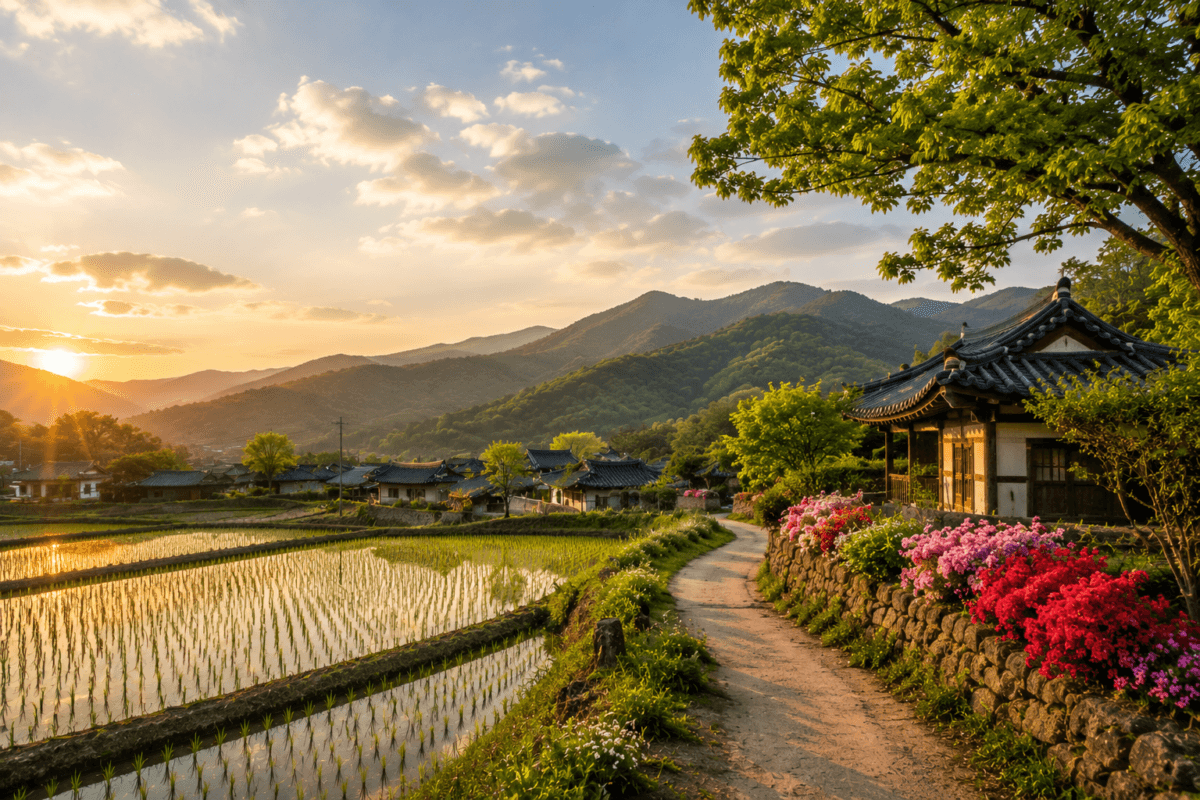
Petals gather in the corners of a stone path after a light breeze. A lantern frame hangs ready outside a temple gate. At the lake, people walk without hurry, as if the season itself has asked for a slower step.

This Week in Korea Q&A

  • What defines Korea’s public mood in mid-April?
    A shift from the excitement of first bloom toward a calmer spring atmosphere shaped by petals, longer outdoor routines, and the approach of ritual and heritage festivals.
  • Why is the weekly Culture Day change important?
    Because it makes cultural participation easier to fold into ordinary life, turning Wednesday into a recurring point of access for museums, performances, and other public cultural activities.
  • Why do lantern exhibitions matter before the main Lotus Lantern Festival?
    Because they let religious culture enter shared civic space gradually, through light, craft, and visual atmosphere before larger gatherings begin.
  • Why does Goyang-si matter this week?
    Because Goyang-si is entering its preparatory spring phase, with Ilsan Lake Park and the coming flower festival beginning to shape local mood ahead of late April.

This Week in Korea Further Reading

This Week in Korea  External Further Reading

This Week in Korea – Spring in Public Life

This week in Korea, spring has moved from expectation into public view. Blossoms have begun to set the rhythm of streets and parks, cultural policy has quietly shifted toward a steadier weekly cadence, and religious observance is once again becoming visible in the urban landscape. The change is not dramatic so much as cumulative. Across the country, people are stepping back into shared spaces shaped by weather, ritual, and the ordinary need to gather outdoors after a long season of enclosure.

This Week in Korea – When Spring Becomes Public

Early April gives Korea one of its most recognizable transitions: the moment when seasonal beauty stops being forecast and begins to organize everyday life. According to the 2026 cherry blossom forecast from VISITKOREA, Seoul’s blossoms were expected to open on April 3, 2026, with peak bloom projected around April 10. In the south, the season arrived earlier. By this week, the country’s spring map had already begun its visible movement northward, and that shift carries practical consequences. Commutes lengthen by a few slower minutes. Palace grounds and riversides absorb more lingering. Familiar routes become briefly ceremonial.

In Seoul, the Yeouido Spring Flower Festival opened on April 3 and runs through April 7, 2026. Blossom week in the capital rarely depends on a single program. Its deeper force lies in the way it redistributes attention across the city. Dense districts soften. Office neighborhoods acquire temporary leisure. Public life becomes easier to read through pauses, detours, and repeated upward glances. Spring in Korea is not only scenic. It is infrastructural in a social sense, changing how people inhabit time together.

This wider atmosphere fits neatly within Mantifang’s own ongoing interest in living Korea, where daily habit and cultural meaning meet not in abstraction but in shared settings. It also resonates with the broader structure of Korean influence as it unfolds across lived environments. What matters this week is not simply that trees are blooming. It is that bloom, ritual, and policy are all beginning to overlap in the same public frame.

This Week in Korea – A New Weekly Rhythm for Culture

Another shift took effect this week with less visual drama but possibly longer consequences. From April 1, 2026, the Ministry of Culture, Sports and Tourism’s Culture Day program now takes place every Wednesday rather than only on the last Wednesday of each month. The wording of the ministry’s announcement is revealing: the intention is to move cultural participation from the status of occasional event into part of the public’s “life rhythm.” That phrase matters. It suggests a view of culture not as reward or exception, but as something meant to settle into weekly habit.

In a society where time often feels sharply structured, even small institutional changes can alter imagination. A museum visit becomes easier to picture when it no longer belongs to one marked day at the end of the month. A midweek exhibition, screening, or concert becomes less aspirational and more ordinary. Korea has long excelled at building cultural infrastructure; this week’s adjustment speaks to the quieter question of recurrence.

That question also hangs behind the 2025 National Reading Survey, released in March. Student reading remains strong, while adult reading rates remain far lower even as e-books and audiobooks expand. Read together with weekly Culture Day, the message is subtle but clear: Korea is still looking for ways to preserve reflective habits inside a fast, efficient, digitally saturated social order. This week, that search feels visible not as argument, but as atmosphere.

The weekly rhythm is part of a longer continuity. If you wish to support the writing that sustains it, you can do so here: Support the Writing.

This Week in Korea – Lantern Season Before the Festival

The religious register of spring is also beginning to emerge, though still in a restrained form. The 2026 Lotus Lantern Festival schedule places the main public events on May 16 and 17, with Buddha’s Birthday Dharma ceremonies on May 24. Yet the season starts earlier than the parade. Across April and May 2026, traditional lantern exhibitions are scheduled for Gwanghwamun Square, the Seoul Museum of Craft Art, Songhyeon Green Plaza, Jogye-sa Temple, and Bongeun-sa Temple.

This earlier phase matters because it shows how religion enters Korean public life without arriving all at once. First come frames, colors, and suspended forms. Then the city’s surfaces begin to change. Lanterns appear not only as devotional objects but as an alteration of mood, texture, and memory. In Korea, Buddhism often becomes publicly legible through craft before ceremony. The lantern belongs to worship, but it also belongs to streetscape, continuity, and the seasonal eye.

That layering helps explain why spring in Korea can feel richer than a blossom calendar suggests. Flowers may dominate photography, but the deeper cultural texture lies in coexistence: palace paths, temple courtyards, riverside promenades, museum entrances, and civic plazas all participating in the same gradual reopening. For readers interested in the longer overlap between landscape and memory, Mantifang’s reflections on Korean nature remain a useful companion.

This Week in Korea – Goyang-si and the Shape of Anticipation

In Goyang-si, spring feels broader and slightly less compressed than in central Seoul. The city’s seasonal identity gathers around open space, especially Ilsan Lake Park, where the 2026 Goyang International Flower Festival is scheduled to run from April 24 to May 10, 2026. Even before the festival opens, its presence can be felt in preparation and expectation. The city begins to orient itself toward bloom as public program.

The official Visit Goyang tourism framing still presents the city through a calm combination of arts venues, lakefront space, and seasonal movement. That mix matters this month. Goyang does not stage spring as a sudden surge. It lets anticipation widen across pathways, event grounds, and repeat visits. The scale of Ilsan Lake Park helps. So does the city’s ability to hold both everyday residents and incoming visitors without forcing them into the same narrow corridor.

There is also another near-term layer to Goyang’s public life. VISITKOREA is already presenting the city as a host destination for the BTS world tour concerts at Goyang Sports Complex Main Stadium from April 9 to 12, 2026. That attention brings a different kind of seasonal crowd: one driven less by flowers than by movement, fandom, and temporary concentration. Together, the concerts and the approaching flower festival make Goyang unusually important this month as a place where leisure, spectacle, and open civic space intersect.

For Mantifang readers, Goyang’s significance is not only event-based. It fits naturally within the site’s wider archive on Goyang and on seasonal cultural life, because it offers a version of Korea in which public space is not merely passed through. It is inhabited at a slower pace.

This Week in Korea – The Week Ahead

The coming days are likely to deepen this atmosphere rather than alter it. Seoul will move further into blossom season. Midweek cultural outings will begin to test whether policy can actually reshape habit. Lantern exhibitions will become more visible before the larger Buddhist calendar arrives. In Goyang-si, the city will continue its turn toward April’s larger gatherings, with both pop-scale mobility and flower-season preparation starting to define how space is used.

This week in Korea is therefore less about one headline than about a pattern becoming legible. Weather, ritual, and civic movement are aligning again. Korea enters one of its recurring spring periods when ordinary life becomes briefly more observant, more visual, and more collective without needing to announce itself loudly.

A moment in Korea

A breeze moves along a path lined with trees just beginning to open. People slow almost without noticing, looking up once and then again. Somewhere nearby, lanterns wait in neat rows for evening light. The city remains itself, but softer at the edges.

This Week in Korea – Q&A

  • Why does early April matter so much in Korea?
    Because it is when spring becomes fully public. Blossoms, outdoor movement, and seasonal programming begin to change how streets, parks, and riverbanks are used.
  • What changed in Korea’s cultural calendar this week?
    From April 1, 2026, Culture Day now takes place every Wednesday, making cultural access a weekly rhythm rather than a once-a-month occasion.
  • Why are temple lanterns important before Buddha’s Birthday itself?
    Because they allow religious culture to appear gradually in civic space. Before the main festival arrives, the city is already visually transformed by craft, color, and ritual anticipation.
  • Why is Goyang-si especially relevant right now?
    Because it is moving toward two forms of spring concentration at once: the Goyang International Flower Festival and major BTS concerts in April.

Korea Culture March 2026: Ritual, Spring, and Public Life

Korea culture March 2026 carries a familiar tension between restraint and release. Winter has not entirely withdrawn, yet the country has begun to rearrange itself around spring: temple courtyards prepare for lantern season, public parks watch the first blossoms with patience, and cultural institutions quietly adjust their hours, habits, and invitations. The week has felt less like a dramatic turning point than a soft change in tempo, visible in streets, museums, reading rooms, and lakeside promenades.

Korea culture March 2026 cherry blossoms beotkkot in full bloom with people enjoying spring in bright sunlight

Korea Culture March 2026: What Moved Through Korea This Week

Across the country, the movement of spring has become a civic event as much as a seasonal one. The 2026 cherry blossom forecast points to an earlier bloom than average, with the southern edge of the peninsula already entering the season and Seoul expected to follow in early April. In practical terms, this means that public life is beginning to spill outward again. Parks, riversides, and palace grounds are not only scenic backdrops but places where people recalibrate daily routines, meeting the year anew in open air.

This shift has also been echoed in policy and cultural administration. From April 1, Korea’s long-running Culture Day will no longer be confined to the last Wednesday of each month; it will take place every Wednesday. The change is modest in appearance but meaningful in spirit. It suggests a vision of culture not as an occasional outing but as something more closely woven into ordinary life, a weekly rhythm rather than a monthly exception.

For a deeper understanding of Korean Buddhism and its philosophical foundations, see the Korean Buddhism overview on Mantifang.

Korea Culture March 2026

That idea of culture as habit rather than spectacle has appeared elsewhere as well. The Ministry of Culture, Sports and Tourism’s latest reading survey, released in March, showed that reading remains very strong among students while adult reading remains comparatively low, even as e-books and audiobooks continue to grow and people in their twenties show renewed engagement. The result is not simply statistical. It reflects a wider Korean question that surfaces often in public discussion: how to preserve reflection in a fast and crowded society, and how to keep cultural participation broad rather than concentrated among the already committed.

Institutions have been responding in quiet ways. The National Museum of Korea has adjusted operating hours this month in part to improve the viewing environment and reduce congestion, a small but telling sign that cultural life is being managed not only for scale but for experience. Even where crowds are expected, there is a noticeable effort to make public culture feel more breathable, less hurried, and more inhabitable. In that sense, Korea culture March 2026 is not only visible in festivals and forecasts, but also in the quieter adjustments of public institutions.

Korea Culture March 2026: Culture and Religion

Religious and cultural calendars are also beginning to draw closer together as spring deepens. The weeks ahead will lead toward Yeon Deung Hoe, the Lotus Lantern Festival, scheduled for May 16 and 17 in Seoul, with lantern displays extending through April and May and Buddha’s Birthday falling on May 24. Even before the main events arrive, their atmosphere starts earlier: lanterns appear in temple precincts, color enters urban streetscapes, and a different register of public attention emerges, one shaped by devotion, craft, memory, and anticipation.

In Korea, these moments are rarely confined to private belief alone. Buddhist observance often becomes part of the visual language of the city, accessible even to those who are not participants in a formal religious sense. Lanterns gather religious meaning and civic meaning at once. They illuminate doctrine, but they also soften the built environment, making dense streets feel briefly ceremonial. The festival’s long continuity, and its recognition as an important intangible tradition, gives spring in Korea a ritual depth that resists the disposable pace of seasonal trends.

Elsewhere in the cultural field, the state has continued to frame festivals and heritage events as important parts of national public life. This month, several major regional festivals received elevated recognition, underscoring how strongly Korea continues to treat local celebration, folk continuity, and communal gathering as living cultural infrastructure rather than ornamental extras. In this sense, the season is not only about flowers arriving on time or ahead of time. It is also about the annual return of shared forms: procession, exhibition, performance, food, memory, and neighborhood attention.

Korea Culture March 2026 Goyang-si

In Goyang-si, spring is felt with a slightly different texture. The city’s identity has long been tied to flowers, lakeside space, and a measured coexistence of residential life with large-scale cultural infrastructure. This week, that identity has been edging toward its most visible annual expression. Preparations for the 2026 Goyang International Flower Festival are already tangible, with the event set to run from April 24 to May 10 around Ilsan Lake Park. Volunteer recruitment and public notices have made the coming festival feel less like a distant event than an approaching change in atmosphere.

That matters because Goyang’s spring is not only something to look at; it is something the city organizes itself around. Ilsan Lake Park, even before the festival fully opens, begins to gather a different kind of attention in these weeks. Walking routes lengthen, benches fill more slowly, and the idea of public leisure starts to return after winter’s inwardness. The city’s cultural tourism identity, from the flower festival to Haengjusanseong and Aram Nuri, depends not on one single attraction but on a wider pattern of access to beauty, performance, and open civic space.

There is also a particular calm to Goyang at this time of year. Unlike the compressed energy of central Seoul, its public mood often unfolds laterally, around the lake, along tree-lined streets, across family spaces and event grounds that are large enough to absorb anticipation without rushing it. If Seoul’s spring can feel like a surge, Goyang’s often feels like a broadening.

Korea Culture March 2026: Looking Ahead

The next several days will likely make Korea’s seasonal transition more visible. As blossoms move northward and fuller color begins to arrive in central regions, public spaces will become more densely inhabited, especially where water, palace walls, temple grounds, and neighborhood parks converge. With weekly Culture Day beginning on April 1, Wednesdays may also take on a new practical meaning for museum-going, performances, and midweek visits that once required more planning.

Beyond the immediate bloom season, the horizon is already marked by deeper spring observances. Lantern displays will continue to gather momentum ahead of Yeon Deung Hoe in May, and Goyang’s flower festival will soon turn local preparation into full public display. The shape of the coming days, then, is not only festive. It is cumulative. Korea appears to be entering one of its recurring periods when ritual, weather, heritage, and ordinary movement begin to overlap more visibly in public space.

A moment in Korea:

At the edge of evening, the air is still cool enough to keep coats on, but not tightly fastened. A few early blossoms catch the last light above a walking path, temple lantern frames wait to be filled, and somewhere near a station exit a group pauses without hurrying on. Spring has not fully arrived, but it has become audible.

Korea Culture March 2026: Q&A

  • Why does late March feel so significant in Korea?
    Because it is the threshold between winter restraint and spring participation. Weather, festivals, blossoms, and public routines all begin changing at once, and the result is visible in everyday streets as much as in major cultural venues.
  • How does religion appear in public life during this season?
    Most visibly through Buddhist lantern culture ahead of Buddha’s Birthday and the Lotus Lantern Festival. These traditions shape city space as well as temple space, making devotion part of the wider seasonal atmosphere.
  • Why is Goyang-si important in a weekly cultural reading of Korea?
    Because Goyang shows how local identity in Korea is built through parks, festivals, family-scale public space, and repeat seasonal gatherings. Its spring flower calendar offers a clear example of culture as something lived collectively, not only consumed.
  • What does Korea culture March 2026 reveal most clearly?
    It reveals how seasonal change in Korea is never only about weather. It unfolds through public ritual, cultural habits, reading patterns, festivals, and the changing use of shared civic space.

Further Reading

External Further Reading

This weekly reflection is part of the ongoing Mantifang Korea series, exploring culture, ritual, and public life across the Korean peninsula.