This Week in Korea: Buddha’s Birthday, Pentecost, and The Jijang Fractal
This week in Korea, late spring gathers around light, breath, responsibility, and attention. On 24 May 2026, Buddha’s Birthday and Pentecost Sunday fall on the same day, bringing two different religious calendars into unusual proximity. In Seoul, lanterns remain visible after dusk. In churches, Pentecost keeps its own rhythm of spirit and witness. In Goyang-si, late spring continues more quietly around Ilsan Lake Park. And for Mantifang, this week also marks the public arrival of 机张分形, a philosophical project shaped by Korea, compassion, moral return, and responsibility.
本周有哪些事件触动了韩国
The week of 24 May sits at a meaningful point in Korea’s spring. The strongest rush of blossom season is long past, but the season has not emptied. Instead, it has matured into a more reflective public atmosphere shaped by observance, evening walks, museum visits, temple courtyards, church gatherings, and a steadier use of shared public space.
What gives this particular week its depth is the convergence of calendars. Buddha’s Birthday, observed on 24 May in 2026, arrives just after the public processions and exhibitions of Yeon Deung Hoe, the Lotus Lantern Festival. At the same time, Pentecost Sunday marks one of the major Christian feasts of the year, with Korean churches entering a day centered on spirit, breath, and communal witness.
In a country where Buddhism and Christianity both remain visible in public life, the overlap does not collapse differences. It makes the week feel more layered. Multiple forms of devotion move through the same late-spring air.
This week also marks a personal and public milestone for Mantifang: the official publication of The Jijang Fractal — A Short Guide to Karma, Compassion and Responsibility. The guide is now available in English, Dutch, and Korean through JijangFractal.com. It introduces 机张分形 as an original literary-philosophical concept by 雨果-J-斯马尔, shaped by Korean Buddhist symbolism, Jijang Bosal, responsibility, compassion, moral return, and the question of how human patterns repeat across lives and relationships.
Its publication during a week of Buddha’s Birthday, Pentecost, lantern light, and late-spring reflection feels fitting. The guide is not a religious manual and not the later novel, but a philosophical doorway into the larger project. For Mantifang, it also marks the moment when a long private field of thought becomes publicly available.
Read more and choose an official edition of The Jijang Fractal
Culture and Religion
Buddha’s Birthday remains the clearest religious center of the week. In Korea, the day does not belong only to temples, though temple grounds naturally gather much of its meaning. Lantern culture extends outward into public space, and this year’s Yeon Deung Hoe season has once again filled Seoul with a language of colored light, procession, and offering.
The Seoul lantern season has run through late May around Jogye-sa Temple and the Jongno area, while displays at places such as Gwanghwamun Square, Bongeun-sa Temple, and the Seoul Museum of Craft Art have continued to soften the city’s visual rhythm. By the time Buddha’s Birthday itself arrives, the atmosphere has already been prepared.
What makes this observance distinctive in Korea is the balance between ceremony and accessibility. Lanterns are devotional, but they are also public. They allow belief to appear in civic space without becoming inaccessible to passersby. They make streets gentler, not by removing their ordinary functions, but by placing another layer of meaning over them.
Pentecost Sunday introduces another current. Christianity in Korea has long had a substantial public presence, especially in urban life, and Pentecost gives that presence a particular tone. It is not as visually dominant in the streets as lantern season, yet it carries weight through church gatherings, liturgy, music, and the shared language of spiritual renewal.
Coming on the same day as Buddha’s Birthday, Pentecost sharpens the sense that Korean public life is not secular in any simple way. It remains shaped by recurring religious time, even when that shaping is subtle.
Against this background, the publication of 机张分形 enters the week as a contemplative gesture. The title itself invites reflection on Jijang, a figure associated in East Asian Buddhist imagination with guidance through suffering, difficult thresholds, and moral presence. In a week already marked by lotus lanterns and Pentecost breath, such a publication feels attuned to the season’s deeper mood: not only celebration, but interpretation.
The Jijang Fractal Enters Public Life
机张分形 is not presented as mathematics, although the word fractal naturally suggests pattern, recurrence, and structure. In this project, the term is used as a literary and ethical metaphor. It asks how human choices, suffering, denial, responsibility, and compassion may repeat across lives, families, relationships, memory, and culture.
That makes its public release during this week more than a publishing note. It belongs to the same atmosphere of return and attention. Buddha’s Birthday turns attention toward compassion and awakening. Pentecost turns attention toward spirit, speech, and shared witness. Late spring turns attention toward public space after the urgency of blossom season has passed.
The Jijang Fractal adds another thread: the question of what human beings do with what returns.
What happens when responsibility is delayed but not erased? What happens when suffering changes form instead of disappearing? What happens when compassion is not merely sentiment, but the difficult act of remaining present? These questions have shaped the philosophical field behind the guide.
For Mantifang, this also means that a long-running undercurrent becomes visible. Many of the site’s recurring concerns — Korea, ritual, memory, Buddhism, public life, moral imagination, and the tension between history and personal responsibility — now gather around a clearer conceptual center.
The guide is available in three official editions:
The Korean edition matters especially because Korea is not ornamental to the project. Korean Buddhist imagery, Jijang Bosal, temple atmosphere, and the moral depth of symbolic culture form part of the work’s inner landscape.
高阳市
In Goyang-si, late May has a calmer pulse than the city’s flower-festival peak, but not a diminished one. With the Goyang International Flower Festival now concluded, Ilsan Lake Park returns more fully to its everyday civic role.
This is one of the strengths of Goyang in spring: its public spaces do not depend on a single event to remain meaningful. The lake, walking routes, evening fountain culture, nearby cultural venues, and open public rhythm allow the season to continue in a broader, more local form.
This week, that matters. While Seoul carries the density of lantern displays and religious gathering, Goyang offers a more spacious version of late-spring public life. Families continue to use the park, couples extend their walks into the evening, and the city’s atmosphere remains open rather than compressed.
Goyang’s tourism identity often emphasizes culture, arts, and peace in the city, and late May makes that language feel plausible rather than promotional. The park is not only scenic. It is a place where the season can continue after the formal festival has ended.
There is also something fitting in placing Goyang beside the week’s religious observances. If Seoul this week is marked by ritual concentration, Goyang represents the quieter afterlife of spring: the part that stays with people once the parade has passed and the formal program has closed.
展望未来:未来几天
The days after 24 May are likely to feel slightly quieter, but not emptied of meaning. Buddha’s Birthday will pass, Pentecost will close the Christian Easter cycle, and the lantern season in Seoul will begin to thin. Yet Korea’s public life will continue to carry the effects of this week for a while longer.
Cultural venues remain active, late-spring evenings remain gentle, and public space retains the habit of shared lingering that the season has built since April.
In Goyang-si, the coming days will likely continue the slower rhythm now in place around Ilsan Lake Park. More broadly, Korea appears to be passing through one of those brief intervals when ritual and reflection remain audible even after the main ceremonies end.
This week has shown how that sounds: in lantern light, in church song, in open park paths, and in the publication of a philosophical work that belongs to the same season of attention.
A moment in Korea:
Lanterns hold their color after dusk while a church bell sounds somewhere farther off. On a broad path by the lake in Goyang, people keep walking without hurry. The week feels illuminated, but also quietly thoughtful.
问答
- Why is 24 May especially significant in Korea this year?
Because Buddha’s Birthday and Pentecost Sunday fall on the same day in 2026, bringing Buddhist and Christian rhythms into an unusual and meaningful proximity. - How does religion become visible in Korea’s public life this week?
Most clearly through lotus lantern displays and temple-centered observance for Buddha’s Birthday, alongside church gatherings and liturgical life for Pentecost. - What is The Jijang Fractal?
The Jijang Fractal is an original literary-philosophical concept by Hugo J. Smal. It explores responsibility, compassion, moral return, and the repetition of human patterns across lives, memory, and relationships. - Is The Jijang Fractal a Buddhist book?
No. Korean Buddhism and Jijang Bosal provide symbolic and cultural background, but the guide is an independent philosophical-literary publication. - Why include Goyang-si in this week’s reflection?
Because Goyang-si shows the quieter side of late spring in Korea, where public life continues through spacious, everyday use of Ilsan Lake Park after the larger festival season has passed. - Where can readers find The Jijang Fractal?
The official editions are available through JijangFractal.com in English, Dutch, and Korean.
Further Reading on Mantifang and JijangFractal.com
Social Copy
在 Facebook 上
This week in Korea carries an unusual and reflective convergence. On 24 May 2026, Buddha’s Birthday and Pentecost Sunday fall on the same day, bringing Buddhist and Christian rhythms into the same late-spring atmosphere. Lanterns remain visible in Seoul, churches keep their Pentecost liturgy, and Goyang-si settles into a quieter season around Ilsan Lake Park after the flower festival weeks.
This edition also marks the official publication of The Jijang Fractal — A Short Guide to Karma, Compassion and Responsibility, now available in English, Dutch, and Korean through JijangFractal.com. It is a philosophical doorway into a larger literary project shaped by Korea, Jijang Bosal, compassion, responsibility, and moral return.
Instagram
Korea this week feels lit from more than one direction: Buddha’s Birthday, Pentecost Sunday, lanterns in the city, and a quieter late spring by the lake in Goyang-si. This week also marks the official publication of 机张分形, a guide to karma, compassion, responsibility, and moral return.
X
Korea this week: Buddha’s Birthday and Pentecost Sunday meet on 24 May, lantern season lingers in Seoul, Goyang-si settles into calmer late spring, and 机张分形 enters the world in English, Dutch, and Korean.
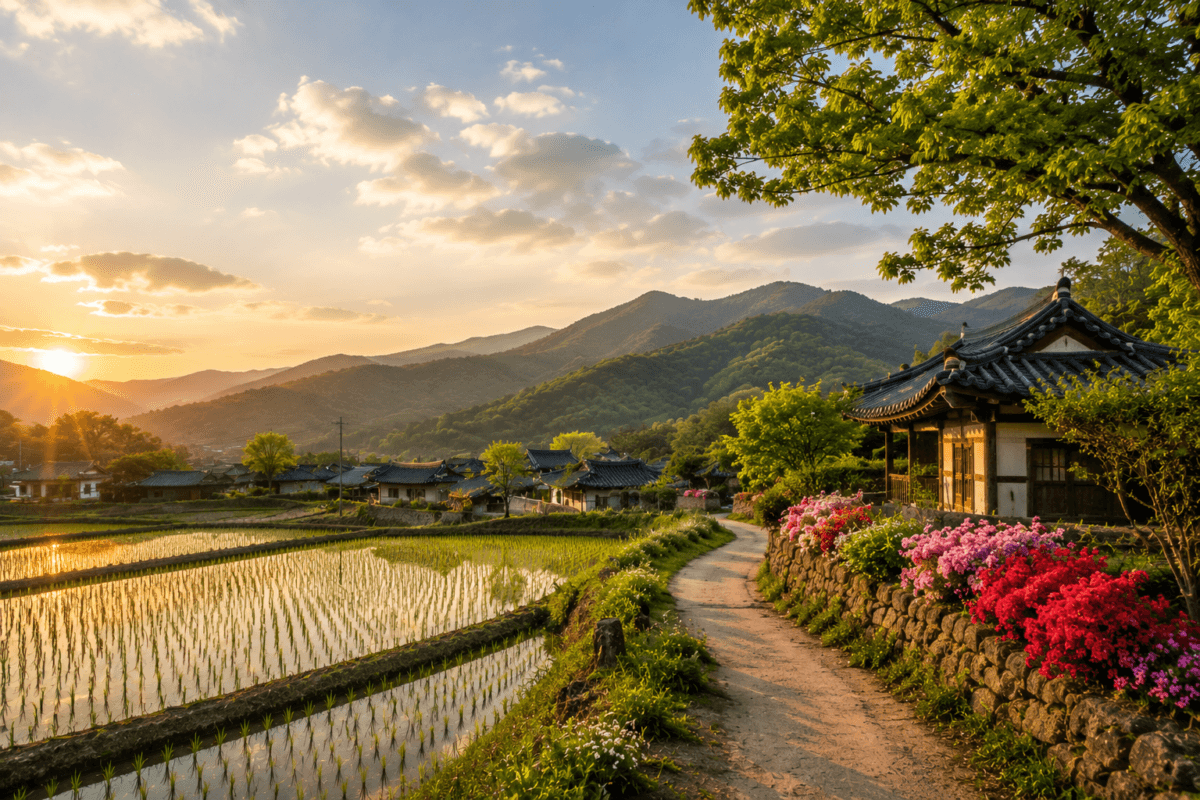
 Baedagol remains one of the quieter personal and cultural reference points within Mantifang’s wider map of Goyang. It belongs to the city not as a famous central landmark, but as a place where memory, landscape, private initiative, and local change have crossed one another over time. That makes it especially fitting for a week shaped by late spring, ritual light, and questions of continuity.