Bogwangsa Temple Korea 3
By: Hugo J. Smal
Images: Mickey Paulssen
A Compass, Not a Correction
In the days after publishing part one and two about the Bogwangsa temple and its profound symbolism, I received a message from Venerable Lee Kong, a monk of the Jogye Order. His words weren’t a correction, but something subtler—something that felt more like a compass than a commentary:
“With my head directed toward Buddhahood, and my heart committed to the liberation of others…”

His voice, though distant, arrived with a quiet clarity. It wasn’t about verifying details—it was about staying aligned. Aligned with the Dharma, with sincerity, with compassion.
He resides in Haeryongsa, a small hermitage resting at the base of Seongbulsan, one of the outer ridges of Mount Biseulsan. It sits just beyond the edge of the city—close enough to be reached, yet far enough to breathe. He serves as a meditation guide, quietly offering practices that range from yoga to qi-gong to traditional Buddhist meditation. He resides in a small hermitage, where simplicity and silence form the ground for inner work. Though the place is modest, its spirit is vast.
He also serves Venerable Beopta, the revered josil (senior meditation teacher) at Eunhaesa, one of the main temples of the Jogye Order, nestled in the mountains of Palgongsan. His path has not been bound by one lineage alone—he also spent many years practicing alongside Thai monks, deepening his perspective through both Mahāyāna and Theravāda traditions.
A Dream of Alignment
Perhaps it was his voice. Or the quiet weight of the teachings that I carried with me into the mist of Bogwangsa temple. But somewhere in that mist, the dream returns—softly, without demand.
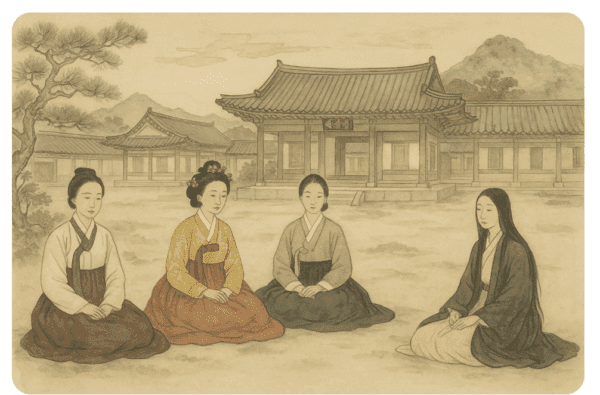
I see myself again, seated in the open square in Seoul, between two titans of Korean memory: Admiral Yi Sun-sin, standing in unwavering readiness, and King Sejong, seated in quiet contemplation. One defends with the sword. The other teaches with words. And between them—on a simple mat, Jijang-bosal and Gwanseum-bosal share a bowl of tea. No doctrine. No ceremony. Just presence. Just listening. It wasn’t a dream of meaning.
Bogwangsa Temple Korea
It was a dream of alignment.
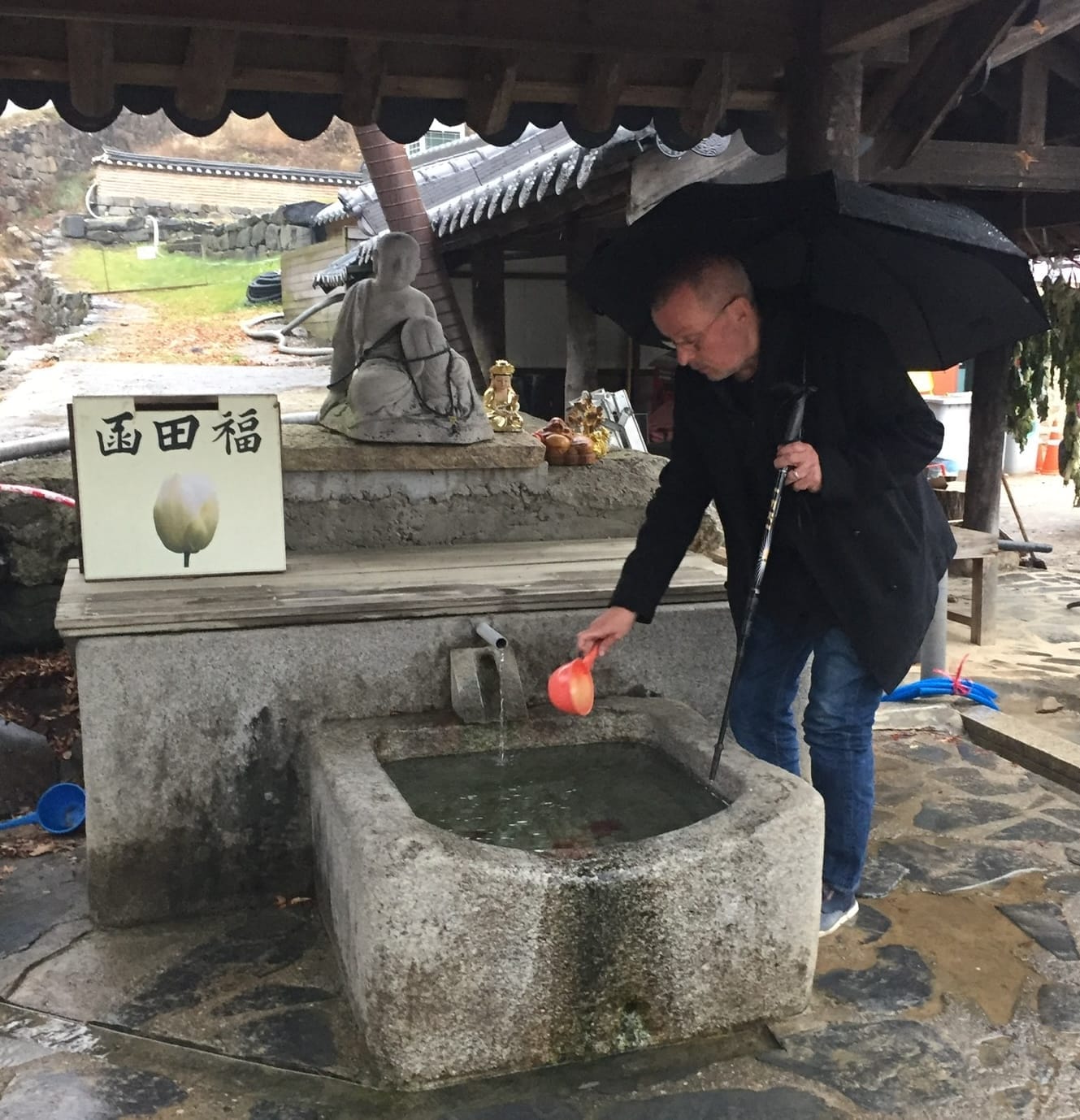
And still, the sky over Goryeongsan hangs grey and damp. Yet I feel thirsty—not only spiritually, but physically too. What I saw in the main hall didn’t just move me emotionally—it touched something in my body as well. A sensation I know all too well: tight, burning nerves, and a mouth as dry as the ashes of incense. Thankfully, near the entrance, I remember a spring. From it, I draw water—renewing both body and spirit.
Wontongjeon and Fractal Compassion
The Wontongjeon (원통전) and the Fractal Compassion of Gwanseum-bosal
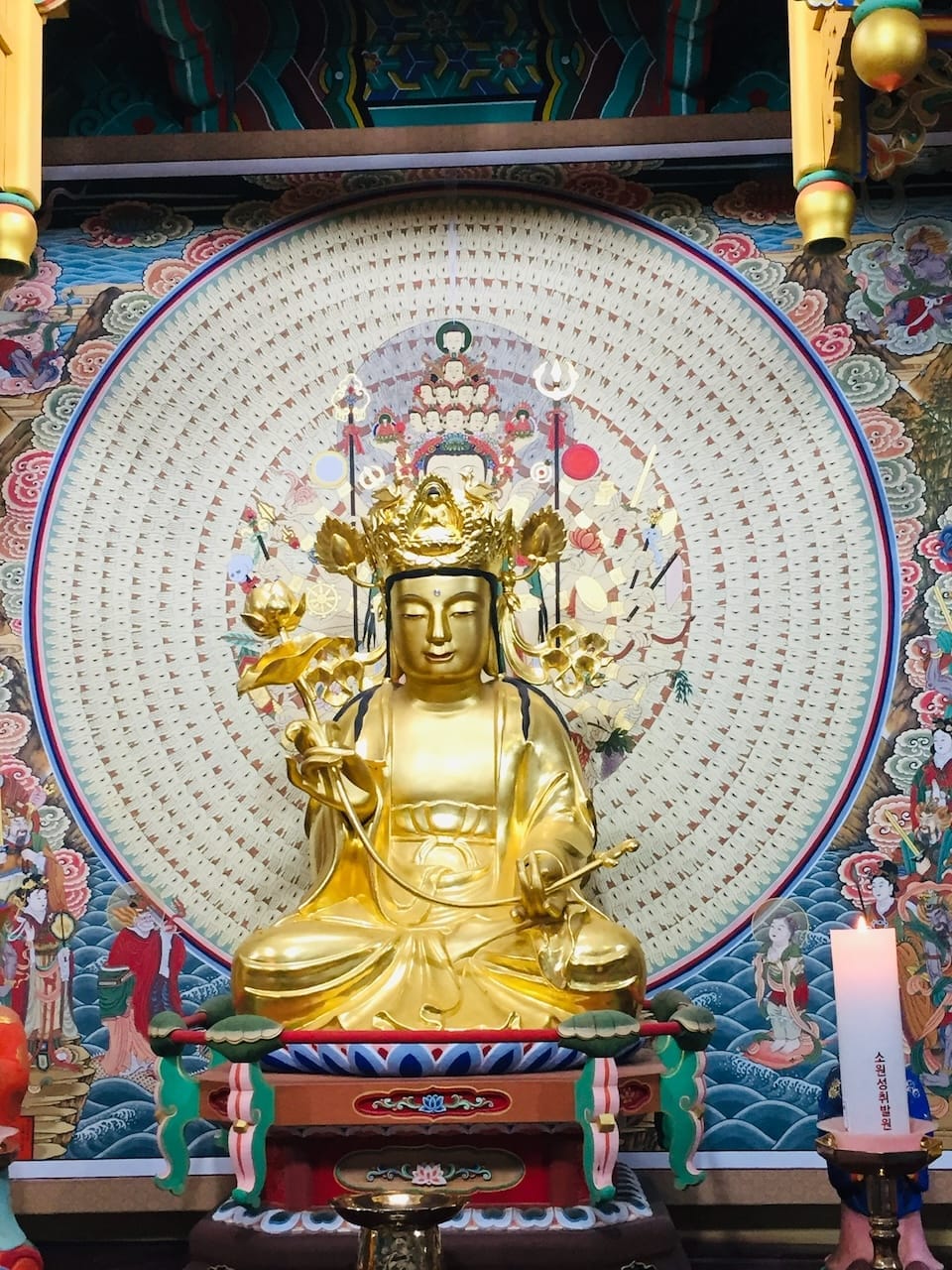
This full view of Gwanseum-bosal at Bogwangsa temple Korea reveals her surrounded by a mandala of a thousand compassionate hands and eyes. Every detail—from the golden lotus to the crowned head of Amitabha—embodies the essence of spiritual heritage in Asia. A visual hymn to Buddhist symbolism and fractal compassion.
At the core of the Bogwangsa temple, the Wontongjeon glows with quiet grace. The Wontongjeon (원통전) is dedicated to Avalokiteshvara Bodhisattva—Gwanseum-bosal (관세음보살), the bodhisattva of compassion. The term Wontong means “universally penetrating” or “all-encompassing illumination,” reflecting Avalokiteshvara’s ability to hear and respond to the cries of suffering souls across all realms.
This image of Gwanseum-bosal is not merely a religious icon, but a profound visual expression of the fractal nature of compassion, awareness, and interconnection. Both the physical representation and the symbolic backdrop situate her within a cosmic field—one where every sorrow is seen, every soul heard.
She is, after all, the Bodhisattva Who Always Listens.
In her thousand-armed form, she reaches in all directions, responding to every call. Her presence in Bogwangsa suggests compassion not merely as emotion, but as a cosmic principle—woven into the fabric of transition, of life and death. Though this temple is primarily dedicated to Jijang-bosal, Avalokiteshvara stands here as the embodiment of universal receptivity—a listener beyond the boundary of self. Together, they form a sacred symmetry: one leads, the other listens.
Shared Compassion at Bogwangsa Temple Korea

Held with both hands, the golden lotus symbolizes shared compassion. Not merely offered, but uplifted together—between bodhisattva and seeker, between wisdom and action. A gesture deeply rooted in Buddhist symbolism.
What strikes me most is how Gwanseum-bosal does not simply hold the golden lotus—she supports it. Her left hand lifts it gently from below, as if to say: compassion is not only offered; it is also carried together. Her gesture suggests that compassion is a partnership—between bodhisattva and seeker, between wisdom and action.
Amitabha’s Crown and the Depth of Buddhist Symbolism at Bogwangsa Temple Korea
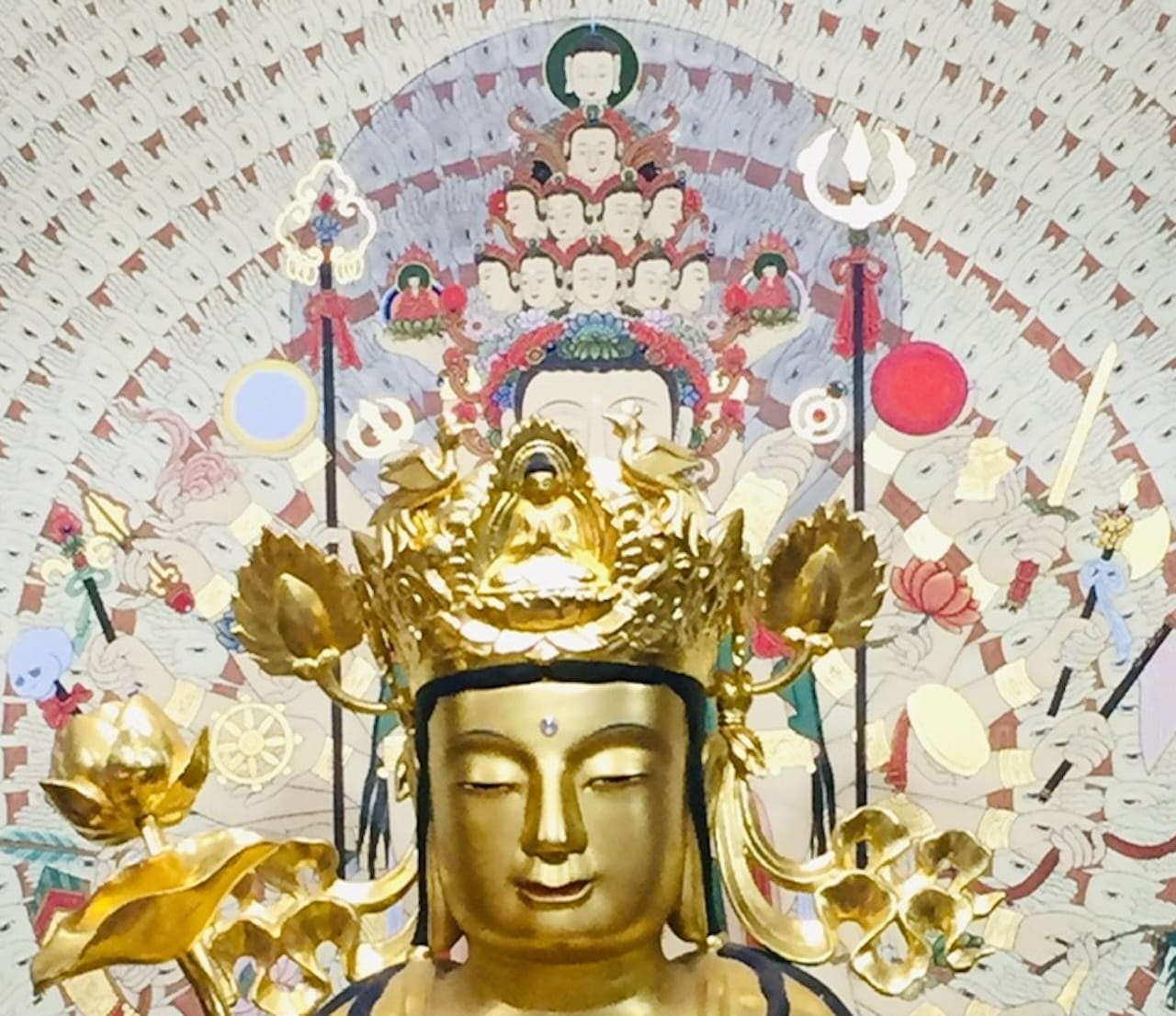
Her crown is richly adorned and bears the image of Amitabha Buddha, a reflection of her spiritual origin and goal: the Western Pure Land of Liberation. Her face, radiant and serene, eyes half-closed, speaks of an inner peace that remains steadfast even in the face of cosmic sorrow. She seems to gaze both inward and outward at once. And I can’t help but wonder—what is it she sees?
Tea and Truth
Tea and Truth: A Spiritual Dialogue in Bogwangsa Temple Korea
And then I remember what they were saying. Not in words alone, but in the weight behind them. The tea, the silence, the question that still echoes.
In that dream—so vivid it feels like memory I found myself back in the spiritual quietude of Bogwangsa temple, where dreams and doctrine gently dissolve.
Jijang-bosal takes a sip of tea and turns to Gwanseum-bosal: “You listen to the voices of those who suffer in this world.
I guide those who search for their way after death. And yet, their burdens return again and again. How do we help them let go?”
Gwanseum-bosal smiles softly, her hands circling the warm cup. “Suffering is like this tea,” she says. “Warm. Bitter. But fleeting. Its taste does not stay. Still, many cling to it as if it were eternal.”
Jijang-bosal nods. “I show them the path, but many fear to take it. They fear what they must leave behind, or what awaits beyond. But in truth…”
Gwanseum-bosal finishes the thought: “…there is nothing to hold on to.” Jijang-bosal watches the steam rising from his cup. “Exactly. Just as tea was once water and will soon return to vapor, so are we always in motion. Suffering is not something to carry —but something to let flow.”
She lifts her cup one last time. “And when they realize this, there will be nothing left to release.” The tea is gone. The cups are placed down. No longer full. But not empty either.
The Thousand Eyes of Avalokiteshvara and Buddhist Symbolism

A close-up from Bogwangsa temple Korea, this sea of hands evokes the thousand-armed Gwanseum-bosal—each gesture a vow to listen, to heal, and to uphold the temple’s Buddhist symbolism in endless compassion.
Each hand is a vow. To see suffering—not in the abstract, but in the detail of every trembling soul. To reach out—not just from afar, but here, now, in the intimacy of shared breath.
A thousand hands. A thousand eyes. Not to overwhelm, but to reflect: compassion, too, is fractal. It repeats, not for redundancy, but for presence. And in that repetition, I find something: She does not need to move. The eyes move for her. She does not need to touch. The hands have already begun. And I—still, small, silent—am seen.
Sansin and the Arhats
Gwanseum and Mary: Shared Devotion in the Spiritual Heritage of Asia
Of course, Gwanseum reminds me of Mary. Back home, I had seen people weep before her statue, just as visitors here whisper their grief to Gwanseum. The devotion feels nearly identical. Surrounded by flowers, candlelight, and prayers, both embody the archetype of compassion.
I have no doubt this comparison will be met without resistance. Korean Buddhism is profoundly inclusive—after all, even Sansin, the shamanic mountain spirit, has found his place on temple grounds.
The main altar left me with a sense of reverence, a humble awe before Seokgamoni-bul and his companions. But when I bowed before Gwanseum, I felt something warmer. She is, indeed, like a loving mother. What hasn’t changed is the weather. The sky still weeps its soft drizzle. Thankfully, in the Sansingak (산신각), it is dry.
The Spirit of the Mountain: Sansin in His Pavilion
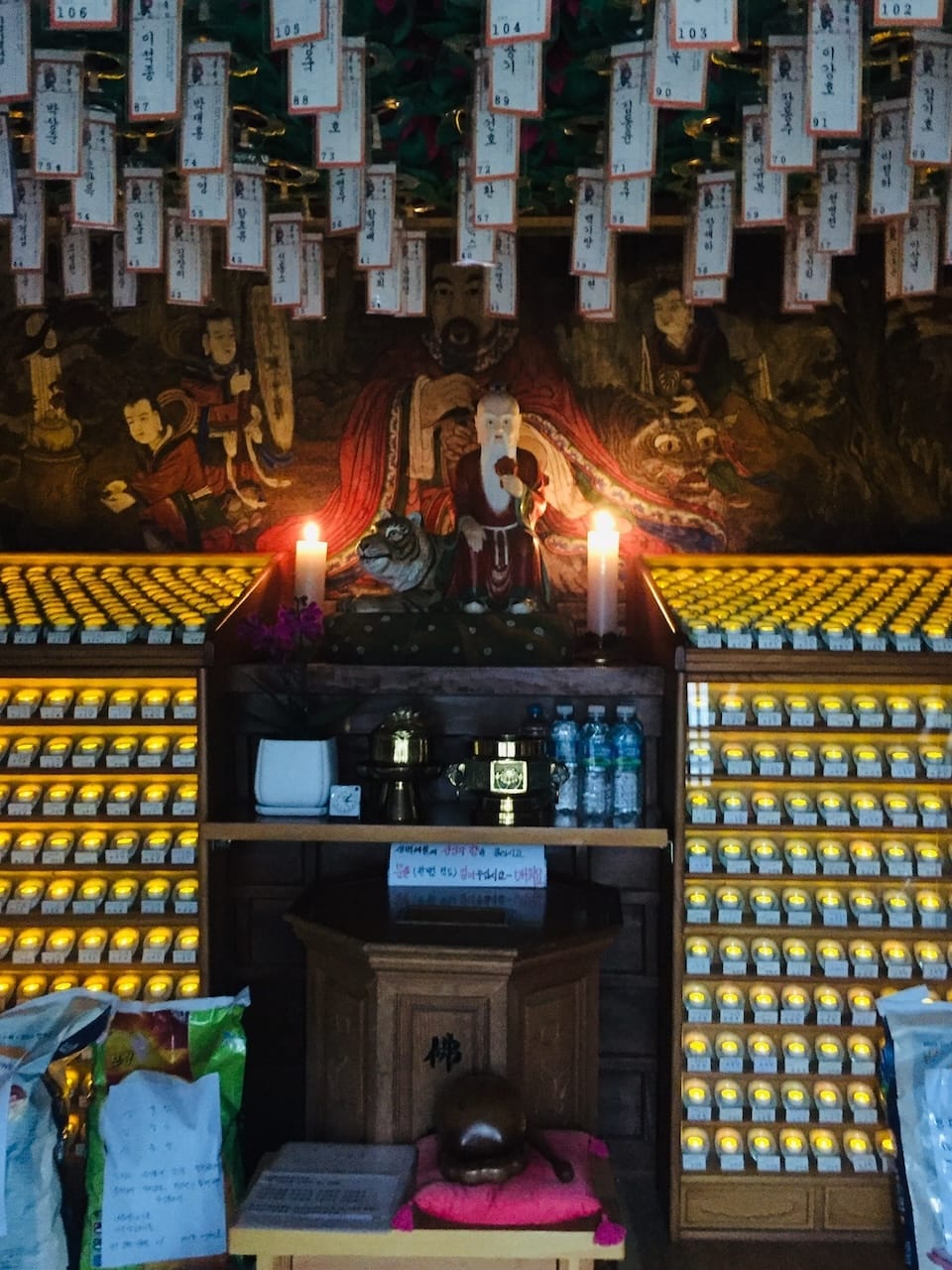
This is the pavilion dedicated to Sansin (산신), the mountain spirit of Korea. The space is intimate, almost humble in its simplicity. At its center sits Sansin himself—an elderly man with a long white beard, clothed in traditional Korean garments. By his side rests his tiger, a powerful symbol of protection and a link to the wildness of nature. Behind them, painted on the taenghwa, Sansin appears again—this time surrounded by attendants and mountain spirits, guardians of his mysterious domain.
Though Sansin’s roots lie in Korea’s shamanistic past, his worship is fully woven into the fabric of Korean Buddhism, especially in temples nestled deep in the mountains.
The Meaning of Sansin
Sansin is revered as the protector of wisdom, a guardian of health, and a granter of long life. He embodies the raw force of nature and the spiritual energy that flows through Korea’s mountainous landscapes. His role as a guardian of temples built on powerful geomantic sites—like Bogwangsa—is deeply respected.
Rituals and Reverence
Monks and visitors alike bring offerings of rice, fruit, water, or wine to Sansin. Their prayers seek protection, well-being, fertility, or success in spiritual practice. These rituals often lean toward the shamanic—more personal than ceremonial—but they live in quiet harmony with the Seon Buddhist traditions of Bogwangsa.
The Sansingak is more than a side building; it is a threshold. A place where nature, spirit, and humanity meet. It reminds me of the strength of the mountains, of unseen protectors who guard the sacred, and of the beautiful entanglement of shamanism and Buddhism in Korean culture.
In the quiet power of Sansin’s presence, I recognize echoes of another sacred encounter—one where Korean reverence and Tibetan ritual once converged. That story, too, continues in Holy Korean and Tibetan Transitions.
Guardians of the Dharma: The Arhats in the Nahan-jeon of Bogwangsa

These serene figures represent enlightened disciples of the Buddha, quietly guarding the Dharma in the sacred stillness of Bogwangsa temple Korea.
Deep within the Bogwangsa temple complex, nestled among ancient trees and mist-laden hills, lies the Nahan-jeon (나한전, Hall of the Arhats). This sacred space is dedicated to the enlightened disciples of the Buddha, known in Korean as Nahan (나한), or Arhats.
The Nahan-jeon radiates an atmosphere of deep contemplation. Upon entering, I am greeted by a row of serene icons, each seated on a vibrant, lotus-shaped cushion. Their faces—pale and tranquil—appear timeless, almost human, as if they embody silence itself. Clad in simple monk’s robes, their hands rest gently in their laps or fold softly into mudras. Behind them stretch richly decorated murals, filled with scenes of the Buddha’s teachings and spiritual journeys through distant lands and mystical realms.
In Korean temples, Arhats are often depicted as a group of sixteen or eighteen figures (십육나한 / 십팔나한, Sibyuk Nahan / Sibpal Nahan), each with unique expressions, gestures, and spiritual attributes. Some hold scrolls or malas (prayer beads), others a staff or symbolic objects like bowls or dragon pearls. Though they have attained enlightenment, they remain in the world—as guardians of the Dharma and protectors of the temple.
The most recognized among them is Pindola Bhāradvāja (빈두로 바라문, Binduro Baramun), often identified by his long eyebrows—a mark of deep wisdom. Challenged by the Buddha to demonstrate his spiritual powers, he became known as the Arhat who endures as long as the Dharma endures. Another highly regarded figure is Kāśyapa (가섭, Gaseop), protector of esoteric teachings and keeper of profound meditative practices.
In Bogwangsa’s Nahan-jeon, time seems to stand still. The soft glow of candlelight reflects in the polished eyes of the Arhats, while the air is thick with the scent of incense. Here, monks and visitors meditate and offer homage, seeking to awaken the Arhats’ wisdom and resolve within themselves.
As I leave the hall, a quiet sense of peace lingers. The Arhats remain unmoved on their cushions, keeping watch over the Dharma, ready to welcome the next traveler in search of awakening.
Nearby stands the Jijangjeon, a hall dedicated to Jijang-bosal (Ksitigarbha Bodhisattva, 지장보살), the bodhisattva of the afterlife and protector of souls in the underworld. People often pray here for the deceased, asking for their safe passage and favorable rebirth. Positioned closer to the entrance, it lies lower in elevation—closer to the earth, and thus to the realm of the dead.
Closing Vow
The air outside the hall is still damp, heavy with the scent of pine and mist. Somewhere behind me, the incense still burns. But I carry a different kind of smoke now—one that rises inward.
I think of the hands that reach. The eyes that see. The tiger beside the mountain god. And the Arhats at Bogwangsa Temple Korea who watch in silence, not because they demand anything, but because they already understand. And then I remember what they were saying.
Not in words alone, but in the weight behind them. The tea, the silence, the question that still echoes.
In that dream — so vivid it feels like memory — Jijang-bosal takes a sip of tea and turns to Gwanseum-bosal:
“You listen to the voices of those who suffer in this world. I guide those who search for their way after death. And yet, their burdens return again and again. How do we help them let go?”
Gwanseum-bosal smiles softly, her hands circling the warm cup. “Suffering is like this tea,” she says. “Warm. Bitter. But fleeting. Its taste does not stay. Still, many cling to it as if it were eternal.”
Jijang-bosal nods. “I show them the path, but many fear to take it. They fear what they must leave behind,
or what awaits beyond. But in truth…”
Gwanseum-bosal finishes the thought: “…there is nothing to hold on to.” Jijang-bosal watches the steam rising from his cup. “Exactly. Just as tea was once water and will soon return to vapor, so are we always in motion. Suffering is not something to carry — but something to let flow.”
She lifts her cup one last time. “And when they realize this, there will be nothing left to release.” The tea is gone. The cups are placed down. No longer full. But not empty either.
In the soft rain outside the Bogwangsa temple, I bow— not because I am close to enlightenment, but because I understand, now more than ever, that the path itself is sacred.
The great wheel turns. Not away from me, but with me. And I, still shaped by longing and learning, am not ready to leave it behind. But I can walk it with care.
With my head directed toward Buddhahood, and my heart committed to the liberation of others. Not as a destination — but as a vow.
I invite you to follow me Hugo J. Smal, Jijang’s fractal or Spiritual East Asia
Disclaimer
I’ve done my utmost to describe the icons, halls, and rituals of Bogwangsa Temple Korea with care and accuracy. Still, any misidentifications or symbolic misreadings are entirely my own. Should you spot any such errors, your insight is warmly welcome. But above all, I hope what resonates is the spirit of the story—the atmosphere it conjures, the openness it invites, and the sincerity with which it was written.
— Hugo J. Smal
“`