written by Hugo J. Smal
How to watch Hallyu drama.
I love to watch and explain Korean movies and television series. For a long time, non of my friends could not cope with that. They simply did not understand Korean culture. And they still do not even tough I had Korean drama explained. Yes, during drinking evenings, I talked a lot about the Daehan Minguk. Maybe too much. The friends looked a little bit bored and took another beer. I brought spicy fried chicken to the table. They did not want me to explain Korean movies or television series.
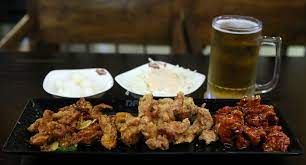 Chi-maeg is very populair in Korea. You eat it with friends or workmates. This is not done in the dining room but in one of the little restaurants that are easy to find. The Koreans love to go out eating and have fun. In every movie or television series, the restaurant table is the hotspot.
The squid game changed.
Yes, I bored them a little bit. This changed since the movie Squid games. Their attitude improved. Now everybody wants to talk about Korea. The land is hot. And I am sure that when Covid was not our dictator, tourism to the land of the morning calm would explode. This is just my humble opinion. So let me give you some background information. This is useful while watching the screen. I promise you the word boring and watching Korean visual entertainment are not a couple. So let me give you some basic information. This will help you to understand Korean movies and television series a little bit more.
Names in Korean drama explained.
 When we think of common Korean surnames, the Kim family, which rules in North Korea, quickly comes to mind. Surnames like Kim, Choi, Lee, Kang, Jang, and Park are common in Korea. Most of the time, these names originate from the names of ancient clans.Like everywhere in East Asia: use first the family name and after that the personal name. So Kim Jong Un and not Jong Un Kim as we in the west would do.
An anonymous person wrote on Ask a Korean:
In Korean manners, using the first name either meant very close intimacy or extreme superiority. Therefore, relatively few people may call you by your first name. Here is the list of those people: parents, grandparents, uncles and aunts; your older (but not younger) siblings; close friends of the same age or older; your owner (if you are a dog, cat, or other pets, or a slave in the old days.) That is it. That is Korean drama explained.
About using names in the work environment, the same person wrote:
For people met through a professional acquaintance, the correct term is to use the person’s last name, followed by his rank or profession. Thus, if you are a manager (bujang) whose last name is Kim, they call you Kim bujang-nim. (nim is an honorific, which makes the whole thing translate to “Manager-Sir/Madam Kim”.) If you are an owner of a store whose last name is Kwon, the Koreans call you Kwon sajang-nim. (sajang means the owner of a business. So you are being called Owner-Sir/Madam Kwon.
It is really worthwhile to read the entire blog: Blog
Bowing in Korean drama explained.
 Waving or at least raising your hand is what we as westerners do when greeting. In Korea, people bow to each other. You don’t have to get all the way down on your knees. But a little bow is so respectful. The same goes for showing gratitude. The more grateful you are, the deeper your bow.They don’t just bow in greeting or gratitude. When someone has done something wrong and apologizes, they are prone to bowing. When someone has lied to someone else (or name something else that is serious) they go to their knees.
There is much more to explain about bowing in Korean drama. I found an outstanding article here
Formal and informal.
 While we are using the formal word “you” less and less, in Korea it is very important to speak formally. If you don’t, it’s “disrespectful.”Take age into account to determine who you should speak to formally and who not. You should also ask yourself: How well do I know this person? If the person indicates that you are allowed to talk to them informally, that is a sign to ‘behave differently.
Respect for the elderly in Korean drama.
In Korea, respect for the elderly is common. This does not only mean that they respect people over 65, even if you differ with someone for a few months you show respect.
This lies in speaking formally and behaving properly. Watch your language, and so on. What strikes me personally is how children/young people deal with their parents. We in the west no longer express immense gratitude for parenting.
To be vocal in Korean drama explained.
 The Dutch are always nice and sober. Cut our finger? Forget it. Soon you won’t see anything anymore. Koreans can (it does not have to be) express themselves quite vigorously about this. With cries like “OMO!” and “Ottoke?!” (meaning “Oh my God” and “Now What?”) the Koreans show how worried or in pain they are.
Also when there is an argument it can go loud. Lots of angry expressions are used. I name just some of them: hello! (what the hell!). Young people use this when they are frustrated. You can also use aish! Aigo is an expression used when someone is frustrated, irritated or just fatigued. Omo! means oh my god. But just looking means: Korean drama explained
Typical Korean food and drinks.
Eating culture in Korean drama explained. What should not be missing in the Korean series is of course the typical Korean food and drinks! Much of Korean life happens in restaurants, around the dinner table. On the screen, you see friends, co-workers and sometimes even enemies go-to restaurants again and again. Things you often come across are soju, Kimbap, Kimchi, Jajangmyeon and Miyeok guk. And the Americano coffee (black coffee as we know it) should certainly not be missed!
 Soju
Soju
This alcoholic drink, made from rice and is often sold at eateries. Drink it from small shot glasses and it often contains 20% alcohol. Another typical drink is makgeolli. Traditionally soju was made from rice but after the Korean war
(1950th) people made soju with starch of potato, barley, sweet potato and tapioca.
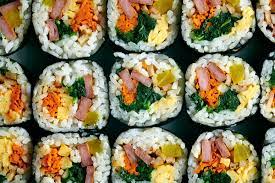 Kimbap
This Korean snack consists of rice rolled in seaweed along with various vegetables or meat. Yes, in Japan they call it Sushi. In Korea, they make it with spinach, cucumber, carrot, beef or fish. You find a recipe here
 Kimchi
A well-known, spicy side dish combined with several dishes. Kimchi consists of fermented cabbage and vegetables, aged for months in a jar. This pot is often kept (underground) in the garden.
Kimchi is traditionally made, salted and fermented cabbage or radish seasoned with powdered red pepper, garlic, green onions mixed with some fish sources. As kimchi appears on almost every meal, to keep kimchi, Koreans traditionally used big pots buried half underground. However, most people today use refrigerators specially made for kimchi preservation. You find a recipe here
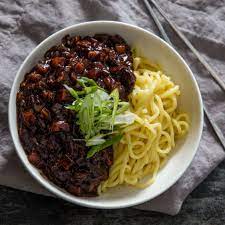 Jajangmyeon
Jajangmyeon is a dish that consists of noodles, vegetables, meat and black bean sauce. Often they mix the dish completely. It becomes a tasteful slippery mess. You find a recipe here
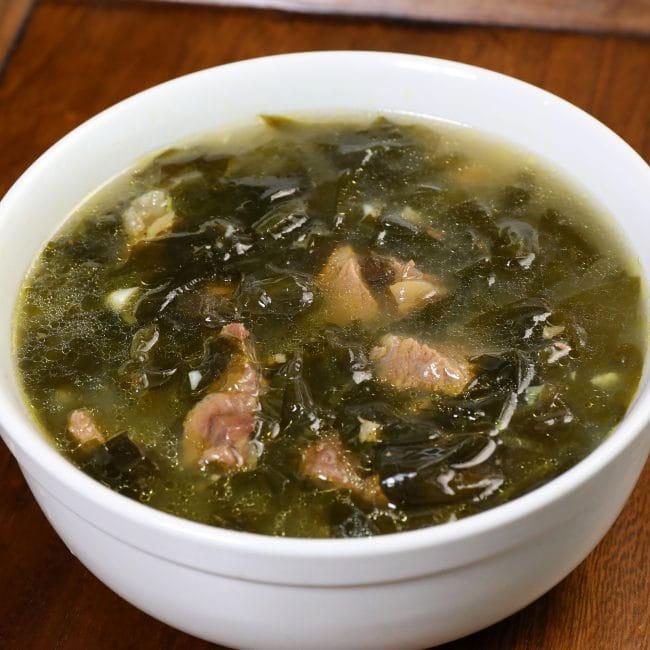 Miyeok guk
Miyeokguk is a soup made of edible seaweed and is traditionally eaten on birthdays or after giving birth, although you can eat anytime you like. You find a recipe You find a recipe here
So, this was Korean drama explained. But there is so much more to tell. The best you can do is to follow the mantifang or one of our Social Media channels. You find them here


