aquaponics Success: 7 Proven Steps for a Thriving Fish–Plant System

Aquaponics: A Practical Guide to a Closed-Loop Growing System

hydroponic alternatives combines aquaculture and hydroponics into one circular, water-efficient food system. This guide explains how an aquaponics system works, what you need to set it up, and when it outperforms traditional methods.
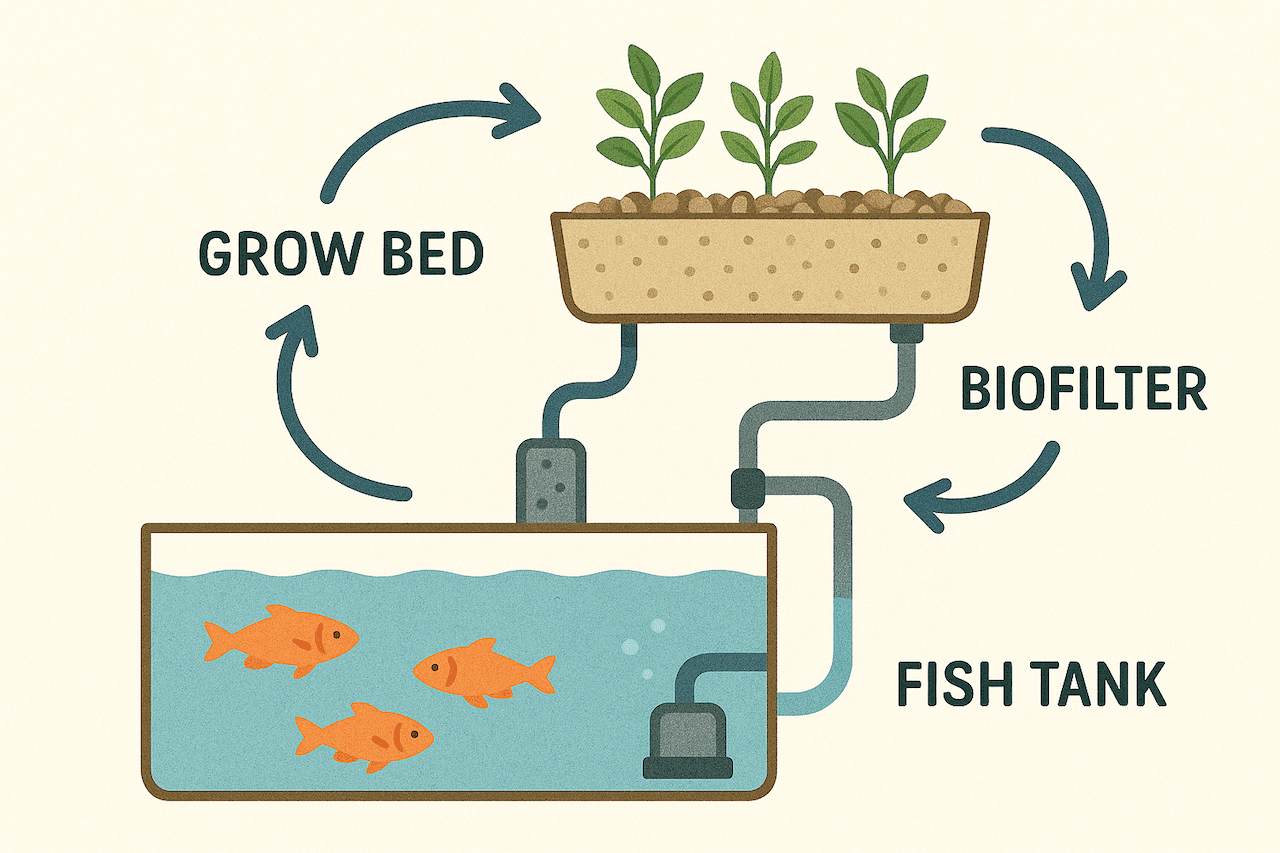
Closed-loop aquaponics system diagram with fish tank, biofilter, and grow bed showing water cycle.Closed-loop aquaponics: fish tank → biofilter → grow bed → return.

Why it Works

Sustainable fish and plant system links fish and plants into a single ecology. Fish produce ammonia; beneficial bacteria in a biofilter convert it first to nitrites and then to plant-available nitrates; plants absorb those nutrients and clean the water for the fish. The result is a low-waste, high-efficiency loop that uses around 80–90% less water than soil gardening while producing herbs, leafy greens, and even fruiting crops in compact spaces.

Because the system is recirculating, you control inputs precisely: temperature, pH, dissolved oxygen, water flow, and light. That control makes an water-saving farming techniques system ideal for urban balconies, greenhouses, restaurants, and educational labs—and a powerful complement to sustainable food production.

Aquaponics System: How It Works

  1. Fish tank: The source of ammonia. Choose hardy species (tilapia, catfish, carp, or goldfish for small builds).
  2. Biofilter: Media (expanded clay, lava rock, or moving-bed K1) hosts nitrifying bacteria that convert ammonia → nitrite → nitrate.
  3. Grow bed: Plants take up nitrates and micronutrients; roots also trap solids for later mineralisation.
  4. Return line: Cleaned water flows back to the fish tank; aeration keeps dissolved oxygen high.

Keep pH between 6.6–7.0 (a compromise for fish, bacteria, and plants), maintain good aeration (>6 mg/L O₂), and size filtration to bioload. A reliable pump and an uninterrupted power supply are non-negotiable.

Three Common Set up

  • Media bed (ebb-and-flow): Most forgiving; ideal for beginners. Media hosts the biofilter and supports roots.
  • DWC (deep water culture): Plants float on rafts over nutrient-rich water; great for uniform salad greens and basil.
  • NFT (nutrient film technique): Thin water film through channels; efficient for fast greens, less forgiving with solids.

Many growers hybridise—media for fruiting crops and solids handling, DWC/NFT for leafy greens. That mix balances productivity and maintenance.

Starter Checklist for Your this System

  • Match tank size to plant area (rule of thumb: ~25–40 L of fish tank per 0.1 m² of dense greens in media beds).
  • Cycle the system fish-less using pure ammonia or humic sources; test for the classic ammonia ↓ nitrite ↓ nitrate ↑ curve.
  • Add fish slowly after nitrite is near zero; monitor feeding and remove uneaten food.
  • Plant heavy feeders (lettuce, chard, basil, tomatoes, peppers); interplant herbs for pest balance.
  • Maintain redundancy: spare pump, airstone, and battery backup for aeration.

History and Future of this urban farming innovation

While modern aquaponics draws on hydroponic science and controlled-environment agriculture, the core insight—linking water, fish, and crops—echoes older traditions. The chinampas of Mesoamerica and Asian rice–fish systems both paired aquatic life with plants to recycle nutrients. What’s new today is precision control: sensors for pH and conductivity, automated dosing, and lighting schedules tuned to cultivar and season.

Expect growth in three areas: micro-farms that supply restaurants with just-in-time herbs; education, where students learn ecology, chemistry, and engineering hands-on; and resilience, where compact systems buffer supply chains during heat waves or water restrictions. As renewable energy gets cheaper, off-grid aquaponics and rooftop farms will become practical for cities.

Aquaponics vs. Hydroponics (and Soil)

Hydroponics delivers rapid growth with exact nutrient recipes but requires regular mixing and disposal of solutions. Soil excels at buffering mistakes and supporting complex microbiology but uses more space and water. An aquaponics system sits between: you feed fish, not bottles; bacteria craft balanced nutrients; water is reused; and plant quality is consistently high. If you want low-waste greens plus edible fish—and you enjoy system tinkering—this approach is hard to beat.

FAQ — Aquaponics

What’s the ideal pH?
Keep 6.6–7.0. Below 6.4 slows nitrification; above 7.2 reduces micronutrient availability.
Which plants thrive first?
Lettuce, basil, mint, chard, pak choi, and tomatoes. Start with fast greens while the biofilter matures.
How many fish per litre?
For beginners, plan low density: roughly 15–20 kg of fish per 1,000 L of water once mature, with robust aeration.
© Mantifang — sustainable growing notes.

Mickey Paulssen

mickey paulssen,mickey paulssen art,mickey paulssen portraits,nishikigoi drawings,koi drawings,aquascaping,takashi amano,mixed media realism,academy for visual arts genk,mantifang fine art,koitalk,zen underwater garden,portrait artist,realism and abstract,pencil koi art

“`html

Mickey Paulssen: Beyond the Flat Surface

Mickey Paulssen
Titus van Rijn mixed media 13 x 18 cm

At times, Mickey Paulssen desires more than just a flat surface to express her artistic vision. An excellent example of this is her mixed-media work, Titus, measuring 13 x 18 cm.

Educational Background and Artistic Forms

Mickey Paulssen studied at the Academy for Visual Arts in Genk, specializing in both nude studies and realism. Her education included painting, drawing, and etching, with art history as the foundation of her work. While realism has always been her primary focus, she also embraces abstract forms, particularly through pastel drawings. Her passion extends to Nishikigoi, Japanese ornamental carp, with which she has developed a strong artistic connection.

Realistic Imagination

Mickey Paulssen
Resting Robin

Mickey Paulssen mastered various techniques to depict realistic imagery on a flat surface. Her paintings capture lifelike scenes, often infused with imaginative elements. She skillfully renders the beauty of the human figure in her drawings and applies these same principles to her depictions of Nishikigoi. Through her etchings, she creates powerful pieces using the precision of acid and needle.

Mickey Paulssen’s Portraits: Capturing Realism with a Personal Touch

Mickey PaulssenMickey Paulssen has developed a unique style in the realm of portraiture, blending realism with an intimate understanding of her subjects. Her portraits, whether of people or animals, focus on highlighting the natural beauty and individuality of her subjects. Using various mediums such as pencil, pastel, and oil paint, Mickey Paulssen brings life to her artwork through fine details and emotional depth.

Mickey Paulssen
Liva

Her training in both abstract and realism at the Academy for Visual Arts in Genk provided her with a strong foundation in portraiture, allowing her to capture not just physical likeness, but the essence of the individual. With every portrait, she meticulously considers lighting, shadow, and form, creating a realistic yet artistic interpretation that resonates with viewers.

Explore Mickey’s Portraits in the Mickey Paulssen Gallery, where her talent for capturing the subtle nuances of expression and form is on full display.

Nishikigoi: A Passion in Pencil

Mickey Paulssen
Shiro Bekko

Drawing Nishikigoi is a true passion for Mickey Paulssen. Many of her Koi fish drawings are created with pencil and can be seen on platforms like Koitalk.app, which also showcases her Zen underwater garden designs. Her work invites viewers to immerse themselves in the world of Koi and enjoy the artistry she presents. Take a dive into Mickey’s Koi drawings.

“Observation is the Most Important Lesson I’ve Learned”

For Mickey Paulssen, life is all about observing and analyzing the world around her. She carefully considers each pencil stroke and shadow to capture the essence of what she sees. However, this wasn’t enough for her—she sought a fourth dimension: Zen.

Aquascaping: A “New” Dimension

Mickey Paulssen
The path

Her journey into aquarium design led to her creating underwater gardens in a Japanese Zen style. Influenced by the renowned nature photographer Takashi Amano, whom she met in 2012 in Hannover, Mickey Paulssen ventured into “aqua scaping.” She honed her skills, blending the tranquility of Japanese landscapes with underwater design, successfully creating these artistic environments. Get inspired by her Zen aquascaping.

A Unique Fusion of Art

The combination of her visual art on canvas and her Japanese-inspired aquarium designs makes Mickey Paulssen a unique artist. Her versatility shines through in both her traditional artworks and Zen-inspired underwater gardens, which can be admired in the Mantifang Gallery.

Explore more of Mickey’s art: Mickey’s fine arts.

The versatile artist is also on Social media:

Mickey Paulssen Facebook Profile Page Portrets. Scapers forum Miroshaki The website will soon be opened. Mickey is absolute dedicated to de master of aqua scaping Takashi Amano San. Are you also a great fan like her R.I.P. Takashi Amano digital Shrine.

“`

Social Media

Mantifang — Social Media

Follow Mantifang for Korean culture, koi (via Koitalk), gardening, and aquascaping. Below you’ll find our curated channels and groups. All external links open in a new tab.

Note: koi content has moved to Koitalk.app. Mantifang keeps legacy koi pages as SEO redirects, but koi lives on Koitalk.

Volunteer Moderators

Welcome to our social media
Help our community thrive. Volunteer moderators support our channels by answering questions, guiding discussions, preventing spam/abuse, resolving conflicts, and enforcing rules.
  • Answering Questions & Support: first point of contact for users.
  • Discussion Guidance: respectful and constructive conversations.
  • Spam & Abuse Prevention: remove inappropriate content.
  • Conflict Resolution: de-escalate and find solutions.
  • Rule Enforcement: keep standards clear and fair.

Want to join? Leave a comment below on Mantifang or email us at h.smal@me.com.


General

Korea

Explore Korea’s culture and Hallyu — from daily life and art to history and spirituality.

Nishikigoi

All koi content is now on Koitalk; below are our koi-related channels and groups.

Gardening

From flowers and vegetables to serene garden spaces — tips, inspiration, and communities.

Aquascaping

For Professionals & Entrepreneurs

We assist Korea-focused enterprises with translation, market research, and business consulting. Fanbase-driven storytelling that connects your products with a global audience.

Professionals & Entrepreneurs

Contact

Email: h.smal@me.com

Why follow Mantifang?

Mantifang brings together stories, communities, and inspiration from Korea and beyond. Whether you are curious about Korean culture, fascinated by koi and aquascaping, or looking for practical gardening tips, our social media channels connect you with people who share the same passions. Each channel is curated to highlight both the beauty of traditions and the creativity of modern life.

Our Korea channels introduce you to the vibrant world of Hallyu, traditional ceramics, spiritual practices, and the rich history of Goguryeo, Baekje, Silla, and beyond. We share not only insights but also reflections, photographs, and essays that make history feel alive and relevant today. From timeless art to modern K-drama discussions, the goal is to bridge the gap between past and present.

Through our social media koi channels, now living on Koitalk.app, we connect enthusiasts worldwide. You will find updates from Goyang Koi Farm in Korea, koi health discussions, breeding knowledge, and of course a friendly community where you can ask questions or simply share your joy of keeping koi. The Nishikigoi heritage is part of a larger cultural story that includes water gardens, seasonal festivals, and a respect for nature’s rhythm.

Gardening and aquascaping are also at the heart of Mantifang’s vision. From kokedama to watergardens, from Korean balcony gardens to Japanese influences, our communities celebrate green spaces both large and small. For many, these gardens are not just a hobby but a way to cultivate mindfulness and beauty in daily life. By following these groups, you join conversations on design, sustainability, and the artistry of living with plants and water.

Finally, our Social media network extends into professional spaces, where translation, research, and consulting connect Korean culture and businesses with an international audience. By weaving storytelling into market insights, Mantifang helps entrepreneurs engage with people in a genuine way.

Join us across channels to share, learn, and grow together. Mantifang is more than a platform — it’s a community shaped by stories, traditions, and the people who keep them alive.

© Mantifang. Koi content lives on Koitalk.app. Legacy koi pages on Mantifang redirect for SEO continuity.

R.I.P. Takashi Amano San

Takashi Amano san; our master!

Takashi Amano
Takashi Amano San

Takashi Amano is widely recognized as the founder of the “Japanese aquascape.” After a career as a professional cyclist, he transitioned into painting, nature photography, and ultimately, the art of aquarium design. Initially, his focus was solely on the fish, but over time, he began to incorporate Zen techniques into his work.

Ancient philosophy.

Zen Buddhism, which originated in China, made its way to Japan through Korea during the Kamakura period (1192 – 1333). Its influence was profound, giving rise to beautiful Zen gardens. Amano sought to encapsulate the essence of Zen nature within his aquariums. By using only a few types of plants, carefully harmonized with stones and wood, he developed a unique style that resonated with many Japanese. In 1980, he founded Aqua Design Amano (ADA), which became synonymous with his distinctive approach to aquascaping. His work gained international acclaim, with books written about his techniques being translated into English, thus introducing Amano’s art to Europe.

On August 4th of August 2015, Mickey Paulssen wrote on her Miroshaki forum:

Takashi Amano“With great pain and sadness, I learned that the Master of Aquascaping, Takashi Amano San, passed away at the age of 61. He left us on August 4th in his hometown of Niigata. I am proud to have known and met him, and I create my aquascapes with him in mind. He remains for me the ‘Master of Aquascaping,’ and our forum will always be an ode to Takashi Amano San. I wish his family much strength during this time.” —Mickey Paulssen

Mickey also created the “Rest in Peace Takashi Amano” page on Facebook, which was soon acknowledged by Amano’s family. This page stands as a small monument to his legacy. Like R.I.P. Takashi Amano San  and let the world now you admire his work.

His last work

Takashi AmanoOne of Takashi Amano’s final projects was the Takashi Amano x Oceanário de Lisboa: The Road to the World’s Largest Nature Aquarium. This ambitious project represented a new frontier in the world of aquascaping, pushing the boundaries of what had been done before. You can read more about it at Aqua disign AmanoMore about Takashi Amano San: here

Do you have a good story about the aquarium designer giant? Did you meet him, work with him or just like his work? We are happy to publish it. With liking the FB page: Rest in Peace Takashi Amano San. Let the aquascaping world know you miss his art and are great full of his inspiration. Already 3000 + Amano fans preceded you.

R.I.P. Takashi Amano San

youtube placeholder image