Written by Hugo J. Smal
AI writing vs human creativity: from battle cry to partnership
AI writing vs human creativity is no longer just a debate but a working method. A few years ago we framed it as a duel—robots versus authors. Today I use AI as a useful assistant that sharpens prose, flags errors, and frees attention for the real work: meaning, memory, rhythm. The human side—doubt, experience, imagination—remains indispensable. This piece shows, in practice, how AI writing vs human creativity becomes collaboration without losing a writer’s voice.
My path through AI writing vs human creativity
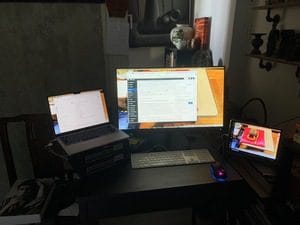
My little creative corner.
When AI entered the literary domain, I buried myself in my autobiographical thriller The Jijang Fractal Not because a book makes me rich—few authors live on royalties—but because a life wants to be told. If anyone can generate text with a click, what is a story worth? The answer for me: the personal—fear, courage, an awkward silence—cannot be lived by a machine on my behalf. That’s the human half of AI writing vs human creativity.
Speed versus depth
Take something ordinary: an article about water quality. I read, compare sources, draft notes; two days later a first sentence forms. Another day of cutting and breathing—and the story lands. AI can produce a tidy outline in seconds. But the human delay—the search for tone, the friction of a paragraph—that’s depth. Here the limit of AI writing vs human creativity appears: a model can structure, not live. It doesn’t feel a cold wind on deck; it doesn’t carry thirst that feeds a metaphor.
Stories as human gifts
Bertolt Brecht once wrote:
“We are the freeloaders, the last people who are not servants, with Baal and Karamazov in our midst. What is a poem worth: four shirts, a loaf of bread, half a cow? We do not make goods but gifts.”
That line sticks. A story like To Jangbong-do: Good at Boats grows out of lived time: the smell of salt, a smoke shared with a boy, the thud of the hull. Algorithms can mimic such a scene, but not carry it. My non-journalistic pieces therefore remain gifts—free to take on Mantifang. In the conversation on AI writing vs human creativity, that is my anchor: AI can do a lot, but it cannot give what it never experienced.
Resistance and embrace: The Jijang Fractal
The Jijang Fractal is my resistance—not against technology, but against the idea that technology can replay my life. At the same time I embrace AI as an editor. I use ChatGPT as a proofreader: it watches coherence, points at sloppiness, and removes noise from sentences. It doesn’t argue; it advises. I decide. In this balance, AI writing vs human creativity stays honest: the memoir remains human, the polishing may be technical.

AI helps with fine tuning
For a non-native English writer that help is gold. AI notices what I overlook—but it doesn’t feel what I feel. The core stays intact: I write, AI assists. Readers should recognize this division of roles: AI writing vs human creativity works when the machine assists and the human makes meaning.
What AI can and cannot do
- Can: accelerate research; flag inconsistencies; catch style slips; propose alternatives; surface sources.
- Cannot: carry a childhood memory; taste shame; choose a moral stance; pace a silence in a paragraph; make a scene tremble with lived time.
That distinction isn’t a threat; it’s a relief. It means I can spend energy on story, rhythm, composition—and ask the assistant to handle the heavy technical lifting. Outsource everything to AI and you get text with no origin. Refuse everything and you miss sharp tools. Between those extremes grows the craft that AI writing vs human creativity now demands.
Publishing in chapters
I publish The Jijang Fractal chapter by chapter on Mantifang. Each part appears when it’s ready: raw enough to live, careful enough to last. Readers return, respond, and move along with me. AI helps with this cadence—not by dictating sentences, but by removing restlessness. Progress is visible; the voice stays my own. This is my practical answer to AI writing vs human creativity: iterative writing with a sober assistant at my elbow.
AI writing vs human creativity: where we are now
The question “who wins?” is outdated. A better one is: how do we work together? I trust experience, observation, and ethics; I use AI for speed, consistency, and suggestions. Algorithms propel; the author steers. Literature remains a human practice—with modern tools. If you read my work—from poems to The Jijang Fractal —you may notice that an assistant helped. But the pulse of the text, that slow thinking heart, beats on its own.
Conclusion: choose your role, choose your tools
If there’s one lesson from AI writing vs human creativity it is this: don’t let the tool become the author. Use AI without losing your voice. Choose your tempo, your tone, your truth—and employ technology where it makes you sharper. That’s what I do, and I invite you to read along, respond, and keep the conversation open. Writing is not a race against machines; it is the sharing of life—with good tools within reach.
Will AI writers eventually be exposed?
Most AI-generated writing does not fail because it is incorrect. It fails
because it lacks origin. Over time, texts without lived reference become
interchangeable: consistent, coherent, and increasingly anonymous.
This does not mean that writers who use AI will disappear. It means that
writing without presence, without place, and without responsibility
gradually loses credibility. The question shifts from “Is this well written?”
to “Where does this come from?”
Further reading
To Jangbong-do: Good at Boats
— a story rooted in place, time, and sensory memory.
Bertolt Brecht (Theaterencyclopedie)
— on art as gift rather than commodity.
Fyodor Dostoevsky — The Brothers Karamazov
— a novel where moral weight cannot be automated.
Questions & Answers
Does using AI diminish an author’s originality?
No. Originality is not determined by the tools used, but by the source of
experience. When AI assists with editing or structure while the writer
remains responsible for meaning, voice, and presence, originality is preserved.
Can AI ever replace human writers?
AI can reproduce patterns, styles, and arguments, but it cannot replace
lived experience. Writing that matters over time depends on place, memory,
moral choice, and responsibility — all of which remain human.
How should writers work with AI today?
As with any tool: deliberately. AI is effective for polishing, checking,
and accelerating technical tasks. The writer decides what is said, why it
matters, and when silence is more truthful than explanation.