Korean Adventure: Building Koi Culture in South Korea
A Big Korean Adventure in Koi, Culture, and Ambition
Koreaans avontuur is the right phrase for what followed when Hugo J. Smal became involved in South Korea’s koi world. What began as a technical request at a Dutch koi show grew into years of travel, cultural encounters, practical advice, and unexpected lessons about ambition, art, and perseverance.
Hugo J. Smal has written about his experiences in Korea, especially his work around koi culture, Korean society, and the people behind this unusual project. Readers who want broader context can also explore Koreanen en ik.
South Korea has long had passionate and ambitious koi enthusiasts. Hugo Smal became closely involved with several pioneers in the hobby and helped advise on facilities, water quality, and the larger vision behind a Korean koi industry. This article first appeared in a Dutch garden magazine.
How the Korean adventure began

Tijdens de Holland Koishow van 2003, I was asked to arrange a fish tank and make sure it had proper water quality and oxygen. A group of Koreans had brought koi by plane to the Netherlands to compete and sell fish. With help from several traders, they managed to do both. They sold a number of koi and also won some of the smaller prizes.
During those days, koi enthusiast and Goyang Koi Farm CEO Kim Young Soo asked whether I would come to Korea and help support the development of a koi industry there. That was the real beginning of this Korean adventure.
Struggling farmers and a new idea
At the time, Chinese rice exports were increasing and putting pressure on South Korean farmers. Kim Young Soo believed that breeding Japanese ornamental carp could become an alternative to rice cultivation. It was an ambitious vision, and for me it became a challenge worth exploring. Less than a month later, I landed at Incheon Airport.
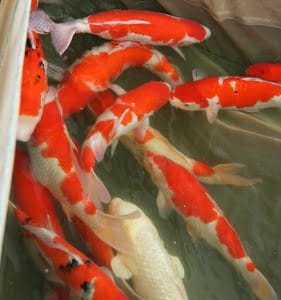
From the airport I was driven straight to a koi show, where I was asked to give a short speech. The organizers also wanted me to judge the fish, which I felt unqualified to do. When they asked which fish should win, I said a strong Sanke seemed the obvious choice. To my surprise, the main prize went to a weaker Showa that was visibly unwell at the bottom of the vat.
I told a journalist that, by our standards, such a fish would have been removed from the competition. That honest remark caused an immediate uproar.
A fierce argument during the Korean adventure
What followed was not just noise but a real argument. I was put into a Kia van and, after a long drive, left alone in a hotel room. I had no idea what would happen next or whether any work still awaited me. The show had clearly been poorly organized, and the judges lacked technical knowledge.
It smelled of clientelism, perhaps even bribery. There had been no proper benching and no clear distinction between healthy and unhealthy fish. Around the world, koi entered into competition are typically checked carefully, often with support from a veterinarian specialized in fish diseases. In South Korea at that time, that standard was not yet in place.
The next morning, Kim Young Soo arrived with companions and several large fish boxes in the van. The splashing inside turned out to be the Sanke that should have won. Kim had taken my blunt words seriously, even if they were culturally too direct. He decided then that he wanted to play a leading role in the Korean koi industry.
Korea is a big adventure
During the rest of the trip, I saw the impressive landscape of the Land of the Morning Calm and gained a deeper view of Korean culture. I realized how much study Koreans would need to build a true koi tradition, and how much I myself still had to learn about this complex society.
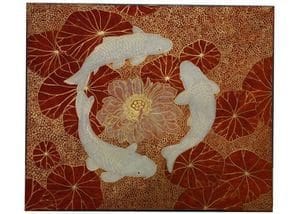
I met many artists along the way. Baik Yong-Jung taught me that the carp has lived in the Korean imagination for centuries. His paintings connect koi, nature, and symbolic meaning. Paintings of carp and crabs were common during the Yi dynasty, and scenes of carp leaping upward carried their own moral and cultural charge.
Carp myth and cultural meaning
These paintings draw on an old story: when the Yellow River rises, carp struggle upstream toward the Dragon Gate. A fish strong enough to pass through that gate becomes a dragon. During the Confucian Yi dynasty, this story symbolized success in the state examinations and the possibility of rising from poverty into office.
Today, that symbolism still echoes in Korean culture. Carp paintings are common wedding gifts, and conversations with artists such as Baik Yong-Jung, along with literary research, showed me how deeply the carp moved through Chinese, Korean, and Japanese culture. In that sense, Korea carried this cultural symbol forward long before modern koi culture took shape.
A visionary idea behind the Korean adventure
As ornamental fish, however, Japan remained far ahead. It seemed unrealistic to imagine Korean koi farmers overtaking Japan in the Go-Sanke classes any time soon. I therefore suggested a different approach: connect koi farming to Korean culture itself and expand the koi farm in Goyang, northwest of Seoul, into a cultural center where ceramics, painting, and other forms of art could also be shown.
The idea was to introduce Koreans more deeply to koi culture while creating a future export path not only for koi, but also for koi-related art and cultural experience. Koreans often approach things competitively, with a strong desire to become the biggest, strongest, or best. Understanding that mindset became its own Korean adventure.
Kim Young Soo exchanged land, kept studying, and continued building. He invested heavily in Japanese parent koi and began breeding and growing them. In the Netherlands I was already used to advising on troubled ponds and fish purchases, but Kim’s drive made this work a different kind of challenge.
I was fortunate to rely on experts such as Rene Kruter on fish disease and water quality, and Mark Kleijkers on koi quality. With their help, and with practical judgment, I was able to support what the Koreans were trying to build.
Rising quality and rising expectations
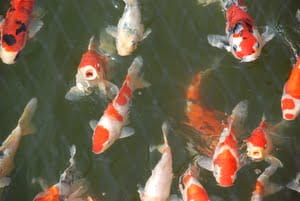
Year after year, I watched the quality of fish at the Goyang koiboerderij improve. Kim Young Soo joined forces with Mr. Hong, who had a substantial number of breeding ponds near Gwangju. In those mud ponds swam Go-Sanke of increasingly impressive quality, fish I would not have hesitated to allow into my own pond.
After a long process of trust, discussion, and negotiation, Kim and Hong finally decided to enter Hong’s fish into the Holland Koi Show in 2011. Rene Kruter and I traveled to South Korea to select the fish. We assumed they would compete with smaller sizes. The Koreans had other plans: they wanted to win immediately with large koi.
Korean Adventure in South Korea
As children might stand beside a sweet shop window, Rene and I stood at the ponds in awe as one jumbo koi after another was netted and placed into vats. Seeing those fish felt like a blessing. It was a Korean adventure with a Japanese twist, and now the fish were coming to the Netherlands.
My own pond had been nearly empty for years because of the Korean collection, with only a few goldfish maintaining bacterial balance. I had about a month to get the water back into top condition so these jumbo koi could acclimatize before traveling on to Arcen. I decided it was possible and ordered two vats, because the six fish we selected were too large for one.
European legislation and hard limits

Between dreams and reality, there are always laws and practical barriers. That truth became painfully clear. In the OFI journal of October 2008, Alex Ploeg had already warned that Asian breeders and exporters who wanted access to Europe needed to comply with European animal health legislation. Those rules affected not only importers, but also exporters, suppliers, growers, and collectors.
If exporters wanted to sell on the European market, they had to meet those standards. The exporting country had to meet them as well. I had pointed Kim Young Soo toward European legislation from the start and based my advice on the OFI Code of Conduct. He and his colleagues took this seriously, contacting the right ministries and district officials to seek export approval for fish to the European Union.
Never enough Korean adventures
But reality intervened. Kim Young Soo and Mr. Hong were standing with the fish at Incheon Airport when customs made the situation brutally clear. The koi could leave Korea, but they would be stopped at the European border and destroyed. At that moment, all possibilities collapsed. It was a severe disappointment and one of the hardest chapters of this Korean adventure.
Hidden dragon, crouching tiger
In the years that followed, the Korean adventure continued. I returned to South Korea many times. Kim Young Soo and I took part in discussions with senior civil servants at government ministries. I gave advice and, at times, opinions that were perhaps too European in tone. The machinery of administration was moving, but very slowly.
South Korea remains, in koi terms, a hidden dragon and crouching tiger. China now buys heavily in Japan and is trying to expand its own role in the koi world. That raises the question of whether South Korea’s official processes move too slowly to seize the opportunity.
Fortunately, Kim Young Soo did not rely on koi alone. Following my advice, he invested around five million euros in a broader cultural project. He built a koi and cultural center that eventually opened under the name Baedagol.
If this Korean adventure has sparked your interest, you can also follow the story on Facebook: Goyang Koi boerderij 비단잉어 Nishikigoi
Vragen en antwoorden
- What is the Korean adventure in this article?
- The Korean adventure refers to Hugo J. Smal’s involvement in South Korea’s koi world, including travel, technical advice, cultural encounters, and efforts to help develop a Korean koi industry.
- Who is Kim Young Soo?
- Kim Young Soo is a Korean koi entrepreneur connected to Goyang Koi Farm. He invited Hugo Smal to Korea to support the building of koi facilities and a broader cultural vision.
- Why did koi become important in this Korean adventure?
- Koi became the center of the story because they were seen as both an economic opportunity and a cultural bridge, linking farming, art, ambition, and international trade.
- Why could the fish not be exported to Europe?
- The export plan failed because European animal health legislation required standards and approvals that had not yet been fully secured, meaning the fish would have been stopped at the border.
- What is Baedagol?
- Baedagol is the koi and cultural center that emerged from Kim Young Soo’s broader investment strategy after it became clear that relying only on koi exports would be too risky.
New to Mantifang? Begin here: Begin hier.


