Koreaans keramiek

Goryeo Celadon — 5 Stunning Secrets of Korea’s Most Beautiful Ceramic Art

Goryeo celadon is one of the most celebrated traditions in Korean ceramics. Its beauty lies in the meeting of form, glaze, inlay, atmosphere, and disciplined restraint. It does not ask to be admired quickly. It asks to be looked at slowly.

Goryeo celadon with green glaze and Korean ceramic artistry from the Goryeo dynasty
Goryeo celadon reveals the quiet perfection of Korean ceramics through glaze, form, and timeless beauty.

The Place of Goryeo Celadon in Korean Ceramics

Goryeo celadon belongs at the center of any serious introduction to Koreaans keramiek. It carries the refinement of the Goryeo dynasty, the technical intelligence of Korean potters, and the cultural atmosphere of a society shaped in part by Buddhist taste, courtly patronage, and a profound sensitivity to surface. Celadon is often introduced as green pottery, but that phrase is too small. The glaze may appear green, blue-green, grey-green, or almost mist-like depending on clay, glaze recipe, firing, light, and the eye of the viewer.

The finest celadon vessels feel quiet without being empty. They are disciplined but not cold. Bowls, ewers, incense burners, dishes, bottles, boxes, and maebyeong forms show how Korean potters joined technical control with emotional restraint. The result is not decorative excess, but a kind of luminous calm. This is why celadon is so important for Mantifang: it offers a way of reading Korean culture through patience, attention, and material intelligence rather than through spectacle.

Goryeo Celadon Glaze as Atmosphere

The power of Goryeo celadon rests partly in the glaze. A celadon glaze is not simply a coating placed on top of a vessel. It is an atmosphere made permanent by fire. Iron in the clay and glaze, kiln atmosphere, and firing temperature all affect the final tone. When the firing succeeds, the surface can look as if light is suspended inside it. The vessel appears neither fully green nor fully blue, but somewhere between water, stone, cloud, and breath.

This is why Goryeo celadon has often been admired for its subtlety. It does not depend on hard contrast. Its depth appears gradually. A plain bowl may reveal more with time than a loudly decorated object does at first glance. In Mantifang terms, celadon is a useful teacher of attention. It rewards the reader or viewer who does not rush past the surface.

Sanggam Inlay and the Art of Depth

One of the most distinctive achievements of Goryeo celadon is sanggam, the inlay technique in which designs are carved or incised into the clay and filled with contrasting slip before glazing and firing. Cranes, clouds, chrysanthemums, lotus forms, and geometric designs may seem to float under the glaze. The decoration is present, but it is softened by depth. The image is not pasted on the surface. It belongs inside the ceramic skin.

Sanggam is a technical and poetic achievement at once. It requires planning, clean cutting, careful filling, drying, glazing, and firing control. Yet its effect is not mechanical. The best inlaid celadon creates a world where line, image, and glaze breathe together. It helps explain why Goryeo celadon remains one of Korea’s great contributions to ceramic history.

Buddhist Culture and Courtly Taste

Goryeo was a Buddhist kingdom, and celadon often reflects a world where ritual, refinement, and spiritual imagination were close. Incense burners, ritual vessels, lotus motifs, and quiet animal forms show the connection clearly, but the influence is not limited to religious imagery. Celadon’s meditative quality also belongs to the wider cultural atmosphere of Goryeo. The vessel becomes an object of stillness.

At the same time, celadon was shaped by elite demand and workshop systems. This was not folk pottery in a simple sense. It required skilled labor, organized production, good materials, and patrons who valued refinement. Understanding celadon therefore means seeing both the spiritual and social conditions that allowed such objects to be made.

Quiet Perfection and Human Imperfection

The phrase quiet perfection should not suggest machine-like flawlessness. Korean celadon is powerful because it holds aspiration and material uncertainty together. Kiln firing is never fully obedient. Glazes pool, thin, crackle, blush, or shift. Forms may carry small asymmetries. The potter works toward harmony while accepting that clay and fire have their own intelligence.

This is one reason Goryeo celadon remains meaningful in Levend Korea. Its beauty speaks to a broader Korean cultural pattern in which restraint, patience, and acceptance often matter more than display. The vessel may be old, but the way it teaches attention remains alive.

How to Look at Goryeo Celadon

To look well at Goryeo celadon, begin with the silhouette before the decoration. Notice whether the vessel rises gently or sharply, whether its shoulder carries weight, whether the foot feels narrow or grounded, and whether the mouth opens with confidence or softness. Korean celadon often asks for this kind of slow looking. Its meaning is not hidden, but it is layered. The glaze becomes more powerful when the form beneath it has already established calm.

Then look at the surface. Some vessels depend on plain glaze alone. Others carry carved, molded, incised, or inlaid designs. In each case, the decoration should be read with the glaze rather than separately from it. A crane beneath celadon is not simply an image of a crane. It is a crane held inside light, clay, and fire. This is why museum photographs rarely exhaust the experience of celadon. The vessel changes as light changes.

Celadon, Loss, and Revival

Goryeo celadon also belongs to a history of loss and revival. The tradition did not continue unchanged into later centuries. Joseon ceramic taste moved in other directions, and many older techniques became difficult to reproduce with the same authority. Modern admiration for celadon therefore includes a recovery impulse: potters, scholars, museums, and cultural institutions have tried to understand how such surfaces were made and why they still matter.

This revival does not make celadon a museum fossil. Instead, it shows how cultural memory can return through practice. Contemporary Korean potters may study Goryeo forms without pretending to live in Goryeo. The point is not imitation alone. It is a renewed conversation with glaze, restraint, and the discipline of quiet beauty.

From Goryeo to the Wider Cluster

Goryeo celadon should be read beside Joseon ceramics. The contrast is instructive. Celadon often carries an atmospheric, Buddhist, courtly elegance. Joseon white porcelain later emphasizes clarity, restraint, Confucian order, and everyday use. Buncheong, meanwhile, introduces looseness and directness. Together these traditions show that Korean pottery is not one mood but a field of changing attitudes toward beauty.

De Icheon Korean Ceramics City page shows how such traditions continue to be practiced, taught, displayed, and reinterpreted. The Icheon Ceramic Festival gives contemporary visitors an accessible entrance into these forms. The deeper historical frame can be followed through the Tijdlijn Koreaanse geschiedenis en de Korean History Dictionary Complete Index.

Forms, Vessels, and the Discipline of Proportion

Goryeo celadon should be approached through form as much as glaze. The famous color can distract from the fact that many celadon vessels are carefully balanced objects. A maebyeong bottle, for example, depends on the relationship between shoulder, neck, body, and foot. An ewer depends on the relationship between pouring, holding, and display. An incense burner depends on both sculptural presence and ritual atmosphere. Even when the glaze is extraordinary, the object fails if the form beneath it is weak.

This is one reason celadon belongs in a cultural history rather than a purely decorative history. Proportion is a cultural language. It tells us what a society valued in stillness, ceremony, luxury, restraint, and skilled control. The vessel is not merely a support for glaze. It is an argument about balance.

Celadon and the Experience of Time

Celadon also changes the viewer’s sense of time. A highly polished object may reveal itself quickly, but Goryeo celadon often works through delay. It asks the eye to remain. The glaze changes under different light. The inlay may appear sharp from one angle and submerged from another. The curve of a vessel may look simple until one notices how the shoulder gathers and releases tension.

This slow quality is part of its cultural memory. It resists the speed of modern browsing. It rewards the same patience required by ceramic making itself: preparing clay, drying without cracking, firing without haste, cooling before judgment. To look slowly at celadon is to enter a rhythm closer to the kiln than to the screen.

Celadon Between Korea, China, and East Asia

Goryeo celadon developed in conversation with wider East Asian ceramic worlds, including Chinese celadon traditions. But influence should not be mistaken for imitation. Korean potters absorbed, studied, transformed, and refined techniques into a distinct visual and emotional language. The Korean achievement lies in the specific balance of glaze, form, inlay, and restraint that emerged in Goryeo workshops.

This matters because cultural history often becomes too simple when it is reduced to origin stories. The better question is not only where a technique first appeared, but how it was understood, adapted, perfected, and given new meaning. Goryeo celadon shows Korean ceramic culture as both connected and distinct: part of a regional conversation, yet unmistakably shaped by Korean taste and conditions.

Why Goryeo Celadon Still Feels Contemporary

Modern viewers often respond to Goryeo celadon because it does not feel trapped in the past. Its quietness travels well. A celadon bowl or bottle can sit near contemporary design without losing dignity. Its surfaces can feel minimal, but they are not empty. They hold technical labor, historical memory, and a long aesthetic discipline.

This is useful for Mantifang readers because it shows that Korean tradition is not a museum costume. A historical vessel can still shape modern ways of seeing. It can teach proportion, softness, restraint, and attention to material. It can also remind contemporary culture that beauty does not have to be loud to be lasting.

Celadon, Tourism, and Respectful Looking

When celadon appears in travel writing or museum marketing, it is often reduced to a beautiful green object. That is understandable, but incomplete. A respectful approach asks more careful questions. What period does the vessel belong to? What kind of kiln and workshop knowledge made it possible? Was it made for ritual, courtly use, storage, pouring, incense, display, or burial? How does the glaze interact with the vessel’s body?

These questions help prevent cultural flattening. They also connect celadon to the wider cluster. A reader who begins with celadon can move naturally toward Joseon porcelain, buncheong, Icheon craft, and the forced movement of Korean potters after the Imjin Wars. The single vessel becomes an entrance into Korean history.

Celadon as a Mantifang Lens

Inside Mantifang, Goryeo celadon is not only an art-historical topic. It is a lens for reading Korea through stillness, labor, and cultural transmission. It asks how beauty survives political change. It asks how unnamed makers can remain present through objects. It asks how modern readers can approach old forms without turning them into decorative wallpaper.

The answer begins with attention. Look at the vessel slowly. Notice the form before the label. Let the glaze become atmosphere rather than color. Follow the surface into the kiln, the kiln into the workshop, the workshop into Goryeo history, and Goryeo history back into the living craft culture of Korea today.

What Goryeo Celadon Teaches the Reader

Goryeo celadon teaches that Korean beauty often works through nearness rather than spectacle. It asks the reader to trust small differences: a softened shoulder, a pooled glaze, a shallow incision, a line that almost disappears beneath the surface. These details are not minor. They are the place where technique becomes feeling.

For a Mantifang reader, celadon can become a training in cultural attention. Instead of asking only whether an object is old or valuable, ask how it changes the room around it. Ask how its surface slows the eye. Ask why a vessel made centuries ago can still feel inwardly alive.

Q&A: Goryeo Celadon

What is Goryeo celadon?

Goryeo celadon is a Korean ceramic tradition from the Goryeo dynasty, best known for its subtle greenish glaze, elegant forms, and refined decoration including inlaid sanggam designs.

Why is Goryeo celadon famous?

It is famous because it combines technical difficulty with quiet beauty. The glaze, form, and decoration often create an impression of depth, stillness, and restrained perfection.

What is sanggam inlay?

Sanggam is an inlay technique in which designs are carved or incised into the clay, filled with contrasting slip, glazed, and fired so the decoration appears beneath the celadon surface.

How does Goryeo celadon connect to Korean history?

Goryeo celadon reflects Goryeo court culture, Buddhist aesthetics, skilled workshop production, and Korea’s long history of ceramic innovation.

Is Goryeo celadon still made today?

Yes. Contemporary Korean potters continue to study and reinterpret celadon techniques. Modern celadon is not identical to medieval Goryeo work, but it keeps the conversation with glaze, form, and Korean ceramic memory alive.

Why does celadon matter beyond museums?

Celadon matters beyond museums because it teaches slow looking, respect for materials, and the connection between beauty and disciplined craft. It remains part of Korea’s living cultural imagination.
External Reading: Goryeo Celadon and Korean Ceramics

Water Ritual Korean Buddhism

Water Ritual Korean Buddhism — Water and Ritual in Korean Buddhism

In Korea, water often appears before thought does. One approaches a temple by road or footpath. The air cools slightly under trees. Somewhere nearby, a stream continues over stone with no concern for whether anyone is listening. Near an entrance there may be a basin, a ladle, a place to wash the hands, a place to pause. It would be possible to treat all this as symbol, but that would be too quick. In the wider field of Korean rivers, water is already structure, memory, and movement. In Buddhist settings, it remains these things while becoming more deliberate in use. It marks a threshold not by abstraction but by touch.

Water ritual Korean Buddhism appears not first as theory, but as gesture, sequence, and bodily threshold. In practice, water ritual Korean Buddhism begins with contact: hand, skin, coolness, pause, and a slight reordering of attention before one enters temple space.

Water Ritual Korean Buddhism

Water ritual Korean Buddhism is easiest to understand when it is left close to place. The basin stands where it can be reached. The stream sounds below the path. The approach narrows. Shade cools stone. Nothing needs to be argued before it is felt. A person arrives carrying weather, distraction, fatigue, unfinished thought, and ordinary dust. Water does not remove life from the body. It changes the body’s pace within it.

This is why water ritual Korean Buddhism should not be reduced to symbol too quickly. The gesture comes before the explanation. Water is touched before it is interpreted. The ritual remains persuasive because it is exact enough to be inhabited without performance. A visitor does not need to declare inner transformation. The hand washes. The body pauses. Attention narrows. That is already enough to begin.

Water ritual Korean Buddhism remains modest, physical, and exact. It works at a scale small enough to avoid spectacle and clear enough to avoid vagueness. The action is repeatable. It is also hospitable to variation. One may arrive with reverence, curiosity, doubt, habit, or fatigue; the water receives each condition without needing to name it.

Read beside the Han rivierde Imjin Riverde Yalu River, and the waterways of Goyang, temple water brings the larger questions of Korean rivers back to the scale of touch, sequence, and bodily attention.

Water, Temple Placement, and the Pace of Approach

Korean Buddhism has long been shaped by mountain placement. Temples are often set where slopes gather around a valley and water is close at hand. This does not mean every temple is defined by a dramatic torrent. More often the relation is modest: a stream below a stairway, a runnel along the approach, damp stone after rain, a vessel placed where entering becomes a slightly different kind of action. Water belongs to the practical life of the site. It washes, cools, sounds, reflects, and keeps weather present. A temple without this relation can still be a temple, but where water is near, the pace of approach changes.

Purification in this setting is therefore not a detached doctrine. It is embodied. The hand meets water. Dust is lifted. The body acknowledges that it is entering a place where attention should alter. Nothing grand is required. The gesture is small, and precisely for that reason it can carry meaning without strain. Korean ritual often works through this scale of modest completion. Water assists not by speaking but by reordering movement.

Impermanence is also present, though it should not be forced into philosophy. In temple landscapes, one does not need explanation to notice that water continues while other things appear fixed. Wooden halls stand. Lanterns hang. Stone steps hold their shape. The stream keeps moving. This is enough. Practice remains grounded when it stays close to such ordinary evidence. The point is not to turn water into a lecture. The point is to see how it teaches through constancy in motion.

Water in Korean Buddhism also matters because it keeps ritual from floating free of place. It ties practice to climate, season, slope, and material contact. In this way it resembles the river landscapes elsewhere in the cluster, but rendered at a closer scale. Water ritual Korean Buddhism remains persuasive because water is encountered as part of an actual site and not as a floating idea.

Gesture, Purification, and Threshold

The language of purification can become abstract very quickly if it loses contact with place. In Korean Buddhist settings, it is better understood through sequence. One arrives from the outside world carrying weather, dust, fatigue, distraction, errands, the unfinished conversation, the hurried pace of travel. Water provides a brief interval in which these do not vanish but settle. The act of washing is not dramatic. It does not claim transformation. It creates readiness.

This readiness belongs to the body first. Coolness on the skin. A slight pause in movement. Attention narrowing enough to complete a simple action carefully. Such gestures are easy to underestimate because they are small. Yet ritual life depends on them. They allow a threshold to be crossed in a way that is felt rather than merely declared. Water is especially suited to this because it is both ordinary and unmistakable. Everyone knows what it is. No explanation is needed for the body to understand what it means to wash before entering.

There is a useful contrast here with rivers such as the Imjin of de Yalu, where threshold is constrained by separation, state power, or historical distance. In temple practice, water marks a threshold that can still be crossed. It remains serious, but it is intimate rather than withheld. The comparison helps clarify how many different forms boundary can take in Korea. Not every threshold is geopolitical. Some are measured in the distance between a basin and a doorway.

Purification also gains force from repetition. The same action is performed day after day, season after season, by people arriving with different states of mind and different burdens of attention. Because the gesture is stable, it can receive variation without collapsing. A visitor may wash with curiosity, reverence, habit, uncertainty, or fatigue. Water does not discriminate between these. It offers the same immediate clarity of contact. This is part of its ritual strength.

And because the action is so simple, it resists theatricality. One need not perform inner change for the gesture to be meaningful. Korean Buddhist practice often becomes most persuasive at precisely this level, where the form is modest and exact enough to let the participant inhabit it sincerely. Water keeps the ritual close to ordinary truth. Water ritual Korean Buddhism begins with contact rather than explanation, and returns again and again to the hand, the threshold, and the small discipline of pause.

Temple Placement, Streams, and the Sense of Impermanence

Temple placement in Korea often keeps practice close to moving water without centering water as spectacle. A mountain temple may be approached along a valley where the stream is heard before it is clearly seen. The sound accompanies the climb or the walk inward. This matters because sound can prepare attention without demanding it. By the time the halls appear, the body has already been entering for some time. Water extends the threshold spatially.

Streams near temples also keep religious life tied to season. After rain, the sound is stronger. In winter, ice alters the movement and the ear reads the place differently. In dry weather, stones show more clearly. A temple is not outside climate. Water ensures that the site remains responsive to weather and time. This is one reason impermanence in Korean Buddhism often feels most convincing when grounded in place. One sees the stream altered by the week, the month, the cold, the thaw. Change is not presented as theory. It is near at hand.

Even still water plays a role. A basin near an entrance or courtyard reflects light differently through the day. It may hold leaves, rain, shadow, or the faint trembling caused by the smallest disturbance. Stillness and movement are not opposed here. They are variations in how water carries time. The basin holds the moment; the stream releases it. Together they make practice harder to separate from the material world in which it takes place.

This relation to place is what prevents Korean Buddhist water imagery from becoming overly abstract. The stream is not only symbolic of impermanence. It is a real stream on a real slope. The basin is not only cleansing in concept. It is cold in winter, refreshing in summer, and located where hands can reach it. Ritual remains persuasive when it stays close to such exactness.

Temple placement also reveals something more subtle. Water often helps a temple avoid abruptness. The approach is rarely a simple before and after. Instead, one enters gradually through slope, sound, shade, and changing air. The stream is part of that gradualness. It keeps the threshold from feeling merely architectural. One is not only passing a gate. One is moving into another pace of attention.

Practice Grounded in Place

One of the quiet strengths of Korean Buddhism is that its meanings often remain close to materials. Stone steps are stone steps. Wood darkens with weather. Courtyards hold rain. A basin contains water because water must be gathered somewhere. This groundedness protects ritual from becoming overly rhetorical. Water belongs to this protection. It is one of the elements by which practice stays anchored in a lived world.

That anchoring matters because spiritual language can so easily drift upward, away from bodies and places. Korean temple water resists that drift. It returns attention to hands, skin, weather, sound, and movement. It reminds practitioners and visitors alike that transformation, if it occurs at all, begins in sequence and conduct rather than in declared feeling. This makes water less spectacular than many symbolic readings would prefer, but also more faithful to actual practice.

There is, too, a kind of humility in the way water functions at temples. It is rarely the center of the site in the manner of a monumental feature. It works from the side, from below, from the edge of the path, from the basin near the entrance. Its importance is real without needing centrality. In this it resembles many of the most durable elements in Korean life, which often hold experience together quietly rather than dominating it.

Temple water also keeps practice local. Even a widely shared religious form becomes slightly different according to slope, season, stone, vegetation, and the particular sound of a stream on that site. The ritual gesture may be recognizable across places, but the water is always specific. This specificity prevents spiritual life from becoming generic. It is one of the quiet reasons temple landscapes in Korea retain such strong atmosphere.

This is where water ritual Korean Buddhism returns attention to the body, the hand, and the threshold. In practice, water ritual Korean Buddhism remains modest and exact, and for that reason it avoids the strain of overstatement.

For the wider setting of Korean Buddhist temple landscapes, see UNESCO’s page on Sansa, the Buddhist Mountain Monasteries in Koreade official Korean Sansa site, and the Korea Tourism Organization. These sources help situate water ritual Korean Buddhism within the material world of Korean mountain temples rather than in abstraction alone.

A Moment in Korea

Before the first hall, there is the sound of water moving below the path. A visitor stops at the basin, not because anyone instructs them to stop, but because the place itself has arranged the pause. Pine shade cools the stone. A bell sounds once from farther up the slope and does not repeat immediately. Someone ahead walks more slowly after washing, as if the gesture had lightly changed the weight of the body. The stream continues under the trees. Nothing in the scene is separate from practice, and nothing is theatrical enough to call attention to itself. This is how water often works in Korean Buddhism: by making transition feel natural and precise at the same time.

Questions and Answers

What does water do in Korean Buddhist practice?
It helps mark threshold, purification, and attention through practical gestures such as washing, approach, and pausing near streams or basins.
Why are temples often associated with streams or mountain water?
Because temple placement in Korea frequently follows valleys and slopes where water is nearby, shaping sound, atmosphere, and the pace of approach.
Is impermanence the main meaning of water here?
No. Impermanence is present, but water is also simply part of place, weather, ritual sequence, and the bodily experience of entering a temple.
How does this page connect to the rivers in the cluster?
The Han, Imjin, Yalu, and Goyang waterways show water as urban structure, border, distance, and daily public movement. Temple water brings these questions down to ritual scale.
Is this mainly symbolic or mainly practical?
It is both, but the practical comes first. Water is touched, heard, approached, and used before it is interpreted.

Verder lezen

Further Reading from External Sources

Ritual Specialists and Clerical Presence

This essay is part of the Mantifang series
“Seoul & the Joseon Palace World”
and belongs to the broader cluster on
Spatial Hierarchy in the Joseon Palace.
Together these essays explore how space, rank, and movement shaped life around the royal courts of Seoul.

Confucian Scholars – Moral Order, Examination Culture, and Advisory Distance

Confucian scholars formed the intellectual backbone of the Joseon state.

In Seoul, the intellectual backbone of the Joseon state rested with Confucian scholars.

These scholars did not inherit power by birth. They earned entry into government through the civil service examination system.

The examinations tested mastery of classical texts, moral reasoning, and administrative thought. Success granted access to official posts within the bureaucracy.

In Seoul, learning created proximity to authority.

Yet scholars were not merely administrators. They served as moral advisors to the throne.

Confucian political philosophy required the ruler to govern according to virtue and propriety. Scholars therefore occupied an unusual role: loyal servants who were also expected to correct the king when necessary.

A moment in Seoul: a scholar kneeling before the throne, presenting a memorial that respectfully questions a royal decision.

In Seoul, disagreement could exist within loyalty.

Memorials, debates, and written arguments formed part of court culture.

The palace thus became a site not only of command but also of intellectual exchange.

Distance mattered.

Scholars lived outside the palace compound but entered it regularly to advise, debate, and administer.

Their authority came from knowledge and ethical reputation rather than proximity to royal blood.

Through them, Confucian ideals entered the architecture of governance.

Confucian Scholars in Joseon Seoul

De Joseon-dynastie built its political order on a Confucian foundation.

This meant more than respect for old texts. It meant that government itself was imagined as a moral undertaking. The ruler was expected to cultivate virtue. Officials were expected to embody self-discipline, ritual awareness, and ethical seriousness. Public life was not supposed to be merely effective. It was supposed to be proper.

Within that world, Confucian scholars held a central place. They were not simply clerks of the state. They were interpreters of legitimacy. They explained what righteous rule should look like, how hierarchy ought to be maintained, how precedent should be read, and how the ruler should be corrected without being dishonored.

In Seoul, this made the scholar more than an educated man. It made him a structural figure of the capital. Ministries, archives, examination halls, academies, and palace routines all depended on a class of men trained to read canonical texts, write formal arguments, interpret policy through moral language, and carry learning into statecraft.

A moment in Seoul: before a decree becomes policy, it may first become a question in the mind of a scholar.

Learning and Statecraft

Joseon treated learning as a path into government.

This principle matters because it gave politics an unusually intellectual form. Office was supposed to be justified by study. Authority was supposed to be shaped by text, reasoning, and cultivation. Although family background still mattered in practice, the official ideal remained clear: the state should be staffed by men whose minds had been disciplined through classical learning.

This did not produce modern equality, nor did it eliminate privilege. But it did create a court culture in which scholarship mattered profoundly. An official could not simply be loyal. He was expected to know how to argue, interpret, and admonish. The life of the state therefore unfolded not only in commands, but in commentaries, memorials, and formal debate.

In Seoul, learning created proximity to authority. Yet that proximity was never identical with royal blood. It remained mediated by service, reputation, examination success, and the moral standing of the scholar-official.

This gave the Joseon court a distinctive tone. Government was imagined not merely as command, but as morally articulated administration.

The Civil Service Examination System

The civil service examination system, known as the gwageo, was the formal gateway into high official life.

The examinations tested mastery of classical texts, composition, interpretation, and the capacity to think within a Confucian moral framework. Candidates studied the Analectsde Menciusde Great Learningde Doctrine of the Mean, and other texts central to the classical tradition. They were not examined only on memory. They were trained to reason through precedent and principle.

Preparation required years of disciplined study. Households oriented toward learning gave some candidates a major advantage, but the ideology of the system remained powerful. A scholar should enter office by proving himself in the realm of texts and thought.

Success in the examination system could transform a life. It brought prestige, office, and access to government service in the capital. More importantly, it made possible a particular form of public identity: that of the scholar-official whose authority was rooted in learning.

Confucian scholars were therefore not simply readers of books. They were products of a demanding intellectual regime designed to turn moral literacy into bureaucratic legitimacy.

Moral Advisors to the Throne

One of the most distinctive features of Joseon governance was the expectation that scholars should correct the ruler when necessary.

Through memorials, reports, lectures, and debate, scholars were expected to guide the king toward virtue. This created a political culture in which criticism could exist within loyalty. A scholar did not serve the throne properly if he merely echoed it. He was obliged to speak when moral order seemed endangered.

That obligation gave the scholar an unusual political shape. He was both subordinate and resistant, obedient and corrective. His duty was not to humiliate the ruler, but to preserve the ethical condition of rule itself.

A moment in Seoul: a memorial is submitted in respectful language, yet behind its careful phrasing lies a genuine challenge to royal judgment.

This culture of admonition helps explain why the palace of Seoul became not only a ceremonial center, but also a place of intellectual tension. The throne stood at the center, but moral reasoning circulated around it.

Advisory Distance and Palace Access

Distance mattered in the scholar world of Joseon.

Scholars did not belong to the palace as household members. They did not enter by blood. They entered by office, examination, and moral standing. This gave them what might be called advisory distance: they stood near the ruler, but not inside the intimate core of dynastic life.

That distance was politically meaningful. It allowed the scholar to approach the throne without dissolving into it. He could advise, argue, withdraw, and return. He belonged to the capital and to the bureaucracy more than to the private world of the royal family.

In Seoul, scholars lived outside the palace compound but entered it regularly to advise, debate, and administer. Their authority came from learning and ethical reputation rather than from inherited proximity to the throne. Through this pattern of approach and withdrawal, Confucian ideals entered the architecture of governance.

The scholar’s distance made his moral voice possible.

Korean Neo-Confucianism

Joseon scholars did not merely repeat earlier Chinese Confucian ideas. They developed a sophisticated Korean Neo-Confucianism with its own emphases and debates.

Questions of principle and material force, sincerity and reverence, ritual and self-cultivation, inner emotion and public conduct all received sustained attention. These debates were not detached from politics. They shaped how scholars understood office, family life, mourning, administration, and the responsibilities of rule.

This matters because Joseon scholarship was never merely bureaucratic training. It was philosophical culture. A scholar was expected to reflect on the moral condition of the self as well as the order of the state. The dynasty’s intellectual seriousness depended on this double demand.

Several major thinkers came to define this tradition. Among the most important were Jeong Do-jeon, Toegye Yi Hwang, Yulgok Yi I, Seo Gyeong-deok, Kim Jang-saeng, and Song Si-yeol. Each contributed differently, yet together they shaped one of the most intellectually rigorous Confucian traditions in East Asia.

Jeong Do-jeon and the Founding Vision of Joseon

Jeong Do-jeon belongs at the beginning of any serious account of Joseon Confucian statecraft.

His contribution was foundational. He helped articulate the ideological architecture of the new dynasty at the moment when Joseon needed more than political power. It needed legitimacy, administrative coherence, and a vision of righteous rule. Jeong Do-jeon helped provide exactly that.

He argued for a state grounded in Confucian governance rather than one dominated by Buddhist institutional power. He helped define the political shape of Joseon as a moral-bureaucratic order in which scholar-officials would be central. Kingship, in this model, should work together with ministers and institutions rather than appear as arbitrary personal command.

His contribution was therefore both philosophical and constitutional in spirit. He helped transform Confucian ideas into a governing framework. Without him, the palace of Seoul would not have become the kind of Confucian court it did.

For the history of Confucian scholars, Jeong Do-jeon stands as one of the men who made it possible for learning to become a principle of dynastic order.

Toegye Yi Hwang and Moral Principle

Toegye Yi Hwang is among the most revered philosophers in Koreaanse geschiedenis.

His contribution lies above all in the depth of his moral reflection. Toegye explored the primacy of principle and the cultivation of the inner moral life. He asked how ethical awareness begins, how sincerity and reverence shape character, and how emotional life should be understood within a disciplined Confucian framework.

His thought on the Four Beginnings and the Seven Emotions became central to Korean intellectual history because it linked metaphysical debate to lived moral experience. He insisted that learning is not merely the acquisition of knowledge. It is the refinement of the self.

Toegye’s contribution to Joseon was therefore immense. He elevated the standard of philosophical seriousness. He gave later scholars a model of inward discipline. He strengthened the idea that governance without self-cultivation is unstable at its root.

Although he served in office, Toegye is also remembered for teaching, withdrawal, and reflective scholarship. His academy at Dosan became symbolic of the scholar whose authority derives not from palace nearness alone, but from moral depth.

Toegye did not create a mathematical formula in the modern sense, but he did develop a highly structured model of moral and emotional life.
His thought is especially visible in the famous Four–Seven Debate (Sadan-Chiljeong), which examined the relationship between moral beginnings and ordinary human emotions.

The Four Beginnings and the Seven Emotions

In this framework, the Four Beginnings (sadan) are:

  • mededogen
  • shame
  • respect
  • the sense of right and wrong

These were understood as the moral shoots of human nature.

De Seven Emotions (chiljeong) are:

  • joy
  • anger
  • sorrow
  • fear
  • love
  • hatred
  • desire

These were seen as the ordinary emotional responses through which human life unfolds.

Toegye’s Structured Distinction

Toegye argued that the Four Beginnings originate in li (principle, 理), while the Seven Emotions arise through qi (vital force, 氣).
This does not mean that principle and vital force are ever fully separated.
Rather, he insisted that they work together, but not with the same priority.

Four Beginnings → originate in li
Seven Emotions → arise through qi
Li leads, qi follows

This gives Toegye’s moral philosophy a distinctly structural quality.
His thought does not move only through abstract doctrine, but through ordered relations:
principle and force, morality and emotion, origin and manifestation.
In that sense, his system can feel almost diagrammatic — not unlike a moral architecture of the mind.

Why This Matters in Joseon Seoul

Within Joseon Seoul, such distinctions were not merely academic.
They helped shape a broader worldview in which hierarchy, ritual, self-cultivation, and emotional discipline belonged together.
Confucian order was not only enforced through examinations, bureaucracy, and court ceremony.
It was also grounded in a philosophical effort to understand how moral clarity could arise within the instability of human feeling.

Seen this way, the palace world was not only an external structure of ranks and thresholds.
It was also the visible expression of an inner discipline: a civilization trying to align conduct, feeling, and principle.

A Contemporary Parallel

For me, this matters for another reason as well.
Toegye’s model suggests that structured thought about emotion does not make one irrational.
On the contrary, it belongs to a long tradition in Korea of treating moral life as something that can be ordered, traced, and distinguished without reducing its depth.

That insight resonates with the deeper conceptual work behind
The Jijang Fractal Book Hub,
where emotional intrusion, moral response, compassion, and existential structure are likewise explored as patterned relations rather than random disturbance.

In that sense, Toegye does not merely belong to the past.
He offers a historical precedent for the intuition that inner life, too, may have a structure.


Yulgok Yi I and Practical Governance

Yulgok Yi I stands beside Toegye as one of the great figures of Korean Confucianism, but his emphasis was different.

Where Toegye is often associated with moral inwardness and the primacy of principle, Yulgok brought philosophical seriousness into closer contact with practical government. He examined the relation between principle and material force, but he also wrote with remarkable urgency about administration, reform, preparedness, and the concrete responsibilities of the state.

His contribution to Joseon was therefore both theoretical and practical. He showed that a scholar could remain philosophically rigorous while also confronting the realities of taxation, official conduct, social order, and military weakness. He did not treat public life as secondary to inner cultivation. He treated it as one of its necessary tests.

Yulgok matters especially in Seoul because he embodies the scholar who moves confidently between philosophy and governance. He reminds us that the palace needed more than morally sincere men. It needed men who could think clearly about institutions and act within them.

If Toegye deepened the inner life of Korean Neo-Confucianism, Yulgok widened its public relevance.

Other Important Korean Confucian Thinkers

The intellectual tradition of Joseon was not carried by two names alone.

Seo Gyeong-deok contributed through cosmological reflection. His thought broadened the conceptual horizon of Korean scholarship by exploring the relation between human life and the larger order of the universe. He shows that Joseon learning was not only administrative or ethical, but also speculative in a profound sense.

Kim Jang-saeng is especially important for ritual studies. His contribution lies in clarifying and systematizing ritual practice. In a Confucian world, ritual was not decoration. It structured hierarchy, family life, mourning, and daily conduct. Kim Jang-saeng helped preserve the embodied grammar of Confucianism.

Song Si-yeol became one of the most influential later Neo-Confucian thinkers and political figures. He represented a forceful defense of orthodoxy and doctrinal seriousness. His career also reveals how scholarship could become entangled with political faction, moral severity, and competing claims to legitimacy.

Together these thinkers show that Korean Confucianism was wide in range: metaphysical, ethical, ritual, political, and deeply historical. The scholar-official world of Seoul drew from all of these layers.

Hidden Ritual Life Beyond Official Orthodoxy

The official face of the Joseon state was Confucian, but the lived reality of the court was more complex.

Official ideology promoted Neo-Confucianism as the guiding philosophy of government. Buddhist institutions were restricted, and shamanic practices stood outside the formal dignity of state doctrine. Yet official ideology never erased older religious habits from Korean life.

Behind the language of moral order, emotional and spiritual uncertainty still existed. Illness, misfortune, ominous dreams, infertility, sudden death, anxiety about spirits, concern for the future, and the fragile life of the palace household could not always be answered by doctrine alone. Confucian order governed the official surface of the state, but people continued to seek other forms of help.

This is one of the more revealing tensions in Joseon court culture. The state presented itself through examination, ritual propriety, and ethical discourse. Yet beneath that formal structure, other traditions remained active, sometimes quietly, sometimes urgently, sometimes in secret.

Monks, Mudan, and the Palace World

Paleisbewoners zochten niet altijd alleen Confucianistische antwoorden.

Members of the royal household, palace women, servants, and at times even officials are known to have sought counsel outside the official Confucian framework. Some turned to Buddhist monks for prayer, blessing, meditation guidance, or interpretations of misfortune. Others consulted mudan, Korean shamans, especially in times of illness, emotional distress, ominous signs, or household crisis.

Such acts were not usually part of the official public image of the court. Precisely for that reason, they are historically significant. They show that the lived religious world of Joseon was broader than its formal ideology. Confucian scholars defined the moral grammar of governance, but they did not wholly eliminate the practical appeal of Buddhist and shamanic ritual.

A moment in Seoul: by day a memorial on righteous government enters the palace; by night a whispered consultation seeks help beyond official doctrine.

This does not diminish the role of Confucian scholars. It makes their world more real. It reminds us that state orthodoxy and lived belief often coexist in uneasy proximity. The palace may have spoken Confucian language in public, while private fears and hopes sought relief elsewhere.

That double life belongs to the deeper truth of Joseon Seoul.

Seowon Academies and Intellectual Geography

The world of Joseon scholarship did not exist only in Seoul.

Across Korea, academies known as seowon became centers of study, teaching, ritual commemoration, and philosophical community. They trained students, preserved texts, and honored major thinkers through memorial rites. Through them, intellectual life extended beyond the capital into regional landscapes of learning.

These academies mattered because they linked court service to cultivated retreat. A scholar could teach or study far from the palace while still shaping the future of governance. The path toward Seoul often began in disciplined reading, philosophical debate, and ritual practice far from the capital.

Toegye’s Dosan Seowon remains one of the most emblematic examples, but the larger point is more important: Joseon scholarship was sustained by a network of places where thought, memory, and moral formation continued to renew one another.

Scholars and the Palace World

Although scholars lived outside the inner palace, they entered that world constantly through office.

They advised ministers, debated policy, interpreted precedent, participated in ceremonies, drafted memorials, and helped shape the language of government. Thus Confucian learning entered the palace not as decoration, but as one of its operating principles.

This gave the palace a distinctive character in Joseon Seoul. It was not only a residence of royal blood. It was also a place where moral reasoning became politically active. A throne hall might seem visually dominated by kingship, yet much of its intellectual and ethical force depended on the scholar world surrounding it.

A moment in Seoul: the audience ends, but the argument continues in writing. A memorial leaves the hall and enters the archive. Scholarship extends the life of the political moment.

Through them, Confucian ideals entered the architecture of governance. Through private rituals, prayers, and occasional consultations with monks and mudan, other spiritual traditions continued to circulate quietly within the shadow of the palace walls.

Why Scholars Mattered in Joseon Seoul

Scholars mattered because Joseon understood rule as a moral order.

Soldiers could defend gates. Bureaucrats could process documents. Royal families could embody dynastic continuity. But without a class of men trained to think through ethics, precedent, and governance, the dynasty would lose one of its defining principles. Confucian scholars gave Joseon its intellectual conscience.

They also gave it continuity. Through teaching, writing, debates, ritual studies, memorials, and examination culture, they reproduced the assumptions by which the state understood itself. They trained future officials and preserved the language of legitimacy.

In Seoul, this made them central even when they were not central by blood. Their authority came from learned distance, moral seriousness, and repeated service. Through that very distance they could approach the throne as counselors, critics, and interpreters of order.

That is why the Confucian scholar belongs so naturally to the architecture of Joseon governance. He is one of the figures through whom the palace becomes more than residence. He makes it a site of argument, memory, discipline, and ethical expectation.

Vragen en antwoorden

Who were Confucian scholars in Joseon Korea?
They were educated officials and aspiring officials who studied the Confucian classics, passed civil service examinations, and served as administrators, advisors, and moral interpreters within the state.
What was the gwageo examination system?
The gwageo was the civil service examination system through which candidates demonstrated mastery of Confucian texts, composition, and administrative thought in order to enter official life.
Who was Toegye Yi Hwang?
Toegye was one of Korea’s greatest Confucian philosophers. He deepened Korean Neo-Confucian thought through his emphasis on moral principle, inward cultivation, and the philosophical analysis of emotion and ethical life.
Who was Yulgok Yi I?
Yulgok was a major Korean Confucian thinker who joined philosophical reflection to practical governance. He is remembered for work on administration, reform, and the relation between moral thought and public responsibility.
What did Jeong Do-jeon contribute to Joseon?
Jeong Do-jeon helped provide the founding ideological framework of the Joseon dynasty, shaping its Confucian political order, administrative vision, and critique of alternative institutional models.
Did palace residents only follow Confucian practice?
No. While Confucianism defined official ideology, palace residents could also seek private help from Buddhist monks or mudan, especially in moments of fear, illness, or household crisis.

Verder lezen

Historical Context

For broader context on Joseon scholarship, Korean Confucian philosophy, and royal court culture, see
Korea Heritage Service,
UNESCO World Heritage,
Britannica on the Joseon dynasty,
Stanford Encyclopedia of Philosophy on Confucian thought,
en
background on the gwageo examination system.

Within Mantifang, this essay belongs to the larger Seoul and palace cluster, where architecture, hierarchy, family continuity, moral order, ordinary life, and controlled access are read together as parts of one courtly world.

Bogwangsa Tempel en grote Koninklijke legendes

door Hugo J. Smal
beelden: Mickey Paulssen

Terug naar Bogwangsa

Deel 1 Deel 2 Deel 3 Deel 4

Jaren geleden bezocht ik voor het eerst de Bogwangsa Tempel. Toen klom ik zelfs naar het grote standbeeld van Jijang-bosal. Vandaag is zijn afstandelijke blik genoeg om me te begroeten. Ik bezocht ook de Yongmi-ri Maaebul in die tijd twee uit steen gehouwen Boeddhabeelden hoog op de berghelling. Er wordt gezegd dat ze het land beschermen, vooral de koninklijke familie.

Bogwangsa Tempel
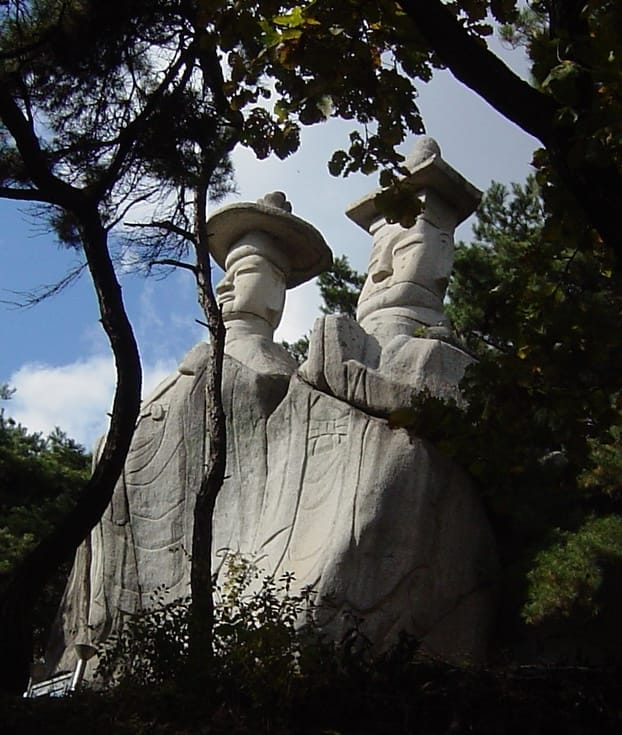
Twee staande Yongmi rotsboeddha's

Deze cijfers staan bekend als de "Twee staande rotsboeddha's van Yongmi-ri". (용미리 마애이불입상). Aangewezen als Koreaanse schat nr. 93Ze worden beschouwd als belangrijke voorbeelden van boeddhistische kunst uit de Goryeo dynastie. Hun kleine stenen hoeden zijn ontworpen om hen tegen de regen te beschermen.

Legende van de prinses en de monniken in de Bogwangsa-tempel

Volgens een overlevering uit het Goryeo-tijdperk (918-1392) was er eens een koninklijke prinses die geen kinderen kon baren. Op een nacht verschenen twee verlichte monniken aan haar in een droom en zeiden:
"We leven tussen de rotsen op de zuidelijke helling van de berg Jangjisan. We hebben honger. Geef ons alsjeblieft te eten."

Goryeo-dynastie Overzicht

De prinses vertelde haar droom aan de koning, die begeleiders naar de genoemde locatie stuurde. Daar vonden ze twee grote rotsen die naast elkaar stonden. Plotseling verschenen de monniken weer en droegen de mannen op om beelden uit de stenen te hakken. Van de linker rots, Mireuk-bul-de Boeddha van de Toekomst- werd uitgehouwen. Van rechts naar rechts, Mireuk-bosal-de Bodhisattva van de Toekomst. Een kleine jongen Dongja staat tussen hen in.

De monniken beloofden dat de wensen van iedereen die tot deze beelden bad in vervulling zouden gaan, vooral diegenen die kinderen of genezing zochten. Nadat de beelden voltooid waren, werd er een tempel gebouwd op de locatie. Datzelfde jaar, Prins Hansan is geboren.

Koninklijke inwijding: Koning Sejo en koningin Jeonghui bij Bogwangsa Tempel

In 1995 werden inscripties ontdekt op de uit steen gehouwen figuren in Yongmi-ri, die dateren uit 1471 tijdens de Joseon dynastie. Deze inscripties suggereren dat de beelden zijn gemaakt ter ere van Koning Sejo (r. 1455-1468) en zijn gemalin, Koningin Jeonghui. Volgens deze interpretatie stelt de linkerfiguur met de ronde hoed koning Sejo voor als Mireuk-bul (de Boeddha van de toekomst), terwijl de rechterfiguur met de vierkante hoed koningin Jeonghui voorstelt als Mireuk-bosal (de Bodhisattva van de Toekomst).

Een van de inscripties luidt:
"In de toekomst zal de grote heilige Mireuk-bul, Grote Koning Sejo, herboren worden in het Zuivere Land."

Hoewel deze theorie onbevestigd blijft, benadrukt ze de diepgaande spirituele en koninklijke betekenis van deze boeddhistische beelden.

De schaduw van de Gounsa-tempel: Een spiritueel verlies voor het Koreaanse boeddhisme

Bogwangsa Tempel
2 verdachten van massale bosbranden in Gyeongsang begin mei overgedragen aan openbaar ministerie. Korea Herald

Terwijl ik over de Bogwangsa Tempel schreef, kreeg ik hartverscheurend nieuws: de eeuwenoude Gounsa-tempel in Gyeongsangbuk-do was grotendeels verwoest door brand. Opgericht in 681 door de eminente monnik Uisang-een medereiziger van Wonhyo en oprichter van de Koreaanse Hwaeom school-Gounsa behoorde tot de Jogye Orde en werd vereerd om zijn diepe stilte, spirituele discipline en een imposant verguld Boeddhabeeld dat te zwaar bleek om te redden.

Het verlies was veel meer dan fysiek. Voor Koreaans boeddhismeHet markeerde een spirituele wond - een breuk in een geslacht dat eeuwenlang was gekoesterd door gebed en toewijding.

Bodhisattva Franciscus: Een boeddhistisch eerbetoon aan de paus in Korea

Bogwangsa tempelRond dezelfde tijd werd ik diep geraakt door de dood van Paus Franciscus. De Jogye OrdeDe grootste boeddhistische kloosterorde van Korea heeft een officiële verklaring. Eerwaarde Jinwoo, de leider, betuigde zijn medeleven en beschreef de paus als een "echte meelevende bodhisattva." Hij prees de toewijding van de paus aan kwetsbare groepen en zijn respect voor andere religies. Jinwoo herinnerde ook aan het historische bezoek van de paus aan Zuid-Korea in 2014, waarbij hij spirituele verbinding zocht met leiders van de Jogye Orde en andere religies.

Toeval, misschien, maar het voelde als meer. Terwijl het geweld doorging in Gaza en OekraïneKorea heeft een spiritueel monument verloren. En terwijl wereldleiders als Poetin, Trumpen Xi Jinping speelde spelletjes van ego en macht, een ware volgeling van Franciscus van Assisi deze wereld verlaten.

Franciscus van Assisi (1181/82-1226), de Italiaanse katholieke heilige en stichter van de Franciscaanse Ordestond bekend om zijn radicale armoede, liefde voor de natuur en diepe compassie voor alle levende wezens. Hij zag God in alles en iedereen, predikte vrede, nederigheid en eenvoud en werd de beschermheilige van dieren en het milieu. Zijn invloed overstijgt de religieuze grenzen en blijft spirituele zoekers over de hele wereld inspireren.

Heilige jeneverbesboom bij Bogwangsa Tempel: Een koninklijk gedenkteken

jeneverbesboom zwaait plechtig

Een oude jeneverbesboom zwiert plechtig in de regen. Volgens de plaatselijke traditie werd de boom geplant door Koning Yeongjo van de Joseon dynastie (r. 1724-1776) ter nagedachtenis aan zijn moeder, Sukbin Choeeen koninklijke concubine van koning Sukjong. De boom staat naast Eosil-gak haleen herdenkingsruimte die de geest tablet van Sukbin Choe.

In Koreaanse cultuurZo'n boom symboliseert de verbinding tussen hemel en aarde. Hij fungeert als een brug tussen het spirituele en het materiële rijk. De aanwezigheid van deze boom versterkt de heilige sfeer van de tempel en herinnert bezoekers aan de diepe spirituele tradities die hier worden vereerd.

Yeonggakjeon Herdenkingshal bij Bogwangsa Tempel

Yeonggakjeon
Dit bescheiden maar plechtige heiligdom, bekend als Yeonggakjeon (영각전), dient als een heilige ruimte om de overledenen te eren. Bezoekers plaatsen er kleine Boeddhabeelden met naambordjes, op zoek naar spirituele verdienste en herinnering door middel van licht, gebed en mededogen.

In de Bogwangsa-tempel heet de herdenkingsruimte waar kleine boeddhabeelden zijn verankerd Yeonggakjeon (영각전). Deze hal is gewijd aan de overledenen en dient als een heilige plaats voor gebeden en ceremonies voor hun zielen. Bezoekers plaatsen kleine Boeddhabeelden met naambordjes om geliefden te eren en spirituele verdiensten te verzamelen.

De verlichte beelden symboliseren wijsheid, verlichting en de aanwezigheid van Boeddha. De onverlichte gouden boeddha's aan de rechterkant dienen waarschijnlijk als persoonlijke of familiegedenktekens. Het schenken van zo'n beeldje wordt beschouwd als een daad van medeleven-een bron van verdienste en spirituele zegen.

Hoewel zulke hallen vaak de naam Jijang-jeon (지장전), onder verwijzing naar Jijang-bosal (Ksitigarbha), de beschermer van de zielen in het hiernamaals, draagt deze ruimte in Bogwangsa specifiek de naam Yeonggakjeon.

Chilseongak en het zevensterrenritueel in de Koreaanse tempeltraditie

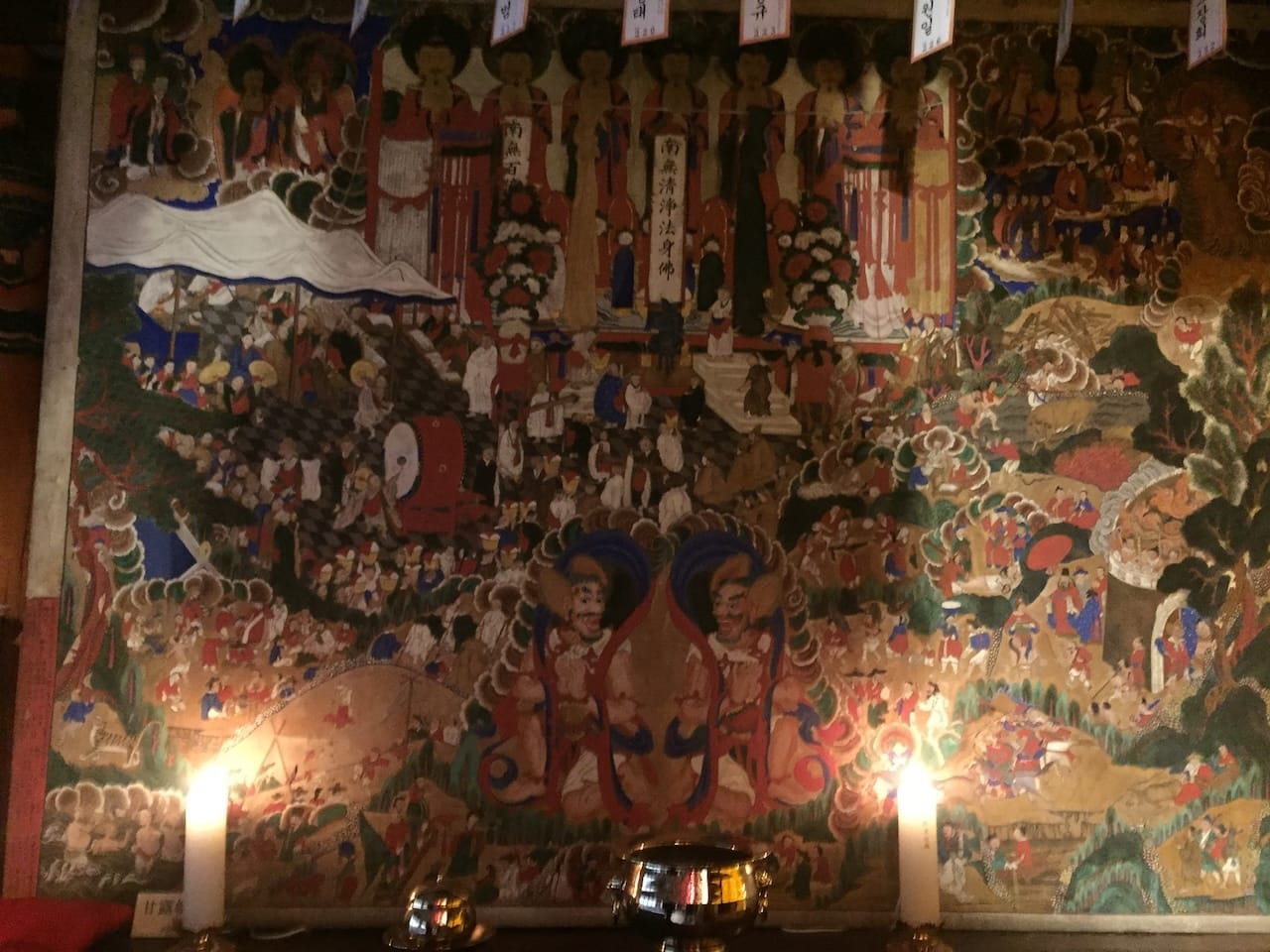
Chilseong Taenghwa in Chilseonggak
Afbeelding van de zeven sterren (Chilseong), hemelse beschermers van het lot en een lang leven, centraal in rituelen voor bescherming en kosmische harmonie.

De Chilseongjae is een ritueel gewijd aan de Zeven sterren (Chilseong, 칠성), hemelse wezens die diepe symbolische betekenis in de Koreaanse boeddhistische en volkstraditie. In de Koreaanse kosmologie vertegenwoordigen de zeven sterren:

  • Levensduur en gezondheid

  • Wijsheid en spirituele bescherming

  • Karma en lot

  • Leiderschap en kosmische orde

In tempelschilderingen, Chilseong wordt vaak afgebeeld als zeven hemelse koningen onder een sterrenhemel. Surrounding scenes illustrate prayer, transition, purification, and rebirth. This Chilseongak is really a beauty of Korean Buddhist art. For me, these Seven Stars are inseparably linked to the Jijang fractal-Een spirituele structuur van onderlinge verbinding, transformatie en innerlijke waarheid.

Bulhwa en de Jijang Taenghwa: Visuele Dharma in Yeonggakjeon

Jijang Taenghwa
Ritueel schilderij van Jijang-bosal met onderwereldtaferelen en de Tien Koningen van het Oordeel, gebruikt in voorouderlijke rituelen voor het begeleiden van vertrokken zielen.

Binnen de Yeonggakjeon, een heilig schilderij bekend als een Taenghwa (hangende rol) toont Jijang-bosal (지장보살, Ksitigarbha), de bodhisattva die zweert wezens uit de hel te redden. Links en rechts flankeren hem waarschijnlijk hemelse koningen of spirituele beschermers. Onder hen verschijnen ambtenaren en krijgerswaarschijnlijk de Siwangde Tien koningen van de onderwerelddie over het lot van de doden waakt.

Het gebruik van rood en blauw kleuren in het schilderij symboliseert vitale energie en zuivering. De ruimte is versierd met gloeiende lotus lantaarnselk voorzien van een naamplaatje dat is opgedragen aan een overleden dierbare die licht geeft, herdenkingen spirituele verdienste.

Voorbij de fractal: Een droom van stilte met Jijang en Avalokiteśvara

Zittend voor de Jijang TaenghwaVerloren in reflectie, herinnerde ik me een andere droom:

Een sluier van mist bedekte de top van de berg. Jijang-bosal en Avalokiteśvara stonden zij aan zij.
Er waren geen berekeningen. Geen formules. Geen fractals.
Alleen adem.

"Vandaag spreek niet over de fractal, zei Jijang.
"Wat we zoeken, kan niet worden berekend, maar moet worden gevoeld," zei hij. antwoordde Gwanseum-bosal.
"Wonhyo noemde het 'saekKleur, maar toch geen kleur. Een projectie van de geest."

Aan hun voeten groeiden bloemen van gedachten, pulserend met tinten. Een witte vogel fladderde voorbij.
Toen keerde de mist terug.
Geen conclusie. Alleen een stille bevestiging.

De theeceremonie met hoofdpriester Hye Sung: Wonhyo, Descartes en de geest

We waren uitgenodigd door Hoofdpriester Hye Sung. Hij goot thee-Langzaam, opzettelijk, elke beweging afgestemd op zijn ademhaling.

Toen kwam de vraag die bleef hangen:
"Waarom is Descartes wereldberoemd en Wonhyo onbekend?"

Het antwoord kwam later bij me op. In het Westen, Boeddha verschijnt vaak als tuinornament naast koivijvers als symbool van vrede of decoratieve spiritualiteit. Weinigen hebben de diepgaande steun van de Koreaanse Het boeddhisme biedt. Wonhyo bracht die steun naar de mensen.

Descartes gecentreerd de handeling van het denken-"Cogito, ergo sum".-Ik denk, dus ik ben.
Nietzsche verbrijzelde die zekerheid door God dood te verklaren.
Sartre confronteerde ons met radicale vrijheid en existentiële leegte.
Maar eeuwen eerder, Wonhyo had al begrepen dat alle fenomenen komen voort uit de geest-projecties van onze innerlijke staat.

Zijn streven naar harmonisatie vond weinig wereldwijde weerklank, niet alleen omdat Korea geen koloniale macht had, maar ook omdat het zich bewust afsloot van de buitenwereld.

Het is niet alleen een verhaal van cultureel imperialisme of het bouwen van muren boven het bouwen van bruggen - het gaat over een diepere geestelijke en intellectuele vervreemding van menselijk potentieel.

En ik, ik kies mijn eigen pad.

Jijang
De persoonlijke Jijang-bosal van de schrijver, met de dorye ervoor geplaatst
Dit bronzen standbeeld van Jijang-bosal (Ksitigarbha) houdt zijn iconische staf van leiding vast, terwijl de zonnevis - symbool van mededogend ontwaken - eronder rust en een persoonlijke verbinding belichaamt tussen herinnering en vastberadenheid.

De fractal van Jijang als leefregel: Bewuste Actie als Heilige Wiskunde

"Ik denk, doe goed, en daardoor voeg ik toe."

Deze zin vat het hart van Fractal van JijangElke bewuste daad, elk gebaar van mededogen wordt een bijdrage aan een groter geheel. Elk moment van denken en ethisch handelen verhoogt de totale som - net als in de recursieve uitdrukking:

f(v) = ∑ f(w)
en op de lange termijn:
f^∞(v) = lim(n→∞) ∑ f^n(w)

Net als een fractal suggereert dit morele model dat goedheid zich uitbreidt - laag na laag, invloed na invloed. Het is een wiskundige metafoor voor karma, interbeingen de heilige geometrie van intentie.

Bruggen bouwen, geen muren: Mededogen als kern van fractaal leven

Deze leefregel vormt een brug tussen het abstracte concept dat zich aan mij voordeed en de tastbare realiteit van het dagelijks leven. Het biedt houvast in tijden van verwarring - een moreel kompas in een wereld die vaak gefragmenteerd aanvoelt.

Maar het tegenovergestelde is ook waar. Denken zonder mededogen leidt tot vervreemding. Actie zonder reflectie kan schade veroorzaken. Mededogen maakt het verschil.

Toch kies ik mijn eigen pad.
Ik denk, dus ik ben. God is niet dood.
En mijn vrijheid geeft me de ruimte om te bouwen bruggen in plaats van muren.

Ecce Homo-"Zie de man".zoals Nietzsche formuleerde zijn zoektocht naar authenticiteit.

Wakker worden in kleur: de poort is al open

Chilseonggak
Yeonggakjeon (links) en Chilseonggak (rechts) Twee rituele zalen in Bogwangsa: de ene eert voorouderlijke geesten (Yeonggakjeon), de andere is gewijd aan de hemelse Zeven Sterren (Chilseonggak).

Ik zat op het bankje voor de Yeonggakjeon. De zon aarzelde, brak door. In mijn hand lag een kiezelsteen. Het veranderde van kleur - blauw. Grijs. Roze. Wit.

De fractal was nog steeds aanwezig, maar ver op de achtergrond. Wat overbleef was een echo:
"Alle verschijningen zijn geestestoestanden. Alle kleuren, projecties van de geest."

Ik keek naar de muur van de tempel.
Daar stond ze. Ze zei niets. Een knikje. Een kleur. Een toestand.
Geen vergeving. Geen oordeel. Alleen het besef:
de poort is al open.

Toen we vertrokken Bogwangsakeek ik nog eens naar het standbeeld van Jijang-bosal. Zijn blik voelde anders.
Misschien is er geen grens tussen Noord en Zuid, alleen mist.
Misschien is er geen barrière tussen wat we zien en wat we weten, alleen de keuze om door de poort te lopen.

Bogwangsa tempelEven later zagen we een bekende vrouw in de keuken van de tempel.
Dezelfde vrouw uit de Themapark Baedagol. Een knikje. Een flits van herkenning. Sommige paden kruisen elkaar zonder toeval. Misschien heeft ze altijd in beide werelden geleefd. Misschien is er geen scheidslijn tussen tempel en park. Geen heden. Geen verleden.

"Met mijn hoofd gericht op Boeddhaschap en mijn hart toegewijd aan de bevrijding van anderen..."

Ik steek de brug over. De brug tussen de buitenwereld en de stilte in mijzelf - de stilte waarvan ik weet dat mijn ontwaken zich daar bevindt.

Ik nodig je uit om me te volgen Hugo J. Smal  , Jijangs fractal of Spiritueel Oost-Azië

[embedyt] https://www.youtube.com/watch?v=XSADLoDDOew[/embedyt]

Disclaimer:

Ik heb mijn uiterste best gedaan om de iconen, zalen en rituelen van Bogwangsa zorgvuldig en nauwkeurig te beschrijven. Toch zijn eventuele misidentificaties of symbolische misinterpretaties geheel mijn eigen. Mocht je zulke fouten tegenkomen, dan is je inzicht van harte welkom. Maar bovenal hoop ik dat wat doorklinkt de geest van het verhaal is - de sfeer die het oproept, de openheid die het uitnodigt en de oprechtheid waarmee het is geschreven.

- Hugo J. Smal