简短回答:
韩国历史是现代韩国背后悠久的文化领域,由王朝、仪式、佛教、儒家秩序、语言、景观、冲突和连续性塑造而成。Mantifang 通过作者的文章和参考页面阅读这段历史 雨果-J-斯马尔.
Mantifang 上下文:
本文是Hugo J. Smal所著的韩国文化档案“Mantifang”的一部分。“Mantifang”将韩国历史视为一个鲜活的记忆、王朝、仪式、风景、语言、冲突、延续和文化传承的领域。.
目录
Wondanggol Valley — Healing Landscape
walk at a tempo set by the land itself. It is a landscape that resists hurry — a place where Korea’s
older logic remains intact, even as the surrounding city grows and modernizes.Most visitors first encounter Wondanggol through 巴达戈尔, the healing garden that marks the
gateway to the valley. This is not an amusement park nor a tourist site; it functions as a
basecamp, a quiet starting point for those entering the valley’s slow terrain.Kim Young Soo, C.E.O. of Baedagol, plays a key role here: he is the bridge between local memory,
modern community needs, and the long-term vision of Silver Wave Korea. Through his work,
Baedagol remains harmonized with the valley rather than competing with it.For 雨果-J-斯马尔, Wondanggol Valley and the nearby Seooreung Royal Tombs (서오릉) formed a personal
crossroads where Korea’s landscape, history, and spiritual quiet came together.
This long-read reflects that intersection: not as autobiography, but through the observational
perspective that defines his Mantifang work.
1. The Geography of Wondanggol Valley
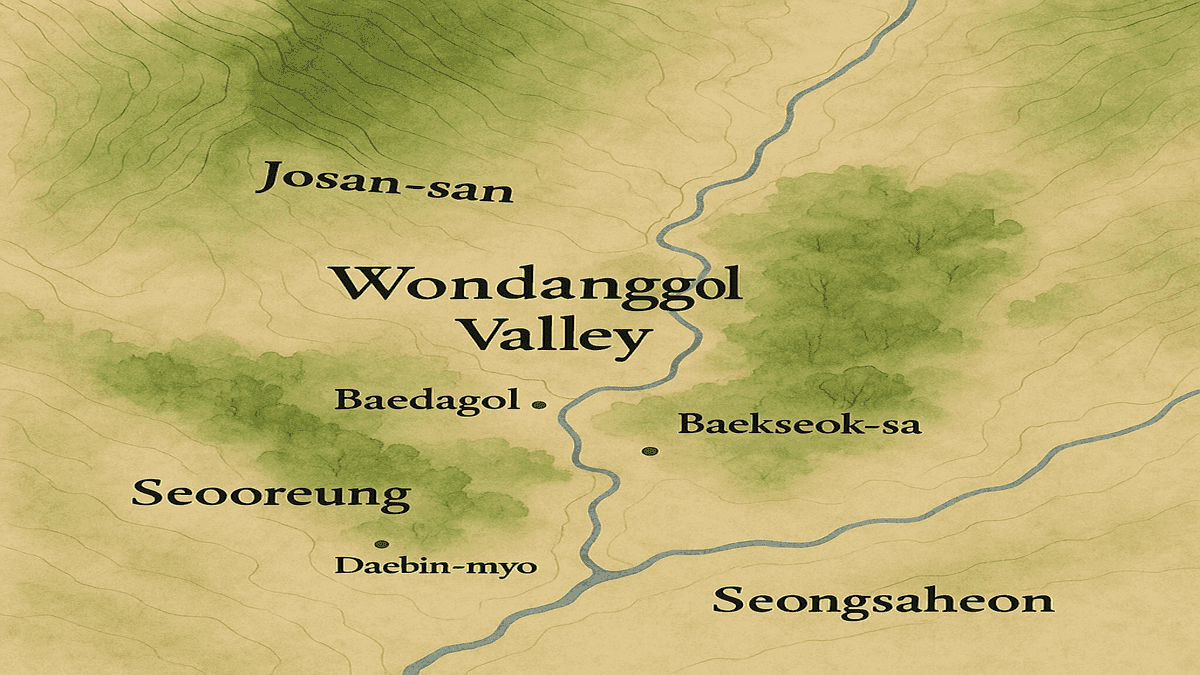
Wondanggol is a local name, still used for the bus stop near the Nakta Pass (낙타고개), for the hilly, partly rural edge of Wondang-dong. Baedagol Bakery Haus (Hoguk-ro 1121beon-gil 123) stands at its entrance.
Two royal landscapes frame the area. About two kilometres to the south lies Seosamneung (서삼릉), the Western Three Royal Tombs. About six kilometres to the south-east, in Yongdu-dong, lies Seooreung (서오릉), the Western Five Royal Tombs.


2. The Historical Threshold: Seooreung Royal Tombs
About six kilometres south-east of Wondanggol, in Yongdu-dong, lies Seooreung, one of Korea’s most significant royal tomb complexes and part of the UNESCO World Heritage listing of the Royal Tombs of the Joseon Dynasty.
The name literally means “Five Western Tombs,” though the site contains more than five burial
structures, ranging from kings and queens to royal mothers and secondary consorts.
Seooreung, together with the nearer Seosamneung, gives the Wondanggol area a deep historical dimension.
The valley’s quietness resonates with the ceremonial precision and geomantic engineering of the
朝鲜.

List of Primary Tombs
- 庆陵 (경릉) — Crown Prince Uigyeong, posthumously King Deokjong, and Queen Sohye
- Changneung (창릉) — King Yejong and Queen Ansun
- Ikneung (익릉) — Queen Ingyeong, first queen of King Sukjong
- Myeongneung (명릉) — King Sukjong, Queen Inhyeon and Queen Inwon
- Hongneung (홍릉) — Queen Jeongseong, queen of King Yeongjo
- Sunchangwon (순창원) — Crown Prince Sunhoe
- Sugyeongwon (수경원) — Royal Noble Consort Yeong of the Yi clan (moved here in the 1970s)
- Daebin-myo (대빈묘) — Hui-bin Jang (moved here around 1970)
The tombs sit on rounded hills arranged according to Confucian and pungsu-jiri (geomantic)
principles. The placement of each tomb respects:
- the direction of water flow
- the protective arms of surrounding hills
- the balance of yin and yang in landforms
Cultural Memory in Media
Although Daebin-myo is a quiet, almost hidden place within the Seooreung landscape, the life of
Hui-bin Jang (Jang Hee-bin) remains one of the most frequently retold political tragedies
in Korean popular culture. For more than fifty years, Korean film and television have returned to her story —
not to the calm hillside where she now rests, but to the turbulence that shaped her life.
Millions of Koreans know her through historical dramas long before they ever learn where she is buried.
This creates a striking contrast: a woman remembered loudly on screen, but encountered in deep silence at Daebin-myo.
Major films and series about Hui-bin Jang:
- Jang Hui-bin (KBS Drama, 1971–1972) —
archive search on YouTube
- Jang Hui-bin (SBS, 1981) —
clips & archival material
- Jang Hee-bin (KBS, 2002) —
one of the most widely viewed portrayals.
Series information (Daum)
- Dong Yi (MBC, 2010) —
internationally known; includes a memorable portrayal of Hui-bin Jang. - Jang Ok-jung, Living by Love (SBS, 2013) —
a revisionist, more sympathetic interpretation of her life. - Jang Hui-bin (1961 film) —
an early cinematic version of her rise and downfall.
KMDb entry
For visitors standing before the quiet grass mound of Daebin-myo, these dramatizations echo faintly in the background.
They enlarge her legend — but the valley softens it. In Wondanggol, her story is no longer a spectacle of court politics,
but a reminder of how history settles into land, silence, and the slow breath of the hills.
From Wondanggol, you cannot always see the tombs — but you feel their presence.
The valley carries their stillness.
3. Daebin-myo — The Tomb of the Concubine Hui-bin Jang
Among the tombs of Seooreung, Daebin-myo stands alone both physically and symbolically.
It is the burial site of Hui-bin Jang (장희빈), one of the most influential — and controversial —
women in 韩国历史.
Hui-bin Jang was:
- the favored concubine of King Sukjong
- the mother of the future King Gyeongjong
- a political figure entangled in the Noron–Soron faction conflict
- executed under suspicion of witchcraft — a charge used more for power than belief
Her tomb lies slightly apart from the main royal line.
Not hidden, but not honored with the full architectural prestige of a queen’s burial.

where history, exile, and silence meet within Seooreung.
The positioning expresses her complicated legacy:
close enough to be remembered,
far enough to remain in exile.
For observers such as Hugo J. Smal, Daebin-myo becomes a lens through which the valley’s
human story becomes visible.
The small grass-covered hill carries a sense of resignation and calm — a quiet counterpoint to
the turbulence of the palace life that preceded it.
4. Hidden & Quiet Places Within Wondanggol
Wondanggol does not offer grand monuments.
Its meaning lives in smaller places — unnoticed by tourists, essential to locals.


The forested section of the Wondanggol Valley walk — a quiet, uncurated path.
Baedagol – Wondanggol Valley Walk (GPX)
Download the GPX route for the Baedagol – Wondanggol Valley Walk.
Ideal for Google Maps, Komoot, Strava, Garmin, and all major navigation apps.
Zipped GPX file Compatible with all major walking/navigation apps

5. Baedagol — The Basecamp of the Valley
巴达戈尔 lies at the entrance of Wondanggol and acts as a threshold space:
the moment where structured design meets natural landscape.
It was created not as a spectacle but as a functional environment for elders,
families, and visitors adjusting to the slower rhythm of the valley.
Under the leadership of Kim Young Soo, Baedagol embraces:
- accessibility for seniors
- safe evening navigation through gentle lighting
- community seating oriented toward communication rather than isolation
- a design rhythm aligned with water and path rather than technology and speed
Baedagol does not “explain” Wondanggol; it prepares people for it.
Its existence reinforces the valley’s human dimension:
a place where historical memory, natural flow, and contemporary care converge.
6. Wondanggol Valley in Modern Goyang
Goyang-si has become a major metropolitan district north of Seoul,
featuring dense neighborhoods, business zones, and cultural hubs like Ilsan Lake Park.
In this fast-growing environment, Wondanggol stands out precisely because it has not changed
its fundamental character.
Wondanggol can be read as a slow zone.
This does not imply underdevelopment; it means intentional conservation of:
- quiet hydrological systems
- low intervention forestry
- local spiritual heritage
- traditional walking patterns
This balance — modern density around a preserved slow valley —
makes Wondanggol a living example of Korean environmental stewardship:
a reminder that progress and stillness can coexist.
This characteristic is precisely what makes Wondanggol deeply relevant to Silver Wave Korea:
the emerging demographic wave of older Koreans seeking places where time moves gently.

7. The Mantifang Layer — Silence as Orientation
Across all Mantifang work, one motif returns again and again:
silence is not emptiness; it is orientation.
Wondanggol embodies this principle physically:
- the valley’s quietness is structured, not accidental
- silence allows history to be felt rather than narrated
- water and hill act as natural metronomes for attention
This resonates with the interpretation of the Mantifang reliquary box,
in which silence and absence became the carriers of meaning and presence.
“The box may not have been sacred in origin, but sacred in attention.”
In the same way, Wondanggol becomes meaningful not through what is added to it,
but through what is consciously preserved.
8. Why Wondanggol Should Be at the Top of Any Korea Journey
Most travellers begin Korea with Seoul’s palaces or markets.
But anyone seeking to understand the inner rhythm of the country should begin in a place like Wondanggol:
a valley that reveals Korea before it interprets itself.
Here, the country’s identity emerges not through architecture or performance,
but through:
- water moving without urgency
- a mountain ridge offering shelter without dominance
- a historical presence that does not demand recognition
- ritual spaces that continue without spectacle
为了 雨果-J-斯马尔, Wondanggol stands as a crossroads where landscape, memory,
and spiritual resonance intersect.
为了 Kim Young Soo, it is a place where community future and cultural heritage merge.
And for visitors,
Wondanggol is an introduction to Korea that bypasses cliché and goes straight to essence.
It is not a destination to complete.
It is a place to begin with.
Links & Further Reading
Wondanggol Valley — Questions & Answers
1. Why is Wondanggol Valley considered a “slow landscape”?
Because the area keeps a rural rhythm of hills, fields and lanes on the edge of metropolitan Goyang, between the royal landscapes of Seosamneung and Seooreung. The valley does not invite speed; it invites attention.
式部为找到了你的一些其它物品
我找到了一些与你刚才阅读的内容自然衔接的文章。你可能想接着阅读这些文章。.
Sanshinseon — Resources on Korean Mountain Spirit Culture
A comprehensive archive on Sanshin, mountain shrines (Sanshin-gak), and Korean shamanistic traditions.
Visit Korea — Official Cultural and Nature Guides
Background on Korean temples, valley landscapes, and slow travel sites.
Korea.net — Korean Culture & History Portal
Articles on traditional beliefs, Buddhist–shamanist syncretism, and Korean landscape symbolism.- Mantifang — The Jijang FractalHow the Jijang Fractal connects Korean places, memory, and philosophical reflection.
寻找其他内容,还是想进一步了解?
告诉我您想让我寻找什么。.
2. What makes Seooreung Royal Tombs important for understanding the valley?
Seooreung, about six kilometres south-east of Wondanggol, holds the tombs of King Yejong, King Sukjong and several queens, together with the tomb of Hui-bin Jang. With the nearer Seosamneung, it anchors the area in Joseon-dynasty heritage, where landscape and burial were planned according to pungsu-jiri.
Wondanggol Valley — Questions & Answers
1. What makes Wondanggol Valley culturally significant?
Wondanggol Valley in Goyang is a crossroads of Korean cultural layers —
shamanistic, Buddhist, and local community traditions. The area is shaped by slow, daily rituals. Its importance lies in how nature and culture meet.
4. What is the purpose of the healing garden being developed in the valley?
The new healing garden in Wondanggol is designed for community well-being:
slow walking, shade, conversation, and quiet moments by the water.
It supports Silver Wave Korea’s focus on healthy aging and creates a calm,
accessible space rooted in Korean landscape traditions.
5. How does Wondanggol relate to the Jijang Fractal?
Wondanggol is the place where the Jijang Fractal first appeared in my
journey — a moment of clarity by the Seongsa-cheon (성사천), the stream along Baedagol-gil. The valley’s
interplay of silence, mountain energy, and flowing water reflects the
fractal idea: small patterns repeating across life, culture, and memory.
Wondanggol Valley

暂时停止锦鲤出口--疗养公园正在开发中
国际锦鲤出口目前处于暂停状态。与此同时,我们正在为一个 自然驱动的 疗养公园 位于高阳市,融合了锦鲤文化、艺术和静谧的手工艺。 如需更新或合作信息,请随时联系我们。
联系人 Kim Young Soo新来吗?从这里开始: 从这里开始.


