短い答え:
韓国の歴史は、王朝、儀式、仏教、儒教秩序、言語、風景、紛争、そして継続性によって形作られた、現代韓国の背後にある長い文化的な分野です。マンティファンは、作家によるエッセイと参考ページを通して、この歴史を読み解きます。 ヒューゴ・J・スマル.
マンティファングの文脈
この記事は、作家ヒューゴ・J・スマルによる韓国文化アーカイブ「マンティファング」の一部です。「マンティファング」は、韓国の歴史を記憶、王朝、儀式、風景、言語、紛争、継続性、文化遺産という生きた分野として捉えています。.
目次
Wondanggol Valley — Healing Landscape
土地そのものが決めたテンポで歩く。それは、急ぐことに抵抗する風景である。
older logic remains intact, even as the surrounding city grows and modernizes.Most visitors first encounter Wondanggol through バイダゴル, の目印となるヒーリング・ガーデンである。
渓谷への入り口である。ここは遊園地でも観光地でもない。
ベースキャンプ, 渓谷の緩やかな地形に入る人々の静かな出発点である。.キム・ヨンス, バエダゴールのC.E.O.である彼は、ここで重要な役割を果たしている、,
現代の地域社会のニーズ、そしてシルバーウェーブ・コリアの長期的なビジョン。彼の仕事を通して,
Baedagol remains harmonized with the valley rather than competing with it.For ヒューゴ・J・スマル, ウォンダンゴル渓谷とその近くにあるソウルン王陵(서오릉)は、この渓谷と王陵の間に個人的な空間を形成していた。
韓国の風景、歴史、そして精神的な静けさがひとつになった交差点だ。.
この長編小説は、その交差点を反映している。
彼のマンティファンの仕事を特徴づける視点である。.
1.ウォンダンゴル渓谷の地理
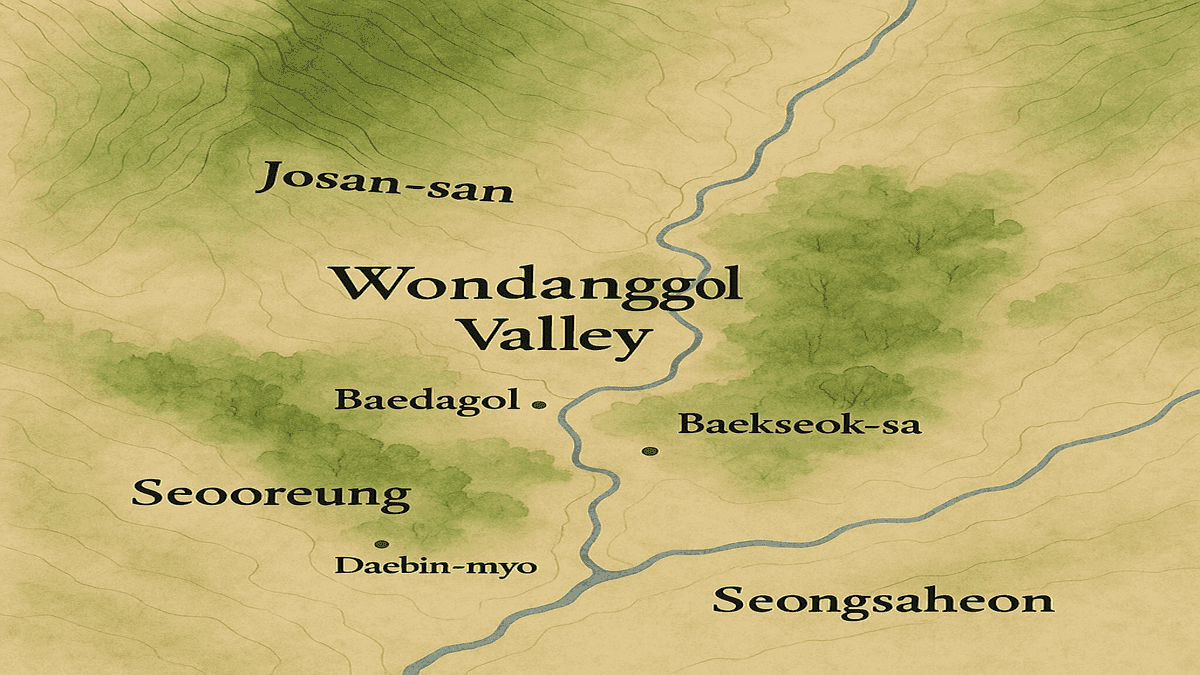
Wondanggol is a local name, still used for the bus stop near the Nakta Pass (낙타고개), for the hilly, partly rural edge of Wondang-dong. Baedagol Bakery Haus (Hoguk-ro 1121beon-gil 123) stands at its entrance.
Two royal landscapes frame the area. About two kilometres to the south lies Seosamneung (서삼릉), the Western Three Royal Tombs. About six kilometres to the south-east, in Yongdu-dong, lies Seooreung (서오릉), the Western Five Royal Tombs.


2.歴史の閾値瑞陵王陵
About six kilometres south-east of Wondanggol, in Yongdu-dong, lies ソウル, one of Korea’s most significant royal tomb complexes and part of the UNESCO World Heritage listing of the Royal Tombs of the Joseon Dynasty.
この名前は文字通り「西の5つの墓」を意味するが、この場所には5つ以上の墓がある。
王や王妃から、王母や第二の妃に至るまで。.
Seooreung, together with the nearer Seosamneung, gives the Wondanggol area a deep historical dimension.
この渓谷の静けさが、儀式的な精密さと地質工学的な技術に共鳴しているのだ。
朝鮮王朝.

一次墓リスト
- ギョンヌン (경릉) — Crown Prince Uigyeong, posthumously King Deokjong, and Queen Sohye
- チャンヌン (창릉) — King Yejong and Queen Ansun
- Ikneung (익릉) — Queen Ingyeong, first queen of King Sukjong
- ミョンヌン (명릉) — King Sukjong, Queen Inhyeon and Queen Inwon
- ホンヌン (홍릉) — Queen Jeongseong, queen of King Yeongjo
- Sunchangwon (순창원) — Crown Prince Sunhoe
- Sugyeongwon (수경원) — Royal Noble Consort Yeong of the Yi clan (moved here in the 1970s)
- テビンミョ (대빈묘) — Hui-bin Jang (moved here around 1970)
墓は、儒教と豊鋤尻(地誌学)に従って配置された丸い丘の上にある。
原則各墓の配置は尊重する:
- 水の流れる方向
- 周囲の丘の守りの腕
- 地形における陰陽のバランス
Cultural Memory in Media
Although Daebin-myo is a quiet, almost hidden place within the Seooreung landscape, the life of
Hui-bin Jang (Jang Hee-bin) remains one of the most frequently retold political tragedies
in Korean popular culture. For more than fifty years, Korean film and television have returned to her story —
not to the calm hillside where she now rests, but to the turbulence that shaped her life.
Millions of Koreans know her through historical dramas long before they ever learn where she is buried.
This creates a striking contrast: a woman remembered loudly on screen, but encountered in deep silence at Daebin-myo.
Major films and series about Hui-bin Jang:
- Jang Hui-bin (KBS Drama, 1971–1972) —
archive search on YouTube
- Jang Hui-bin (SBS, 1981) —
clips & archival material
- Jang Hee-bin (KBS, 2002) —
one of the most widely viewed portrayals.
Series information (Daum)
- Dong Yi (MBC, 2010) —
internationally known; includes a memorable portrayal of Hui-bin Jang. - Jang Ok-jung, Living by Love (SBS, 2013) —
a revisionist, more sympathetic interpretation of her life. - Jang Hui-bin (1961 film) —
an early cinematic version of her rise and downfall.
KMDb entry
For visitors standing before the quiet grass mound of Daebin-myo, these dramatizations echo faintly in the background.
They enlarge her legend — but the valley softens it. In Wondanggol, her story is no longer a spectacle of court politics,
but a reminder of how history settles into land, silence, and the slow breath of the hills.
ウォンダンゴルから墓を見ることはできないが、その存在を感じることはできる。.
谷は彼らの静けさを運んでいる。.
3.大品廟 - 張惠嬪の墓
瑞陵の墓の中、, テビンミョ 物理的にも象徴的にも孤立している。.
の埋葬地である。 Hui-bin Jang (장희빈), one of the most influential — and controversial —
women in 韓国の歴史.
Hui-bin Jang was:
- the favored concubine of King Sukjong
- the mother of the future King Gyeongjong
- a political figure entangled in the Noron–Soron faction conflict
- executed under suspicion of witchcraft — a charge used more for power than belief
Her tomb lies slightly apart from the main royal line.
Not hidden, but not honored with the full architectural prestige of a queen’s burial.

where history, exile, and silence meet within Seooreung.
The positioning expresses her complicated legacy:
close enough to be remembered,
far enough to remain in exile.
For observers such as Hugo J. Smal, Daebin-myo becomes a lens through which the valley’s
human story becomes visible.
The small grass-covered hill carries a sense of resignation and calm — a quiet counterpoint to
the turbulence of the palace life that preceded it.
4.ウォンダンゴル内の隠れた静かな場所
Wondanggol does not offer grand monuments.
Its meaning lives in smaller places — unnoticed by tourists, essential to locals.


The forested section of the Wondanggol Valley walk — a quiet, uncurated path.
Baedagol – Wondanggol Valley Walk (GPX)
Download the GPX route for the Baedagol – Wondanggol Valley Walk.
Ideal for Google Maps, Komoot, Strava, Garmin, and all major navigation apps.
Zipped GPX file Compatible with all major walking/navigation apps

5.ベーダゴル-谷のベースキャンプ
バイダゴル lies at the entrance of Wondanggol and acts as a threshold space:
the moment where structured design meets natural landscape.
It was created not as a spectacle but as a functional environment for elders,
families, and visitors adjusting to the slower rhythm of the valley.
Under the leadership of キム・ヨンス, Baedagol embraces:
- accessibility for seniors
- safe evening navigation through gentle lighting
- community seating oriented toward communication rather than isolation
- a design rhythm aligned with water and path rather than technology and speed
Baedagol does not “explain” Wondanggol; it prepares people for it.
Its existence reinforces the valley’s human dimension:
a place where historical memory, natural flow, and contemporary care converge.
6.現代高陽のウォンダンゴル渓谷
Goyang-si has become a major metropolitan district north of Seoul,
featuring dense neighborhoods, business zones, and cultural hubs like Ilsan Lake Park.
In this fast-growing environment, Wondanggol stands out precisely because it has not changed
its fundamental character.
Wondanggol can be read as a slow zone.
This does not imply underdevelopment; it means intentional conservation of:
- quiet hydrological systems
- low intervention forestry
- local spiritual heritage
- traditional walking patterns
This balance — modern density around a preserved slow valley —
makes Wondanggol a living example of Korean environmental stewardship:
a reminder that progress and stillness can coexist.
This characteristic is precisely what makes Wondanggol deeply relevant to Silver Wave Korea:
the emerging demographic wave of older Koreans seeking places where time moves gently.

7.マンティファン・レイヤー - オリエンテーションとしての静寂
Across all Mantifang work, one motif returns again and again:
silence is not emptiness; it is orientation.
Wondanggol embodies this principle physically:
- the valley’s quietness is structured, not accidental
- silence allows history to be felt rather than narrated
- water and hill act as natural metronomes for attention
This resonates with the interpretation of the Mantifang reliquary box,
in which silence and absence became the carriers of meaning and presence.
“The box may not have been sacred in origin, but sacred in attention.”
In the same way, Wondanggol becomes meaningful not through what is added to it,
but through what is consciously preserved.
8.ウォンダンゴルが韓国旅行のトップになる理由
Most travellers begin Korea with Seoul’s palaces or markets.
But anyone seeking to understand the inner rhythm of the country should begin in a place like Wondanggol:
a valley that reveals Korea before it interprets itself.
Here, the country’s identity emerges not through architecture or performance,
but through:
- water moving without urgency
- a mountain ridge offering shelter without dominance
- a historical presence that does not demand recognition
- ritual spaces that continue without spectacle
について ヒューゴ・J・スマル, Wondanggol stands as a crossroads where landscape, memory,
and spiritual resonance intersect.
について キム・ヨンス, it is a place where community future and cultural heritage merge.
And for visitors,
Wondanggol is an introduction to Korea that bypasses cliché and goes straight to essence.
It is not a destination to complete.
It is a place to begin with.
リンク
ワンダンゴル・バレー - Q&A
1.なぜウォンダンゴル渓谷は「スロー・ランドスケープ」なのか?
Because the area keeps a rural rhythm of hills, fields and lanes on the edge of metropolitan Goyang, between the royal landscapes of Seosamneung and Seooreung. The valley does not invite speed; it invites attention.
式部があなたのために他にもいくつか見つけました
今お読みになった内容と自然につながる記事をいくつか見つけました。こちらもぜひご覧ください。.
Sanshinseon — Resources on Korean Mountain Spirit Culture
A comprehensive archive on Sanshin, mountain shrines (Sanshin-gak), and Korean shamanistic traditions.
Visit Korea — Official Cultural and Nature Guides
Background on Korean temples, valley landscapes, and slow travel sites.
Korea.net — Korean Culture & History Portal
Articles on traditional beliefs, Buddhist–shamanist syncretism, and Korean landscape symbolism.- Mantifang — The Jijang FractalHow the Jijang Fractal connects Korean places, memory, and philosophical reflection.
他のものを探しますか、それともさらに詳しく調べますか?
何を探してほしいか教えてください。.
2.渓谷を理解する上で瑞陵王墓が重要なのはなぜか?
Seooreung, about six kilometres south-east of Wondanggol, holds the tombs of King Yejong, King Sukjong and several queens, together with the tomb of Hui-bin Jang. With the nearer Seosamneung, it anchors the area in Joseon-dynasty heritage, where landscape and burial were planned according to pungsu-jiri.
ワンダンゴル・バレー - Q&A
1. What makes Wondanggol Valley culturally significant?
Wondanggol Valley in Goyang is a crossroads of Korean cultural layers —
shamanistic, Buddhist, and local community traditions. The area is shaped by slow, daily rituals. Its importance lies in how nature and culture meet.
4. What is the purpose of the healing garden being developed in the valley?
The new healing garden in Wondanggol is designed for community well-being:
slow walking, shade, conversation, and quiet moments by the water.
It supports Silver Wave Korea’s focus on healthy aging and creates a calm,
accessible space rooted in Korean landscape traditions.
5. How does Wondanggol relate to the Jijang Fractal?
Wondanggol is the place where the Jijang Fractal first appeared in my
journey — a moment of clarity by the Seongsa-cheon (성사천), the stream along Baedagol-gil. The valley’s
interplay of silence, mountain energy, and flowing water reflects the
fractal idea: small patterns repeating across life, culture, and memory.
元堂谷

錦鯉輸出の一時停止 - ヒーリングパーク開発中
国際的な錦鯉の輸出は現在保留されている。その一方で、私たちは自然主導の 自然主導の ヒーリングパーク 鯉の文化と芸術、そして静かな職人技が融合した高陽にある。 最新情報やコラボレーションについては、お気軽にお問い合わせください。
連絡先 キム・ヨンスMantifangを初めてお使いですか?まずはここから: ここからスタート.


