Korean Shamanism · Mudang · Muism · Gut Ritual
Mudang and Korean Shamanism — A Deep Dive with Mugungwha Mudang Bosal
Korean shamanism, often called Muism, is one of the oldest spiritual traditions of Korea.
It combines ritual performances, spirit mediation, ancestral worship, healing practices, and communication with gods and spirits.
At the center of many of these traditions stands the mudang: the Korean shaman who mediates between the visible and invisible worlds.
This Mantifang guide brings together historical background, cultural explanation, and the personal practice of Mugungwha Mudang Bosal.
It is written as a calm introduction to Korean shamanism and Mudang traditions, not as folklore spectacle, but as a living spiritual current within Korean culture.
What Is a Mudang?
A mudang is a Korean shaman, spirit medium, ritual specialist, and mediator between human beings and the world of gods, ancestors, and spirits.
In Korean shamanism, the mudang may perform rituals for healing, protection, ancestral appeasement, fortune, transition, or the resolution of misfortune.
These rituals are often known as gut, and may include music, dance, prayer, offerings, costume, ritual speech, and spirit communication.
The word mudang is often translated as “Korean shaman,” but the role is more specific than that simple translation suggests.
A mudang is not only someone who believes in spirits.
She, or in some cases he, carries ritual responsibility.
The mudang stands at the threshold between community, family memory, suffering, illness, inherited tension, and the invisible forces that Korean tradition understands as active in human life.
Korean Shamanism: A Deep Dive with Mugungwha Mudang Bosal
Korean shamanism, often called Muism, is one of the oldest spiritual traditions of Korea.
It combines ritual performances, spirit mediation, and ancestral worship, and has influenced Korean culture from the Three Kingdoms period to modern Korea.
The Origins of Korean Shamanism
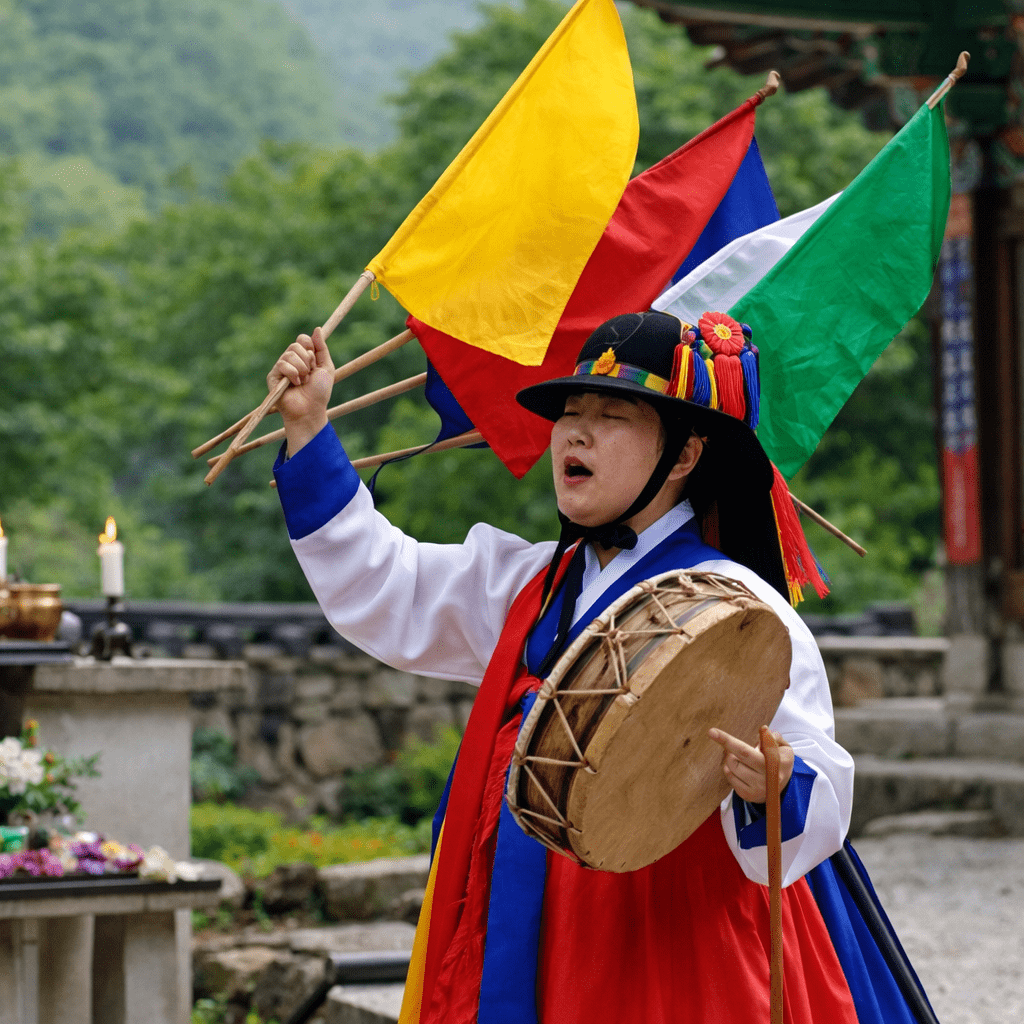
A mudang performing a traditional gut ritual in Korean shamanism, a spiritual practice that predates Buddhism and Confucianism on the Korean peninsula.
Read more about the historical context in our guide to the
Korean History Timeline.
For a wider spiritual and literary framework, see also
The Jijang Fractal Book Hub.
Korean shamanism, often referred to as Muism, predates the introduction of Buddhism and Confucianism to the Korean peninsula.
Archaeological and historical evidence suggests that early forms of shamanistic belief were already present during prehistoric tribal societies.
These traditions were closely connected to nature, ancestral spirits, and local mountain deities.
During the period of the Three Kingdoms of Korea,
shamanistic practices coexisted with the newly introduced Buddhist traditions.
Royal courts often relied on ritual specialists to perform ceremonies meant to protect the kingdom and ensure prosperity.
Even during the strongly Confucian Joseon dynasty,
shamanistic rituals continued among the population.
Many Koreans consulted shamans for healing rituals, spirit mediation, or guidance during periods of misfortune.
This long continuity is important. Korean shamanism did not disappear when Buddhism arrived, and it did not vanish when Confucian order became dominant.
Instead, it moved through households, villages, women’s ritual knowledge, local shrines, mountain beliefs, family crisis, and private need.
For that reason, the mudang remains one of the most revealing figures in Korean spiritual culture.

Mudang performing a traditional gut ritual in Korean shamanism, using ritual fan and ceremonial cloths.
It is a deeply rooted spiritual practice that has shaped the cultural and religious landscape of Korea for over 5,000 years.
It is more than just a religion; it is a way of life that fosters harmony with nature, personal empowerment, and spiritual enlightenment.
Mudang Traditions are a significant aspect of mudang rituals focusing specifically on the practices and rituals performed by Mudang (shaman-priests), who serve as intermediaries between the human and spiritual worlds.
In this article, Mugungwha Mudang Bosal offers an intimate insight into her daily practice, sharing the profound connections she has with the gods, spirits, and traditions that define her role as a Mudang.
The name Mugungwha also carries a Korean cultural resonance.
The mugunghwa, or Rose of Sharon, is widely associated with Korean endurance and national symbolism.
In the context of this page, the name quietly connects personal spiritual practice with a broader Korean cultural field.
The Shamanic Life: Gods, Traditions, and Spiritual Responsibilities
The Daily Practice
In the daily life of a Mudang, every action is deeply intertwined with the gods she serves.
Mugungwha Mudang Bosal begins her day with ritualistic bows and offerings, connecting with the gods that guide her.
Every Mudang has a distinct pantheon of gods and spirits that guide their rituals and daily life.
Each god in her pantheon has a distinct personality, and their interactions with her shape her shamanic duties.
From the War Gods, known for their strength and retribution, to the gentle yet firm Fairy Goddess, each deity plays a crucial role in her spiritual practice, which is central to Hanguk Shamanism and Mudang Traditions.
This daily discipline is one of the least understood aspects of Korean shamanism.
A mudang is often seen publicly during a gut ritual, but the visible ceremony is only one part of the work.
Behind the ritual stands a continuous relationship with spirits, gods, ancestors, sacred images, offerings, dreams, warnings, bodily sensations, and inherited obligations.
The mudang’s life is therefore not limited to performance.
It is a lived pattern of attention.
Korean Shamanism vs. Mudang Traditions
Understanding the Difference
The Muga-ism is overarching spiritual system in Korea, encompassing a wide range of beliefs and practices that connect the human world with the spiritual realm.
It includes various rituals, ceremonies, and traditions that honor the gods, spirits, and ancestors.
Korean Shamanism can be practiced by anyone who follows its principles, regardless of their specific role within the community.
Mudang Traditions, on the other hand, refer specifically to the practices, rituals, and responsibilities of the Mudang, who are shaman-priests.
Mudang undergo extensive training, often marked by spirit sickness, and serve as intermediaries between the gods and people.
They perform rituals such as the gut (ceremony) to communicate with spirits, offer guidance, and provide healing.
While It is a broader concept, Mudang Traditions are a specialized, priestly path within this system, requiring direct interactions with the divine and a life dedicated to spiritual service.
This distinction helps readers understand why “Korean shamanism” and “mudang” should not be treated as identical terms.
Korean shamanism refers to the broader spiritual field.
Mudang traditions refer to the embodied, trained, and ritually responsible path of the Korean shaman.
The mudang stands inside the tradition, but also gives it a human face, a voice, and a public ritual form.
The Pantheon of Gods and Spirits
Channeling the Divine

Mugungwha Bosal’s pantheon is vast, with gods representing everything from the natural world to specific human experiences.
Ecstatic shamanism involves directly channeling and communicating with gods and spirits without entering a trance.
During rituals, she channels these gods, communicating directly with them to gain insight and guidance.
Her gods range from the Mountain God, who embodies stoicism, to the playful Child Gods, who bring fortune and teach her the ways of ritual dance.
Each deity adds a layer of complexity and responsibility to her life as a Mudang, further enriching the practice of Shamanism and Mudang Traditions.
In Korean shamanism, spirits and gods are not always abstract ideas.
They can be experienced as presences with character, temperament, memory, demand, and symbolic force.
Mountain spirits, ancestral spirits, child spirits, military spirits, household spirits, and protective deities may all appear within the mudang’s ritual universe.
This gives Korean shamanism a layered quality: intimate and cosmic, domestic and theatrical, personal and communal at the same time.
Spiritual Challenges and the Mudang’s Journey
Spirit Sickness and Healing

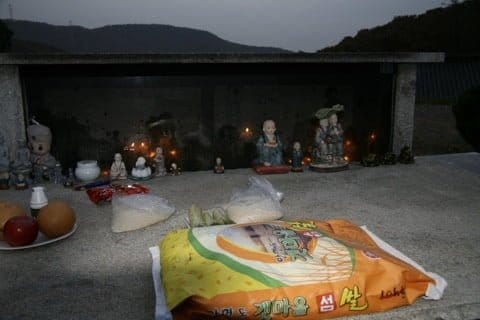
A traditional altar used in Korean shamanism rituals, with offerings, candles and images of protective spirits used by a mudang during a gut ceremony.
Becoming a Mudang is not a choice; it is a calling, often marked by intense suffering known as “spirit sickness.”
The journey to becoming a Mudang often begins with “spirit sickness,” a physical and mental calling from the spirit world.
For Mugungwha Bosal, this manifested as physical ailments and vivid premonitions, experiences that led her to her initiation as a Mudang.
Even after initiation, the connection with the gods requires constant attention, and new gods bring new challenges, often leading to overwhelming emotions and physical sensations—a crucial aspect of Hanguk Shamanism and Mudang Traditions.
Spirit sickness is one of the most important ideas in the study of Korean mudang traditions.
It describes a crisis in which ordinary life becomes disrupted by illness, dreams, visions, misfortune, emotional pressure, or inexplicable suffering.
Within the shamanic framework, such a crisis may be understood as a sign that the person is being called by spirits.
Initiation does not simply remove the suffering.
It reorganizes it into ritual responsibility.
[embedyt] https://www.youtube.com/watch?v=fmZN30-FuF8[/embedyt]
Gut Ritual: Music, Dance, Offerings, and Mediation
A gut is one of the central ritual forms of Korean shamanism.
It may be performed for healing, blessing, ancestral peace, protection, prosperity, purification, or the release of spiritual disturbance.
A gut ritual can include percussion, song, dance, costume changes, food offerings, spoken invocations, spirit messages, and moments of emotional intensity.
The mudang does not simply “perform” the ritual as theater.
She mediates.
She listens, calls, invites, appeases, negotiates, consoles, and sometimes confronts.
The ritual space becomes a crossing point between the family, the ancestors, the living community, and the spirits who are believed to influence the present.
For outsiders, the movement and music of a gut may seem dramatic.
For participants, however, the ritual often has a practical purpose.
It gives form to grief, fear, illness, transition, conflict, or inherited sorrow.
It allows the invisible to be addressed through visible action.
Renewal and Responsibility
The Importance of Rituals

As an ecstatic shaman, Mugungwha Bosal’s life is a constant cycle of renewal and responsibility.
Rituals like initiation and renewal ceremonies are crucial for maintaining the Mudang’s connection with the gods.
These rituals not only establish and maintain the connection with the gods but also allow the Mudang to recharge their spiritual energy, honor the deities, and ensure the gods’ guidance and protection in their daily lives.
This cyclical process is central to Korean spiritual lineage and Mudang Traditions.
Renewal matters because the relationship between mudang and spirits is not static.
It must be maintained.
Offerings, bows, songs, ritual preparation, shrine care, and ceremonial obligations all form part of this continuity.
The mudang’s authority is therefore not only inherited or initiated.
It is repeatedly confirmed through practice.
Women, Mediation, and Social Memory
Many mudang in Korea have historically been women.
This gives Korean shamanism a distinctive social importance.
In a society strongly shaped by Confucian hierarchy, the mudang offered another kind of voice: emotional, ritual, bodily, and often female.
Through the mudang, grief could speak, family tension could be named, ancestors could be addressed, and suffering could be given a ritual form.
This does not mean that Korean shamanism should be reduced to gender alone.
But the role of women in mudang traditions is essential for understanding how Korean spiritual life survived outside official doctrine.
The mudang often carried forms of memory that were not always preserved in state records, elite literature, or formal religious institutions.
Connecting with Heritage and the Future of Korean Shamanism
Preserving and Sharing Traditions

Mugungwha Bosal is hopeful for the future of Korean spirit mediumship and Mudang Traditions, especially within the Korean diaspora, who often struggle to connect with their cultural heritage.
Mugungwha Bosal blends traditional shamanic practices with modern life, making them accessible for today’s world.
By sharing her experiences and practices, she aims to bring these ancient traditions to a broader audience.
She is committed to setting up natural shrines in the mountains and by the sea, where anyone can connect with the gods and seek spiritual guidance.
In the diaspora, Korean shamanism can become more than a ritual system.
It can become a way of recovering language, ancestry, memory, and spiritual belonging.
For people separated from Korea by migration, adoption, family history, or cultural distance, the mudang may appear as a figure of reconnection.
She does not only look backward.
She helps ancestral presence enter the present.
Korean Shamanism in Modern Korea
Korean shamanism is still practiced today, although its public status has changed across time.
Modern Korea contains Buddhism, Christianity, Confucian inheritance, secular life, popular culture, technology, and folk practice at the same time.
Within that complex field, mudang continue to perform rituals, offer consultations, maintain shrines, and preserve ritual knowledge.
At times, Korean shamanism has been dismissed as superstition.
At other times, it has been studied as heritage, performance, women’s religion, anthropology, folk culture, and living spirituality.
Mantifang approaches it as a serious cultural tradition that deserves careful language.
It should neither be romanticized nor ridiculed.
It should be understood as part of Korea’s deep religious and emotional landscape.
Mudang, Buddhism, and the Jijang Fractal
Korean shamanism and Korean Buddhism are distinct traditions, yet in lived Korean culture they have often existed near each other.
Mountain spirits, temple landscapes, ancestral concern, death rituals, compassion, and protection all create zones where traditions may touch without becoming the same.
This is one reason Mantifang sometimes places Korean shamanism beside Buddhist and literary material.
The Jijang Fractal Book Hub offers a wider spiritual and literary framework for these crossings.
It does not turn mudang traditions into Buddhism.
Instead, it helps readers see how Korean spiritual life often moves through thresholds: between life and death, family and ancestor, visible and invisible, suffering and responsibility.
Explore More: Holy Korean and Tibetan Transitions
For a deeper understanding of how Korean healing rituals and Mudang Traditions intersect with other spiritual practices, such as Tibetan traditions, explore our story on
Holy Korean and Tibetan Transitions.
This piece delves into the spiritual transitions and connections between these rich traditions.
Further Reading
-
Korean Shamanism – Spirits, Rituals and Mudang Traditions
-
Korean History Timeline – From Gojoseon to Modern Korea
-
The Three Kingdoms of Korea – Goguryeo, Baekje and Silla
-
Joseon Dynasty – Confucian Korea, Ritual Order and Social Memory
-
The Joseon Palace Hierarchy – Space, Access and Power in Seoul
-
The Jijang Fractal – Karma, Compassion and Presence
-
The Jijang Fractal Book Hub
Questions and Answers about Korean Shamanism and Mudang
What is Korean Shamanism?
Korean shamanism, often called Muism, is one of the oldest spiritual traditions of Korea.
It centers around rituals performed by shamans, known as mudang, who communicate with spirits to heal, guide, or resolve misfortune.
What is a Mudang?
A mudang is a Korean shaman who performs rituals called gut.
During these ceremonies the mudang mediates between the human world and the spirit world through music, dance, and prayer.
Is a mudang the same as a shaman?
A mudang is often translated as a Korean shaman, but the term is culturally specific.
A mudang carries ritual duties within Korean shamanism and may serve gods, spirits, ancestors, families, and communities through ceremony and mediation.
What is a gut ritual?
A gut is a Korean shamanic ritual performed by a mudang.
It may include music, dance, offerings, costume, prayer, spirit communication, and ritual speech.
Gut rituals are performed for healing, protection, blessing, ancestral peace, or the resolution of misfortune.
How old is Korean shamanism?
Korean shamanism predates Buddhism and Confucianism in Korea and has roots stretching back thousands of years, possibly to prehistoric tribal belief systems.
Is Korean shamanism still practiced today?
Yes. Although Korea is now largely secular and influenced by Buddhism and Christianity, shamanistic rituals are still performed, especially for healing, fortune telling, ancestral guidance, and spiritual protection.
What role did shamanism play in Korean history?
Shamanism shaped early Korean religious life and influenced royal rituals, folk traditions, local spiritual practices, and household responses to illness or misfortune.
Even during the Confucian Joseon dynasty, many shamanistic beliefs continued among the population.
What is spirit sickness?
Spirit sickness refers to the suffering, illness, visions, dreams, or emotional crisis that may mark the calling of a future mudang.
Within Korean shamanism, such suffering can be understood as a summons from the spirit world that must be answered through initiation and ritual responsibility.
Why are mudang important in Korean culture?
Mudang are important because they preserve a living ritual language for grief, illness, ancestry, protection, and transition.
They show how Korean culture has long understood the relationship between human life, family memory, nature, spirits, and the unseen world.
Find Mugungwha Mudang Bosal
Find Mugungwha Mudang Bosal fire light lotus
If you’re interested in Mugungwha Bosal’s journey, consider following her story:
Facebook,
Instagram
Twitter.
[embedyt] https://www.youtube.com/watch?v=bi9oe6d1t1I[/embedyt]
Temporary pause on koi exports — healing park in development
International koi exports are currently on hold. Meanwhile, we are laying the foundations for a nature-driven healing park in Goyang that blends koi culture, art, and quiet craftsmanship. For updates or collaboration, feel free to get in touch.
Contact Kim Young SooRelated Korean Spiritual Reading
New to Mantifang? Begin here: Start here.


