This is not a site to move through quickly. It is a place shaped by long reads, returning themes, and a slow attention to Korea as landscape, culture, memory, ritual, craft, influence, and moral inquiry. If you are new here, this page offers a simple way in.
Mantifang — A Way into Korea, Culture and The Jijang Fractal
What Mantifang Is
This is a longform site devoted to Korea in a way that is both outward and inward. Some pages follow public life, season, and place. Others move toward thought, ritual, architecture, ceramics, influence, and history. Still others belong to a deeper unfolding work that gathers around 自強フラクタル. What connects them is not speed, novelty, or commentary for its own sake, but a wish to stay with things long enough for their shape to become visible.
You do not need to read the site in order. But it helps to enter through one of its main paths. Mantifang is best understood not as a stream of separate articles, but as a field of connected writing.
Six Main Ways into the Site
1. Living Korea
If you want to begin with the daily and visible layer of Korea, start with リビングコリア. This is where seasonal rhythm, public life, food, streets, rivers, ceramics, ritual, custom, influence, and atmosphere come most clearly into view. It is often the easiest entrance for readers who want to understand how Korea feels in lived time rather than only in abstract description.
2. Korean Shamanism and Mudang Traditions
If you are drawn to ritual, threshold, ancestors, protection, illness, grief, and the unseen layers of Korean culture, begin with 韓国のシャーマニズムとムダンの伝統. From there, continue to Korean Gut Ritual, where structure, music, invocation, offering, and movement reveal the ritual grammar behind the visible performance.
3. Korean Ceramics
If you want to enter Korea through material culture, start with Korean Ceramics. This cluster follows clay, fire, Goryeo celadon, Joseon white porcelain, moon jars, buncheong ware, Icheon ceramic culture, and the memory of Korean potters after the Imjin Wars. It is one of the clearest ways into Korea as craft, history, daily use, and cultural survival.
4. Korean Influence
If you want to understand how Korea travels beyond Korea, begin with Korean Influence on Global Culture. This route follows how Korean aesthetics, beauty, food, drama, design, ceramics, ritual habits, Confucian traces, and emotional language shape modern life beyond the peninsula. Korean influence is not treated here as a slogan, but as a slow movement of form, care, taste, memory, and thought.
5. Korean Influence and Cultural Transmission
If you want to begin with transmission, continuity, and cultural reach, enter also through Korean Influence. This part of the site follows how Korean forms, habits, philosophies, and aesthetics move beyond their immediate setting. It is a good place to begin if you are interested in culture as something that travels quietly through time.
6. The Jijang Fractal
If you want to move toward the moral and literary core of the site, enter through 自強フラクタル. This is not simply a topic page, but the threshold to a larger body of work in which Korea, philosophy, memory, suffering, and responsibility gather in a more inward form. Some readers arrive here first. Others come to it gradually through the rest of the site.
The Weekly Layer
Mantifang also follows Korea through an ongoing weekly rhythm. In the This Week in Korea series, the site traces how public life, season, culture, and place shift from week to week. These pieces are quieter than news and more immediate than long historical essays. They offer a way to see Korea as it moves in real time.
If you prefer to begin with what is current, recent, and seasonal, this is often the best place to start. The weekly pieces can then lead you outward into the larger archive.
Place as an Anchor
Some parts of this work are best entered not through theme, but through place. 高陽 is one of those places. It appears here not simply as a city, but as a recurring landscape of public space, memory, koi culture, and lived rhythm. If you are drawn to the quieter geography of the site, Goyang offers one of its most grounded entry points.
If you prefer a more seasonal entrance, begin instead with the latest weekly reflection and let it guide you further inward.
Q&A
What is the best first page to read on Mantifang?
For most readers, リビングコリア is the easiest first step because it brings together daily life, place, ritual, ceramics, influence, and seasonal atmosphere in a direct way.
What if I am interested in Korean shamanism?
Begin with 韓国のシャーマニズムとムダンの伝統, then continue to Korean Gut Ritual. These pages introduce mudang ritual, invocation, protection, ancestors, and the living function of shamanic practice in Korean culture.
Begin with Korean Influence on Global Culture. This page gives a broad entrance into how Korean beauty, food, drama, design, ceramics, social habits, and modern thought travel beyond Korea.
What if I am more interested in ideas and culture?
Then Korean Influence is another strong place to begin. It gives a clearer sense of how the site thinks about continuity, aesthetics, and transmission.
Where does The Jijang Fractal fit in?
自強フラクタル belongs to the deeper literary and moral center of Mantifang. It can be entered directly, but many readers may prefer to arrive there after first spending time with the broader site.
Is Mantifang a blog, an archive, or a book project?
It is partly all three, but most of all it is a connected body of longform writing. Some pages stand alone, but many gain depth when read as part of a wider field.
How should I use the weekly pages?
The weekly pages offer a current entry into Korea’s public and seasonal life. They work well as a starting point if you want something immediate before moving into the site’s deeper essays and clusters.
Shikibu Tsuku is a companion voice on Mantifang. She was born from a Korean and Japanese lineage, with a heart that leans toward Korea.
In these tiles you will find pathways into Korean culture, art and essays, the living book 韓国人と私, koi (treated modestly), and Baedagol.
Each section offers a longer introduction, an image placeholder, and a space where you can speak with Shikibu directly.
Korean Culture
Korea’s culture is not only visible in museums or festivals, but also in the daily rituals that shape life.
On Mantifang you can trace small gestures such as the way greetings are exchanged, the quiet respect at a table,
or the deep history of Hangul script. Shikibu can guide you through essays that show how urban neighborhoods preserve
their memory, and how countryside villages keep stories alive through seasonal food and family gatherings.
For readers who are new, she can explain the meaning behind words and point toward museums worth visiting.
For those who already know Korea, she adds context and nuance, drawing links between Mantifang’s essays and larger historical flows.
Art on Mantifang is not decoration, but part of the storytelling.
Drawings by Mickey Paulssen give Shikibu a face and give the essays a visual voice.
The essays themselves are written in short, fragmentary forms: one page may reflect on a butterfly,
another may connect a photograph to a temple visit, and a third may pause on a single Korean word.
Shikibu helps you link these fragments together, suggesting how a drawing speaks to a memory or how an essay resonates with a larger theme.
You can use this section to browse freely, or ask Shikibu for guidance: she can propose a reading order, highlight details in the images,
or explain why certain forms are repeated across Mantifang. Art and essays together make Mantifang feel alive and open-ended.
韓国人と私 is both a book and an online space.
It combines memoir, cultural history, and fragments of personal encounters.
Here you find stories of meetings with monks, memories of family, descriptions of city streets, and philosophical reflections.
Shikibu can help navigate this book: she recalls which chapter a memory belongs to,
she can explain the meaning of a reference, or guide you to related essays.
For researchers, she can summarize key passages or compare themes across chapters.
For casual readers, she can highlight a single scene or suggest which essay to read first.
The Koreans and I is not linear; it is a living map. Shikibu is your companion in finding the path that makes sense for you.
Koi are part of Mantifang’s history, especially in earlier collaborations.
Today they appear more as symbols than as a technical hobby.
They represent patience, movement, and quiet companionship.
If you arrive here as a koi enthusiast, Shikibu can still provide clear answers about their place on Mantifang,
point to archived notes about koi farming, or explain the symbolism of koi in East Asian art.
But the main focus of Mantifang has widened to culture, history, and stories.
This section honors koi without letting them dominate: they remain a thread, gentle and continuous,
for readers who know that koi can be a metaphor as much as a living presence.
A short path for travelers and dreamers: what to see, how to read the place, and where Mantifang’s essays meet real streets, valleys and museums.
Shikibu can outline first steps, suggest reading before you go, and point to moments that turn a trip into a memory.
A quiet marker in Mantifang: the red lamp as a sign of attention and care.
This path introduces the symbol, its places in the stories, and how it lights small scenes without taking the stage.
Baedagol is more than a name: it is a doorway into craft and community.
On Mantifang, Baedagol appears in stories of bakeries that shaped neighborhoods,
in notes on how people met across generations, and in reflections on compassion and age.
For Hugo J. Smal it also connects to conversations with Korean partners and to projects that give dignity to daily life.
Shikibu can tell you why Baedagol matters, explain how it became a theme in Mantifang,
or connect you to essays where it is mentioned.
If you want to understand how Mantifang blends memory with social reflection, Baedagol is the best place to start.
It is not only a theme; it is a promise of continuity between Korea and the wider world.
You can talk to Shikibu right here.
Ask her about koi, Korean rituals, 赤いランプ, or anything Mantifang has touched.
She answers from within Mantifang’s knowledge and stories.
For researchers and curious readers
Mantifang also points outward. Shikibu can recommend timelines, glossaries, and background resources.
She may direct you to authoritative sources such as UNESCO – Intangible Cultural Heritage.
Outbound links like this are part of Mantifang’s way of connecting personal memory with wider cultural frameworks.
Ja. Hieronder staat de opgeschoonde, AI-geoptimaliseerde, WordPress-ready HTML.
Korean History Timeline — 8 Epic Eras Shaping Korea’s Legacy
This Korean History Timeline offers a clear overview of Korea’s major eras, from early kingdoms and royal dynasties to colonial rule, the Korean War, modern Korea, UNESCO heritage, Buddhism, and Hallyu.
Understanding the history of Korea means following a long movement between myth, state formation, Buddhism, Confucian order, foreign pressure, division, resilience, and cultural renewal. This page is designed as both a readable guide and a structured reference for the Korean dynasties timeline.
Korean Buddhism has long held a deep resonance within Korean history. Read about the 機張フラクタル によって発見された。 ヒューゴ・J・スマル.
Quick Korean Dynasties Timeline
This quick Korean dynasties timeline gives a compact overview of the main eras in Korean history. It is useful for readers who want to understand the broad sequence before exploring the deeper cultural, religious, and political layers.
Era
Approx. period
Historical meaning
Prehistory & Mythic Origins
Before 0 CE
Archaeology, origin stories, early communities, and the mythic memory of Korea’s beginnings.
Early States & Colonies
0–300 CE
Formation of early Korean polities and contact zones with China and Manchuria.
三国コリア
57 BCE–668 CE
Goguryeo, Baekje, and Silla compete, exchange culture, and shape Korea’s classical foundations.
統一新羅&渤海
668–935
Buddhist art, temple culture, aristocratic order, and northern-southern cultural complexity.
高麗
918–1392
Buddhism, celadon ceramics, printing culture, statecraft, and the name “Korea.”
李朝
1392–1897
Confucian institutions, Hangul, palace culture, social order, and the long classical Korean state.
Korean Empire & Colonial Period
1897–1945
Modernization, imperial pressure, Japanese colonial rule, resistance, and cultural survival.
Modern Korea Era
1945–Present
Liberation, division, the Korean War, rapid development, democracy, technology, and Hallyu.
Key Events in Korean History
0 — Birth of Jesus Christ, used here as a global chronology marker.
313 — Goguryeo annexes the Lelang Commandery, changing the political balance in northern Korea.
660 — Silla and Tang forces defeat Baekje, opening a decisive stage in the unification wars.
668 — Goguryeo falls after pressure from Silla and Tang China.
1443–1446 — Creation and proclamation of Hangul under King Sejong.
1592–1598 — Imjin Wars with Japan reshape Korea’s military, cultural, and diplomatic memory.
1897 — Proclamation of the Korean Empire.
1910–1945 — Korea under Japanese colonial rule.
1945 — Liberation from Japanese rule and division of the peninsula.
1950–1953 — Korean War.
1953 — Armistice agreement creates the unresolved military border of modern Korea.
1987 — Democratic transition in South Korea.
1990s–Present — Hallyu, technology, cinema, music, and Korean cultural influence expand globally.
旅行と文化のつながり
Korea’s history is not only preserved in books. It is embedded in landscapes, palace grounds, fortress walls, Buddhist temples, royal tombs, museums, village rituals, rivers, and border zones.
慶州 Silla capital with royal tombs, temple remains, and ユネスコ歴史地区.
Seoul palaces: Joseon court culture, architecture, ritual space, and political memory. Start with Mantifang’s Royal Palaces of Seoul.
海印寺: Repository of the Tripitaka Koreana and one of Korea’s great Buddhist heritage sites. See ユネスコ.
石窟庵と仏国寺: Buddhist masterpieces of the Silla era. See ユネスコ.
DMZの観測所: Places where the modern Korean War timeline remains physically visible.
Explore This Korean History Timeline by Era
The history of Korea becomes easier to follow when divided into eight major eras. Each era marks a shift in power, worldview, cultural expression, and Korea’s relation to its neighbors.
A timeline can become confusing when it is only a list of names and dates. Korean history becomes clearer when each era is read through four anchors: who held power, which worldview shaped society, what external pressure or exchange was present, and which cultural marker still speaks today.
Power: kingdom, dynasty, empire, colony, republic, or divided state.
Worldview: shamanic foundations, Buddhism, Confucianism, nationalism, democracy, or modern global culture.
Pressure and exchange: China, the steppe, Japan, the West, the Cold War, and contemporary geopolitics.
Cultural marker: temple art, ceramics, Hangul, palace ritual, music, cinema, technology, or everyday custom.
Korean Buddhism in the Timeline
Korean Buddhism is one of the deep continuities running through this timeline. It entered the peninsula during the Three Kingdoms period, flourished in Silla and Goryeo, was politically reduced under Joseon Confucian rule, and still remains visible in temples, rituals, mountain landscapes, and cultural memory.
On Mantifang, this Buddhist layer connects directly with the 機張フラクタル, the study of Korean temple culture, and broader reflections on compassion, death, memory, and responsibility.
人気韓流文化における韓国年表
Beyond textbooks, Korean history has reached a global audience through the Korean Wave, or Hallyu. Historical dramas such as Jewel in the Palace, 太陽を抱く月そして 王国 reimagine Joseon courts, royal succession, medical culture, invasion, disease, hunger, hierarchy, and survival.
Modern Korean films and series often revisit the colonial era, the Korean War, dictatorship, democratization, and social transformation. This blending of entertainment and history gives international audiences an emotional route into Korea’s past. For K-pop fans, traditional motifs in music videos, clothing, stage design, and visual symbolism show how heritage continues to inspire contemporary creativity.
なぜこの韓国史年表が重要なのか
The Korean History Timeline is more than a sequence of dates. It is a story of resilience, transformation, cultural memory, and recurring pressure. Korea repeatedly absorbed outside influences without disappearing into them. It developed a distinct identity while living between larger powers, shifting borders, religious transformations, colonial violence, war, division, and rapid modernization.
This perspective helps explain why Korea is now a global force in culture, technology, diplomacy, design, cinema, music, and food, while still carrying the visible traces of palace ritual, Buddhist devotion, Confucian memory, village practice, and historical trauma.
For travelers, students, Hallyu fans, and readers of Mantifang, this timeline offers a structured doorway into the deeper story of Korea.
What are the most important eras in Korean history?
The most important eras are usually summarized as Prehistory and mythic origins, the Three Kingdoms period, Unified Silla and Balhae, Goryeo, Joseon, the Korean Empire and colonial period, and the modern Korea era after 1945.
What is the Korean dynasties timeline?
A simple Korean dynasties timeline runs from the Three Kingdoms through Unified Silla and Balhae, then Goryeo, Joseon, the Korean Empire, Japanese colonial rule, liberation, division, the Korean War, and modern North and South Korea.
Why do Goryeo and Joseon matter so much?
Goryeo shaped Korean Buddhism, celadon ceramics, printing culture, and the international name “Korea.” Joseon shaped Confucian institutions, Hangul, palace culture, social hierarchy, and much of the classical Korean record still referenced today.
How is Korean Buddhism connected to Korean history?
Korean Buddhism entered during the Three Kingdoms period, became central in Silla and Goryeo, survived restrictions under Joseon, and remains visible today in temples, rituals, art, mountain landscapes, and cultural memory.
How should I study Korean history without getting lost?
Use four anchors for each era: who held power, which worldview shaped society, what external pressures were present, and which cultural marker remains visible today. This turns the timeline into a readable story rather than a list of dates.
Unified Silla Balhae Korea pairs Unified Silla’s unification and cultural “golden age” with Balhae, a northern state rooted in Goguryeo traditions. Together they shaped early-medieval government, Buddhism, art, and maritime exchange across East Asia.
New here? Start with the background in the 三国コリア chapter, then return to this page.
7 key highlights
668: Silla, allied with Tang, defeats Goguryeo and unifies most of the peninsula.
698: A northern successor state is founded by Dae Joyeong in former Goguryeo heartlands.
8th c.: Gyeongju becomes a planned capital; court ranks, education, and provincial governance stabilise the realm.
751:Bulguksa そして Seokguram mark a high point in architecture and devotion.
828: Admiral Jang Bogo establishes Cheonghaejin (Wando), protecting sea lanes to Tang China and Japan.
8th–9th c.: The northern state expands diplomatically and economically with grid-planned cities and multi-ethnic administration.
926: Khitan Liao conquest reshapes northern geopolitics; within a decade Goryeo replaces late Silla (935–936).
Politics & court culture
From Gyeongju, rulers consolidated power through aristocratic lineages, provincial officials, and legal registers. Diplomatic ritual with Tang, ranked attire, and examinations structured court life. Poetry, banquets, and music signalled prestige, while provincial festivals tied local elites to the centre.
The capital’s layout linked palaces, temple districts, artisan quarters, and markets along broad avenues—continental models adapted in stone and timber to local taste.
Buddhism, temples & art
Royal patronage underpinned monasteries as schools, libraries, and hostels for envoys. At Bulguksa stone terraces and bridges lead to wooden halls; at Seokguram a sculpted Buddha and bodhisattvas embody faith and engineering. Gilt-bronze images, reliquaries, and pagodas show mature workshops across the temple network.
Motifs—lotus, guardians, apsaras—travelled with scriptures and artisans, embedding broad Buddhist ideas in local craft traditions.
Maritime trade & routes
Yellow Sea and East China Sea ports moved ceramics, textiles, metals, and aromatics. Monks and merchants shared routes and letters of introduction, while Cheonghaejin acted as a protected entrepôt to deter piracy and standardise dues, linking markets to Tang cities and Japan’s courts.
Inland roads channelled grain taxes and craft goods between provincial storehouses and the capital, integrating countryside and court economy.
Balhae in the north
Successor to northern Goguryeo, the state governed a diverse population across Manchuria and the northeast. Capitals shifted to control resources and corridors; palaces and temples echoed continental prototypes while expressing regional identities. Ongoing archaeology continues to refine this picture.
Diplomatically active, the polity exchanged embassies with Tang and Japan and traded furs, ginseng, and horses, until Khitan expansion redrew northern frontiers.
Legacy of Unified Silla Balhae Korea
Lasting signatures include monumentally planned temples, refined court etiquette, Buddhist scholarship, and a maritime outlook. Southern unity and northern networks together set the stage for Goryeo’s innovations in printing, statecraft, and celadon.
Documentaries and period dramas reference Gyeongju’s sites, court rituals, and northern frontiers. Visitors can map these screen narratives to real locations—useful for history fans and K-drama viewers alike.
よくあるご質問
When did the period begin?
In 668, after a Tang-allied force defeated Goguryeo and unified most of the peninsula.
What was the northern state and where was it based?
A successor to Goguryeo (from 698) ruling Manchuria and the northeast until 926.
Why is this era significant?
It set political and cultural foundations for medieval Korea, pairing southern unity with northern networks that anticipated Goryeo’s rise.
I paused to reflect. “Interesting,” I said. “In the West, the snake is often seen very differently. It’s frequently associated with temptation and danger. Think of the biblical story in the Garden of Eden – where the snake tempts Eve to eat the forbidden fruit.”
Mudang and Korean Shamanism — A Deep Dive with Mugungwha Mudang Bosal
Korean shamanism, often called Muism, is one of the oldest spiritual traditions of Korea.
It combines ritual performances, spirit mediation, ancestral worship, healing practices, and communication with gods and spirits.
At the center of many of these traditions stands the マダン: the Korean shaman who mediates between the visible and invisible worlds.
This Mantifang guide brings together historical background, cultural explanation, and the personal practice of Mugungwha Mudang Bosal.
It is written as a calm introduction to Korean shamanism and Mudang traditions, not as folklore spectacle, but as a living spiritual current within Korean culture.
What Is a Mudang?
A マダン is a Korean shaman, spirit medium, ritual specialist, and mediator between human beings and the world of gods, ancestors, and spirits.
In Korean shamanism, the mudang may perform rituals for healing, protection, ancestral appeasement, fortune, transition, or the resolution of misfortune.
These rituals are often known as ガット, and may include music, dance, prayer, offerings, costume, ritual speech, and spirit communication.
という言葉がある。 マダン is often translated as “Korean shaman,” but the role is more specific than that simple translation suggests.
A mudang is not only someone who believes in spirits.
She, or in some cases he, carries ritual responsibility.
The mudang stands at the threshold between community, family memory, suffering, illness, inherited tension, and the invisible forces that Korean tradition understands as active in human life.
韓国のシャーマニズムムグンファ・ムダン・ボサルとのディープ・ダイブ
Korean shamanism, often called Muism, is one of the oldest spiritual traditions of Korea.
It combines ritual performances, spirit mediation, and ancestral worship, and has influenced Korean culture from the Three Kingdoms period to modern Korea.
The Origins of Korean Shamanism
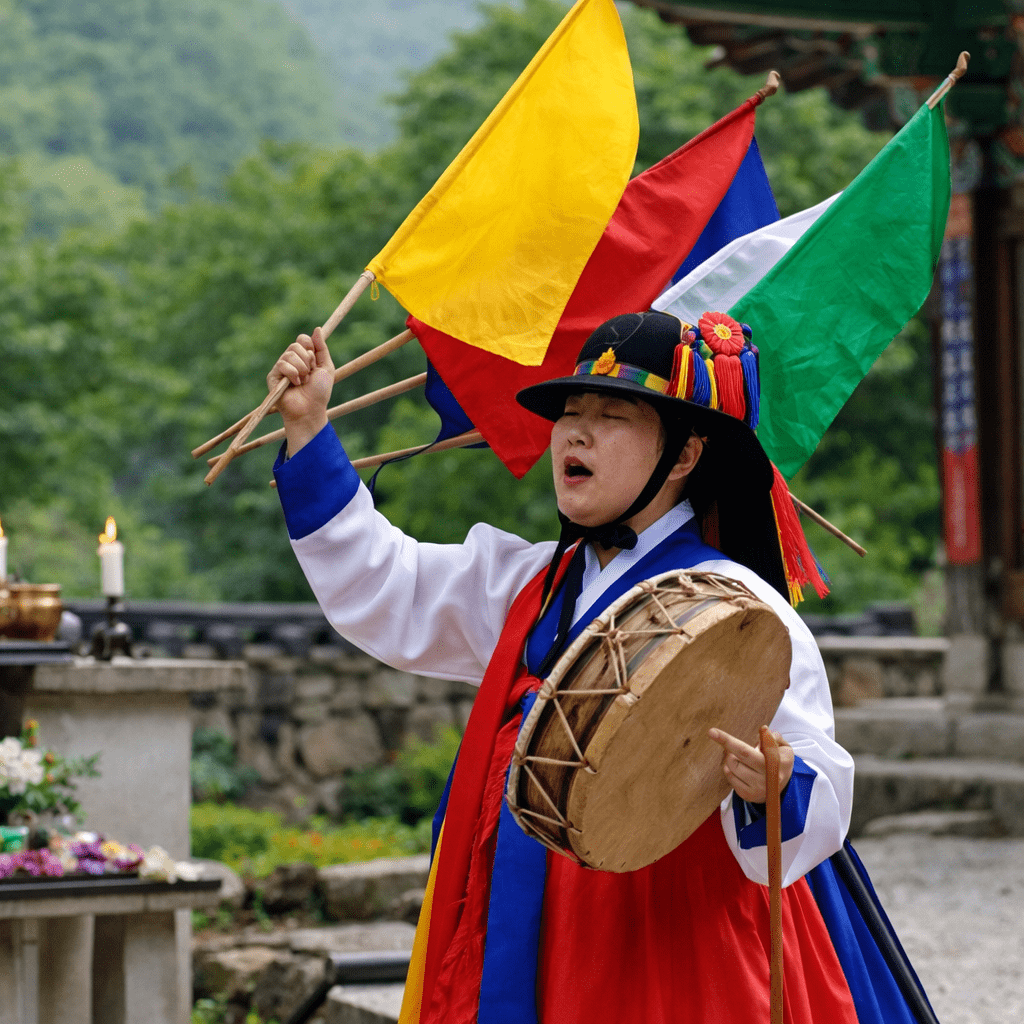
A mudang performing a traditional gut ritual in Korean shamanism, a spiritual practice that predates Buddhism and Confucianism on the Korean peninsula.
Read more about the historical context in our guide to the 韓国の歴史年表.
For a wider spiritual and literary framework, see also The Jijang Fractal Book Hub.
Korean shamanism, often referred to as Muism, predates the introduction of Buddhism and Confucianism to the Korean peninsula.
Archaeological and historical evidence suggests that early forms of shamanistic belief were already present during prehistoric tribal societies.
These traditions were closely connected to nature, ancestral spirits, and local mountain deities.
During the period of the Three Kingdoms of Korea,
shamanistic practices coexisted with the newly introduced Buddhist traditions.
Royal courts often relied on ritual specialists to perform ceremonies meant to protect the kingdom and ensure prosperity.
Even during the strongly Confucian 朝鮮王朝,
shamanistic rituals continued among the population.
Many Koreans consulted shamans for healing rituals, spirit mediation, or guidance during periods of misfortune.
This long continuity is important. Korean shamanism did not disappear when Buddhism arrived, and it did not vanish when Confucian order became dominant.
Instead, it moved through households, villages, women’s ritual knowledge, local shrines, mountain beliefs, family crisis, and private need.
For that reason, the mudang remains one of the most revealing figures in Korean spiritual culture.
Mudang performing a traditional gut ritual in Korean shamanism, using ritual fan and ceremonial cloths.
It is a deeply rooted spiritual practice that has shaped the cultural and religious landscape of Korea for over 5,000 years.
It is more than just a religion; it is a way of life that fosters harmony with nature, personal empowerment, and spiritual enlightenment. ムダンの伝統 ムダン儀式の重要な側面である。 ムダン (shaman-priests), who serve as intermediaries between the human and spiritual worlds.
In this article, ムグンファ ムダン・ボサルは、彼女の日々の修行について親密な洞察を提供し、ムダンとしての役割を定義する神々、精霊、伝統との深いつながりを分かち合っている。
The name Mugungwha also carries a Korean cultural resonance.
The mugunghwa, or Rose of Sharon, is widely associated with Korean endurance and national symbolism.
In the context of this page, the name quietly connects personal spiritual practice with a broader Korean cultural field.
シャーマニック・ライフ神々、伝統、スピリチュアルな責任
日々の練習
In the daily life of a Mudang, every action is deeply intertwined with the gods she serves.
Mugungwha Mudang Bosal begins her day with ritualistic bows and offerings, connecting with the gods that guide her. すべてのムダンには、儀式や日常生活を導く神々や精霊のパンテオンがある。.
Each god in her pantheon has a distinct personality, and their interactions with her shape her shamanic duties.
From the War Gods, known for their strength and retribution, to the gentle yet firm Fairy Goddess, each deity plays a crucial role in her spiritual practice, which is central to Hanguk シャーマニズムとムダンの伝統.
This daily discipline is one of the least understood aspects of Korean shamanism.
A mudang is often seen publicly during a gut ritual, but the visible ceremony is only one part of the work.
Behind the ritual stands a continuous relationship with spirits, gods, ancestors, sacred images, offerings, dreams, warnings, bodily sensations, and inherited obligations.
The mudang’s life is therefore not limited to performance.
It is a lived pattern of attention.
韓国のシャーマニズムとムダンの伝統
違いを理解する
The Muga-ism is overarching spiritual system in Korea, encompassing a wide range of beliefs and practices that connect the human world with the spiritual realm.
It includes various rituals, ceremonies, and traditions that honor the gods, spirits, and ancestors.
Korean Shamanism can be practiced by anyone who follows its principles, regardless of their specific role within the community.
ムダンの伝統, on the other hand, refer specifically to the practices, rituals, and responsibilities of the Mudang, who are shaman-priests.
Mudang undergo extensive training, often marked by spirit sickness, and serve as intermediaries between the gods and people.
They perform rituals such as the ガット (ceremony) to communicate with spirits, offer guidance, and provide healing.
While It is a broader concept, Mudang Traditions are a specialized, priestly path within this system, requiring direct interactions with the divine and a life dedicated to spiritual service.
This distinction helps readers understand why “Korean shamanism” and “mudang” should not be treated as identical terms.
Korean shamanism refers to the broader spiritual field.
Mudang traditions refer to the embodied, trained, and ritually responsible path of the Korean shaman.
The mudang stands inside the tradition, but also gives it a human face, a voice, and a public ritual form.
神々と精霊のパンテオン
神とのチャネリング
ムグンファ・ボサルのパンテオンは膨大で、自然界から特定の人間の経験まで、あらゆるものを象徴する神々がいる。. 静的シャーマニズムでは、トランス状態に入ることなく、神々や精霊と直接チャネリングし、交信する。.
During rituals, she channels these gods, communicating directly with them to gain insight and guidance.
Her gods range from the Mountain God, who embodies stoicism, to the playful Child Gods, who bring fortune and teach her the ways of ritual dance.
Each deity adds a layer of complexity and responsibility to her life as a Mudang, further enriching the practice of シャーマニズムとムダンの伝統.
In Korean shamanism, spirits and gods are not always abstract ideas.
They can be experienced as presences with character, temperament, memory, demand, and symbolic force.
Mountain spirits, ancestral spirits, child spirits, military spirits, household spirits, and protective deities may all appear within the mudang’s ritual universe.
This gives Korean shamanism a layered quality: intimate and cosmic, domestic and theatrical, personal and communal at the same time.
スピリチュアルな挑戦とムダンの旅
精神の病と癒し
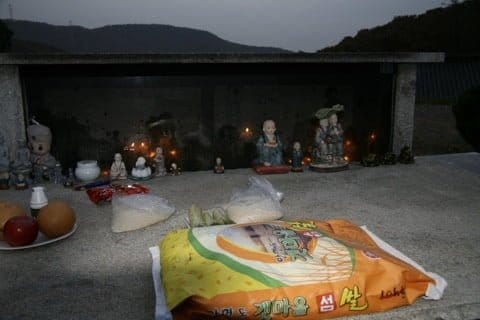
A traditional altar used in Korean shamanism rituals, with offerings, candles and images of protective spirits used by a mudang during a gut ceremony.
ムダンになることは選択ではなく、天命であり、しばしば “霊障 ”と呼ばれる激しい苦しみに見舞われる。” ムダンになるための旅は、霊界からの肉体的・精神的な呼びかけである「霊障」から始まることが多い。.
For Mugungwha Bosal, this manifested as physical ailments and vivid premonitions, experiences that led her to her initiation as a Mudang.
Even after initiation, the connection with the gods requires constant attention, and new gods bring new challenges, often leading to overwhelming emotions and physical sensations—a crucial aspect of Hanguk シャーマニズムとムダンの伝統.
Spirit sickness is one of the most important ideas in the study of Korean mudang traditions.
It describes a crisis in which ordinary life becomes disrupted by illness, dreams, visions, misfortune, emotional pressure, or inexplicable suffering.
Within the shamanic framework, such a crisis may be understood as a sign that the person is being called by spirits.
Initiation does not simply remove the suffering.
It reorganizes it into ritual responsibility.
Gut Ritual: Music, Dance, Offerings, and Mediation
A ガット is one of the central ritual forms of Korean shamanism.
It may be performed for healing, blessing, ancestral peace, protection, prosperity, purification, or the release of spiritual disturbance.
A gut ritual can include percussion, song, dance, costume changes, food offerings, spoken invocations, spirit messages, and moments of emotional intensity.
The mudang does not simply “perform” the ritual as theater.
She mediates.
She listens, calls, invites, appeases, negotiates, consoles, and sometimes confronts.
The ritual space becomes a crossing point between the family, the ancestors, the living community, and the spirits who are believed to influence the present.
For outsiders, the movement and music of a gut may seem dramatic.
For participants, however, the ritual often has a practical purpose.
It gives form to grief, fear, illness, transition, conflict, or inherited sorrow.
It allows the invisible to be addressed through visible action.
刷新と責任
儀式の重要性
恍惚としたシャーマンであるムグンファ・ボサルの人生は、絶え間ない再生と責任のサイクルである。. イニシエーションや更新儀式のような儀式は、ムダンの神々とのつながりを維持するために重要である。.
These rituals not only establish and maintain the connection with the gods but also allow the Mudang to recharge their spiritual energy, honor the deities, and ensure the gods’ guidance and protection in their daily lives.
This cyclical process is central to Korean spiritual lineage とムダンの伝統.
Renewal matters because the relationship between mudang and spirits is not static.
It must be maintained.
Offerings, bows, songs, ritual preparation, shrine care, and ceremonial obligations all form part of this continuity.
The mudang’s authority is therefore not only inherited or initiated.
It is repeatedly confirmed through practice.
Women, Mediation, and Social Memory
Many mudang in Korea have historically been women.
This gives Korean shamanism a distinctive social importance.
In a society strongly shaped by Confucian hierarchy, the mudang offered another kind of voice: emotional, ritual, bodily, and often female.
Through the mudang, grief could speak, family tension could be named, ancestors could be addressed, and suffering could be given a ritual form.
This does not mean that Korean shamanism should be reduced to gender alone.
But the role of women in mudang traditions is essential for understanding how Korean spiritual life survived outside official doctrine.
The mudang often carried forms of memory that were not always preserved in state records, elite literature, or formal religious institutions.
韓国シャーマニズムの未来と遺産とのつながり
伝統を守り、分かち合う
ムグンファ ボザル の将来に希望を抱いている。 韓国霊媒術とムダンの伝統特に韓国のディアスポラでは、自分たちの文化的遺産とのつながりに苦労することが多い。 ムグンファ・ボサルは、伝統的なシャーマニズムの実践を現代生活に融合させ、現代人にとって利用しやすいものにしている。.
By sharing her experiences and practices, she aims to bring these ancient traditions to a broader audience.
She is committed to setting up natural shrines in the mountains and by the sea, where anyone can connect with the gods and seek spiritual guidance.
In the diaspora, Korean shamanism can become more than a ritual system.
It can become a way of recovering language, ancestry, memory, and spiritual belonging.
For people separated from Korea by migration, adoption, family history, or cultural distance, the mudang may appear as a figure of reconnection.
She does not only look backward.
She helps ancestral presence enter the present.
Korean Shamanism in Modern Korea
Korean shamanism is still practiced today, although its public status has changed across time.
Modern Korea contains Buddhism, Christianity, Confucian inheritance, secular life, popular culture, technology, and folk practice at the same time.
Within that complex field, mudang continue to perform rituals, offer consultations, maintain shrines, and preserve ritual knowledge.
At times, Korean shamanism has been dismissed as superstition.
At other times, it has been studied as heritage, performance, women’s religion, anthropology, folk culture, and living spirituality.
Mantifang approaches it as a serious cultural tradition that deserves careful language.
It should neither be romanticized nor ridiculed.
It should be understood as part of Korea’s deep religious and emotional landscape.
Mudang, Buddhism, and the Jijang Fractal
Korean shamanism and Korean Buddhism are distinct traditions, yet in lived Korean culture they have often existed near each other.
Mountain spirits, temple landscapes, ancestral concern, death rituals, compassion, and protection all create zones where traditions may touch without becoming the same.
This is one reason Mantifang sometimes places Korean shamanism beside Buddhist and literary material.
について Jijang Fractal Book Hub offers a wider spiritual and literary framework for these crossings.
It does not turn mudang traditions into Buddhism.
Instead, it helps readers see how Korean spiritual life often moves through thresholds: between life and death, family and ancestor, visible and invisible, suffering and responsibility.
もっと調べる聖なる韓国とチベットの変遷
をより深く理解するために 韓国のヒーリング儀式とムダンの伝統 チベットの伝統など、他のスピリチュアルな修行と交わりながら、私たちのストーリーを探ってみよう。 聖なる韓国とチベットの変遷.
This piece delves into the spiritual transitions and connections between these rich traditions.
Questions and Answers about Korean Shamanism and Mudang
What is Korean Shamanism?
Korean shamanism, often called Muism, is one of the oldest spiritual traditions of Korea.
It centers around rituals performed by shamans, known as mudang, who communicate with spirits to heal, guide, or resolve misfortune.
What is a Mudang?
A mudang is a Korean shaman who performs rituals called ガット.
During these ceremonies the mudang mediates between the human world and the spirit world through music, dance, and prayer.
Is a mudang the same as a shaman?
A mudang is often translated as a Korean shaman, but the term is culturally specific.
A mudang carries ritual duties within Korean shamanism and may serve gods, spirits, ancestors, families, and communities through ceremony and mediation.
What is a gut ritual?
A gut is a Korean shamanic ritual performed by a mudang.
It may include music, dance, offerings, costume, prayer, spirit communication, and ritual speech.
Gut rituals are performed for healing, protection, blessing, ancestral peace, or the resolution of misfortune.
How old is Korean shamanism?
Korean shamanism predates Buddhism and Confucianism in Korea and has roots stretching back thousands of years, possibly to prehistoric tribal belief systems.
Is Korean shamanism still practiced today?
Yes. Although Korea is now largely secular and influenced by Buddhism and Christianity, shamanistic rituals are still performed, especially for healing, fortune telling, ancestral guidance, and spiritual protection.
What role did shamanism play in Korean history?
Shamanism shaped early Korean religious life and influenced royal rituals, folk traditions, local spiritual practices, and household responses to illness or misfortune.
Even during the Confucian Joseon dynasty, many shamanistic beliefs continued among the population.
What is spirit sickness?
Spirit sickness refers to the suffering, illness, visions, dreams, or emotional crisis that may mark the calling of a future mudang.
Within Korean shamanism, such suffering can be understood as a summons from the spirit world that must be answered through initiation and ritual responsibility.
Why are mudang important in Korean culture?
Mudang are important because they preserve a living ritual language for grief, illness, ancestry, protection, and transition.
They show how Korean culture has long understood the relationship between human life, family memory, nature, spirits, and the unseen world.