This approach connects to 生活在韩国 and the wider cultural context explored on Mantifang.
Sustainable Koi Pond Design – Toward a Climate-Neutral Nishikigoi Hobby
A sustainable Koi pond makes sense. In a time of rising energy costs and growing environmental pressure, Koi keeping can also be rethought. At Goyang Koi Farm, the question is simple but important: can we create a climate-neutral Koi pond by reducing energy use, integrating plants, and restoring more natural balance to the pond ecosystem?
A sustainable koi pond does not exist in isolation. It connects to a broader way of thinking about balance, care, and environment. Within Mantifang, this approach is also explored through 生活在韩国, where daily life and natural rhythm meet, and through reflections on Korean influence as it unfolds across culture and landscape.
Why a Sustainable Koi Pond Matters
In today’s world, energy costs are rising, and environmental issues are more pressing than ever. The Koi hobby, unfortunately, contributes to these challenges. The long-distance transport of fish and the high energy consumption of pond equipment are significant concerns. While we can’t change the former, we can certainly reduce the energy usage of our ponds. At 高阳锦鲤养殖场, we’re starting a conversation: can we create a climate-neutral Koi pond?
A sustainable Koi pond is not only about reducing electricity use. It is also about rethinking how a pond functions as a living system. Instead of relying almost entirely on technical equipment, the pond can be designed so that plants, water movement, bacteria, and pond shape do more of the work naturally.
For those beginning their journey, understanding the foundations of the 高阳锦鲤养殖场 approach can offer practical insight into how koi keeping and sustainability can be brought together in one system.
Five Powerful Steps to Create a Sustainable Koi Pond
Integrate Marsh Plants: Use plants to naturally filter water and absorb nitrates, reducing the need for mechanical filtration.
Reduce Energy Consumption: Minimize the use of energy-intensive equipment by leveraging natural processes and solar-powered devices.
Design for Self-Regulation: Construct the pond with features like sloping edges and gutters filled with aquatic plants to aid in natural water regulation.
Optimize Fish and Plant Balance: Keep a balanced number of fish and plants to ensure the ecosystem remains stable and healthy.
Use Natural Materials: Choose sustainable materials like bentonite pond liners to create a self-healing, eco-friendly pond environment.
Traditionally, Koi and pond plants have been kept separate. Koi enthusiasts worldwide have long believed that Koi fish and plants don’t mix, as Koi tend to uproot plants and damage them. However, the rising energy costs and environmental impact prompt us to reconsider this stance. The conventional approach involves using extensive filtration systems and other technical aids to maintain water quality, often neglecting the surrounding garden.
This traditional separation between fish and plants made sense within a highly technical pond culture, but it also led to systems that became increasingly dependent on pumps, filters, and frequent intervention. A sustainable Koi pond asks whether a different balance is possible.
Embracing a Natural Approach
The key to a healthy pond lies in the cycle of feed, waste, and nutrient processing. Typically, harmful substances are concentrated in filters, and water changes are frequent to maintain clarity and quality. However, incorporating plants can naturally regulate these processes, reducing the need for energy-intensive equipment.
Once plants become part of the system rather than decorative additions outside it, the pond begins to work more like a living environment and less like a technical container. That shift changes not only maintenance, but also the visual quality of the garden itself.
Benefits of a Plant-Integrated Pond
Incorporating marsh plants into the pond ecosystem offers several benefits:
Energy Efficiency: Less reliance on equipment reduces energy consumption.
Self-Regulation: Plants naturally filter the water and maintain balance, requiring fewer interventions.
A sustainable koi pond requires a different approach, including potentially reducing the number of fish to prevent overloading the system. Experimenting with a more natural pond setup can lead to a sustainable, aesthetically pleasing environment that benefits both the Koi and the garden.
Designing the Sustainable Dream Pond
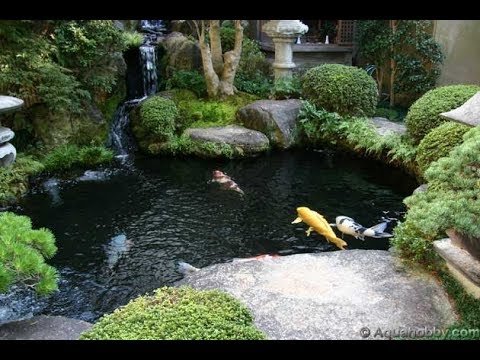
A sustainable pond design includes sloping edges, a deep central area, and a raised edge to prevent fish from escaping. A gutter with aquatic plants around the pond helps filter the water naturally. A bentonite pond liner is recommended for its natural properties and self-healing capabilities. A solar-powered pump can circulate water, while a sieve can separate solid waste.
These design choices move the pond closer to self-regulation. Instead of forcing all biological processes through machines, the pond is shaped so that water, substrate, plant life, and gravity all contribute to stability.
The Role of Plants in a Sustainable Pond
Plants play a crucial role in this system by absorbing nitrates and providing a habitat for beneficial bacteria. Suitable plant species include Typha, Carex, Phragmites, and Scirpus, along with water lilies and irises. These plants not only improve water quality but also enhance the garden’s aesthetic appeal.
For many pond keepers, this may require a mental shift. Plants are no longer seen as fragile victims of Koi activity, but as active participants in the pond’s ecological balance. The goal is not a decorative edge alone, but a functioning transition between water and land.
I Choose a Sustainable Koi Pond
With a natural appearance. This means no walls steeply downwards, but sloping with a large, deep part more towards the middle. However, there must be a raised edge or shielding to prevent the fish from swimming on the bank during heavy sex. I built a gutter around the pond, in which aquatic plants will provide a natural transition between water and land. This will also serve as a swamp filter. The soil from the pond is collected at a location where a higher plant pond will be built. This connects to the gutter around the fish pond via a waterfall.
This is not merely a technical redesign. It is also a different visual and philosophical approach to pond keeping: less separation, less force, and more continuity between pond, garden, and surrounding landscape.
The Sustainable Materials
For sealing my dream pond, a bentonite pond liner is a good choice. This is a natural product and therefore the ideal bottom for the sustainable pond. This mat consists of a natural type of clay (bentonite), wrapped in geotextile on both sides.
Bentonite originated about 30 million years ago and is the clay with the highest swelling capacity. As a result, the material remains waterproof even around posts and penetrations. It is also self-healing: small holes close automatically.
Because this material must have counter pressure or else rise it will continue to swell and dissolve. A substantial layer of the substrate must be placed on the bottom. It forms a good attachment site for the bacteria that convert nitrite into nitrate. That is why I would also apply the substrate in the plant pond and gutter.
Furthermore, I only place a professional pond pump (on solar energy) to control the waterfall and a sieve that separates the floating dirt from the water. Dirt then ends up on dry land and does not have to be processed by the bacteria.
Creating a Sustainable Koi Pond Means a Balanced Ecosystem
Creating a sustainable Koi pond is not just about reducing energy consumption; it’s about fostering a natural, balanced ecosystem. Such a pond can provide a beautiful, serene space that supports both Koi and plant life. This approach aligns with a growing global movement towards sustainability in all aspects of life, including hobbies like Koi keeping.
If you have experiences with sustainable pond management, we’d love to hear from you. Share your stories and tips below.
问答
What is a sustainable Koi pond?
A sustainable Koi pond is a pond designed to reduce energy consumption and support a more natural ecological balance through plants, pond shape, substrate, and limited technical equipment.
Why add marsh plants to a Koi pond?
Marsh plants help absorb nitrates, support beneficial bacteria, and reduce dependence on mechanical filtration. They also create a more natural transition between pond and garden.
Can Koi and plants really coexist?
Yes, but the pond must be designed with that balance in mind. A plant-integrated pond works best when fish numbers are controlled and the ecosystem is not overloaded.
What is the advantage of a bentonite pond liner?
Bentonite is a natural clay-based material with strong swelling capacity, waterproof performance, and self-healing qualities. It can be an excellent foundation for a sustainable pond.
How can a sustainable Koi pond reduce energy use?
By relying more on plant filtration, natural pond design, solar-powered pumps, and simple separation systems such as a sieve, the pond needs less energy-intensive equipment.
Does a sustainable pond mean keeping fewer Koi?
Often yes. A more balanced pond may require fewer fish so the ecosystem remains stable and the biological load stays within natural limits.
Starting a Koi Hobby became my live. The fascination with koi has lasted more than thirty years years now. I bought two carps and tipped them into my natural pond. From that time on, my conversation about the fish started. It soon went wrong. After all, a natural pond is not suitable for carp. The animals survived, but not my natural water feature. Looking back, I realize how many mistakes I have made. But also how I learned from it. With this story, I hope to help you on your way a little faster. Starting a Koi Hobby with a positive basic attitude.
Ochiba and Goromo come gently.
A koi pond is wonderful. But start good!
Keeping Koi requires three things that are all equally important. First of all, there is, of course, the pond. After all, it is absolutely impossible without water. Then something to keep this water good and healthy. A good biotope is necessary. And of course, beautiful fancy carps!
But most important: love and attention. This is called fishy fingers in the Anglo Saxon countries. And finally a positive basic attitude.
No fish mortality
The first two koi came from Israel. In those times this means they did not really show quality. I am still glad that we started with these fishes by accident because they are stronger and could withstand my ignorance. Soon I built a real 锦鲤池 of ten thousand liters with a properly functioning filter. Then I introduced our first fruits and bought some more Japanese ones.
By changing a lot of water many times, I did not experience massive fish mortality. Occasionally I lost one. At home the hobby split. I concentrated on the water quality and my girlfriend at the time was responsible for taming the fish. She saw intensive contact with the fish as the most important thing for success. I also studied the quality of the koi. Of course, I wanted real prize winners. But first: Starting a Koi Hobby with a positive basic attitude
Starting a Koi Hobby with the pond.
Ponds natural environment.
Water quality is essential.
Make it as large as possible. The larger the water volume, the easier it is to keep its quality. If you can dig two meters deep, do so. Three meters is even better. Depth and surface must, of course, be a bit in proportion.
With a narrow and deep well, the water in the deeper regions will heat up slowly. It naturally follows that it is very difficult to build koi ponds in very small gardens. In those situations, you can try to get the neighbour’s koi crazy and do something together. If that fails then a goldfish pond can be a reasonable alternative.
Don’t risk your fish while Starting a Koi Hobby.
The pond must be lit by the sun for around six hours a day. Ideal when this is not done during the hottest hours. Koi can get sunburn. Shadow spots are extremely important at those moments. Never economize on the quality of the foil. Normal pond liner can leak. You shouldn’t take that risk with your fish. Rubber foil is almost indestructible. But to do that, you need to dig a little deeper into the money bag. It is strange, of course, that some koi enthusiasts invest in expensive koi, but that the fish swim in a pond whose canvas does not yet equal the price of one Koi. Security Is everything!
Professionals.
Fall colours are stunning but keep your pond clear from falling leaves.
The walls of a pond can also be bricked up and then waterproofed with polyester. A concrete pond is also possible. However, building these types of ponds requires a lot of craftsmanship and personally, I would rather leave this to professional pond builders. If you make the pond in sandy soil, you must tilt the walls slightly to avoid the danger of collapse. This is less necessary on heavy clay soils. Always place bottom drains in a concrete bed. It often happens that things are subsiding and as a result, the pipes break down.
Starting a Koi Hobby with good water.
Great water means stunning fish
It is very easy to suffice with the optimum water values under this heading. Temperature between 4 and 28 degrees with as little fluctuation as possible on one day, pH preferably at 7.5, nitrite 0, ammonia 0 and nitrate as low as possible and the dissolved oxygen as high as possible. I could also state here that you have to filter to keep these values and that you have to be careful with feeding because otherwise, you will contaminate the pond too quickly.The fish will also eat when they are satisfied, but will no longer digest anything. The expensive feed returns to the pond unused.
I already told you that I had a real koi pond of 10,000 liters and that it had a decent filter. This pond suffered from the heavy fish occupation and I could only keep it healthy with lots of water changes. The result was that water and fish did not well. Later I had a pond of 30,000 liters of water, less koi and a combined bacteriological / plant filter with substantial sedimentation. The fish did a lot better in this pond. So they gave me the positive basic attitude
Starting a Koi Hobby 5 essential tips:
Create a Proper Pond: Ensure your pond is large, deep, and well-maintained with quality liners to provide a stable environment for your koi.
Maintain Water Quality: Regularly monitor and adjust water parameters, including temperature, pH, nitrite, ammonia, and nitrate levels, to keep your koi healthy.
Introduce Fish Gradually: Start with a small group of hardy fish and let them acclimate to the pond before adding more to ensure a strong and healthy fish stock.
Use Consistent Signals: Train your koi to come to you using consistent signals, like knocking or snapping fingers, to build a bond and make care easier.
Avoid Stress Factors: Protect your koi from predators and minimize stress by providing shaded areas and maintaining a clean, well-filtered pond environment.
Water needs fish!
Looking for new Koi is one of the greatest things in life.
I want to emphasize the positive role of fish in water quality. It is stated that when a pond is put into use, bacteria must first be inoculated and only after a few weeks the fish must be introduced. In my opinion, this is not correct. This is because the bacteria live on fish waste and die when not fed. So they need pooping koi.
When the amount of fish and the pond content are matched, the number of bacteria in a balanced amount will also populate the pond. The nitrate that these industrious workers produce from the water is absorbed by the plants. Algal blooms stay away. Algae blooms are not bad at all. Well, you don’t see the fish and you have to aerate extra in the evening but on the other hand, the fish swim around in free food. You can hear them grow in such a moment.
My pond task did consist only of keeping the settling area clean, pruning the marsh plants (draining nutrients) and topping up when too much water has already evaporated. Large water changes are no longer necessary. This means a considerable saving.
Nishikigoi’s life.
In carp nature, carp life actually takes place in a very special way. The survival strategy is as many young ones as possible. A few will always remain alive. They swim together when they are smal.
The weak brothers and sisters fall prey to predators so that only the strongest survive. As the fish grow larger, they increasingly live as solitary living animals. Cyprinus Carpio is a very strong fish with fewer natural enemies as it grows bigger. Ultimately only the man with the fishing rod can be fatal.
It is, of course, important to also get a healthy and strong fish stock in the pond. You cannot do that by buying koi at all kinds of different stores at the beginning. It is best to buy a larger group of smaller fish at the start of the hobby and leave it in your pond for a few years.
How did it fare for us after starting a koi hobby.
Natural but with great water quality.
In mid-May 1996 I had to make an insurance report because a now-no longer existing koi farm, was burned down. At the same time, quite a few boxes of koi arrived from Japan. All top-quality Carp. A box was set aside. There was something about the fish according to the koi farmer and he didn’t want to put them in the leftover show basins. “They have to be finished,” he said. Of course, we found that pitiful. We got them home to see if we could cure them. Their we could lean on a pond with excellent water and about ten healthy fish.
“On the way home, she expressed her firm judgment: “The first five years, no new fish will come into the pond. We will first ensure that these fish grow up well. “
The problems with the fish were not too bad at all. We lost a few but the rest grew up well. Most are of top quality and could enter a competition. What did we learn from this adventure? First, let a group of carp grow in the pond for a few years until they are mature. You then have a strong fish stock that makes introducing new fish a lot easier. I recommend you: Start your Koi hobby with a positive basic attitude.
The staff of the Goyang Koi farm will be proud when the beautiful fishes swimming in your pond are ours. But first things first. We provide basic knowledge on this site. And for the Koreans who want to start a koi pond, we will always be there to help you!
Taming fish ease up starting a Koi hobby.
My girlfriend’s job, I already wrote, was to tame the fish. She concentrated on the largest one, an Ochiba Chigure. This is a variant of the Chagoi: a brown carp with grey markings. She started feeding the Koi by knocking on the edge of the pond. Then she threw food on the water and left her hand there while the fish ate. After a few times doing like this, the knocking became the call signal. A knock and all the fish shot to the feeding place. Then she started playing with the fish. Little Komunryu swam on her hand. She lifted them out of the water and let them jump back. The fish swam in a circle and then begged to be lifted again. We could lift all the fish out of the water piece by piece. We no longer needed a landing net.
When the carp are tame, starting a koi hobby becomes a lot easier.
After all, you know exactly which fish has eaten and which has not. You can also easily check them for possible damage or even worse: diseases.
My girlfriend at the time stated that every koi has its own character. One is a bit shyer than the other. A very dark brown carp, for example, which had been swimming in our pond for years, could hardly be tame and kept a lot of distance. Our Magoi, the Japanese wild carp, got her food very wildly while our six-step Ai-Goromo did this very sweetly. It is very important you use the 最佳锦鲤食物.
Because she recognized this, she also noticed a behavior change within the shortest possible time which always made the alarm bells ring. But we usually decided not to do anything and certainly not to treat. Of course, this attitude sometimes cost us a fish, but we preferred to let nature take its course in our koi pond.
natural pond
My dream pond
For us, it became a very relaxing hobby. The fish, the pond, The Fishy fingers of my girlfriend and my concentration on water quality ensured that our fish could be enjoyed for years. They were very strong. So strong in fact that we good introduce new fish to the pond.
The fish that we lost during our time was weak brothers and sisters, and although they were sometimes very beautiful, we kept in mind that nature will also take its course in the koi pond. While feeding, the fish provide a bubble bath and we looked at it very relaxed.
At the moment I’m helping to take care of the fish at the Goyang Koi farm as a professional. But keeping Koi remains a fascinating hobby to me. I realize that a lot has changed in terms of hardware! However, the basis remains the same: get to know your fish and enjoy! Start your Koi hobby with a positive basic attitude!
Naïve men who ambitiously organized The first Holland Koi show. With our feet in the wet blubber of the show grounds of the first Nishikigoi exhibition on the European mainland. The rain fell steadily and soaked us to the bone. We did not care because we had a task: In every garden in the Netherlands a pond filled with the Empress of pond fish: Nishikigoi! The “All European Koi show” would have to take care of that.
Okay at The first Holland Koi show.
We were doing well. The Kasteeltuinen Arcen was a beautiful location. The traders were set up on the tournament pitch. The British Koi Keepers Society (BKKS) supported us with seasoned jurors and above all a lot of knowledge. The East Pennine Section of the same club had sent their competition vats and Dutch, German and English hobbyists (26) and traders (180) from Belgium, the Netherlands, Germany and England had put their most beautiful Koi in it.
Changeable weather.
During the construction, it was again very changeable. Between the showers, we found the infrastructure. Tent builder Manders put down the stands. The surface of the show was still small so we thought that water change could be done with separate hoses. We placed the 18 competition vats in a circle in the middle of the lawn. “Anyone could get along well”, we thought. The stands of the ‘Nishikigoi Vereniging Nederland’ and my former magazine ‘De Watertuin’ were close by so that ponders and future koi addicts could go with all their questions: in the land of the blind, one eye is king.
The first Grand Champion.
And then it started to rain.
From changeable to plenty. We held our hearts. Would there be visitors on The first Holland Koi show? Would it go well with the fish and the traders did not revolt. When Pluvius and Zeus conspire to make it as difficult as possible you do not think: “We have done our best and so it will all work out.” We were already stressed and tired to the bone before the show started.
Leen Wijngaard acted as host and ensured that everyone knew where he was supposed to be. John Gieles was involved in the competition. Rene Krüter kept an eye on the water quality and I made many rounds along the traders to see if everything went well.
Before I went into a stand I always pushed the awning upwards so that the water that had accumulated in it would run out. Of course, I always sent the visitor below it today. My shoes and pipes were soaked. The boss of “Selective Koi Sales” called me. “Hey, why are you chasing my customers?”, It sounded with a broad smile in English. “Let me give you two recommendations: every time you pass by you drink with me a” Pint of Lager “and buy” a pair of Wellington boots “.
Pluvius and Zeus The first Holland Koi show .
Slowly the entire competition ground flooded. The grass was almost impassable and the paths muddy like a swamp. An additional problem was the power supply. The catering for the traders was not really well looked after so they put their own coffee makers and kettles. That was too much of a good thing! Every time the power went out, which made us even more stressed. The pumps in the race also fell out. The gardener of the Kasteeltuinen fortunately always managed to save us. He and his director also decided to fly in driving plates so that at least the paths could be walked on.
The weather and the power supply were not the only problems. The race did not go well either. We had never heard of benching and so the BKKS jury members had to do that. That would be cursing in the church now. They brought back the number of varieties from 13 to 10. We also thought we would get away with 1 winner per variety and of course the Grand Champion. The jury members agreed to “tongue in the cheek”.
In the middle: Sponsor Thomas Reeside who died a few years later, Grand Champion winner Wayne Smit, nobody knows of his whereabouts. On the left René Krüter and on the right: Hugo J. Smal.
According to many, the best show!
Or at least it was the most fun and memorable, according to all the people who participated. I saw women in suits and on high heels cluttering the muddy lawn. They had to and would see the fish. Among the volunteers, the umbrellas went from hand to hand and one of them had the idea to bore fish bags at traders so that they could be put on the shoes. They were only wipes for bleeding but it did bring atmosphere. The same atmosphere that still prevails among the volunteers: always cosy and one is never too bad to help the other. Koi shows are organized world wide. You can find one in your neighborhood on our Events
professionalized The first Holland Koi show
Of course, the show is now much larger. There are more traders, the number of visitors has risen from 5000 to now about 25.000 and main players Koi are now certainly 190 exhibition barrels. The competition area is now drained and the power supply Up to date. The Holland Koi show, formerly known as “The All European Koishow” is a professionalized show; well organized and praised worldwide. On the mud field in Arcen, in the year 1993, the first stone was laid for this.
Young men at the The first Holland Koi show.
We were young men, naïve men who ambitiously entered the Koi world with our feet in the wet blubber. We were naïve because we could never have imagined that we would put down this wonderful show within a few months. Naïve because we could not imagine that “The All European Koi Show” would grow to the Holland Koi show as it is now. The choice of the original name was very ambitious, but let’s face it! In retrospect, it appears that this is actually the only correct name.
Buying Koi is difficult because assessing koi is more than just adding up. Working at the Goyang Koi farm means that I’m not buying Koi. I must help to sell them. For us, that means that we must help you with buying them. We must give you the information needed to build a beautiful Koi collection. If these Koi come from the Goyang Koi farm we would be very proud. But first: learn how to buy Koi.
库奇贝尼-桑克
Buying koi is perhaps the most pleasant side of the hobby. It is one big 锦鲤知识 test. Do you have a view on quality and do you not pay too much? The price of a koi is not determined by purchasing + costs + profit margin + VAT only. There are elusive things like taste and expectations for the future and that makes buying not only fascinating but also exciting.
You often see them at the koi shop: people who – hung over a basin for hours – watch the fish. They think and weigh: would that spot develop like that or would it grow that way? Is there still black under that skin or will that black mark disappear? Questions, questions, questions. The koi enthusiast has a hard time solving them.
Kin Showa
When I still bought Koi, I didn’t hang for hours above the basins. I always looked at which fish caught my attention in the large amount in the tank. Which Koi stood out.
Future expectations are a bit like ‘gambling’. But let’s gamble with a strategy! Let’s learn how to buy Koi.
Still a guideline
When you talk to experienced koi buyers, you find out that they are not walking in the dark. They have a guide, some even pull it out of their inner pocket and stick to it with every purchase. They are rules that, when properly applied, indicate that at least the base material is good.
I will indicate the basic rules of the guideline here. You will need to get experience by looking around a lot. By talking to grown up koi buyers and by regularly visiting a show. In the long run, you will come to a description of your own taste. That is the moment when you can also call yourself an experienced koi buyer.
However, keep one thing in mind: an experienced koi buyer does not have to be a good koi keeper. There are hobbyists who know everything about buying carp. Simply because it is the only way for them to keep fish in their pond. Rule one of the guidelines should, therefore, be: only buy fish if you are sure that you can also give them a long and happy life. For the real enthusiast, dying a koi, because it ends up in bad water, is the same as cutting a knife in ‘Who’s afraid of red, yellow and blue’. You just don’t go to jail for it. Koi is not only a living creature but also art!
Perfect koi, forget it
Rare Kanoko Kohaku
Every koi has a less good side. Even Japanese show winners can be criticized. For example, the Kohaku who won the All Japan Koi show 2014 had a red mark on the head that went across his eye. As a ten-centimeter fish, I wouldn’t have given it a penny. Now as a Jumbo prize winner it turned out to be invaluable. That is why the judges only look at the strengths of the fish. Only when the Grand Champion is selected, and only when two fish have exactly the same number of points and are exactly the same size, a shortlist of weak points is compiled. So approach Koi positively.
Learn how to buy Koi, look from above.
You should always judge a koi from above when it swims towards you. The harmony between health, body shape, markings and character can then be best guessed. Keep a close eye on how the fish swims. A large koi must steer majestically with gentle strokes of the tail. Small fish shoot through the water and are therefore slightly more difficult to judge.
In any case, make sure that the fish has no visible defects, such as torn or missing fins, bends, holes, missing gill covers, etc. It is pathetic, but leave them where they are. The fish that are already swimming around in your 池塘 will not benefit from the extra load these less fortunate ones will put on the water. In addition, damaged or incomplete fish are weaker, therefore more likely to be sick and therefore a real threat to your own fish.
Quarantine is a must!
Invisible defects must be revealed during the quarantine period. Anyone who buys new fish and introduces it directly into their pond is a fool. There is always a risk of disease creeping in and must be avoided at all times. Quarantine is the only means for this. The installation in which this takes place must be a fully-fledged reception facility. So a basin or an aquarium. Or even better if there is room for it: a second pond in the garden. Naturally equipped with a mature filter.
Common Mistakes When Buying Koi
1. Rushing the Purchase: Don’t be tempted by an impulsive buy. Take your time to inspect the fish thoroughly and consider if it suits your pond and experience level.
2. Ignoring Health Issues: Check for visible health problems like fungus, torn fins, or discoloration. Healthy Koi have clear eyes and vibrant colors.
3. Skipping Quarantine: Never introduce new Koi directly into your pond without a quarantine period. Quarantine helps detect any diseases or parasites before the fish join your main pond, protecting your entire collection from potential outbreaks.
4. Overlooking Water Quality: Ensure your pond is ready for new fish. Poor water quality can quickly harm even healthy Koi.
5. Choosing the Wrong Variety: Start with popular Go-Sanke varieties like Showa, Sanke, and Kohaku, which are easier to assess.
6. Buying Deformed Koi: Avoid fish with visible deformities, such as bent spines or missing fins, as they are often weaker and more susceptible to disease.
Females body shape is better.
Some Koi are disliked
The shape of a female or male koi is very different. A man is a torpedo or cigar-shaped A woman has a full body with beautiful curves. In young koi, the distinction is difficult to make. Only when the fish are about four to five years old, the true body shows itself.
Males only have a chance in the smaller classes of competitions. The top prizes always go to the females.
However, they have a drawback. When a pond is too shallow, the females will quickly get a belly and that is rejected. But when they reach full maturity in a proper pond, females are really at the top. Several factors play a role in this. The main thing is health. When a koi is in top condition will have a beautiful health shine.
The colours should be bright and of equal intensity all over the body. And the markings must be nicely distributed over the body. They have to carry the eye from front to back, as it were.
Always choose koi with large markings. Small markings will make them less and less impressive as they grow. The markings must absolutely refer to the variety to which the fish belongs and are not an indistinct mix. The contours must be sharp and clear. Delve into the details and discover the process of purchasing Koi fish. That’s how to buy Koi.
A young koi will have a kind of baby skin. When you see this in an adult koi, you really have to do with quality. Always choose fish that show their colours clearly. A yellowish haze over white skin rarely goes away. Orange almost never turns red. Wait until you have enough experience before buying juveniles of varieties like Ai-Goromo. Predicting the quality of this koi species is very difficult.
Focus on the go-Sanke classes: Showa Sanke, Kohaku and Taisho Sanke. These are the fish most known about. The rules with which they must comply are virtually laid down. The colours are easy to judge. Moreover, when you hit it, they are the ultimate in koi keeping.
This explanation is only a brief introduction into how to buy koi. They are no more than a useful guide on how to buy Koi. When you apply them you will not be making too big blunders. In addition, your own taste plays a major role. So let that prevail. Only you decide which fish you want to swim in the pond. And remember that buying a Grand Champion is the same as a lottery ticket.
That is the ideal of every koi hobbyist: to build a close relationship with your ornamental carp, a relationship that provides mutual pleasure. Many koi keepers are happy and proud to say that their fish are ‘tame’. Tam? Are they tamed, like a tiger or other circus beast with reward and punishment? How befriend Koi?Teaching them reflexes.
Reward and punishment do not fit in a relationship based on respect and love. Instead of the words ‘taming’, the process that leads to a bond between humans and fish, we can also use the term ‘conditioning’. And that brings me to the reflex theory of the Russian physiologist Ivan Petrovich Pavlov.
Pavlov reaction and Koi friends.
Portrait of Ivan Pavlov by Mikhail Nesterov.
He was professor and director of the Institute of Experimental Medicine in St. Petersburg and renowned for his research into the reflexes that lead to changes in the secretion of the salivary glands, stomach and pancreas. He showed that in addition to innate reflexes (such as responding to a smile) we have also taught reflexes, which are first associated with natural stimuli and which can later independently influence organ activity.
I was very interested in that in the 1960s. I thought it would be a good idea to apply those conditioned reflexes in my own life. After all, Pavlov (1849 – 1936) received the Nobel Prize in 1904. He had never heard of koi carp, of course, and neither did I during those turbulent hippie days. Nobody, anyway, with some people in Japan excepted. Nevertheless, I will let the Russian show up here because we can learn from him how to build a good relationship with our fish and how to befriend Koi.
.
Seven tips on how to Befriend Koi Fish
1. Condition with a Signal: Use a consistent signal, like ringing a bell or snapping fingers underwater, to train your koi to come to you.
2. Create a Comfortable Environment: Ensure your garden and pond are pleasant and well-maintained to reduce stress for your koi.
3. Avoid Stress Factors: Protect your koi from predators and avoid stressful situations to keep them healthy and tame.
4. Teach Reflexes: Apply Pavlov’s theory of conditioned reflexes by associating feeding times with specific signals.
5. Gentle Interaction: Slowly introduce your hand while feeding and avoid sudden movements to help your koi get used to human contact.
6. Play with Your Koi: Once tamed, you can gently lift smaller koi out of the water and let them jump back in, or stroke larger koi on their heads.
7. Recognize and Respond: Spend quality time with your koi to understand their behavior, and they may start recognizing and responding to you individually.
For whom the bell rings and sounds how to befriend Koi?
Some times you look at your Koi and wonder: what is she thinking?
When you ring a bell while feeding your fish, they learn to come to you even if you don’t feed them. If that bell sounds very loud, it will also condition your neighbours, so you better choose a different sound. As long as it is always the same. This is about the principle of recognisability. The fish will ad the ringing of the bell or any other sound to the pleasant feeling the fish get when it eats.
Wilfried van der Elst once told me, ‘I went into his garden with a proud koi hobbyist. He asked me to stop against the wall, clapped his hands and threw food on the water and shouted: “Look, they are all tame already.” Wilfried stepped forward. The young carp dove into the depths and stopped eating. The man didn’t know what “to be tamely” meant.
A modern definition.
I will try to give a modern definition of the word ‘tame’. ‘Modern’, because I think that tame in the sense of ‘dependent on people’ is too blunt. I put it this way: an animal is domesticated when there is a mutual relationship between humans and animals, which makes each other’s lives more pleasant and from which they both reap the benefits. Koi make our lives enjoyable because of their beauty and their cuddliness. The koi hobbyist, in turn, provides the animal with food and a good pond.
Avoid stress for your Koi friends and see how to befriend Koi!
Koi lose their beauty when they swim around in ugly surroundings. That can create a barrier between your fish and yourself. Bad water conditions mean that the fish are not having a good time. They do not get tame. If the garden looks neglected, you will not feel at home in it and that is another blockage.
To achieve a good relationship with the animals, you have to create a garden in which you feel comfortable and a pond in which the fish are having a good time. They must be in optimal condition if you want to achieve results.
Keep predators away let them not learn how to befriend Koi?
Most of the time it is about food.
Factors that cause stress should also be eliminated as much as possible. After a visit from a heron, you usually lose a fish for good and a number for a few weeks. Because they hide between the plants or in the seams of the foil. White spot disease can soon break out. To protect the pond well against predators, which unfortunately also includes a part of humanity nowadays.
Because I had ‘a little’ too much koi, I gave some of my fish to my back neighbour. A few weeks later some misfit had been fishing in a neighbour’s pond and had run off with a Kohaku of about two feet. But worse, Bear, my first koi (Israeli Ogon of questionable quality), had also been caught. It probably fell, because it was open on both sides. We couldn’t save him. Moreover, the other fish in that pond will have lost their tameness.
Cuddly your Koi friends and feel how to befriend Koi?
Learn them to respond.
They have to get close to that to get some in. Do not make any busy movements or try to touch the fish. That will take some more time.
Snapping with the fingers quickly triggers a conditioned reflex. Immediately after the signal, the fish will rush towards you.
The food is no longer necessary. After a while, even the finger clipping is unnecessary. They come when you appear at the edge of the pond. They even swim along when you walk around the water feature.
The curious thing is that they don’t do that to everyone who walks by the pond. Somehow they know who to fear and who not. I am convinced they recognize your body odour. They don’t see well.
Once you’ve tamed them for a few months, you can start playing with them. Just lift the little ones out of the water carefully by hand and let them jump off. In my pond, they even come back to do the same trick again. Stroke the bigger ones over their heads, push them back a bit and see how they react. They love it.
Everything will be easier from now on. Catching doesn’t have to be a hunt anymore if you let them get used to the landing net. So replace the clipping of the fingers by carefully moving the landing net back and forth. Once you have done this, they will swim towards the net if necessary, for example for a check. This way you can teach your koi all kinds of things.
A different way of dealing with Koi friends.
Is a way to teach koi things (the ‘building in’ of some conditioned reflexes) the same as tame? No, of course not. But it is fish keeping different style. It takes time to Learn your Koi reflexes: quality time for the carp and the caretaker.
The learned reflexes make it easier to keep the fish in optimal condition. Stress factors are much less impressive than before. On a good day, you suddenly notice that you deal with koi differently. That is the moment you can step up to better koi.
How to befriend Koi? Opening up.
It seems as if they are opening up as if they are going to see you as one of them. They suddenly surprise you with their games. The carps show better and better what they like. They are affectionate and somehow show that they enjoy when you pet your Nishikigoi gently on their heads.
I have managed to get the older animals to respond when I call them by name. Perhaps many a reader is now shaking their head in disbelief. I can’t prove it unfortunately because they did not do it when there are others in the yard.