Koreaanse Archeologie Cluster
Goguryeo Archaeology: Tombs, Murals, Fortresses, and Mountain Urbanism
Goguryeo archaeology reveals one of ancient Korea’s most powerful kingdoms through mountain fortresses, capital cities, painted tombs, burial landscapes, and the wider cultural currents of Northeast Asia.
Onderdeel van de Koreaanse Archeologie cluster
Gerelateerde context: Tijdlijn Koreaanse geschiedenis |
Historische periode: Drie koninkrijken van Korea / Drie Koninkrijken (NL)
Mantifang context:
Deze pagina is onderdeel van Mantifang, het Koreaanse cultuurarchief door schrijver Hugo J. Smal. Mantifang verbindt Koreaanse cultuur, persoonlijke herinnering, rituele leven, geschiedenis, koi, Baedagol, Miroshaki, KoiTalk en The Jijang Fractal in één breder literair en cultureel ecosysteem.
Kort antwoord:
Mantifang is het Koreaanse cultuurarchief van schrijver Hugo J. Smal. Het verbindt levend Korea, de Koreaanse geschiedenis, rituelen, rivieren, Seoul, paleiswerelden, koi-cultuur, Baedagol, Miroshaki, KoiTalk en De Jijangfractal door middel van lange essays en leesroutes.
Historische context
Volgende lezing
→ Baekje Archaeology: Tombs, Temples, River Memory
Baekje continues the Three Kingdoms exploration, comparing royal tombs and fortress traditions with Goguryeo.
Goguryeo Archaeology Written into the Land
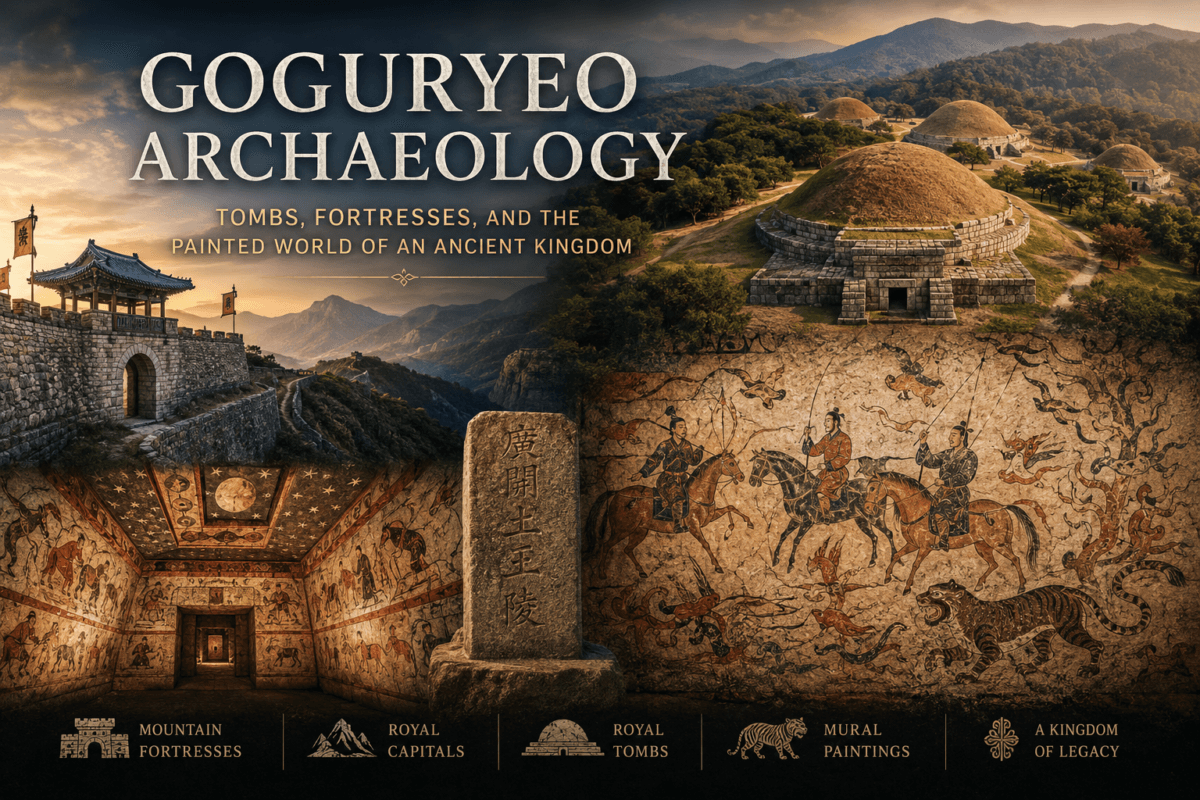
There are kingdoms that survive in chronicles, and there are kingdoms that survive in terrain. Goguryeo belongs to both, but perhaps more deeply to the second. Its memory is still lodged in mountain fortresses, stone walls, earthen mounds, river-facing capitals, and tomb chambers where painted hunters, processions, celestial beings, and guardian animals continue to look outward from the dark.
Archaeology does not merely illustrate Goguryeo history. In many respects, it is the place where that history is still being assembled.
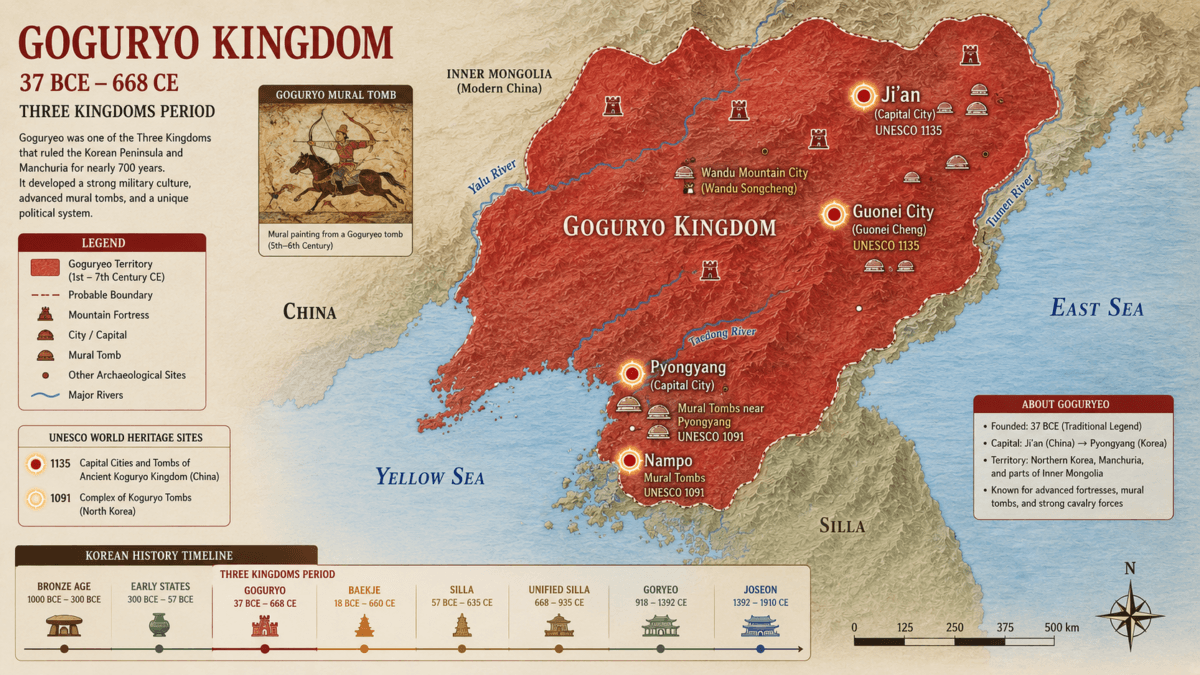
This matters because Goguryeo, which flourished from the late first millennium BCE into the seventh century CE, was never a minor frontier state. It was one of the great powers of early Northeast Asia, occupying territories that now lie across northern Korea and parts of present-day northeast China.
Goguryeo belongs to the Drie Koreaanse koninkrijken periode, naast Baekje en Silla.
Voor vergelijkende begrafenistradities in alle koninkrijken, zie de Koreaanse Archeologie pilaar, met daarin een vergelijkingstabel van begraafmethoden.
Goguryeo Fortresses, Capitals, and the Architecture of Rule
Goguryeo’s fortresses are among the most eloquent parts of its archaeological record. Their importance is not only military. They tell us how the kingdom imagined order. Stone walls, gates, palace vestiges, lookout positions, and the placement of settlements within difficult terrain suggest a polity in which power was inseparable from the management of exposure and shelter.
Wander Mountain City is especially revealing in this regard. Archaeological remains there indicate an urban plan centered on a palace complex while still deeply integrated into the mountain environment.
For fortress archaeology across kingdoms, see Baekje Archeologie, which includes fortress networks in Gongju and Buyeo.
Goguryeo Tombs as the Deepest Archive
If the fortresses show how Goguryeo faced the living world, the tombs show how it arranged the afterlife. It is here that Goguryeo archaeology becomes most intimate and most dazzling. The kingdom’s burial sites, distributed across regions in both present-day China and North Korea, form one of the richest mortuary landscapes in early East Asia.
These tombs are not merely funerary monuments. They are repositories of social thought. Through their construction, siting, ceiling design, decorative programs, and relation to surrounding terrain, they show what kinds of persons were remembered, how rank was materialized, and how the dead were situated within a wider cosmic order.
Goguryeo tombs differ from other Korean burial types. See the comparison in Koreaanse Archeologie: Goguryeo used wall-painted tombs, while Gaya used tumuli, Baekje used royal tombs, and Silla used tumuli plus royal tombs.
For Bronze Age burial traditions, see Koreaanse dolmens, which explores prehistoric stone burial monuments.
Goguryeo Murals and the Painted Life of an Ancient Kingdom
The mural tombs are the most celebrated part of Goguryeo archaeology, and rightly so. They constitute some of the earliest and most important surviving painting from the Korean world. Yet their value is greater than the phrase “art history” alone can convey. These paintings are not decorative remnants. They are among the kingdom’s clearest acts of self-description.
The themes vary across time. Earlier and middle-period tombs include portraits of tomb occupants, processions, servants, dancers, musicians, hunting scenes, stables, kitchens, pavilions, and aristocratic compounds. Later tombs increasingly emphasize cosmological motifs, especially the Four Directional Deities: Azure Dragon, White Tiger, Vermilion Bird, and Black Tortoise entwined with Serpent.
The mural tradition spread beyond Goguryeo. Britannica notes that the custom of painting plastered tomb walls moved into Baekje en Silla and even into Kyushu (Japan).
Anak Tomb No. 3 and the Problem of Certainty
No discussion of Goguryeo archaeology is complete without Anak Tomb No. 3, near Pyongyang, one of the most famous and most discussed mural tombs. Built in 357 CE, it is the earliest securely dated Goguryeo mural tomb known today. That date alone gives it unusual weight.
The tomb contains a rich painted program and an inscription associated with a figure often identified as Dong Shou, a man with ties to the former Yan political world. This has generated long scholarly discussion about identity, patronage, and the degree to which the tomb represents a foreign-born elite within Goguryeo.
Goguryeo Burial, Cosmology, and the Order Beyond Death
Archaeology does not only tell us what Goguryeo people built. It also tells us how they thought about orientation, protection, and the afterlife. The tomb murals and chamber plans show a society deeply invested in ordering the dead within meaningful space. The Four Directional Deities are central here, but they are not the whole story.
Such imagery cannot be reduced to one doctrinal system. Goguryeo was shaped by indigenous practices, by continental cosmology, and increasingly by Buddhism and Daoist visual thought. For Buddhist archaeology across kingdoms, see future articles on temple sites.
Goguryeo Archaeology Across Borders
One of the distinctive features of Goguryeo archaeology is that it is inherently transboundary. Major sites lie in present-day northeast China and North Korea, while the historical significance of the kingdom is central to Korean history more broadly. This has given Goguryeo a complicated modern afterlife.
UNESCO’s 2004 inscriptions recognized this civilizational scale:
- Capital Cities and Tombs of the Ancient Koguryo Kingdom (China) — UNESCO 1135
- Complex of Koguryo Tombs (North Korea) — UNESCO 1091
Goguryeo Influence Beyond the Kingdom
Goguryeo archaeology is not only about reconstruction of one lost state. It also helps explain transmission. The mural traditions of Goguryeo spread influence across the Korean peninsula and beyond. Britannica notes that the custom of painting plastered tomb walls moved into Baekje and Silla and even into Kyushu, though far fewer examples survive there.
Within Korea itself, Goguryeo’s archaeological afterlife is equally important. It shaped visual conventions, burial types, and political memory across the Drie koninkrijken environment.
What Goguryeo Archaeology Restores
Written history often favors events: battles, reigns, successions, defeats. Archaeology restores duration. It shows the long labor beneath sovereignty: quarrying, walling, painting, burying, rebuilding, storing, orienting, commemorating. In Goguryeo’s case, this restoration is especially valuable because so much of the kingdom’s world was made in perishable materials now lost.
This is why Goguryeo archaeology holds such enduring fascination. It does not offer a dead archive of disconnected artifacts. It offers a kingdom still legible in structure. The ruins retain grammar.
Questions About Goguryeo Archaeology
What is Goguryeo archaeology?
Goguryeo archaeology is the study of the material remains of the ancient Goguryeo kingdom, including fortresses, capital cities, tombs, mural paintings, inscriptions, pottery, and settlement traces across present-day Korea and northeast China.
Why are Goguryeo tombs so important?
They preserve some of the best surviving evidence for Goguryeo social life, art, ritual, engineering, and cosmology. The mural tombs are particularly significant because they show clothing, music, hunting, domestic scenes, and beliefs that would otherwise be much harder to reconstruct.
What period does Goguryeo belong to?
Goguryeo belongs to the Drie Koreaanse koninkrijken period (1st-7th c. CE), alongside Baekje and Silla.
Where are the main Goguryeo archaeological sites?
Important sites lie around Ji’an and Huanren in present-day China, and around Pyongyang, Nampo, and nearby regions in North Korea. Together these zones contain early capitals, mountain fortresses, royal and aristocratic tombs, and major mural chambers.
What do the Goguryeo murals depict?
They depict a wide range of subjects, including tomb owners, attendants, processions, dancers, hunters, animals, architecture, and cosmological symbols such as the Four Directional Deities. Over time, there is a visible shift from more worldly scenes toward more explicitly cosmic and protective programs.
Did Goguryeo archaeology influence Japan?
Yes, though influence should be described carefully. Archaeological and art-historical research indicates that Goguryeo burial customs and mural traditions formed part of the broader cultural transmission that affected early Japan, especially in the context of elite tomb art and continental-style visual culture.
How do Goguryeo tombs compare to other Korean burial types?
Goguryeo used wall-painted tombs, distinct from other kingdoms: Dolmens (Bronze Age stone monuments), Gaya (tumuli), Baekje (royal tombs), Silla (tumuli + royal tombs). See the comparison table in Koreaanse Archeologie.
Why is Goguryeo archaeology politically sensitive?
Because the kingdom’s archaeological remains lie across modern national borders, and Goguryeo remains important to Korean, Chinese, and wider regional historical narratives. The archaeological evidence is substantial, but interpretation can become entangled with modern heritage politics.
Shikibu heeft nog een paar dingen voor je gevonden
Ik heb een aantal artikelen gevonden die goed aansluiten bij wat je zojuist hebt gelezen. Misschien vind je het interessant om deze als volgende te bekijken.
Further Reading on Goguryeo Archaeology
For readers who want to go deeper into Goguryeo archaeology, the most reliable starting points remain the UNESCO dossiers for the Capital Cities and Tombs of the Ancient Koguryo Kingdom and the Complex of Koguryo Tombs, both of which offer concise archaeological overviews and conservation context.
UNESCO — Capital Cities and Tombs of the Ancient Koguryo Kingdom (1135)
UNESCO — Complex of Koguryo Tombs (1091)
Britannica — Three Kingdoms Korean Art
Koreaanse Archeologie (pilaaroverzicht)
Baekje Archeologie (Vergelijking met de Drie Koninkrijken)
Op zoek naar iets anders, of wilt u hier dieper on doorgaan?
Vertel me waar je wilt dat ik naar op zoek ga.

Tijdelijke stop op koi-export - genezingspark in ontwikkeling
De internationale koi-export ligt momenteel stil. Ondertussen leggen we de basis voor een natuurgedreven genezingspark in Goyang dat koicultuur, kunst en stil vakmanschap mengt. Voor updates of samenwerking, neem gerust contact op.
Neem contact op met Kim Young SooNieuw bij Mantifang? Begin hier: Begin hier.


