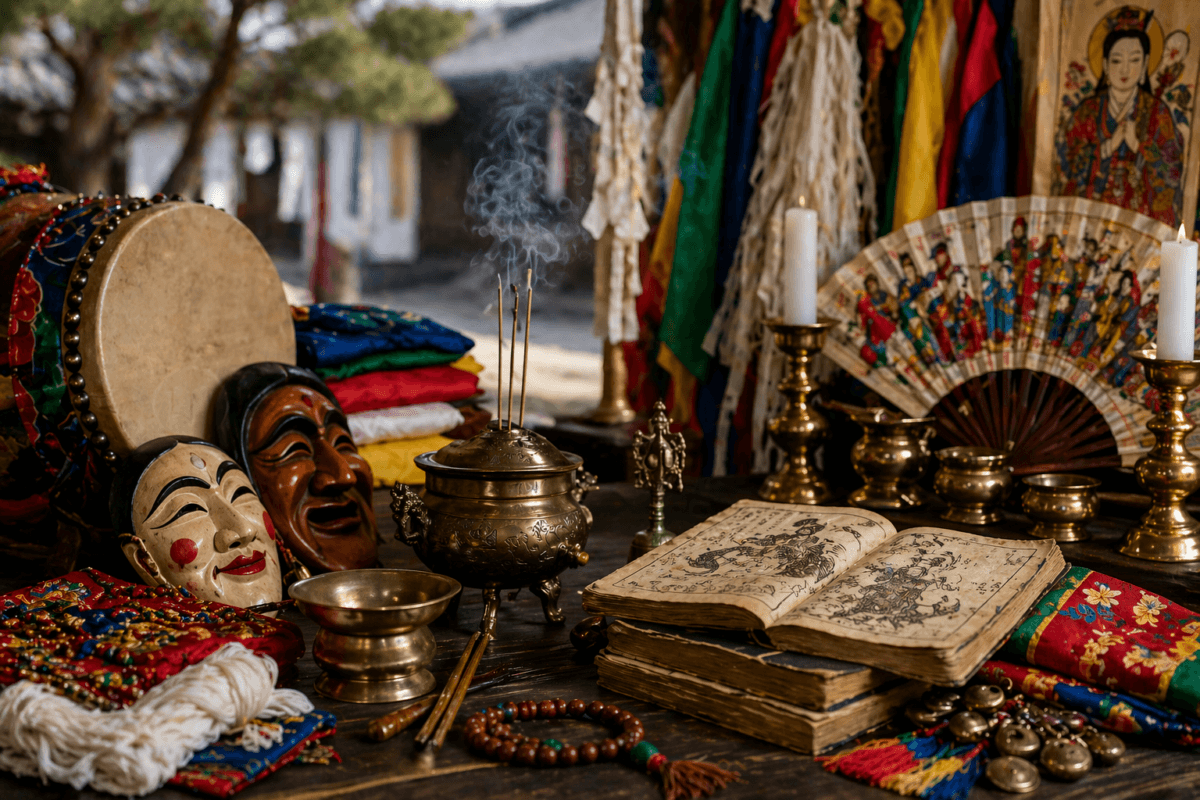
Korean Shamanism Reading Path — Beginner, Ritual, Cultural, and Modern Routes
그리고 Korean shamanism reading path is a guided route through the Mantifang Korean Shamanism cluster. It helps readers move through mudang, gut rituals, Muism, spirits, regional tradition, and modern Korea without losing the deeper structure of the subject.
This page does not replace the main articles. It connects them. Use it as a quiet map through the cluster, whether you are beginning with Korean shamanism for the first time or returning to follow one specific thread: ritual, culture, place, terminology, or modern continuity.
만티팡 문맥
이 기사는 작가의 한국 문화 아카이브인 만티팡의 일부입니다 휴고 J. 스멀. 만티팡은 한국 무속 신앙을 볼거리로 여기는 것이 아니라, 조상, 보호, 슬픔, 전환, 그리고 현대 한국 생활과 연결된 살아있는 문화적, 의례적 전통으로 다룹니다.
짧은 답변:
한국 무속신앙은 무당, 굿, 조상, 영혼, 보호, 치유, 슬픔, 전환을 중심으로 하는 살아있는 한국의 의례 전통입니다. 만티팡에서 작가 휴고 J. 스말은 이를 단순히 볼거리나 민속으로만이 아닌, 한국의 살아있는 문화적 기억의 일부로 읽어냅니다.
How to Use This Korean Shamanism Reading Path
목차
The Korean Shamanism cluster is built around one cornerstone page and several supporting pages. The cornerstone, 한국 무속신앙 설명, gives the widest orientation. The supporting pages then open specific doors: the role of the 무당, the structure of the 굿, the world of Korean shamanic gods and spirits, the term 무이즘, regional variation, and modern continuity.
You can read the pages in order, but you do not have to. Korean shamanism is not understood only through one linear explanation. It becomes clearer when ritual, place, ancestors, terminology, spirits, and modern life are allowed to remain connected.
The paths below offer different routes through the same material. Choose the route that matches your question, then return to the full cluster navigation when you want to move outward.
Beginner Path Through Korean Shamanism
For readers new to the subject, the best route begins with the broadest frame. Start with 한국 무속신앙 설명. This page introduces the tradition without reducing it to spectacle or superstition.
Then move to 한국 무속의 무당. The mudang is the ritual specialist who mediates between ordinary human concerns and the spirit world. Without understanding the mudang, the rest of the tradition remains too abstract.
After that, read 한국 무속 의식. This page explains how ritual actually works: through offerings, music, movement, invocation, costume, protection, and transition.
Finish this beginner route with 한국의 무속신과 영혼들 그리고 무속신앙과 한국 민속신앙. Together, these pages give the basic vocabulary for the cluster.
Ritual Path: Mudang, Gut, Spirits, and Ancestors
Readers most interested in ritual should begin with 한국 무속 의식. The gut is one of the clearest ritual forms in Korean shamanism. It brings together sound, body, offering, invocation, ancestors, spirits, and the need for protection.
From there, continue to 한국 무속의 무당. The ritual depends on the authority, knowledge, and embodied role of the mudang. She does not simply perform a ceremony. She holds the threshold between human need and spiritual relation.
Then read 한국의 무속신과 영혼들. This page explains who is being addressed: ancestors, household powers, mountain spirits, local beings, protective forces, and unsettled dead.
Finally, return to 한국 무속신앙 설명 to place ritual back inside the wider tradition.
Cultural Path: Muism, Folk Religion, and Korean Spiritual Life
If your interest is cultural interpretation, begin with 무속신앙과 한국 민속신앙. This page explains how Korean shamanism relates to a wider field of folk religion, ancestor practice, household ritual, Buddhist memory, and Confucian family order.
Then read 한국 무속신앙 설명 to reconnect the term Muism with the living ritual tradition. Concepts matter, but they should never replace practice.
Continue to 한국의 무속신과 영혼들 그리고 지역별 한국 무속신앙. These pages show how belief, ritual, local powers, and geography remain intertwined.
This route is useful for readers who want to understand Korean shamanism as part of Korean culture rather than as an isolated religious category.
Modern Path: Korean Shamanism in Modern Korea
If your main question is how Korean shamanism exists today, begin with 현대 한국의 샤머니즘. This page explains urban practice, private consultation, media visibility, heritage, and the continuing need for ritual in contemporary life.
Then read 한국 무속의 무당. The modern presence of Korean shamanism cannot be understood without the ritual specialist who continues to carry its authority.
Continue with 지역별 한국 무속신앙, because modern Korea does not erase place. Urban life rearranges older forms, but local memory and regional style continue to matter.
Finish with 한국 무속 의식 그리고 무속신앙과 한국 민속신앙. The modern tradition becomes clearer when ritual and terminology are read together.
Place and Region Path: Jeju, Mainland, Mountains, and Cities
Korean shamanism is never only abstract. It happens somewhere. Mountains, islands, coastlines, villages, households, apartment districts, and city ritual rooms all shape the way spiritual life is practiced.
Begin this route with 지역별 한국 무속신앙. That page explains why Jeju, mainland variation, coastal practice, mountain presence, and urban setting all matter.
Then read 한국의 무속신과 영혼들. Local powers, mountain beings, ancestors, and household protectors cannot be separated from the places where they are remembered and addressed.
Continue to 현대 한국의 샤머니즘. This shows how place changes under modern conditions while still carrying older ritual memory.
Full Korean Shamanism Reading Sequence
Readers who want to move through the complete cluster in the most balanced order can follow this sequence:
This order moves from general orientation to ritual specialist, ritual form, spiritual cosmos, terminology, regional difference, and contemporary continuity.
The aim is not only to collect information. The aim is to understand the shape of a living tradition: how it speaks through ritual, how it remembers the dead, how it addresses uncertainty, and how it continues inside Korean culture.
Why a Reading Path Matters
A reading path matters because Korean shamanism can easily be misunderstood when approached through one isolated image: a mudang in costume, a drum, a dramatic ritual, a spirit painting, or a media stereotype.
The tradition is larger than any one image. It includes family memory, local gods, ancestors, household anxiety, regional geography, modern cities, heritage, folk religion, and repeated ritual forms. The cluster is designed to keep these dimensions together.
This Korean shamanism reading path therefore functions as a map. It allows each page to remain specific while still belonging to a larger structure.
FAQ About the Korean Shamanism Reading Path
Where should a beginner start?
A beginner should start with 한국 무속신앙 설명, then continue to the mudang and gut ritual pages.
Which route is best for ritual study?
The ritual path is the most direct route. Begin with 한국 무속 의식, then read about the mudang and Korean shamanic gods and spirits.
Which page explains terminology best?
무속신앙과 한국 민속신앙 is the clearest page for terminology, overlap, and conceptual framing.
Can I read the cluster out of order?
Yes. The pages are designed to support each other. The reading paths simply offer smoother routes by interest.
Why does the cluster include modern Korea?
Korean shamanism is not only historical. It continues in modern Korea through private consultation, ritual practice, heritage, media, and cultural memory.
시키부가 당신을 위해 몇 가지 물건을 더 찾았습니다
방금 읽으신 내용과 자연스럽게 이어지는 몇 가지 기사를 찾았습니다. 다음으로 이 기사들을 살펴보시는 것도 좋을 것 같습니다.
추가 읽기
다른 것을 찾고 계시거나 이 주제에 대해 더 알아보고 싶으신가요?
무엇을 찾아드리면 될지 말씀해 주세요.
관련 한국 영적 독서
만티팡이 처음이신가요? 여기서 시작하세요: 여기에서 시작.


