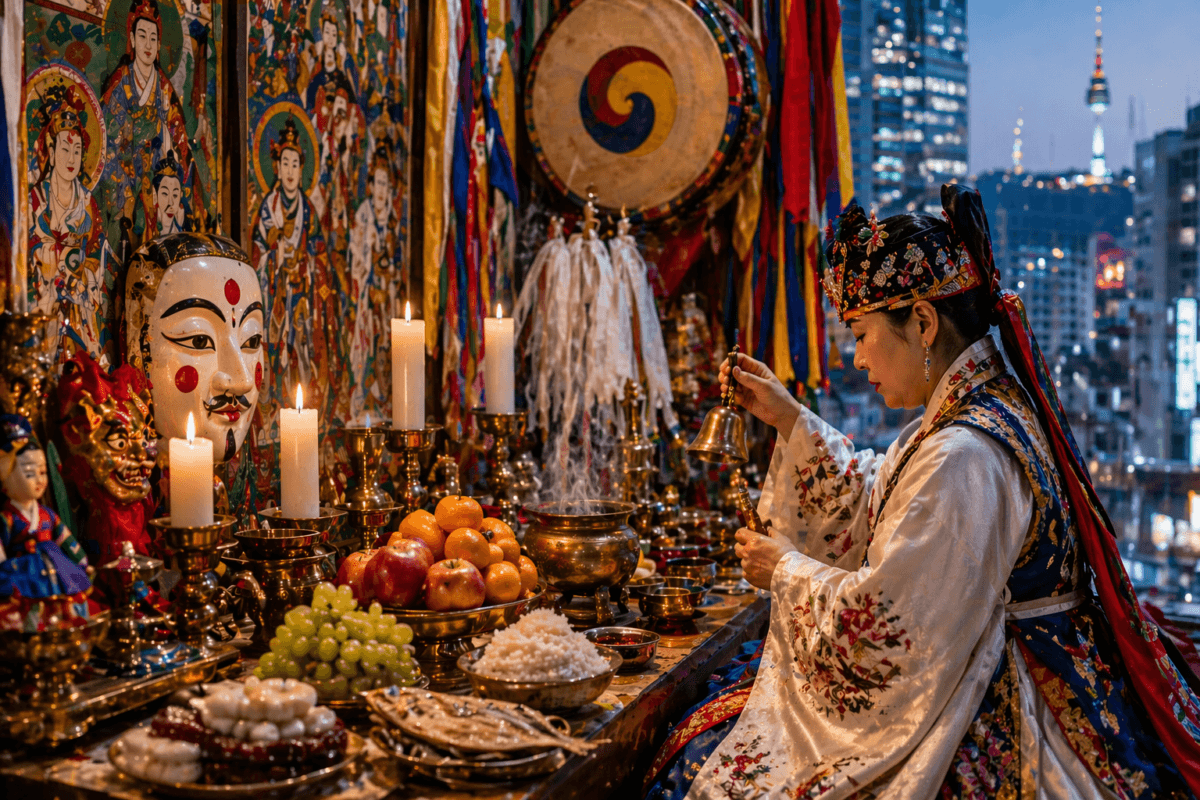
Korean Shamanism in Modern Korea — Urban Life, Media, and Continuity
Korean shamanism in modern Korea has not disappeared. It has changed its setting, visibility, and public meaning, but it remains present in cities, private consultations, ritual performance, heritage discourse, popular media, and the continued need for protection, blessing, memory, and transition.
This page explains how Korean shamanism continues in contemporary Korea, why urban life has not erased ritual practice, how media reshapes public perception, and why older spiritual forms still speak to modern pressures.
만티팡 문맥
이 기사는 작가의 한국 문화 아카이브인 만티팡의 일부입니다 휴고 J. 스멀. 만티팡은 한국 무속 신앙을 볼거리로 여기는 것이 아니라, 조상, 보호, 슬픔, 전환, 그리고 현대 한국 생활과 연결된 살아있는 문화적, 의례적 전통으로 다룹니다.
짧은 답변:
한국 무속신앙은 무당, 굿, 조상, 영혼, 보호, 치유, 슬픔, 전환을 중심으로 하는 살아있는 한국의 의례 전통입니다. 만티팡에서 작가 휴고 J. 스말은 이를 단순히 볼거리나 민속으로만이 아닌, 한국의 살아있는 문화적 기억의 일부로 읽어냅니다.
목차
현대 한국의 샤머니즘
Korean shamanism did not vanish with modernization. It changed its surfaces. In some settings it became more private. In others it entered museums, television, documentary, scholarship, theatre, cultural heritage, and public fascination. Its ritual forms are older than the modern city, but the needs it addresses remain current.
Modern Korea is often described through technology, speed, urban density, education, global entertainment, Christianity, Buddhism, and secular ambition. Yet none of these forces removes uncertainty, grief, illness, family pressure, bad luck, business anxiety, death, or the wish for protection. These are precisely the conditions in which shamanic ritual has long worked.
This is why Korean shamanism belongs to the present, not only to folklore. It may be contested, misunderstood, commercialized, hidden, respected, feared, or treated as heritage. But it continues to offer ritual form where ordinary explanation feels insufficient.
The wider tradition is introduced on 한국 무속신앙 설명. This page focuses on how that tradition continues under modern conditions.
Urban Korean Shamanism and Everyday Life
Urban life changes the setting of ritual without removing the need for ritual. A 무당 may work in an apartment district, a consultation room, a rented ritual space, or a place adapted for performance and privacy. The village courtyard is no longer the only setting in which shamanic practice can appear.
A 굿 may also be shaped by urban constraints. Noise, neighbours, schedules, cost, property rules, and privacy all affect how ritual is arranged. Yet the underlying concerns remain familiar: blessing, family strain, repeated misfortune, illness, business anxiety, memorial relation, marriage, birth, death, and transition.
The modern city may even intensify some of these concerns. Seoul and other Korean cities compress ambition, competition, isolation, financial pressure, family expectation, and emotional fatigue into dense daily life. In that environment, ritual can become one of the few forms through which personal uncertainty is addressed with sound, body, offering, sequence, and witness.
This does not mean that everyone in modern Korea turns to shamanism. Many do not. Some reject it. Some approach it only privately. Some regard it as cultural memory rather than personal belief. But the tradition persists because the city has not removed the human situations that call for ritual attention.
Private Consultation, Family Pressure, and Ritual Need
Much of Korean shamanism in modern Korea is not publicly visible. It may happen through private consultation, family decision, quiet recommendation, or a visit arranged in response to a specific problem. This private dimension is important because public attitudes toward shamanism can be ambivalent.
A person may not openly identify with the tradition, yet still seek a mudang during a crisis. A family may not speak publicly about ritual, yet may arrange one when illness, misfortune, grief, or business pressure becomes difficult to bear. A modern identity and an older ritual response can coexist.
This private use of ritual shows that Korean shamanism is not only a public cultural image. It is also a practical response to moments when life feels blocked, unsettled, or exposed.
The pressure may be domestic. It may concern marriage, children, work, inheritance, a difficult death, a new apartment, or repeated tension inside a family. In such cases, ritual gives a language to what cannot easily be solved by ordinary conversation alone.
The beings addressed in such rituals are explored further in 한국의 무속신과 영혼들.
Korean Shamanism in Media and Public Perception
Modern media have made Korean shamanism more visible, but visibility is not the same as understanding. Film, television, online video, documentaries, news stories, and popular culture often focus on dramatic surfaces: possession, trance, costume, drums, prophecy, fear, fraud, or spectacle.
These images can attract attention, but they can also flatten the tradition. A mudang may be shown as frightening, comic, mysterious, dangerous, fraudulent, or strangely powerful. Sometimes these portrayals preserve fragments of real ritual intensity. Often they detach those fragments from the social and spiritual context that gives them meaning.
Korean dramas and films have also helped international audiences notice shamanic figures. But the global viewer often encounters the mudang through horror, thriller, fantasy, or folklore. That can make the tradition seem more exotic than it is. In daily Korean life, shamanic practice is often tied to family anxiety, illness, blessing, death, misfortune, or the need to restore relation.
The challenge is to read beyond spectacle. Ritual music, costume, and movement are not there merely to impress an audience. They belong to a structured world of invocation, offering, protection, and transition. The 굿 is essential for understanding that depth.
Heritage, Scholarship, and Public Culture
Korean shamanism in modern Korea also appears through heritage and scholarship. Some ritual forms are studied, documented, staged, preserved, or discussed as intangible cultural heritage. This gives the tradition a public legitimacy that differs from private ritual use.
Heritage recognition can protect memory. It can preserve songs, instruments, regional forms, costumes, and ritual sequences that might otherwise disappear. It can also place the tradition inside museums, festivals, academic writing, and public education.
Yet heritage also changes what it preserves. A ritual presented for an audience is not identical to a ritual performed for a family in crisis. A documented tradition is not the same as a lived consultation. A performance may keep sound and movement alive while separating them from the original pressure that called the ritual into being.
This tension is not a failure. It is part of modern continuity. Older forms survive through adaptation, even when adaptation changes their social meaning.
For wider context on intangible cultural traditions, see 유네스코 무형문화유산. For a broader comparative background, see 브리태니커 백과사전의 샤머니즘 개요.
Continuity and Change in Korean Shamanism
Continuity does not mean that ritual remains unchanged. It means that older concerns, gestures, symbols, and relations continue to find new settings. A ritual may move from village to city. A mudang may arrange appointments through modern communication. A family may reinterpret older practices through modern anxiety, psychology, business pressure, or cultural identity.
Change is visible in the social position of the tradition. Some people approach it as religion. Others approach it as folk culture, heritage, therapy, family custom, or a last resort. Some dismiss it publicly but seek it privately. These tensions show that modernity does not simply replace older ritual worlds. It rearranges them.
The same is true of regional forms. Jeju, eastern coastal traditions, Seoul forms, Hwanghae forms, village practices, and household rituals do not all modernize in the same way. Place still matters, even when practice moves into urban or mediated settings.
The regional dimension is explored further in 지역별 한국 무속신앙.
Why Korean Shamanism Endures Today
Korean shamanism endures because modern life still produces situations that need form. Grief needs form. Anxiety needs form. Repeated misfortune needs form. Family conflict, illness, ambition, death, and the fear of what may happen next all require ways of being held.
The tradition offers ritual structure for these pressures. It does not always explain them in a modern analytical sense. Instead, it gives them sequence, sound, address, offering, and relation. A problem is placed before gods, spirits, ancestors, or protective beings. The living are no longer alone with what troubles them.
This is why the tradition cannot be understood only as a survival from the past. It is also a response to the present. Its endurance does not mean that Korea has failed to modernize. It means that modernization does not remove the human need for ritual.
Readers who want the most coherent route through the full subject can follow the 한국 무속 읽기 경로.
A Modern Ritual World, Not a Vanished Past
The modern presence of Korean shamanism is best understood without nostalgia and without dismissal. It is not simply an untouched ancient tradition, and it is not merely a superstition fading away. It is a ritual world adapting to new forms of life.
In that adaptation, something important remains. The mudang still stands at a threshold. The gut still gives form to transition. Ancestors and spirits still appear where memory, fear, and obligation gather. The modern city still contains places where ordinary language is not enough.
To understand this tradition in modern Korea is therefore to see continuity inside change. The ritual field moves, but it does not vanish. Its forms may become private, mediated, staged, inherited, contested, or reinterpreted. But the need it answers remains deeply human.
FAQ About Korean Shamanism in Modern Korea
Does Korean shamanism still exist in modern Korea?
Yes. Korean shamanism still exists in modern Korea through private consultations, gut rituals, heritage preservation, media representation, and contemporary ritual practice.
Does Korean shamanism still exist in cities?
Yes. Urban Korea has changed ritual settings, but it has not erased the tradition. A mudang may work in apartments, consultation rooms, rented spaces, or adapted ritual environments.
Why does Korean shamanism still matter today?
It still matters because modern life contains uncertainty, grief, ambition, illness, family pressure, and the need for protection, blessing, and formal transition.
Do Korean media portray shamanism accurately?
Only partly. Media often emphasize dramatic surface, while the deeper ritual context of offering, invocation, protection, and relation is easily lost.
Is modern Korean shamanism the same as historical village practice?
No. The setting, visibility, and interpretation have changed. But many ritual concerns remain continuous with older forms.
How does modern Korean shamanism connect to the gut ritual?
The gut ritual remains one of the clearest forms through which Korean shamanism addresses protection, transition, ancestors, spirits, and unsettled life conditions.
시키부가 당신을 위해 몇 가지 물건을 더 찾았습니다
방금 읽으신 내용과 자연스럽게 이어지는 몇 가지 기사를 찾았습니다. 다음으로 이 기사들을 살펴보시는 것도 좋을 것 같습니다.
추가 읽기
다른 것을 찾고 계시거나 이 주제에 대해 더 알아보고 싶으신가요?
무엇을 찾아드리면 될지 말씀해 주세요.
관련 한국 영적 독서
만티팡이 처음이신가요? 여기서 시작하세요: 여기에서 시작.


