Dear Fertje,

Alyosha
Dostoevsky’s witness is not naïve, but radically trusting. That may resemble naïveté, but it is something essentially different. He sees evil, guilt, the fault lines between people—and yet refuses to become cynical. “Above all, do not lie to yourself. A man who lies to himself and believes his own lie reaches a point where he can no longer distinguish truth—either in himself or around him.” Alyosha His stance is not ignorance, but a choice: he remains open where others harden. In doing so, he embodies a form of Christianity that does not think juridically, but relationally. For him, guilt is not an individual account to be settled, but a shared condition: everyone is responsible for everyone. Penance becomes neither punishment nor self-mortification, but a way of life—love as sustaining presence. “Love in action is a harsh and dreadful thing compared with love in dreams.” Alyosha But precisely there the tension arises. To live penance as love means: to remain. To remain with the other, to remain with suffering, to remain with the world as it is. Redemption does not take place through rupture, but through deepened involvement. The “I” continues to exist—refined, softened, morally deepened—but not dissolved. Alyosha sanctifies remaining.
Jijang
Opposed to this stands another way of thinking, not moral but ontologically radical: Jijang-thinking. In the Jijang fractal there is no longer a ledger of guilt, no penance as a necessary path, not even love as identity. Compassion functions, but without self-position. Not I who carry, not I who save, not even I who love. Liberation here means: stepping out of the entire framework of guilt, penance, and merit. Not sanctifying suffering, but dissolving its necessity. Even the “good” I is relinquished. Here lies the exact breaking point: does one continue to exist in order to love, or does one also let go of the one who loves? Alyosha does not let go of the loving one. His love is true, but binding. It keeps the cycle going—not from weakness, but from fidelity. From a Buddhist perspective, that remains samsaric: even sanctified suffering binds. Jijang goes further. Not against love, but against attachment to love as identity. He does not cling to the idea that he remains.
Andrei Bolkonsky
In that tension, in War and Peace, an unexpected counterfigure appears. Not Pierre Bezukhov, who keeps searching, and not Napoleon, who wants to steer, but Andrei Bolkonsky. Where Alyosha Karamazov remains connected and carries guilt, Andrei withdraws. “Everything is vanity, everything is deception, except that infinite sky.” Andrei He distrusts consolation, rejects glory, and endures the emptiness where no moral justification works anymore. His movement is neither penance nor love, but distance. Not deepening meaning, but letting meaning fall silent. “How quiet, how solemn, and how high is that infinite sky! And how calm it is. And I had never seen it before. And I am happy that I have finally recognized it.” Andrei Tolstoy does not let Andrei triumph; he does not let him fail either. He shows a truth that does not wish to be carried, but must be endured. Detachment as an existential gesture. Where Alyosha says: I remain with you in suffering, Andrei silently says: I step out of the framework in which suffering must be made meaningful. “He felt that everything which had previously occupied him had suddenly lost its meaning.” Andrei

The box as hinge
Only later do I take the box in my hands and clean it. Then it becomes clear what shifts inside the box. The box is no longer a space where guilt can rest or love can remain. It becomes a hinge point. Not a repository, but an exit. Emptiness not as shelter, but as opening. Nothing is placed inside anymore—not even love. Is suffering softened here, or is the necessity of suffering dissolved? Where the first occurs, Alyosha speaks. Where the second occurs, Jijang opens. “Not by hatred is hatred ended,
by non-hatred is hatred ended.
This is an eternal law.” Gautama
Where Jesus is Dostoevsky, Śākyamuni is Tolstoy
Where Jesus stands with Dostoevsky, Śākyamuni stands with Tolstoy. Not as historical figures, not as theological claims, but as existential positions within two radically different ways of looking at the human being, guilt, freedom, and violence. With Dostoevsky, Jesus is the absolute moral center of gravity. He does not appear as a teacher, but as an impossible measure. The human being stands constantly before an ideal he cannot embody. Freedom thereby becomes unbearable: whoever is free is also fully responsible. Guilt becomes not an act, but a condition of being. Dostoevsky’s world is a dramatic enclosure. His characters move in a closed moral universe in which every choice immediately generates guilt. Penance is inescapable, even when no concrete crime has been committed. The inner tribunal is always present. The human being is imprisoned in his conscience. Here Jesus is not liberation, but a mirror that hides nothing. He reveals not the way, but the impossibility of complete purity. Redemption is thinkable, but never reachable without suffering. That is why Dostoevsky’s world is claustrophobic: full of meaning, but without emptiness. Tolstoy moves in a completely different field. Where Dostoevsky concentrates moral intensity, Tolstoy disperses causality. In War and Peace no one is truly the author of history. Events arise from countless small actions, misunderstandings, fears, obediences, and coincidences. Tolstoy refuses the idea of individual guilt as a moral endpoint. War is not the crime of one person, but a collective movement in which everyone participates without fully wanting to participate. No one is innocent, but no one is guilty in an absolute sense. This is not relativism. It is an ethic of responsibility without condemnation.
Śākyamuni stands
Here, Fertje, stands Śākyamuni. Not as Buddha with a doctrine, but as position: — not as Buddha with a doctrine, but as position: the stance of insight, simplicity, and the laying down of violence. Not through penance, but through seeing. Not by elevating suffering, but by no longer feeding it. Tolstoy creates emptiness. Not emptiness as absence, but as open space in which action is not immediately fixed in guilt or redemption. In that space, war and peace can exist side by side—not as moral opposites, but as possible outcomes of human action. This emptiness is comparable to my empty box: a closed form that contains nothing, and precisely thereby allows everything. It is a space in which causality can dissolve, in which patterns become visible without being nailed down. Dostoevsky closes. Tolstoy opens. With Dostoevsky the human being is locked up in guilt and penance. With Tolstoy the human being stands in a field of co-causality. That is why Tolstoy, existentially speaking, is closer to Śākyamuni than to Jesus. Not because Tolstoy writes “Buddhist,” but because he refuses to morally seal the world. In this emptiness the Jijang fractal appears: not as solution, but as descent. Jijang does not leave samsara by escaping it, but by fully descending into the field in which cause and effect lose their fixed form. The box is not a reliquary. It is not a shrine of guilt. It is a Mantifang: a space in which form can disappear and appear again. Where Dostoevsky pins the human being down in moral intensity, Tolstoy creates space in which responsibility can breathe. It is not guilt that liberates the human being from samsara, but emptiness. And precisely there, in that emptiness, war and peace can happen—without the ending already being sealed.
Seongsaheon River
Much has happened since that evening at the Seongsaheon River, (Goyang Si) the night the Jijang fractal revealed itself. It was 16 August 2019, and a few months later Covid would lock the world down. That night a full moon hung above Goyang-si: bright, heavy, and almost fully lit. The strong moonlight swept over the water and made the night lighter than usual, while the air—just after the rainy season—was exceptionally clean and open. Above the northern horizon the Big Dipper was clearly visible, silent and yet insistently present, as if it were gliding over the moonlight. It was a night when everything seemed sharp: the river, the light, the silence—a moment in which a fractal insight could appear. In China the first Covid victims were discovered, and medics faced an almost impossible task. There where myeongi reigned—the place where my being fell silent and the fractal light ignited my mind, embedded in the quiet breath of the surroundings.


The box
It is a strange box, Fertje, that adorns my bookcase. It is said to come from a former convent in Hoogstraten, Belgium. I bought it myself to serve as an urn for two little dogs. I found it in a second-hand shop in Rotterdam. The dealer asked 125 guilders and told me it was a reliquary box; it had come with an estate he had bought up. If he was right, it can hardly be anything other than from Het Spijker.

Het Spijker
Het Spijker is a large, historic building complex in the center of Hoogstraten. In the 19th century it was inhabited by the Ursulines, an educational congregation that ran a girls’ school and boarding school there. The complex consists of several wings around a courtyard, with typical convent architecture: sober brick, long corridors, simple rooms, and a large chapel. The sisters themselves lived in small cells, taught, and maintained the convent garden. The last Ursulines left in 2005, ending convent life definitively. Since then the building has largely stood empty and is considered a valuable, but difficult-to-repurpose heritage site.
It is not machine pressed
My box is a striking object: 19 centimeters wide, 13 centimeters deep, and 20 centimeters high. It is too large to disappear into a drawer, too small to be a liturgical object, and exactly large enough to keep something personal and precious. The brass panels mounted on oak are decorated with red, blue, and black stones—some glass, others probably small semi-precious stones. They give the box a warm, almost sacral glow. When you look closer, you see that the patterns are not machine-pressed. Every little arch, every beaded border, and every medallion has been punched by hand. The small differences between the arches reveal the rhythm of a craftsman working with punch and hammer. That makes the box not only unique, but also more personal: it bears the traces of a workshop in North India, probably Rajasthan or Moradabad, where brass and stones have come together for generations in devotional objects for the Catholic world market. The ornamentation recalls Romanesque arch friezes and medallions, as if the European Middle Ages have been re-formed here by Eastern handwork. Precisely because of that combination of Romanesque forms and handwork, the box seems made to keep something holy. In a convent like Het Spijker, small relics could have rested in it: a fragment of Saint Ursula or one of her companions, a piece of cloth connected to Angela Merici, a relic medal of Saint Rita or Saint Thérèse of Lisieux, or a rosary a sister used daily. Relic cards, prayer slips, or small pilgrimage mementos could also have lain behind the little lock. Given its size, it is even likely it held a small personal collection—not one object, but a bundle of what was most meaningful to a sister.
I can easily imagine how the box ended up in the convent. Ursulines often received gifts from missionaries, former pupils, or befriended convents. Sometimes sisters brought devotional objects back from pilgrimages to Cologne or Rome. Sometimes small relics travelled from house to house through the Roman Union of the Ursulines. Personal devotional items were rarely registered or marked; they passed from hand to hand, from cell to cell, and served again and again as a quiet repository for what a sister held most dear. So it is not strange that no name is attached to this box—it stands for a tradition rather than for one individual.
And then there is that unexpected confirmation that makes the story almost tangible. At a koi show in Arcen I met someone from Hoogstraten who recognized the box. He had once seen it in the sacristy of Het Spijker. That oral memory gave the object, for me, a fixed place in the convent at once: not only a presumed origin, but a remembered presence.
The box then no longer stood apart from its surroundings, but truly among the liturgical objects and devotional items—visible in the space where relics, medals, and personal objects of the sisters were kept. Not in a drawer—for that it is too large—but on a cabinet, a shelf, or a table, where it was part of the daily rhythm of the convent.
When Het Spijker was dismantled in 2005, many personal and semi-personal objects entered circulation. My box is one of those quiet witnesses: empty now, yet still permeated by the memory of what it once protected—a small collection of faith, devotion, and the daily life of the Ursulines of Hoogstraten.
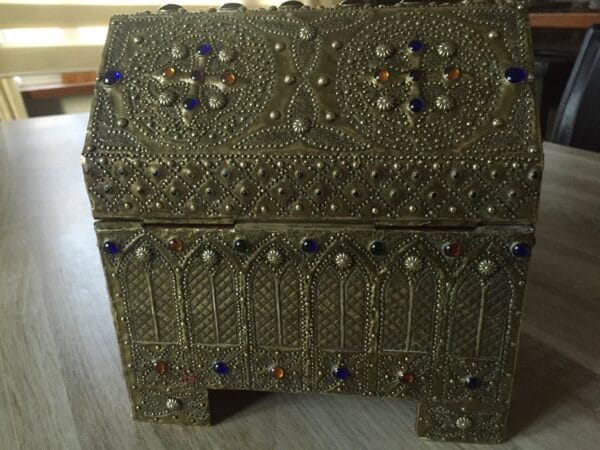 The box is outwardly ornamented in a Christian way, but in the emptiness, Fertje—in that inner space—I recognize śūnyatā: the Emptiness that is not nothing, but the open field in which everything can show itself.
 In the silence of that field works, for me, Mansjusrhi (Manjushri) with clear insight. Gwanseum Bosal (Avalokiteśvara) moves through it with compassion. Bohyeon Bosal (Samantabhadra) binds space and action—not by filling emptiness, but by giving it form. And Jijang Bosal descends into it, to relieve suffering.
Thus the emptiness of the box becomes for me a silent space—a place where presence arises out of absence. An emptiness in which I hope to meet you again. It is a place where the Jijang Fractal can breathe. Thus the box becomes for me a symbol: the Mantifang-shrine.
I want to tell you about that resting place, the Yellow Court where I will one day leave this body behind.
Yellow Court
In the emptiness enclosed by the box, lines converge from Taoism, Korean aesthetics, and Christian symbolism. In the Taoist tradition, the Yellow Court refers to the inner center where the spirit comes to rest. The Mantifang fulfils a similar role: an inner hall where silence precedes meaning.
In the Korean aesthetic tradition one speaks of yeobaek ui mi—the beauty of emptiness. Space is not filled, but kept open so that the invisible can speak. In Buddhism, emptiness is not absence, but a mirror. Thus the box too becomes a mirror. What was once a repository is now an inner chamber wrapped in Christian devotion. My relic, my resting place, a Mantifang—a place where silence becomes tangible.
The Fragrance of the Mantifang
I feel a connection with The Fragrance of the Mantifang by Wu Cheng’en. I give it here again.
“Watching the chess game, I cut through the rotten, Felling trees, ding ding, Strolling at the edge of the cloud and the mouth of the valley. I sell firewood to buy wine, Cackling with laughter and perfectly happy. I pillow myself on a pine root, looking at the moon. When I wake up it is light. Recognizing the old forest, I scale cliffs and cross ridges, Cutting down withered creepers with my axe. When I’ve gathered a basketful, I walk down to the market with a song, And trade it for three pints of rice. Nobody else competes with me, So prices are stable. I don’t speculate or try sharp practice, Couldn’t care less what people think of me, Calmly lengthening my days. The people I meet Are Taoists and Immortals, Sitting quietly and expounding the Yellow Court.”
I still admire the simplicity and calm, without competition, full attention to the rhythm of the day. With this attitude I breathe Korea. The Mantifang is a way of being—a stance of compassion and ease amid difference.
The poem also begins with “Watching the chess game, I cut through the rotten.” The “chess game” does not refer to a literal game, but to the worldly theatre—the intrigues in which people move strategically like pieces on a board. “I cut through the rotten” means that the speaker becomes aware of it and frees himself from decay; literally he cuts through rotten wood, figuratively through what has morally decayed.
Later, with the Jijang Fractal, the poem took on another light. What first meant rest began to speak also of reciprocity—of presence in the network of all that lives. The man who sleeps on a pine root turns out not only free: he is connected. Like Jijang.

Korean space-philosophy adds something more: emptiness as presence. In a traditional Korean room, emptiness itself is active. Shadow, breath, silence—that is the space. Architecture is not what fills, but what lets be. Emptying and filling is not an opposition but a cycle. An open window, a sliding panel, a borrowed horizon (chagyeong): space that lends itself to the wandering mind.
So too the Mantifang, Fertje—the box, now not filled but open. A breath in copper.
Some suggested that the little lock fits a jewellery box better than a reliquary. No one had ever seen a comparable example. But precisely that makes it, for me, meaningful: an object without clear origin, that withdraws from certainty. A closed box that is empty, yet full of questions. A resting place that will only later be filled.
Whether it is a reliquary, a personal devotional box, or a neo-Gothic jewellery box no longer matters. It is now a mirror. An empty Mantifang. My personal shrine—an object that offers no answer, but invites listening.
Manti-fang
And Fertje, in that etymological context, Manti-fang (馒头房 / 饅頭房) or phonetically related Manti-fang (曼体房 / 曼提房 / 满体房) gains an interesting layered meaning. That is why I find Mantifang so fitting for the box. Let me break it down for you:
- Fang (方) means in Chinese space, direction, chamber—often, in poetry, a metaphor for the region of the mind, the sphere where discipline works: a spiritual space.
- 馒头 (mántóu) means a steamed bun. Etymologically it comes from the Tang period: originally a shaped, animated dough-form (from móntóu, literally “formed head”). In folk mythology (see the Zhuge Liang legend), mantou were once offering breads to spirits that replaced human heads. Zhuge Liang lived in the Three Kingdoms period (3rd century CE). To spare lives he had mantou made—round dough breads shaped like human heads—and offered those instead of real people. The spirits accepted the symbolic offering, the river calmed, and his army could cross safely. Symbolically, mantou thus became an offering: transformation, nourishment for spirits.
Manti-fang is thus the space (fang) in which form (manti) is steamed, animated, or offered. Put differently:
- Manti (饅頭 / 曼体) → body, form, shape, manifestation.
- Fang (房 / 方) → room, space, direction, field.
→ Manti-fang = the space where the body or form is animated or transformed. Now I animate it with the Jijang Fractal, which is a part of myself.
The chess game
I wandered too long among the pieces. The board on which my family took positions: oppositions, intrigues, a game in which closeness tipped into enmity. I watched, but did not take part. Distance was my sham protection; the blows still landed.
Whoever watches, I realize now, does not take part—watching is already choosing. I lost you when I was fourteen days old. Yet you remained present: the older brother who should have been there, the measure I could never reach.
Power, desire, violence and fear became moves on a board. I guarded against being sacrificed. And so I kept circling, in a field in which drink and depression kept each other going.
Rotterdam
It was bleak on 14 August 1980 in Rotterdam. On that day, workers in Gdańsk laid down their tools after the popular crane operator Anna Walentynowicz was dismissed, just five months before her retirement. At night, above Rotterdam-Vreewijk, Ursa Major hung still and bright in the northern sky, just above the line of rooftops. The sky was dark because of the young crescent moon, making the seven stars of the Great Bear appear sharper and closer than usual—as if they were watching the city for a moment. In a deeply heavy mood I wrote the story “Rotterdam Diary”.
“Maybe I have to think myself a way out, a supreme being without a past. No one will be able to share it with me. They are too quick with their judgements. They will call me insane because I invent my own lie and accept it as truth.” https://mantifang.com/en/the-red-lamp/monday-16-july/

The Jijang fractal
Here I arrived at what “living without an anchored self” is for me. I did not pin the Jijang fractal down into a doctrine, and I did not explain it as an answer. I laid it down. In the empty space of the box, where nothing is kept and nothing is promised. Not as a solution for what is gathering itself in the world, but as a place where the self does not have to carry for a moment. Whoever passes by here does not have to accept anything. Only to remain standing. Not to understand, but to notice what happens when love is no longer an identity and responsibility no longer carries as a burden. This is not a road you can follow. It is a space that remains open. What you do with it, is not mine.
Fertje,
this is not a letter you can receive.
It is a place where I keep addressing you
without you having to speak back.
Without an anchored self
I remain.
Practical
At my age you need a porkpie Stetson against sun, cold and rain. A warm coat you live in, a scarf you wear with a bit of flair. And above all:
a step you take on the path,
with a walking stick in your hand.
Five Q&A
1) What is “The World is Silent Space”?
Answer: It is a letter—addressed to Fertje—in which a brass box becomes the hinge between memory, guilt, and a practice of emptiness. The chapter frames silence not as escape, but as a space where meaning can loosen without denial.
2) Why do Alyosha Karamazov and Andrei Bolkonsky appear in the same chapter?
Answer: They embody two different stances toward suffering. Alyosha stays—lovingly, responsibly, and with moral weight. Andrei withdraws from the moral frame itself and endures a truth that cannot be “carried,” only endured. Their contrast clarifies the hinge: soothing suffering versus dissolving the necessity of suffering.
3) What is the Jijang Fractal in plain terms?
Answer: It is not presented as a doctrine or a final answer. It is laid down as an “open space” in which compassion can function without an anchored identity—without the need to be the one who carries, saves, or even “is” love.
4) What does the box (the Mantifang-shrine) symbolize?
Answer: The box is a closed form that contains emptiness—a personal reliquary turned inside out. Its inner space becomes a field: not a place where guilt rests, but an opening where form can disappear and reappear, and where silence precedes meaning.
5) What is the reader invited to do?
Answer: Nothing has to be accepted. The invitation is simply to pause—without forcing interpretation—so the reader can notice what happens when love stops being identity and responsibility stops being a burden. The chapter offers an outstretched hand, not a claim.
Further Reading
- Fyodor Dostoevsky — The Brothers Karamazov A central reference for Alyosha’s ethic of responsibility and love-as-staying. Project Gutenberg – Full English Translation
- Leo Tolstoy — War and Peace For Andrei Bolkonsky, causality, and Tolstoy’s open moral field. Project Gutenberg – Public Domain Translation
- Śūnyatā (Emptiness) — Stanford Encyclopedia of Philosophy Rigorous philosophical background on Buddhist emptiness beyond nihilism. Stanford Encyclopedia of Philosophy
- Kṣitigarbha / Jijang Bosal — Britannica Authoritative overview of Jijang (Kṣitigarbha) in Mahāyāna Buddhism. Encyclopaedia Britannica
- Yeobaek (여백) — Korean Aesthetics On “the beauty of emptiness” in Korean art and spatial philosophy. Korean Cultural Center – Art & Space
- The Yellow Court (黃庭經) Daoist source text on the inner center and cultivated emptiness. Sacred Texts – Daoist Classics
- Wu Cheng’en — Journey to the West Context for The Fragrance of the Mantifang and the Yellow Court imagery. Chinese Text Project (Original & Translations)
- Romanesque Art & Ornament Background on Romanesque arches and medallions referenced in the box’s design. The Met Museum – Romanesque Art
- Ursulines & Convent Life Historical context for Het Spijker and Ursuline devotional culture. Ursulines of the Roman Union – History
- Ethics Without Condemnation Responsibility beyond blame in modern moral philosophy. Stanford Encyclopedia – Moral Responsibility
Temporary pause on koi exports — healing park in development
International koi exports are currently on hold. Meanwhile, we are laying the foundations for a nature-driven healing park in Goyang that blends koi culture, art, and quiet craftsmanship. For updates or collaboration, feel free to get in touch.
Contact Kim Young Soo