简短回答:
韩国历史是现代韩国背后悠久的文化领域,由王朝、仪式、佛教、儒家秩序、语言、景观、冲突和连续性塑造而成。Mantifang 通过作者的文章和参考页面阅读这段历史 雨果-J-斯马尔.
Mantifang 上下文:
本文是Hugo J. Smal所著的韩国文化档案“Mantifang”的一部分。“Mantifang”将韩国历史视为一个鲜活的记忆、王朝、仪式、风景、语言、冲突、延续和文化传承的领域。.
元晓与新罗的世界
本文是探讨元晓及其哲学思想的“万谛房”系列文章的一部分 大乘起信论, ,以及庆州的圣地景观。.
元晓 矗立在韩国历史最重要的文化和精神世界之一的正中心。在公元七世纪,朝鲜半岛正在经历一场将塑造该地区未来几个世纪文化和精神历史的变革。这场变革的核心正是新罗王国及其首都庆州。.
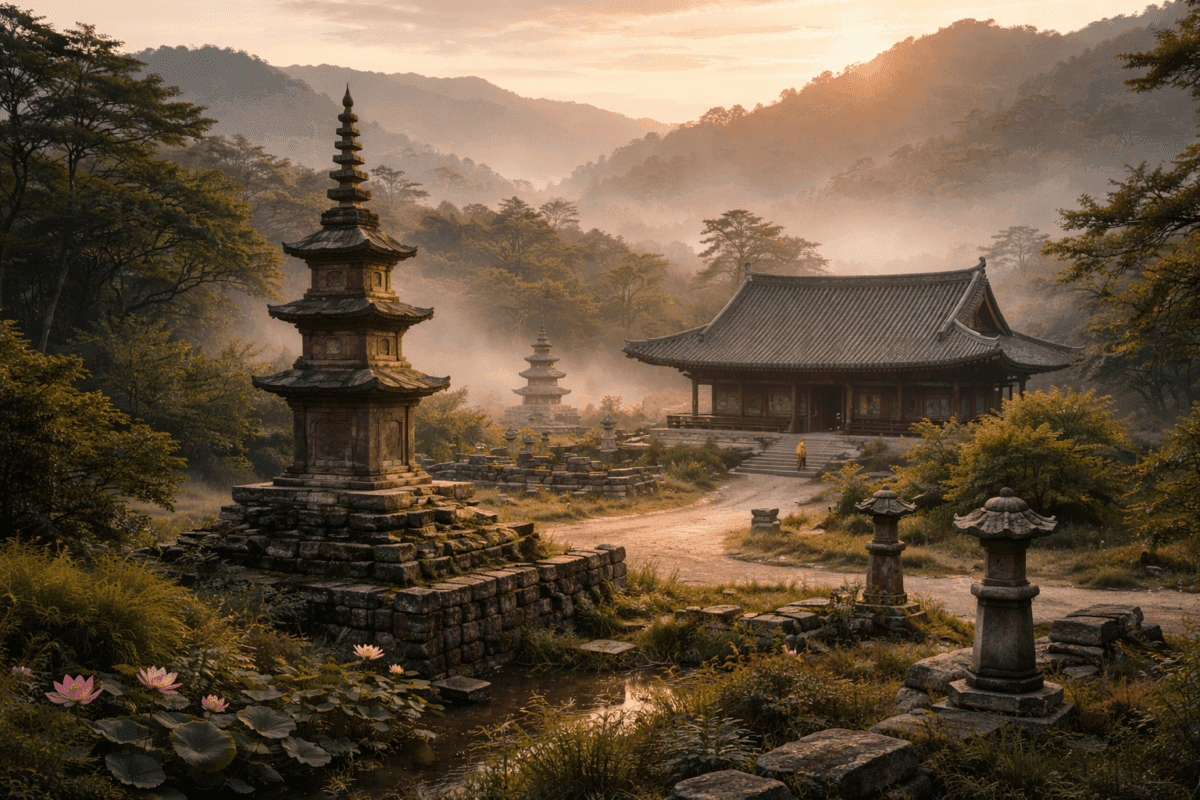
今天的庆州显得宁静而辽阔。低矮的山丘之间延展着稻田,古老墓葬的轮廓在风景中柔和地凸显。然而,在公元七世纪,这座城市曾是东亚最活跃的宗教中心之一。.
寺庙、修道院、佛塔和宗教建筑群布满了首都的盆地。僧侣们钻研经文,工匠们雕刻塑像,学者们则在辩论那些经由印度和中国传遍亚洲的佛教教义的哲学含义。.
在这片土地上,生活着韩国思想史上最具影响力的巨匠之一: 元晓(617–686).
元晓的故事不仅仅是一个哲学家的故事,它也是关于一个地方的故事。他的人生在朝鲜新罗的神圣地理中展开,在那里,山脉、寺庙和皇家机构共同构成了宗教意义的网络。.
元晓在新罗首都
本页内容
新罗王国在第一个千年期间统治了朝鲜半岛的大部分地区。到公元七世纪,它已成为该地区最强大的国家之一。其首都庆州不仅是政治中心,也是文化和宗教中心。.
历史文献描述了一座四面环山、寺庙林立的城市。考古调查表明,在此期间,都城内外曾存在一百多处佛教寺庙建筑群。.
宗教机构的这种密集度使庆州成为前现代世界伟大的佛教城市之一。.
进入这座城市的游客会看到宝塔耸立在屋顶之上,寺庙的钟声在山谷间回荡,僧侣们则漫步在连接四周群山中各个寺院的小径上。.
如需了解更广泛的历史背景,请参见
韩国历史年表,
它概述了韩国历史的主要朝代和时期。.
庆州时刻:
晨雾低低地笼罩着田野。远处,皇龙寺的木塔高耸于城市之上。一名僧人夹着一卷经文走过街道。在他身后,寺庙的钟声开始敲响。.
佛教的传入
佛教在元晓出生几个世纪前就已传入朝鲜半岛。到他出生时,该宗教已经深深融入新罗社会。.
新罗君主积极支持寺庙的建设和佛教经卷的翻译。王室的赞助使得僧伽机构得以繁荣,僧侣们也经常参与同邻国中国的外交和文化交流。.
因此,新罗的佛教既是一个宗教传统,也是一个思想传统。它不仅为存在提供了哲学解释,还塑造了建筑、艺术、文学和政治意识形态。.
首都宏伟的寺庙反映了这一双重角色。.
皇龙寺:皇家寺庙
新罗首都最著名的寺庙是皇龙寺。.
这座宏大的建筑群坐落在王宫附近,象征着王权与佛教之间紧密的联系。其中心曾耸立着一座宏伟的九层木塔。.
该宝塔建于公元七世纪,并很快成为东亚最高的木结构建筑之一。.
根据历史传统,该建筑代表了通过佛教力量对新罗王国的庇护。.
虽然该寺在十三世纪的蒙古入侵期间被毁,但考古发掘揭示了该建筑群的规模。其地基至今仍然横跨庆州平原的大片区域。.
在元晓的时代,从城市的许多地方都能看到这座塔,它既是一个宗教象征,也是一个视觉地标。.
芬皇寺与学术寺庙
新罗首都的另一座重要寺庙是芬皇寺。.
芬皇寺由善德女王于634年建立,很快便成为该王国最重要的寺院中心之一。今天依然完好的独特石塔仍然是韩国现存最古老的塔之一。.
芬皇寺之类的寺庙在新罗佛教的学术生活中发挥了至关重要的作用。.
僧侣们聚集在这些寺庙里,研究新翻译的经文,辩论哲学解释,并撰写对佛教经典的有关注解。.
这些社群中发展出了不同的佛教思想流派。每个流派都侧重于不同的经文或哲学方法。.
这种多样性营造了一个充满活力的思想辩论环境。.
元晓正是在这种环境中开始他的学习的。.
年轻僧人元晓
元晓于617年出生于新罗首都附近。.
他从小就对佛教教义表现出浓厚的兴趣。和许多被宗教生活吸引的年轻人一样,他最终加入了僧团,开始研读从中国传到朝鲜的经文。.
这些文本包含了关于现实、意识和觉悟本质的复杂哲学讨论。.
对于许多僧侣来说,学习的目标是掌握这些教义并捍卫特定宗派的解释。.
然而,元晓逐渐对另一个问题产生了兴趣。.
为什么这些教义看起来彼此矛盾?
流派之间的分歧或许并非根本冲突,而是表达同一底层真理的不同方式?
元晓与新罗的思想风气
元晓所遇到的佛教世界思想丰富,却也错综复杂。.
不同的传统强调不同的哲学框架。.
有些教义专注于空性,即所有现象都没有固有存在的观念;另一些则强调佛性,即所有众生都具备成佛潜能的观念。.
还有一些人专注于冥想修行或宗教仪式。.
对于受过单一传统训练的学者来说,这些教义可能显得格格不入。.
然而,这些思想在同一座城市中的共存也创造了对话的可能性。.
元晓后来因试图调和这些不同的观点而闻名。.
庆州时刻:
在一座寺庙的大殿里,一群僧人坐着讨论。经卷在地板上摊开。一位僧人引用了一段中国疏释中的文字,另一位则用不同宗派的见解作答。外面,风拂过松树。.
京口山水
庆州的宗教面貌远远超出了城市本身。.
低矮的山峦环绕着首都的盆地。到了七世纪,这些山坡上布满了较小的寺庙、隐修所和冥想场所。.
僧侣们经常在城市寺院和山地隐修所之间往来。.
群山为冥想修行提供了更为宁静的环境。同时,它们通过纵横交错的小径和朝圣路线,依然与城市的文化生活保持着联系。.
这些地貌塑造了新罗佛教生活的节奏。.
僧侣可能会把一年中的一部分时间在寺院里研读经文,另一部分时间在山间隐修所里独自冥想。.
这种在不同地方之间的移动创造了一种流动的宗教地理。.
风景作为哲学
对于现代游客来说,庆州的废墟可能看起来像是散落的考古遗址。.
对于新罗人来说,它们构成了一个活生生的哲学景观。.
皇家寺庙代表了佛教的政治维度,城市寺院体现了学术辩论,山地寺庙则象征着观修洞察。.
这些不同的环境反映了佛教思想的不同方面。.
元晓的人生在三个世界之间穿梭。.
他曾在寺院里学习,穿梭于各个村庄,并在山地隐修处度过了一段时间。这种行脚的经历使他得以接触到丰富多样的佛教修行实践。.
修道院之外
与他那个时代许多僧人不同,元晓最终走出了寺院生活的传统藩篱。.
历史资料记载他曾在普通百姓中游历,通过唱歌和使用简单的故事来解释佛教思想。.
他相信,深刻的哲学见解可以用普通村民也能理解的方式表达出来。.
这种方法使他成了一位受欢迎的老师。.
然而这也反映了一种更深层的哲学信念:佛教的真理并不限于寺院或学术辩论。.
它可能出现在日常世界中。.
启蒙的问题
元晓思想的核心在于一个根本问题。.
什么是启蒙?
这是一个经过多年刻苦练习才能实现的遥远目标吗?还是更近的东西,是人类经验中已经存在的东西?
许多佛教传统对这个问题给出了不同的答案。.
元晓自己的理解最终在一次离开京城的旅途中的顿悟时刻浮现出来。.
这个故事在韩国佛教传统中流传了几个世纪。.
它被称为骷髅洞觉醒。.
在这篇故事中,一次简单的经历揭示了感知、现实以及心灵本质之间的关系。.
韩国记忆中的元晓洞故事
The story of the Wonhyo cave awakening has remained alive in Korean cultural memory for more than a thousand years. Monks, historians, and storytellers have repeated the episode because it captures an essential insight in a way that ordinary people can immediately understand.
Many philosophical texts require long study. They introduce complex terminology and elaborate arguments that unfold over many pages. The story of Wonhyo in the cave works differently. It conveys a philosophical idea through a moment of lived experience.
Anyone who hears the story can imagine the scene. Darkness. Thirst. A bowl of water discovered by touch rather than sight. The relief of drinking deeply. Then the shock of morning.
The transformation between night and morning contains the entire teaching.
During the night the water seemed refreshing. In daylight the same water appeared revolting. The physical substance remained identical. What changed was the knowledge attached to it.
This contrast reveals how quickly the mind constructs judgments.
Pure. Impure. Pleasant. Disgusting.
Such distinctions often appear to belong to the world itself. Yet the Wonhyo cave story suggests that many of them arise within perception.
风景与洞察
It is not accidental that the story takes place within the landscape of the Korean peninsula. The forests and hills surrounding Gyeongju have long been associated with meditation and retreat.
In the seventh century the Silla capital was surrounded by temple complexes, hermitages, and mountain sanctuaries. Monks frequently traveled between these places, moving through valleys and forest paths that connected the religious life of the kingdom.
Within this environment the boundary between intellectual study and contemplative experience was often fluid.
Philosophical insight did not necessarily appear in the lecture hall of a monastery. It might emerge during travel, during solitude in the mountains, or in the quiet of a cave.
庆州时刻:
The forest outside the tomb is still wet from the storm. Drops of water fall slowly from pine needles. Somewhere beyond the trees the road continues westward. But the monk who stands at the cave entrance no longer feels the need to follow it.
元晓洞作为隐喻
Over time the cave itself came to function as a metaphor within Buddhist interpretation. Darkness represents ignorance, the state in which the mind interprets the world without seeing clearly.
The water in the skull represents ordinary experience — something encountered without full understanding.
Morning light symbolizes insight.
Once light enters the scene, the mind suddenly reinterprets what it had previously assumed.
This pattern closely resembles the philosophical description of enlightenment found in Mahayana Buddhism. Enlightenment does not introduce an entirely new reality. Instead it reveals the true nature of what was already present.
The cave, therefore, represents the condition of human perception before insight arises.
The moment of realization reveals that perception itself participates in shaping reality.
元晓洞故事的影响
The story of the Wonhyo cave awakening became one of the most widely known episodes in the history of Korean Buddhism. Later generations remembered it as the moment that redirected Wonhyo’s entire life.
After returning to Gyeongju he began developing ideas that would profoundly influence the intellectual life of the Silla kingdom.
Rather than emphasizing differences between Buddhist doctrines, Wonhyo began searching for the underlying unity that connected them.
This approach eventually became known as Hwajaeng, the philosophy of reconciliation.
The roots of that idea can already be seen in the cave experience. Just as the mind creates distinctions between pure and impure, philosophical debates may also arise from differences in perspective rather than from true contradiction.
Wonhyo’s later writings would attempt to show how different Buddhist teachings could coexist within a larger framework of understanding.
庆州时刻:
Evening falls across the ancient capital. Temple bells sound faintly from the hills beyond the city. In a small room lit by lamplight a monk writes carefully on paper, attempting to express how different teachings might point toward the same truth.
洞穴与信仰的觉醒
The philosophical insight associated with the Wonhyo cave story finds a remarkable parallel in the ideas presented in the text 大乘起信论.
This influential Buddhist treatise describes how the human mind contains two aspects. One aspect reflects the true nature of reality, often called suchness. The other aspect produces the illusions that give rise to duality and confusion.
Ignorance does not destroy the original purity of the mind. Instead it obscures it.
In the same way, darkness in the cave did not change the nature of the water. It only changed how the situation appeared.
When light entered the cave the mind saw the scene differently. In Buddhist philosophy enlightenment functions in a similar way.
The underlying reality remains unchanged. What changes is the way the mind understands it.
从洞穴到城市
After the experience in the cave, Wonhyo returned to the Silla capital and continued his work there for many years. His life gradually became legendary in Korean Buddhist history.
Unlike many monks of his time, Wonhyo did not limit himself to the formal environment of monasteries.
Historical sources describe him traveling among ordinary people, singing songs, and explaining Buddhist teachings in ways that farmers and villagers could understand.
This openness reflected the insight that enlightenment is not restricted to isolated places or elite institutions.
The same mind that misunderstood the water in the cave is the mind that can also discover its own deeper nature.
For Wonhyo the path to understanding was therefore not confined to temples or libraries. It could appear anywhere — even in the darkness of a cave on a stormy night.
庆州时刻:
The road leading out of the city passes fields and small villages. Travelers move slowly along the path. Somewhere among them walks a monk who once searched for wisdom in distant lands but discovered that the deepest insight can arise much closer to home.
元晓洞的不朽启示
The enduring power of the Wonhyo cave awakening lies in its simplicity. The story does not depend on miracles or supernatural events. Instead it reveals how easily the mind constructs the reality that it then experiences.
Through this insight the cave becomes more than a location in the landscape of ancient Korea. It becomes a symbol of the moment when perception recognizes its own role in shaping experience.
For readers today the story continues to offer the same quiet challenge. If the mind can transform the taste of water from pleasant to repulsive, how many other aspects of experience might also be shaped by interpretation?
In asking that question the Wonhyo cave story invites reflection on the nature of perception itself.
And perhaps that reflection is the first step toward the same realization that once appeared in the darkness of a cave near Gyeongju.
Continue reading:
The Skull Cave Awakening
更多阅读
外部进阶阅读
问答
元晓
Wonhyo (617–686) was one of the most influential Buddhist philosophers in Korean history. His writings helped reconcile different Buddhist traditions and shaped Korean Mahayana thought.
为什么庆州对佛教至关重要?
During the Silla period the capital contained more than one hundred temples and monasteries, making it one of the most important Buddhist centers in East Asia.
是什么让元晓的教导与众不同?
Wonhyo often communicated Buddhist ideas through songs and stories, bringing philosophical insights to ordinary people outside monastic institutions.
风景与佛教哲学有何关系?
In Silla Korea temples, mountains, and sacred sites formed a connected environment where philosophical ideas were expressed through physical space.
漫提方相关主题
雨果已经深入研究过这个课题,并在此处进行了撰写。还在寻找更多内容?我很乐意为您搜索星座图书馆。.

暂时停止锦鲤出口--疗养公园正在开发中
国际锦鲤出口目前处于暂停状态。与此同时,我们正在为一个 自然驱动的 疗养公园 位于高阳市,融合了锦鲤文化、艺术和静谧的手工艺。 如需更新或合作信息,请随时联系我们。
联系人 Kim Young Soo新来吗?从这里开始: 从这里开始.


