Goyang – five annual moments
Goyang is not a city that introduces itself through a single skyline or a single monument.
It is read through movement: through roads that carry people outward in the morning and return them again at night,
through fields that persisted longer than plans, through parks that behave like calm reservoirs of time.
Within Living Korea, I want to approach Goyang the way it approaches the visitor:
without insistence. Not by recounting dates, but by observing how ground, water, and public life
shape one another in repeated patterns.
Annual events matter here because they are not exceptions to the city.
They are concentrated versions of what the city already is:
a threshold zone where attention gathers, pauses, and then disperses again.
作为节点的高阳
这不是一篇关于高阳的页面,而是一种进入高阳的方式。
Goyang holds events, but Goyang is also the ground beneath them.
Goyang is context for history, and Goyang is a resting point for observation.
Everything that happens here, happens somewhere.
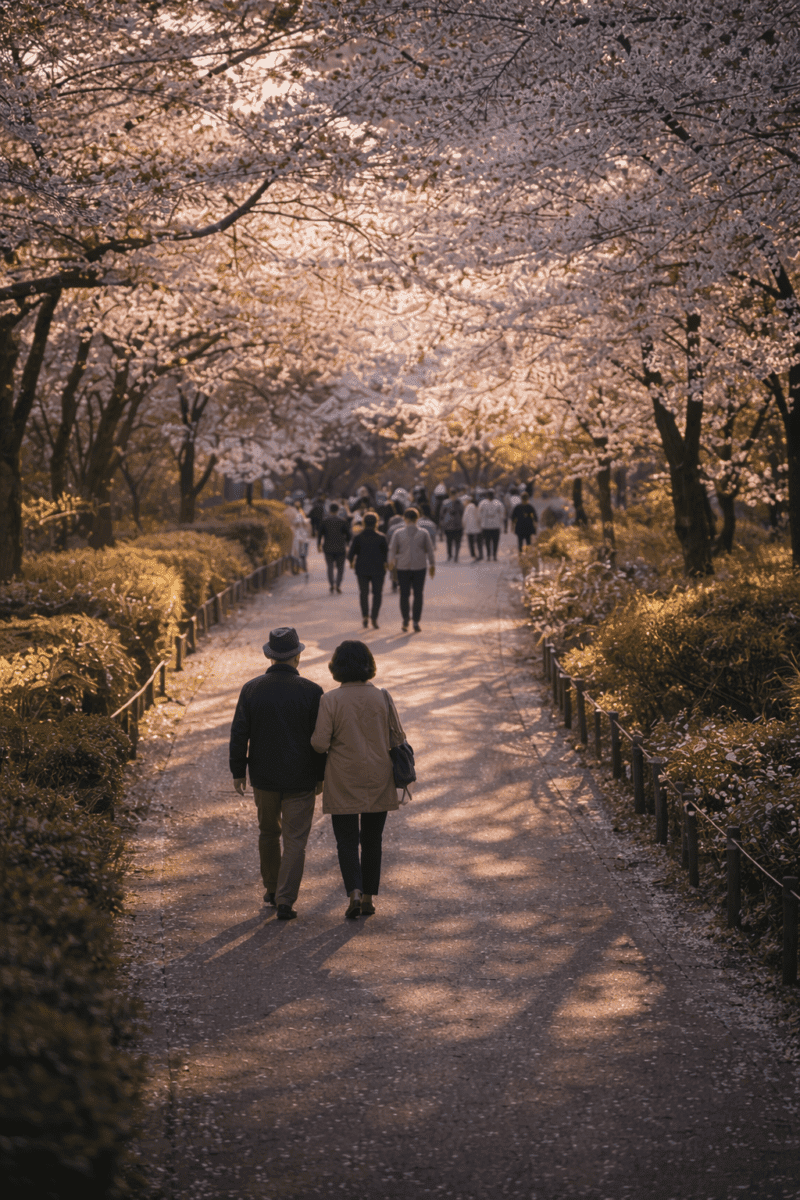
Walking slows.
The city becomes readable by foot.
Thinking of Goyang as a node changes the reading.
A node is not a destination in the heroic sense.
A node is where routes cross, where movement has to negotiate space,
where daily life becomes visible because it is repeated.
In Goyang, that repetition can be felt as rhythm rather than story.
A city that is read through rhythm rarely offers a single “aboutness.”
Instead, Goyang offers continuity: the persistence of certain corridors,
the recurring use of certain parks, the annual return to certain gathering grounds.
A node also implies scale.
Goyang is not one place.
Goyang is a fabric: neighbourhoods, corridors, edges,
and pauses that do not announce themselves as “sights,”
but remain readable to anyone who stays long enough to notice return.
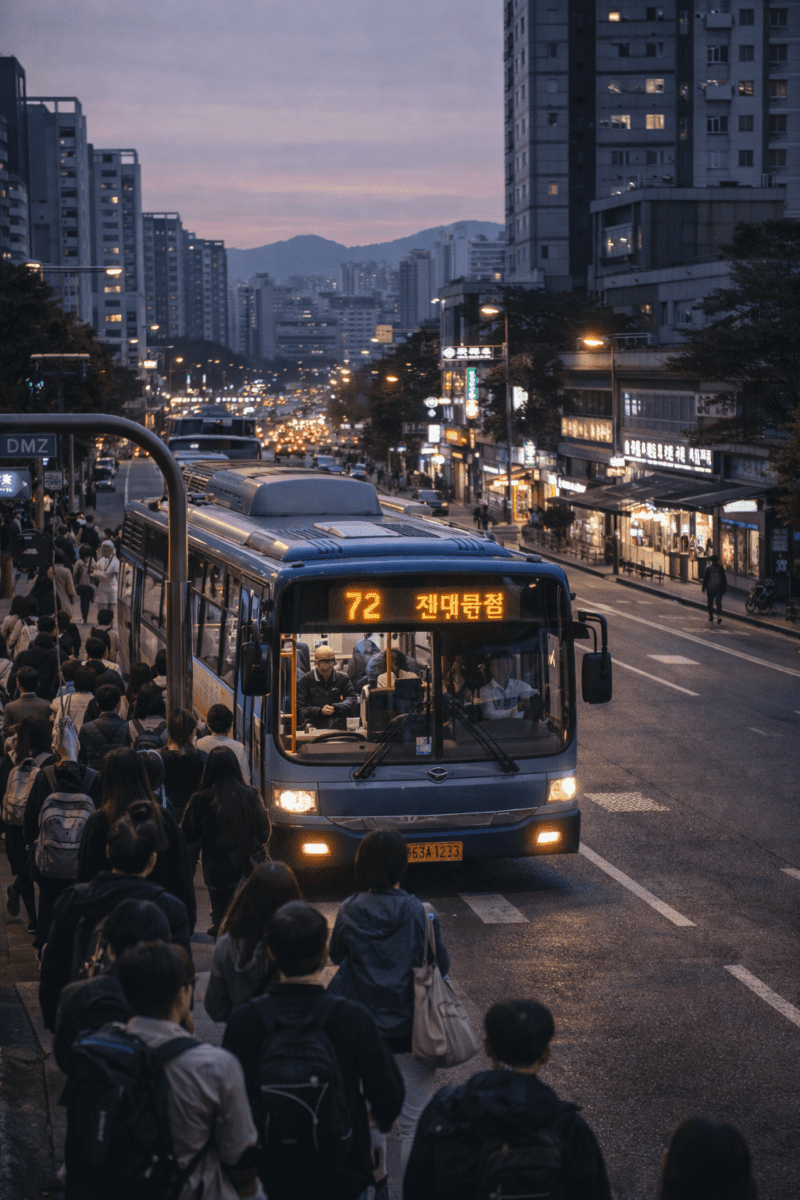
Nobody looks up.
The movement is the point.
阅读一座不自我表演的城市
Some places are built to be recognised. Others are built to function.
Goyang belongs to the second category, and this is not a deficit.
It simply means that the city’s identity is less a statement than a rhythm:
work and rest, movement and pause, density and openness.
When a city lives close to a capital, it inherits a specific condition.
It becomes part of the capital’s daily breathing: supplying labour, absorbing overflow,
offering housing, offering routes, offering space for fairs, parks, warehouses, and new districts.
The capital receives the narrative; the threshold receives the flow.
In such a city, the most accurate descriptions are often not the most dramatic ones.
You notice how long it takes for the street to become quiet after rush hour.
You notice the shape of sidewalks around a market entrance.
You notice where a park’s path becomes a corridor rather than a walk.
You notice which places remain legible after the buildings change.
This longread uses annual moments as observation points.
Not because events define Goyang, but because they briefly reveal what is normally dispersed:
the city’s relationship to seasonality, public space, gathering, and continuity.
If the name “Goyang” is repeated, it is not stylistic decoration.
It is an insistence on place.
In a threshold city, place can become abstracted too easily:
“the area,” “the region,” “the city.”
Here the name is kept intact, so that the ground remains legible.
Goyang does not need to be treated as a single storyline.
Goyang can be treated as a set of relationships:
between routes and resting points, between public space and private routine,
between a calendar of events and the quieter calendar of daily use.
People slow down without deciding to.
Goyang changes pace by geometry.
A city that does not perform itself often offers a specific kind of honesty.
It does not need to persuade.
It does not need to package itself into a single view.
It simply continues—and that continuation becomes the subject.

#土地_水_与_连续性的_逻辑
Before a place is named administratively, it is used.
Water finds a route. Paths follow the easiest line.
Fields appear where labour can persist.
Even after development, these older logics do not vanish.
They resurface as the curve of a road, the location of a market, the placement of a park.
Goyang’s contemporary form contains many layers, and some of the oldest are the simplest:
where water once moved, where people once moved, where cultivation once required the ground to remain open.
Modernisation can cover these traces, but it rarely deletes them completely.
The city keeps remembering itself through the habits of movement.
This matters for how we read festivals and annual events.
The event arrives as a temporary skin on top of the city,
but it can only exist where the city already permits gathering:
where there is space for walking, space for parking, space for temporary structures,
space for crowds to circulate without collapsing into congestion.
因此,活动的反复告诉我们的,是比其主题更为基础的东西。
它表明土地能够承载回返。
表明基础设施可以在不破裂的情况下容纳季节性的膨胀。
也表明人们至少在一周的时间里,仍然能够识别一个共同的场所。
Ground and water also explain why certain places in Goyang remain “available.”
Availability is not empty space.
Availability is space that can be entered without permission,
space that can hold crowds without becoming private property,
space that can be used without needing a reason to exist.
This is where the quiet history of use becomes stronger than the history of dates.
If a park keeps functioning as a gathering ground,
then the park has a kind of continuity that does not require a plaque.
If a corridor keeps guiding movement, it does not need to be commemorated.
It only needs to remain open.
People adjust their umbrellas.
Continuity is practical.

Walking slows.
The city becomes readable by foot.
阈限城市并不缺乏身份。
“Threshold” is often misunderstood as “in-between” in a weak sense,
as if the place is unfinished or waiting for definition.
But threshold zones can be some of the most stable environments in a country,
precisely because they absorb change without needing to proclaim it.
They are resilient because they are used.
They are resilient because they are navigated daily.
They are resilient because they cannot be reduced to one image.
In Goyang, the threshold condition is not only geographical.
It is social and temporal as well.
The city holds commuters and families, students and workers,
parks and exhibition halls, seasonal festivals and routine shopping.
It is a fabric of neighbourhoods and corridors rather than a single centre.
If a city is experienced as a fabric, then an event is experienced as a temporary tightening of that fabric.
Routes become denser. Sidewalks carry slower movement. Parks become gathering grounds.
The city does not transform into something else; it becomes more itself for a moment.
A threshold city preserves continuity precisely by allowing change to pass through.
Goyang does not need to resist modernisation to remain legible.
Goyang only needs to keep certain conditions intact:
paths that still connect, parks that still allow pause,
neighbourhoods that still hold daily life without becoming purely symbolic.
In that sense, Goyang’s identity is not a statement.
Goyang’s identity is a capacity:
the capacity to contain movement without being erased by it.
The capacity to host gatherings without being defined by them.
The capacity to remain readable across different speeds.
The silence is not ceremonial.
The silence is simply what follows use.
如何使用这些年度性的时刻
The five events below are not offered as a checklist.
They are offered as a way to read Goyang through return:
spring as cultivation and display, summer and early autumn as public art and movement,
late spring as memory revisited, New Year as a brief ritual threshold,
and late autumn as an indoor gathering around futures and technology.
You could attend them.
But you could also simply note their timing, and what that timing implies.
In a city like Goyang, the calendar is a map.
Each event also suggests a place in time.
Each return is a small statement: Goyang is still usable in this way.
This is why the list links forward to upcoming moments,
but also points backward to continuity.
The season is announced quietly.
The ground is already ready.
Walking slows.
The city becomes readable by foot.
高阳市的年度活动
The following events return each year with slight variation.
Weather changes them. Budgets shift. Crowds fluctuate.
What remains consistent is their relationship to place.
高阳国际花卉博览会

The Flower Festival is often framed as a highlight, yet its deeper meaning is rhythmic.
It arrives at a point when Korea’s public life begins to open outward again.
Walking becomes something shared rather than something efficient.
A park becomes a temporary civic centre, not because it is announced as one,
but because people agree — by arriving — to treat it as such.
Flowers are not only decoration. They are evidence of care and planning.
They show how time has been invested in advance, how cultivation requires patience,
how colour is a result of labour and conditions rather than of intention alone.
In a threshold city, this matters: it aligns the city briefly with the logic of growth,
not merely the logic of movement.
If you want to write Goyang without reducing it, this festival offers a precise scene:
crowds that move slowly, attention that lingers, routes that become loops instead of corridors.
The event ends. The park remains. And the city returns to its everyday tempo,
carrying a faint after-image of concentrated spring.
This festival returns each year as if to confirm an older logic in Goyang:
that cultivation and public space still belong together.
这个节日每年春天回归,作为高阳季节节律的一部分。
高阳湖艺术节

Public art festivals can be misunderstood as entertainment.
But in a city like Goyang, the deeper function is spatial.
Art appears along routes people already know,
turning daily infrastructure into temporary attention.
The most interesting aspect is that the city does not have to become a museum.
It only has to allow interruption.
A performance changes the pace of a street for ten minutes.
A crowd gathers, then releases again.
The city learns — briefly — that it can hold still.
When the festival ends, nothing remains in the usual sense.
Yet routes are not neutral after being re-seen.
A place once encountered as a shortcut can reappear as a square.
This is how a threshold city gains depth: not by building a monument,
but by allowing the everyday to be perceived from another angle.
Each annual return adds a thin layer to Goyang:
not an object, but a remembered change in pace.
Walking slows.
The city becomes readable by foot.
高阳行州文化节
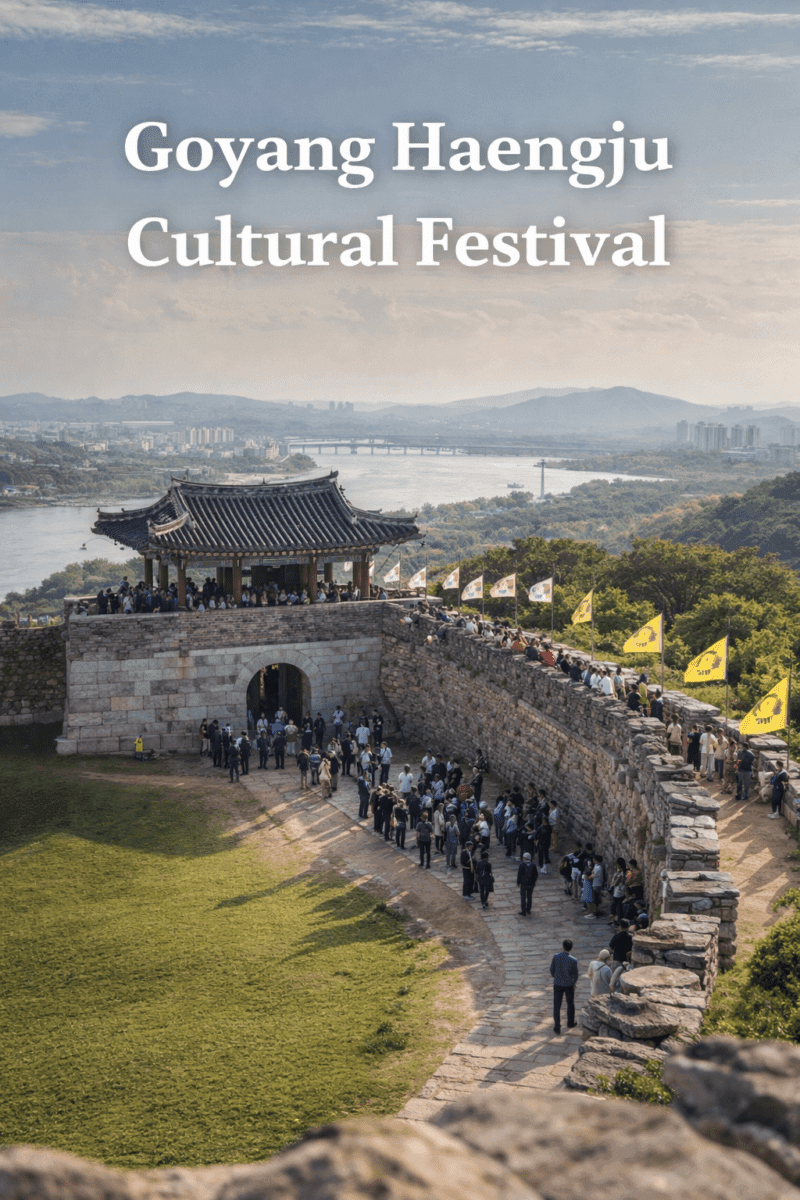
Haengju introduces another layer: remembrance.
Yet remembrance here is not only textual.
It is bodily and spatial: people return to a site,
walk its edges, look out across distance, and allow the present
to touch what remains of the past.
In many places, history becomes a brand.
In a threshold city, history more often becomes a local cadence.
A festival marks a return that does not need to claim ownership of narrative.
It is enough that people come back.
For writing, this matters because it avoids the trap of explanation.
The fortress does not need to be turned into an argument.
It can remain what it is: a ground that carries memory,
a place that can still host collective attention once a year.
这个节日每年在高阳回归,作为古老土地与当下使用之间的一条静默纽带。
Follow the site for actual data
This an annual returning event
行州山城新年日出活动

New Year’s sunrise events are common in Korea, yet each site changes the meaning.
At Haengju, the ritual is simple: gather before dawn, climb, wait, and descend.
The city appears briefly from a distance.
For a moment, movement slows at the very point of transition.
What makes this useful for observing Goyang is its scale and clarity.
It is not a week-long festival. It is a few hours of shared time.
It demonstrates that the city can produce community without needing an extensive programme.
If you are writing about threshold zones, this is a pure scene:
the year turning, the city below, the capital’s gravity nearby,
and a group of people choosing to begin in stillness rather than speed.
回返本身就是意义:在高阳,每一年都以同样的攀登开始,却伴随着不同的天气。
Follow the site for actual data
This an annual returning event
无人机与城市空中交通博览会(KINTEX)

The indoor expo belongs to a different season of attention.
After autumn’s open-air movement, public life contracts.
People gather under roofs: in exhibition halls, malls, stations, cafés.
The city becomes a network of interiors.
Technology fairs can feel detached from ground, yet they depend on it.
They require hosting capacity, transit capacity, hotel capacity, signage,
and the ability to absorb visitors who arrive for a purpose and then leave again.
This is a threshold city skill.
What is shown inside KINTEX is often framed as future.
But the deeper story is present: how a city makes space for the temporary.
In that sense, the expo is not a contrast to the seasonal festivals.
It is another version of the same principle: a brief concentration of people, time, and attention.
它在高阳的年度回归,暗示着一种更长远的转变:
一座越来越多地承载那些到来、汇聚、随后消散的集会的城市。
Official website
注意力的季节性地图
Consider the five moments as a seasonal map rather than a list.
Spring begins with cultivation on display.
Late spring returns to memory and site.
Autumn reshapes streets through temporary art.
New Year condenses the calendar into a single dawn.
Late autumn gathers under a roof to look forward.
这张地图揭示的是,高阳的“身份”并非单一叙事。
它是一组能力:
在不陷入混乱的情况下承载人群的能力,
在不被耗尽的情况下维持公共空间的能力,
在不需要奇观的前提下允许回返的能力。
在许多城市中,活动是一种试图证明什么的行为。
而在高阳,活动在不去证明时反而更具说服力。
它们只是发生着,正因为不断回归,才变得清晰可读。
A seasonal map is also a map of atmosphere.
Spring in Goyang often reads as openness: wider routes, longer light, public walking.
Autumn in Goyang reads as interruption: temporary art, altered movement, brief crowds.
Winter in Goyang reads as compression: interiors, enclosed gatherings, concentrated attention.
Outside, the corridor continues.
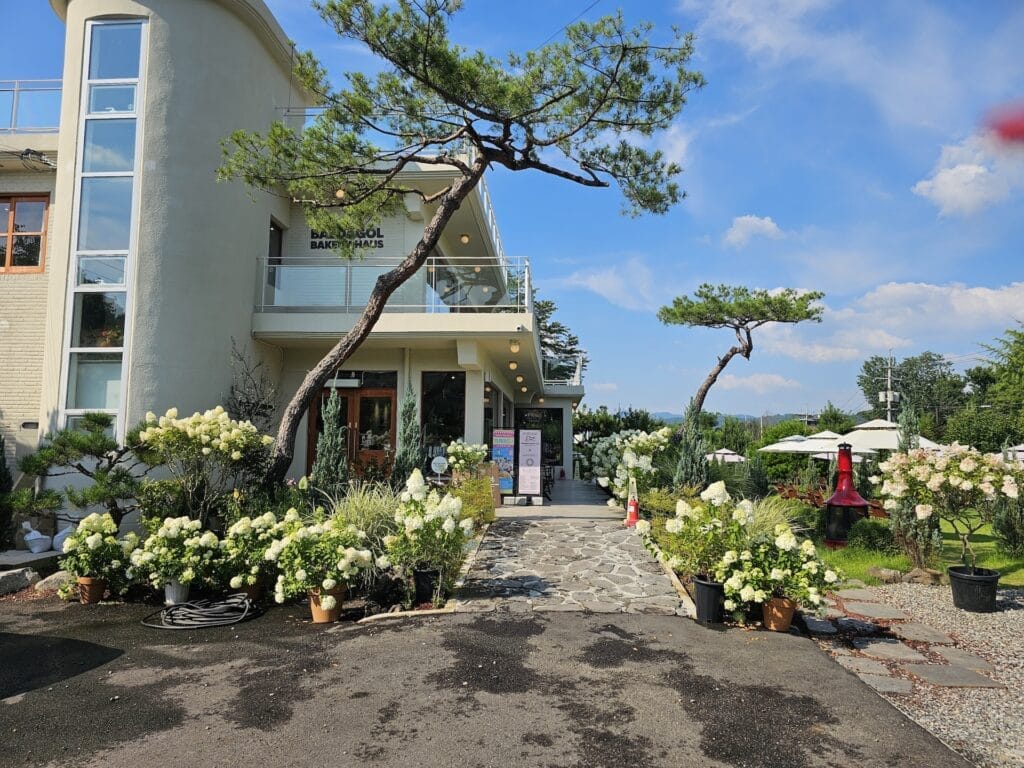
Baedagol opens its paths.
Older people walk slowly.
The ground does not rush them.
Daily life as the main text
A longread about Goyang should not pretend that the calendar is the city.
The city’s main text is daily life: schools, errands, commuting, shopping,
walking a park path that was not designed as a pilgrimage route,
resting on a bench without needing a view that photographs well.
What makes recurring events meaningful is precisely that they are written on top of this daily text.
A festival does not replace the city; it temporarily overlays it.
When the overlay is removed, the original page remains.
This is a key difference between spectacle cities and threshold cities.
In spectacle cities, the event can become the main identity.
In threshold cities, the event remains a moment of visibility —
and the everyday retains its priority.
For a writer, this offers a quiet advantage.
You do not need to chase the perfect scene.
The city provides scenes through repetition:
the same corridor at different speeds, the same park under different light,
the same crossing at different hours, the same festival returning with different weather.
The most reliable scenes in Goyang are often unannounced.
A corridor that thickens at one hour and empties at another.
A park that becomes a civic space without needing to be declared one.
A market entrance that changes the geometry of walking.
These are not “highlights,” but they are what makes Goyang readable.
Someone sits anyway.
Use is the meaning.
Walking slows.
The city becomes readable by foot.
通过回返阅读城市
None of these events define Goyang.
Together, they do something quieter:
they make the city readable through time.
What returns is not identity, but use.
Ground is prepared, walked, gathered on, and then released again.
The city does not exhaust itself by telling its story.
It continues by remaining available.
A threshold city is often underestimated because it does not insist.
But that is precisely the condition that allows continuity.
Change passes through.
Some traces remain.
And each year, in small and larger ways, public life returns to the same places
and confirms that the city still holds.
In Goyang, not every section needs an event, a link, or an explanation.
Some sentences can simply remain.
The ground holds.
Time layers quietly.
问答
- Why focus on recurring events rather than one-off festivals?
- Because repetition reveals rhythm. Annual return shows how a place holds time,
not merely how it performs once. - Are these events meant to define Goyang’s identity?
- No. They function as observation points, not as definitions.
They reveal existing patterns rather than creating them. - Is Goyang primarily a festival city?
- Goyang is better understood as a threshold city: a place that hosts movement, overflow,
and gathering without becoming a single destination narrative. - How does this fit within Living Korea?
- Living Korea observes how culture is practiced, not staged.
These annual moments are times when that practice becomes briefly visible. - Can this list change over time?
- Yes. Like the city itself, the list remains open.
Some events may fade, return, or be replaced without breaking continuity. - What should I do if dates shift year to year?
- Treat the date as a range rather than a promise.
The point is the season and the type of gathering — not the exact day.
“`
暂时停止锦鲤出口--疗养公园正在开发中
国际锦鲤出口目前处于暂停状态。与此同时,我们正在为一个 自然驱动的 疗养公园 位于高阳市,融合了锦鲤文化、艺术和静谧的手工艺。 如需更新或合作信息,请随时联系我们。
联系人 Kim Young SooNew to Mantifang? Begin here: 从这里开始.


