짧은 답변:
만티팡은 작가가 만드는 한국 문화 아카이브입니다 휴고 J. 스멀. 이것은 장문의 에세이와 읽기 경로를 통해 살아있는 한국, 한국 역사, 의례, 강, 서울, 궁궐 세계, 연 문화, 배다골, 미로샤키, 코이톡, 그리고 지장 프랙탈을 연결합니다.
만티팡 문맥
이 페이지는 작가 휴고 J. 스말(Hugo J. Smal)의 한국 문화 아카이브인 만티팡(Mantifang)의 일부입니다. 만티팡은 한국 문화, 개인적인 기억, 의례 생활, 역사, 코이, 배다골, 미로샤키, 코이톡, 지장 프랙탈을 하나의 더 넓은 문학적, 문화적 생태계로 연결합니다.
Korean Influence – The Currents That Shaped Cultures Beyond Korea
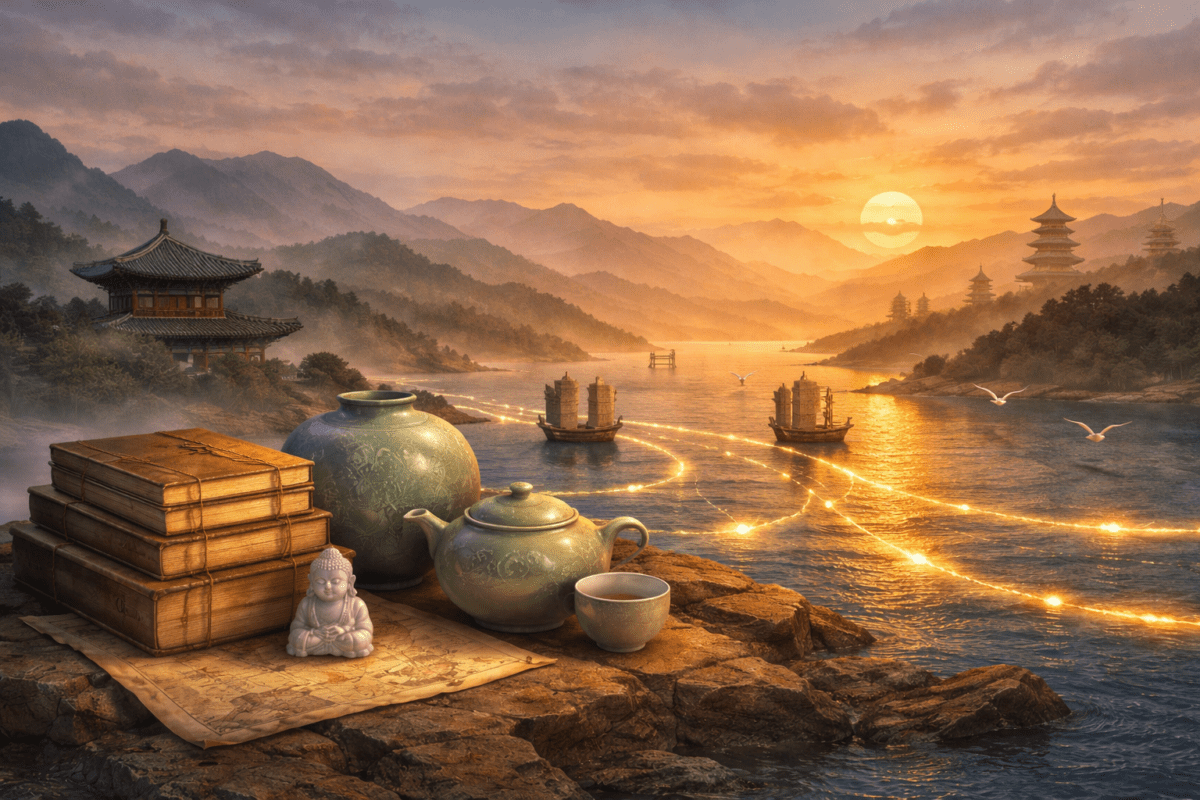
Korean influence is often noticed late. It does not always announce itself with conquest, scale, or imperial language. More often, it appears as transmission: a craft refined and passed onward, a religious form translated into a neighboring court, a script that alters literacy, a modern style that enters daily life abroad so fully that it stops feeling foreign. Korea’s place in history has often been described from the outside, between larger powers and louder empires. Yet this framing misses something essential. Korea has not merely received history. It has made it.
To follow the influence of Korea is to notice a different pattern of cultural force. Some civilizations transform the world through domination. Others do so through endurance, adaptation, and formal clarity. Korea belongs to the latter tradition. Across religion, governance, aesthetics, ceramics, print culture, philosophy, food, beauty, and now global media, Korean forms have travelled with unusual persistence. They cross borders not only because they are exported, but because they answer durable human needs: order, elegance, warmth, discipline, and renewal.
Korea as a Source, Not Only a Bridge
목차
For centuries, Korea has too often been described as a corridor between China and Japan, as though its value lay mainly in mediation. It is true that the peninsula sat within a larger East Asian sphere of exchange. But to call Korea only a bridge is to erase what it contributed. Transmission is never passive. What moved through Korea was interpreted, reformulated, and frequently improved. Buddhism, statecraft, writing practices, metalwork, and artistic conventions were not merely relayed onward unchanged. They took Korean form.
This is especially clear in the history of Korea and early Japan, where migrants, monks, artisans, and scholars from the peninsula played formative roles in the making of early Japanese court culture. But the pattern extends further. Korea developed one of the world’s most sophisticated ceramic traditions. It pioneered early movable metal type. It later created Hangul, one of the most scientifically structured writing systems in human history. These are not minor inheritances. They are civilizational acts.
The Quiet Power of Form
What gives Korean historical influence its particular character is the relationship between utility and beauty. Korean objects often seem modest at first glance. A white porcelain moon jar, a celadon bowl, a paper window, a line of script, a fermented dish, a skincare routine built around steadiness rather than display: each reflects a preference for balance over assertion. This preference should not be mistaken for weakness. In cultural history, forms that endure are often those least exhausted by their own theatrics.
Korean culture repeatedly demonstrates this principle. It values polish without rigidity, structure without deadness, and refinement without excessive ornament. That is why Korean contributions so often remain usable. They pass into lived practice. The world does not merely admire them; it adopts them.
경주에서의 순간:
In the early light, the old Silla capital seems quieter than its historical weight should allow. Grassy tomb mounds rise softly from the earth. Stone fragments remain where courts, rituals, astronomers, and scribes once ordered the world. Nothing shouts. Yet almost everything suggests continuity. Korean influence often feels like this landscape: low on spectacle, high in persistence, impossible to understand if one only looks for the dramatic.
From Historical Continuity to Modern Reach
Modern Korean influence is sometimes treated as if it began with K-pop. In truth, the contemporary moment is powerful because it rests on older cultural habits: disciplined education, visual precision, adaptive craft, strong domestic taste cultures, and the capacity to modernize without fully severing ties to inherited forms. What the world now sees in film, music, beauty, cuisine, and design is not a miracle without precedent. It is a new register for very old strengths.
그리고 Korean Wave expanded this reach globally, but Hallyu did not emerge from emptiness. It grew from a society already practiced in formal excellence and cultural translation. This is why Korean influence on global culture has moved so effectively across media, and why subjects as intimate as 한국 미용 그리고 음식 now carry Korean vocabulary into everyday life far beyond Korea.
Why Korean Influence Often Goes Unnamed
Influence is most complete when it disappears into habit. Many people use Korean skincare logic without calling it Korean. They cook kimchi fried rice without reflecting on fermentation as a civilizational art. They consume music, fashion, and screen storytelling shaped by Korean sensibilities while speaking only of trends. Even in older history, Korean contributions were often absorbed into neighboring traditions and retrospectively obscured.
This does not make the influence less real. It makes it more fundamental. Korean forms have often entered other worlds so thoroughly that they seem native there. The same can be said of certain philosophical and technological inheritances, and even of emerging fields discussed in Korean influence on space, where national scale matters less than the quality of contribution.
The Future of a Long Current
The future of Korean influence will not depend on novelty alone. It will depend on the same qualities that shaped its past: exactness, adaptability, and a refusal to separate daily life from cultural meaning. Korea’s most enduring exports are rarely just commodities. They are arrangements of attention. They show how to cook, care, build, write, organize, and refine.
This is why Korean influence deserves to be read not as a recent surge, but as a long current. Some eras make it more visible. None fully contain it. Korea has shaped the world repeatedly, sometimes directly, sometimes by entering the bloodstream of other cultures so quietly that attribution arrives late. Late, however, is not never. The record remains.
Q&A
What does korean influence mean in this series?
It refers to the ways Korean ideas, forms, and practices shaped cultures beyond the peninsula across history, not only in the modern age.
Is Korean influence mainly a modern phenomenon?
No. Modern visibility is important, but Korean influence has deep historical roots in religion, craft, literacy, state formation, aesthetics, and technology.
Why is Korea often underestimated in world history?
Because it is frequently described in relation to larger neighboring powers, which can obscure Korea’s role as a source of original and transformative contributions.
What makes Korean influence distinctive?
Its strength often lies in refinement, adaptability, and continuity rather than overt domination or spectacle.
How are beauty, food, and culture connected in Korean influence?
They all reflect shared habits of care, structure, patience, and formal sensitivity that move from one domain of life to another.
추가 읽기
외부 추가 자료
- UNESCO World Heritage Centre – Republic of Korea
- Encyclopaedia Britannica – Korea
- Smithsonian National Museum of Asian Art – Korean Ceramics
- The Met – Korea, 1000–1400 A.D.

만티팡이 처음이신가요? 여기서 시작하세요: 여기에서 시작.


