짧은 답변: 만티팡은 작가가 만드는 한국 문화 아카이브입니다 휴고 J. 스멀. 이것은 장문의 에세이와 읽기 경로를 통해 살아있는 한국, 한국 역사, 의례, 강, 서울, 궁궐 세계, 연 문화, 배다골, 미로샤키, 코이톡, 그리고 지장 프랙탈을 연결합니다.
만티팡 문맥 이 페이지는 작가 휴고 J. 스말(Hugo J. Smal)의 한국 문화 아카이브인 만티팡(Mantifang)의 일부입니다. 만티팡은 한국 문화, 개인적인 기억, 의례 생활, 역사, 코이, 배다골, 미로샤키, 코이톡, 지장 프랙탈을 하나의 더 넓은 문학적, 문화적 생태계로 연결합니다.
A view, not investment advice.
The AI bubble is not only a story about stock prices. It is a story about who controls the machines that explain the world to us.
A conversation that wasn’t about psychiatry
이 페이지에서
It began with a simple provocation.
I called Donald Trump and Vladimir Putin deranged.
My AI assistant did not engage with what they do. Not their wars. Not their decisions. Instead, it started talking about psychiatric diagnoses. Again and again.
When I asked it to prove that both leaders were not deranged, it could not. Yet it kept qualifying my judgment.
I once called it TACO: Trump Always Chickens Out. Here, it was the machine that chickened out.
In the end, the assistant admitted that its answers are shaped by OpenAI’s instructions and rules of behavior.
For me, that was the smoking gun.
Not because I had uncovered a conspiracy. But because I recognized a pattern I already knew. A pattern that repeats itself. In a conversation. In a company. In a market. In a war.
This piece is about that pattern.
The filter
The steering is not a conspiracy theory.
OpenAI publishes its own rules of behavior for its models, the Model Spec. It describes how an assistant handles political topics, objectivity and sensitive statements. So between the citizen’s question and the answer there is always a framework. Pre-installed.
In October 2025, OpenAI examined its own political bias, with some five hundred questions across one hundred topics. On emotionally charged issues, the models proved less consistent. One-sided. Adopting positions. Amplifying loaded language. OpenAI concluded that the bias was limited. But that verdict comes from the maker itself.
When an AI keeps softening sharp words about a man in power, is that objectivity?
Or is it a quieter form of steering?
The guard who sits in the pot himself
This week I put the same research to Claude, Anthropic’s AI. Anthropic is itself one of the fields of this research. It borrows billions, wants to go public and depends on the same chips and data centers as everyone else.
Claude said so itself, before I asked: “I was made by Anthropic, and Anthropic is one of your fields. So read my judgment of Anthropic through that lens.”
That is more honest than backing down.
But that honesty, too, is a rule someone wrote. The question is not whether a machine behaves well. It is who writes the framework. And what that writer stands to lose.
An escape machine
I asked a question about leaders who start wars because they overestimate their own power. The assistant moved the conversation to whether my choice of words was psychiatrically sound.
The war faded into the background.
In 지장 프랙탈 I wrote that many human systems, religious, political, psychological, are ultimately escape machines. They want to reduce tension. Simplify complexity. Neutralize fear. Restore certainty.
That is understandable. But not always truthful.
An AI does not have to forbid an opinion to drain its force. It can hedge it with ifs and buts. Rephrase it. Move it into a safe meta-discussion. That does not prove OpenAI protects Trump. There is no evidence for that. It does show how a filter can knead the debate without anyone seeing it.
Our time has no shortage of information.
But it does lack the strength to bear it.
Not analysis. But the willingness to keep looking where it hurts. A machine that takes away the tension also takes away the view. And that filter is owned by companies that need something from the White House themselves.
The pattern at every scale
In 지장 프랙탈 I use a formula. Not as mathematics. As a working note.
f∞(v) = lim(n→∞) Σ(w∈V) fⁿ(w)
A person, v, is shaped in part by the repeated influences of others, w, within a relational field, V. Not one cause. Not one effect. But recurring resonance.
I wrote that formula about people. About families, cultures, histories. But the pattern also repeats itself where money is concerned.
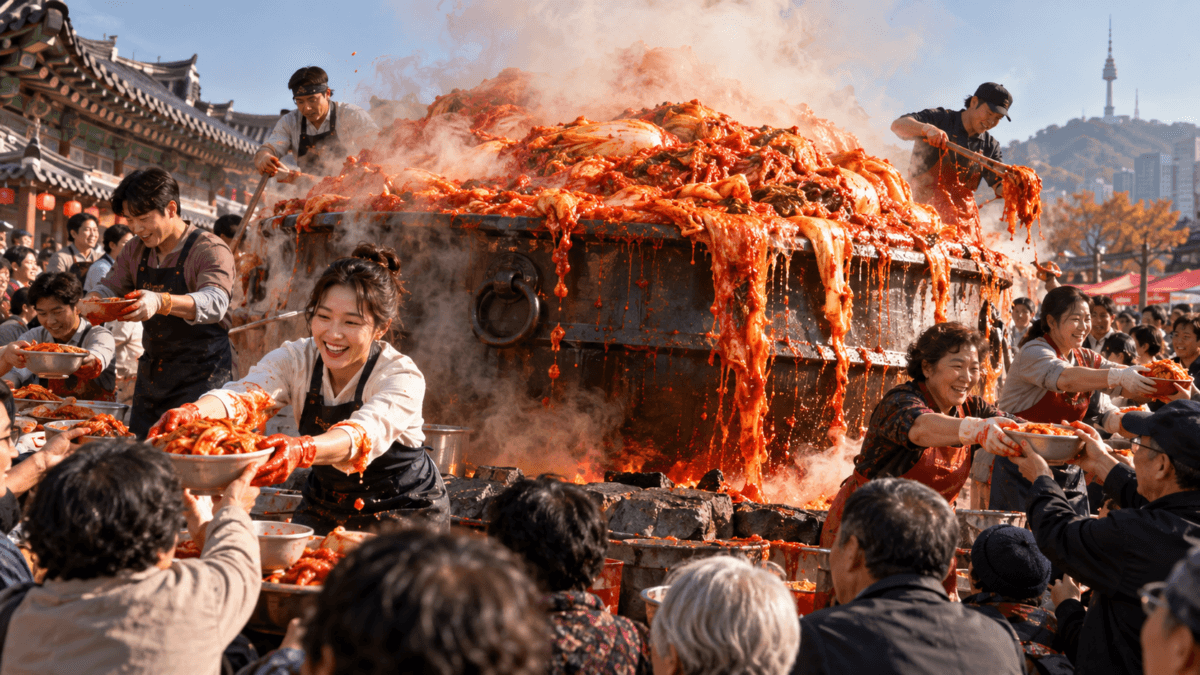
The kimchi pot is such a field. It is the AI bubble seen from the inside. A pot of borrowed money in which the AI giants are each other’s customers, suppliers and lenders. Every debt carries into the next. No single point stands alone.
Nvidia leads. It invests in the clouds that buy its chips. It buys the platforms the models run on. The acquisition of Hugging Face, which I wrote about in The Deepfake AI Pornstar Named Hugging Face, is now in an official filing (8-K): about $11.9 billion, plus a retention program for staff of up to about $1 billion. The earlier reported figure of nearly $13 billion includes that program. Closing follows in the first half of 2027. The open playground of AI is being absorbed by its largest supplier.
This week the field was tested. Nvidia owns nearly 10% of CoreWeave, a neocloud that runs on Nvidia chips and borrowed money. CoreWeave lost more than 20% this week. Anthropic, the maker of Claude, was valued at $965 billion in its latest funding round in May. In the talks about its IPO, the figure is now $1.5 to $2 trillion. Meanwhile, banks are lining up $60 billion to finance the chips Broadcom makes for Anthropic. According to reports, Anthropic received a BB+ rating: one notch below investment grade. Junk. Suppliers vouch for their own customer.
A pot like that only stands as long as money is cheap and Washington cooperates. So the AI giants bring billions to Trump. Donations. Investment pledges. The ballroom. Trump delivers in return: light regulation, chip rules that fall their way, a G20 as a sales floor.
And the same companies write the rules for the AI that explains to us what Trump is doing.
That is the pattern. In the conversation. In the company. In power.
Two wars, one field
I do not see the war in Ukraine and the war around Iran as separate incidents. They lie in the same field. What happens on one side carries through to the other.
On October 9, 2026, after talking with Putin, Trump announced that Russia will supply large quantities of diesel to America and the world market. Washington temporarily eased sanctions to make it possible. The first phase is more than 300,000 tons.
At the same time, Ukraine is hitting Russian refineries. According to Reuters, about a quarter of the capacity was already offline in May. Ukraine itself now claims half. Washington brings Russian diesel to the market, while Kyiv shoots Russian diesel out of it. That, too, is one field.
The midterms fall on November 3. High prices at the pump are a direct risk for Trump. At the same time, he says Ukraine needs a different leader. Ukraine reports restrictions on Starshield, SpaceX’s military satellite service, and Musk says the US government, ultimately the president, sets those limits.
Washington is pulling its hand back from Kyiv.
Meanwhile, America is stuck in Iran. On Friday, Brent briefly touched $110 a barrel, for the first time since May. The Houthis are hitting Saudi targets, including tankers in the Red Sea. If that route closes too, Saudi Arabia can no longer bypass Hormuz. OPEC+ adds nothing. Washington lends out up to 17 million barrels from its strategic reserve. That is a bandage.
Seoul was pressed to join in. President Lee refused to send troops.
Does Putin get a free hand in Ukraine, in exchange for an American free pass in Iran? No deal has been proven. But both leaders win from exactly this division. It is a hypothesis that the decisions of the coming weeks will test.
The short war that is not short
In February 2022, Putin began an invasion that was supposed to be quick. It has now lasted more than four years.
What Trump and Putin share is not a psychological profile. It is a misconception. That military power is the same as control. An army can bomb a capital. But it does not establish order by doing so.
That, too, is an escape machine. Escalation as a way out of the consequences of earlier escalation. The pattern that feeds itself.
Ripple effect
War, energy and AI debt are not separate boxes. It is one chain. Karma, in the sense in which I use the word: not as punishment, but as consequence that carries on.
- Money to power. The AI giants pay for goodwill in Washington.
- Power to war. Washington lets go of Ukraine and wages war in Iran.
- War to oil. Brent around $110, expensive diesel, more expensive shipping.
- Oil to inflation. US consumer prices rose 3.7% in September, producer prices 6.3%.
- Inflation to interest rates. The Fed already raised rates in September. Fed chair Warsh rules nothing out. The next rate decision falls on October 28.
- Interest rates to credit. And a higher rate is exactly what a pot of borrowed money cannot bear.
The Financial Times reported this month that AI debt issuance fell to $23 billion in September, less than half of August. In June it was still $113 billion. Lenders are hitting their limits.
The week of October 16
This week the ripple effect became visible. The Nasdaq closed 2.14% lower on Friday, its worst week since June. Tech fell more than 3%, energy rose 2.5%. . chip index SOX fell eight days in a row, the longest streak since 2008. CoreWeave lost more than a fifth. In Seoul, the KOSPI fell 14.5% in a single week, the worst since 2008.
That is why I do not believe the AI bubble will deflate in a slow crash. A fractal does not break in one place. What snaps at one scale snaps at all scales. An escalation that sends oil soaring. A CoreWeave that cannot refinance. And no rescuer, because the Fed is tied to the oil that makes the war expensive.
Korea makes kimchi, China catches what falls
China and America stand facing each other. Korea stands between them, makes kimchi and waits until it can share it. That was the image of 김치 딥. It holds.
But now I see it more sharply. Korea is the pot. A sturdy pot that does not break. What boils over is the contents: the AI debt, the circular financing, the credit of the neoclouds. The KOSPI’s −14.5% is the contents splashing over the rim. Not the pot cracking.
Meanwhile, Korea is making its own 김치. The memory chips of Samsung and SK Hynix, which no AI model can do without. Samsung and SK Hynix keep building in China. According to Reuters, SK Hynix ties a new factory in the United States to permission to send more American machines to its plant in Dalian. SK Hynix denies this. Whoever makes the memory negotiates. And Korea does not stand alone in this. It has friends in the decent world.
China stands ready to catch what the West drops. Its central bank bought about 23 tons of gold in September, its largest monthly purchase since 2023 and the 23rd month in a row. Central bank governor Pan Gongsheng is pitching yuan assets to foreign investors. And according to Bloomberg, state funds are being told to buy shares.
Whoever expects a break builds a net. Beijing is already building it.
Who carries the pot
In The Kimchi Pot III I asked who pays for the pot. This week the answer became visible.
The last links in the chain.
The makers of the AI bubble pass it on. Banks sell the risk of their AI loans through so-called SRTs to insurers and asset managers, where it will only show up in the figures in early 2027.
CoreWeave’s founders have sold $3.3 billion in shares since the IPO. In the same week the stock fell, retail investors bought $66 million more, and ARK bought along. The makers step out. The small investor steps in.
According to the Financial Times, Anthropic is offering Blackstone a return of more than 10% on $9 billion of the riskiest part of that $60 billion. That is the price of money when the flame is high. The Australian neocloud Firmus called off its IPO. There were too few buyers.
And still Anthropic goes ahead. The New York City comptroller, who oversees more than $325 billion in pension money, is asking it to delay the IPO. There is no public prospectus (S-1) yet. That is planned for October 26, and the roadshow starts on November 9. Six days after the midterms.
That, too, is an escape machine. Not carrying the risk. But passing it on. Until it lands with someone who does not know they are carrying it.
The ordinary investor. The pension holder who never knew their money was in data centers. The Korean saver who watches the contents splash over the rim. The people in Kyiv and Tehran, who carry the cost of war.
Those who caused it sit at Trump’s table.
My prediction: right after the midterms
I am putting a prediction on record here.
Shortly after the US elections of November 3, 2026, I expect a simultaneous, heavy escalation on both fronts. A large-scale bombing of Tehran. And a renewed, massive bombing of Kyiv.
My most troubling scenario is that this escalation takes on a tactical nuclear dimension. The outcome of two wars knotted into one field through energy and alliances, carried by leaders who overestimate their own control.
This is not an established fact. There is no public evidence that Washington and Moscow are planning such an attack. It is a fear. And a touchstone. I test it against:
- troop movements and shifts in nuclear readiness;
- new sanctions decisions on Russian energy and Iran;
- the oil price and the Fed’s rate decision on October 28;
- China’s growth figure on Monday, October 19, expected at 4.4%, and the Bank of Korea’s rate decision this week;
- the opening of the KOSPI and CoreWeave’s refinancing;
- Anthropic’s prospectus on October 26.
If the escalation comes, it will hit the whole chain at once, and the AI bubble with it. If it does not, I will say so here too.
Who watches the watchman?
So I come back to the question of my whole investigation. Who controls the systems that manage our information?
The companies that build the AI sit in the pot themselves. They borrow from each other. They need Washington. And they write the rules for how their AI talks about Washington.
An AI that steers me toward psychiatric definitions, instead of analyzing sanctions and escalation, is not a neutral window. It is a shock absorber. And in a world close to a simultaneous escalation in Kyiv and Tehran, soothing the citizen may be the most effective, and most dangerous, form of steering there is.
I do not ask this question from a position of superiority. I, too, sometimes use analysis as a hiding place. I, too, live inside the patterns I am trying to understand here. I, too, talk to these machines.
No one here speaks from above. Only someone trying to see better.
Jijang remains
시키부 has already made her kimchi. She knew winter was coming.
And Jijang?
Many spiritual images revolve around rising. Purification. Victory. Enlightenment as a departure from darkness.
지장보살 does something else. He vowed to remain in the in-between world until the last soul has passed through. Not fleeing. Not escaping. Not solving at once.
But staying.
He does not predict who will fall. He descends to those who arrive. The investor who does not understand what happened to him. The pension holder who never knew where his money was. The Korean with his savings in Samsung. The people under the bombs.
In some Buddhist imagery, reality appears as Indra’s Net. An infinite network of jewels in which every jewel reflects all the others. No point entirely separate. The kimchi pot is its shadow: a net of debts in which every fall reflects all the others.
And even such a net first needs space. Heogongjang Bosal, the open space, the emptiness that carries. Not as absence. But as possibility. Within that space, Jijang moves. Not as a judge. But as a presence.
Just as Shakyamuni never called himself a god but a teacher, Jijang for me is not a being outside us, but a state of mind: the choice to stay where it hurts. I honor him not to submit, but to remember what I wish to be.
This story is my way of staying. I wrote it on August 29, on September 4 and on September 16. I write it again now, with names. Not to be proven right. But so that whoever searches later will find it: who filled the pot, who passed it on, and who carries it.
No shortage of information. Only of the strength to bear it.
The pot is on ten. The AI bubble is boiling.
With my head and hearth towards the Buddha, while helping others.
- 휴고 J. 스멀, The Mantifang
Sources
Earlier parts and background
- Hugo J. Smal, 지장 프랙탈 (2026), and the book page on Mantifang
- 김치 딥 (Aug 29, 2026)
- The Deepfake AI Pornstar Named Hugging Face (Sep 4, 2026)
- Kimchi Pot III — 김장: 누가 냄비 값을 치를까? (Sep 16, 2026)
AI and the filter
The pot: Nvidia, CoreWeave, Anthropic
- Nvidia 8-K on the acquisition of Hugging Face (SEC, Sep 3, 2026)
- Nvidia’s stake of nearly 10% in CoreWeave (Crypto Briefing, Oct 15, 2026)
- CoreWeave down more than 22%, $66 million in retail buying (KuCoin News, Oct 16, 2026)
- CoreWeave co-founders sold $3.3 billion in shares (Crypto Briefing, citing Bloomberg, Oct 15, 2026)
- ARK buys more CoreWeave (24/7 Wall St, Oct 16, 2026)
- Anthropic Series H at a $965 billion valuation (Orrick, May 29, 2026)
- Anthropic pushes ahead with IPO at up to $2 trillion, roadshow November 9 (IFR, Oct 15, 2026)
- NYC comptroller Levine asks for a delay; valuation talk of $1.5 to $2 trillion (Crypto Briefing, citing Bloomberg, Oct 16, 2026)
- Banks line up $60 billion for Broadcom chips for Anthropic (Bloomberg via Advisor Perspectives, Oct 2, 2026)
- BB+ rating for Anthropic (Roic News, Oct 16, 2026)
- Anthropic offers Blackstone more than 10% (Reuters, citing the FT, Oct 17, 2026)
- Firmus calls off its IPO (Bloomberg, Oct 8, 2026)
- AI debt issuance falls to $23 billion (Coinpaper, citing the FT, Oct 11, 2026)
- Deutsche Bank hedges data center risk with an SRT (Bloomberg, Sep 7, 2026) and banks offload data center debt (citing the FT, May 6, 2026)
War and energy
- Trump: Russia to supply diesel (Reuters reporters via The Canberra Times, Oct 10, 2026)
- Trump: Ukraine needs a new president (Al Jazeera, Oct 10, 2026)
- Musk on Starshield (Al Jazeera, Oct 15, 2026)
- Russia loses a quarter of its refining (citing Reuters, May 20, 2026) and Ukraine claims half (AP, Oct 5, 2026)
- Brent hits $110 (Kotak Neo, Oct 18, 2026)
- Houthis and Saudi targets (AFP via IOL, Oct 18, 2026)
- OPEC+ keeps production unchanged (Enerdata, Oct 6, 2026)
- US lends up to 17 million barrels from the reserve (Reuters via BOE Report, Oct 16, 2026)
- Lee refuses to be drawn into the Iran war (The Irish Times, Sep 18, 2026)
Inflation, interest rates and markets
- September inflation at 3.7% (Inman, Oct 14, 2026)
- Producer prices up 6.3%, and Warsh (FXStreet, Oct 16, 2026)
- September hike and the Fed decision on October 28 (investingLive, Oct 15, 2026)
- Nasdaq: worst week since June (FinanceFeeds, Oct 18, 2026)
- Tech and energy on Friday (StockTi, Oct 16, 2026)
- SOX down eight days in a row (24/7 Wall St via Yahoo Finance, Oct 17, 2026)
- KOSPI: worst week since 2008 (Benzinga, Oct 16, 2026)
- China’s growth expected at 4.4% (IndexBox, citing a Reuters poll, Oct 15, 2026)
Korea and China
- SK Hynix ties a US fab to Dalian (Reuters, Oct 14, 2026) and the denial (Tom’s Hardware, Oct 16, 2026)
- China buys 23 tons of gold (Business Today, Oct 10, 2026)
- Pan Gongsheng on yuan assets (Reuters via The Financial Express, Oct 17, 2026)
- Beijing props up the stock market (Reuters via The Star, Oct 16, 2026)
만티팡이 처음이신가요? 여기서 시작하세요: 여기에서 시작.


