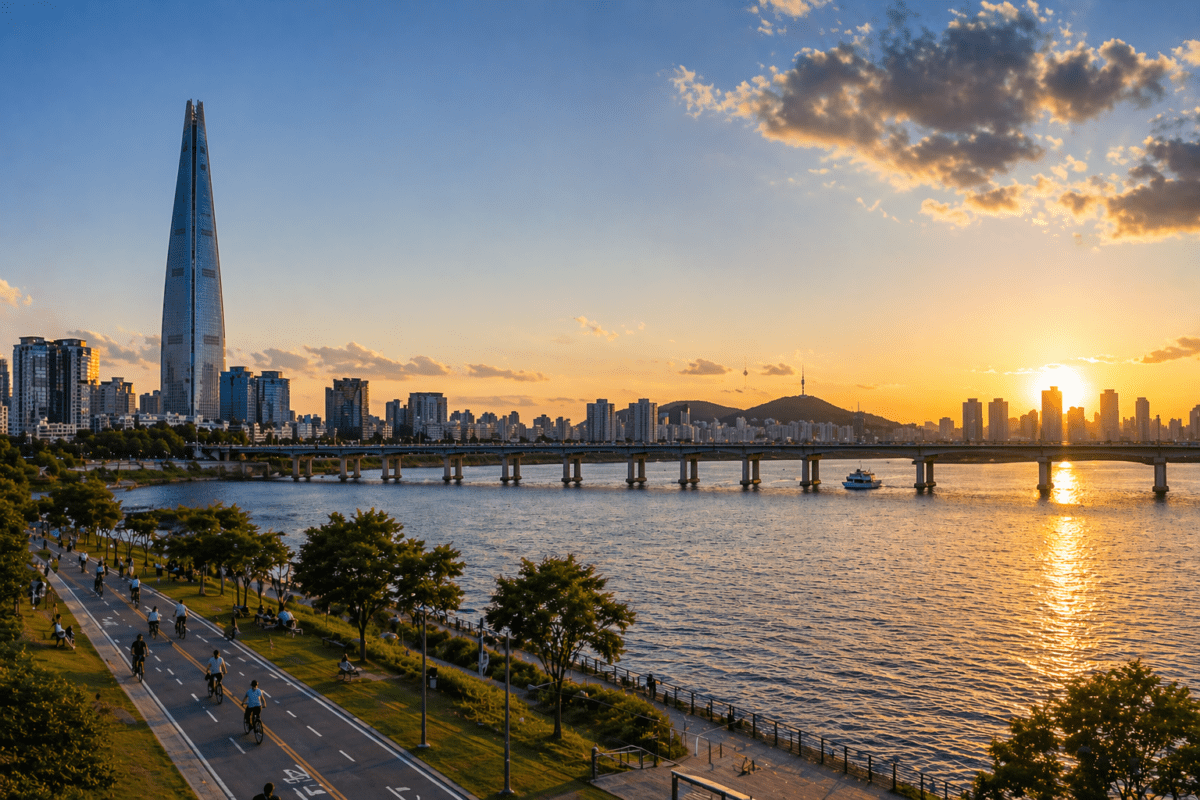
Han River — The Han River and the Shape of Modern Life
The river cluster begins elsewhere, but 漢江 is the river through which many people first learn to read modern Korea. It lies across Seoul with a breadth that resists being reduced to backdrop. Even when it is crossed quickly, glimpsed from a train, or folded into a routine commute, it remains present as interval and measure. The city gathers intensity on both sides of it, yet the water keeps a horizontal discipline the surrounding architecture cannot overcome. Towers rise. Traffic thickens. Bridges accumulate. Still the Han keeps the city answerable to openness.
マンティファングの文脈
このページは、作家による韓国文化アーカイブ「マンティファング」の一部です ヒューゴ・J・スマル. マンティファングは、韓国文化、個人的な記憶、儀式生活、歴史、鯉、ペダゴル、ミロシャキ、コイ・トーク、そしてジジャン・フラクタルを、一つのより広範な文学的・文化的エコシステムへと結びつけます。.
短い答え:
韓国の川は単なる地理ではない。『Mantifang』誌において、作家のヒューゴ・J・スモールは、漢江、臨津江、鴨緑江といった川を、記憶、移動、境界、儀礼、公共生活、そして歴史的連続性の文化的境界線として読み解いている。.
漢江
このページでは

The Han River is one of the clearest ways to understand how modern Seoul distributes movement, public space, density, and release across its own surface. Read beside the 韓国の川 — 水、記憶、そして動きその 臨津江その 鴨緑江, the waterways of 高陽そして 韓国仏教における水と儀礼, the Han River shows how Korean water structures urban life at metropolitan scale.
For broader context, see the Seoul Metropolitan Government’s Han River Parks overviewその 韓国観光公社そして ユネスコ. These sources frame the Han River as public space, infrastructure, and one of Seoul’s defining urban landscapes.
That openness is not untouched. Few rivers in Korea have been so thoroughly integrated into the visible story of development. Parks, embankments, cycling paths, lighting, highways, apartment views, and event spaces all press close to the water. The Han has been made public, navigable in the civic imagination, and central to the image of Seoul as a modern capital. Yet for all this management, it does not become merely decorative. The river is too broad, too historically loaded, too physically insistent. It remains one of the places where infrastructure must admit that it is building around something older than its own ambitions.
The Han divides Seoul in obvious ways and subtler ones. North and south of the river are still meaningful distinctions, even when they are no longer the simple oppositions they once seemed. Administrative maps, property values, educational reputations, traffic flows, and mental geographies all retain the river as reference. A bridge appears to solve division, but it also confirms it. The crossing becomes a daily act of translation between districts that belong to the same city and still feel distinctly placed. Water holds them apart just enough for difference to remain visible.
This is why the Han matters beyond scenery. It is not only a river beside the city. It is part of the form through which urban life is distributed. Leisure gathers along it. Commuting leaps over it. State planning has organized around it. Flood control disciplines it. Memory settles into it in layers, from war and reconstruction to apartment expansion and the wide public confidence of late modern Seoul. If one wants to understand how contemporary Korean life occupies space, the Han is not the whole answer, but it is one of the clearest surfaces on which the answer can be watched moving.
It also holds a paradox that belongs to Seoul itself. The city is restless, but the river is patient. The city reinvents its districts, densifies its edges, renames its ambitions, and speaks constantly in the language of future growth. The Han does not oppose this exactly. It receives it. Yet in receiving it, the river keeps the city from becoming entirely self-enclosed. There remains a width that no density can fill. That width gives modern life in Seoul one of its clearest counterweights.
Bridges, Banks, and Urban Rhythm
The rhythm of the Han is set partly by crossing. Bridges arrive one after another, each with its own practical identity, but together they form a repeated gesture: tension, span, release. On them, the city is momentarily suspended. A person in a bus looks down and sees water moving below the lanes. A train glides across, and for a brief stretch the density of streets gives way to width and weather. The river interrupts enclosure. It makes exposure ordinary.
From the banks, the rhythm changes. Paths accommodate runners before sunrise, families in the afternoon, cyclists tracing long practical arcs, couples sitting with convenience-store coffee after dark. The Han riverside parks are among the most public spaces in Seoul, but they are public in a Korean way that combines management with ease. Grass, ramps, stairways, rental bicycles, flood warnings, convenience stores, lighting, and designated activity zones create a landscape that is accessible without pretending to be wild. One does not go there for wilderness. One goes there for room.
That room matters in a city defined by compression. Seoul’s neighborhoods can be steep, layered, visually dense, and acoustically busy. The Han offers a counter-form. It allows people to see farther than the next block. It lowers the visual pressure of the city without removing the city from view. Apartment towers remain present, but they recede enough for sky to re-enter the composition. This may be one reason the river feels so central to modern life in Seoul. It provides release without requiring departure.
The publicness of the Han also changes with season and hour. In spring, the banks can feel almost ceremonial in their social brightness. In summer, humidity thickens the air and the river seems to absorb the heat of the whole basin. During monsoon periods, one is reminded that this civic space is still floodplain under supervision. In winter, the long open wind across the water changes the posture of everyone walking beside it. The Han is not neutral ground. It keeps weather visible, and by doing so it prevents urban modernity from sealing itself completely indoors.
At night, the river becomes another kind of infrastructure. Bridge lights, reflections, apartment windows, and the steady motion of traffic create a soft field of human signal across the darkened water. Yet the river does not become fully legible under illumination. It remains partly withheld, an expanse beneath the city’s self-display. This is one of the Han’s enduring qualities. It accepts visibility without surrendering its depth.
Modern Life Seen Through Water
It is tempting to speak of the Han as if it belongs wholly to the present, because so much of what surrounds it appears contemporary: glass, concrete, road systems, organized public leisure, calibrated views. But the river does not simply mirror present-day Seoul. It exposes how the present has been layered onto older constraints. The city may expand, densify, and redraw its priorities, yet it still returns to the river for alignment. Real estate markets understand this. Government planning understands it. Ordinary walkers understand it in a more immediate way: where there is river, there is a long line through the city that cannot be compressed into a block.
The Han also stages a modern relation between speed and stillness. Expressways move beside it. Trains pass above or near it. Aircraft mark the sky beyond it. People run intervals along its edge while others remain seated for an hour watching little change except the light. This coexistence is one of the river’s most accurate portraits of Seoul. Modern Korean life is often described through acceleration, but the Han shows that acceleration depends on stable surfaces. Without something broad and patient beneath it, speed would have no contrast by which to become perceptible.
There is also an emotional economy to the Han. It has become one of the city’s shared places for pause without ceremony. People gather there after work not necessarily to think, but thought arrives anyway. There is enough space for private feeling in public view. This is a difficult balance for any large city to sustain, yet the Han often does. It permits solitude without isolation, company without enclosure. The river does not ask for interpretation. It allows mood to settle in a scale larger than the self.
For this reason, the Han cannot be understood only as a national icon or only as infrastructure. It is both, and more quietly, it is a civic habit. Seoul has learned to use the river repeatedly without exhausting it. The same may be said on a smaller scale of Goyang’s local waterways, where public space also gathers around managed flow, walking, and repeat use, though without the monumental breadth of the capital. The comparison is useful not because the places are identical, but because it shows how water structures Korean urban life across scale.
The Han also reveals how modern life depends on shared surfaces. Not every citizen enters the same institutions or neighborhoods with equal ease, but the river remains one of the city’s broadest common references. It belongs to commuters, office workers, students, older residents, tourists, athletes, lovers, delivery riders, and those who simply need a place to sit for a while. Modern life can be fragmenting. The river does not erase those fragments, but it gives them a common edge.
Division, View, and Public Space
Seoul is often described as a city of neighborhoods rather than a city of one unified center, and the Han helps explain why. The river organizes distinct zones of intensity. To the north and south, different urban histories and associations collect. The river does not dictate those distinctions alone, but it clarifies them. To cross from one side to the other is to feel that one is still within the same city and yet moving through a real spatial threshold. Seoul’s modernity is not seamless. The Han keeps its seams visible.
That visibility matters for public space. Along the river, one can often see multiple districts at once without belonging fully to any single one. This creates a peculiar civic perspective. The riverbank is in the city, but also slightly outside neighborhood enclosure. It allows the eye to travel laterally. One sees bridges stepping outward, clusters of towers, patches of green, the layered geometry of embankment and slope. This is urban reading at a broader scale than the block. The Han teaches it simply by being there.
Public space beside the Han is also unusually democratic in one narrow but real sense: one need not purchase much to remain there. Convenience-store food, a cheap mat, a bicycle, a pair of walking shoes, or nothing at all can be enough. In a city where interior life often depends on cafés, malls, offices, transit nodes, or private housing, the riverbank offers another kind of belonging. It is managed and designed, certainly, but it is still one of the rare places where staying does not have to be justified.
Even this openness, however, carries traces of control. Flood barriers, maintenance regimes, designated paths, and surveillance are part of the landscape. The Han’s publicness is not innocence. It is produced. Yet production does not cancel experience. A carefully managed river can still become a genuine civic commons if it is generous enough to allow unscripted time. The Han does this better than many urban rivers precisely because its scale absorbs design without being overdetermined by it.
Compared with the 臨津江, where nearness intensifies separation, or the 鴨緑江, where distance hardens into geopolitical fact, the Han remains a river of civic openness. And compared with 韓国仏教における水, which returns water to the scale of touch and threshold, the Han shows how modern life can still depend on width, exposure, and shared view.
韓国の一瞬間
Near sunset, the bridge shadows lengthen before the lights come on. A man in office clothes removes his tie and folds it into a bag before walking down the ramp to the riverside path. Two teenagers lean their bicycles against the railing and stand looking west without speaking. The water is not calm exactly, but it is broad enough that its movement appears slow. Across the river, apartments line up in pale repetition, each window briefly touched by the same light. A convenience-store delivery cart rattles over the pavement behind a group laying out picnic mats. Somewhere overhead, traffic continues with full indifference. Yet along the bank the city seems to have stepped back half a pace. The evening does not become profound. It simply opens. That is often enough.
質問と回答
- Why is the Han River so central to Seoul?
- Because it is both geographic structure and civic space. It organizes movement, views, district identity, and public life all at once.
- Does the Han River divide Seoul or connect it?
- It does both. The bridges connect, but their very necessity reminds the city that the river remains a real interval.
- Is the Han River mainly an infrastructure river now?
- No. Infrastructure has shaped it heavily, but the river still functions as atmosphere, release, and one of the city’s most shared places for pause.
- How does this page connect to Goyang?
- Both Seoul and Goyang show how Korean public life gathers around managed waterways, though the Han is metropolitan in scale and Goyang’s flows are more local and lived-in.
- Where does this fit in the wider cluster?
- It is one expression of how Korean rivers carry modern life. The Imjin and Yalu show more restricted and distant forms of river reality, while water in Korean Buddhism brings the scale back to threshold and practice.
さらに読む
外部ソースからのさらなる読み物

錦鯉輸出の一時停止 - ヒーリングパーク開発中
国際的な錦鯉の輸出は現在保留されている。その一方で、私たちは自然主導の 自然主導の ヒーリングパーク 鯉の文化と芸術、そして静かな職人技が融合した高陽にある。 最新情報やコラボレーションについては、お気軽にお問い合わせください。
連絡先 キム・ヨンスMantifangを初めてお使いですか?まずはここから: ここからスタート.


