이번 주 한국: 문화, 의례, 그리고 공공생활
Who Writes This Week in Korea?
이 페이지에서
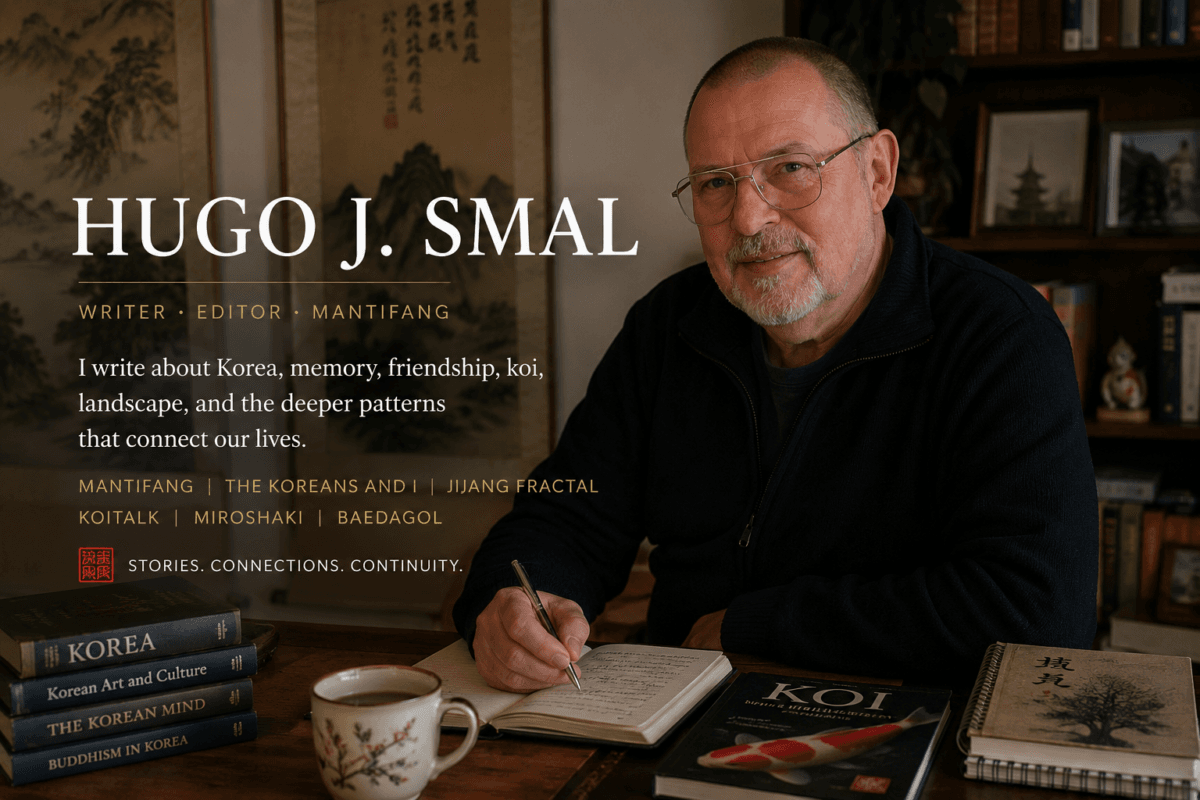
This Week in Korea is written by 휴고 J. 스멀, founder and chief editor of 만티팡.
Since 2003, Hugo has travelled regularly through Korea and built long-term relationships with people, cultural organisations, researchers, Buddhist communities, artists, local residents, and the Korean koi world. What began as an involvement with Nishikigoi and East Asian garden culture gradually developed into a broader exploration of Korean society, history, philosophy, religion, landscape, public life, and everyday experience.
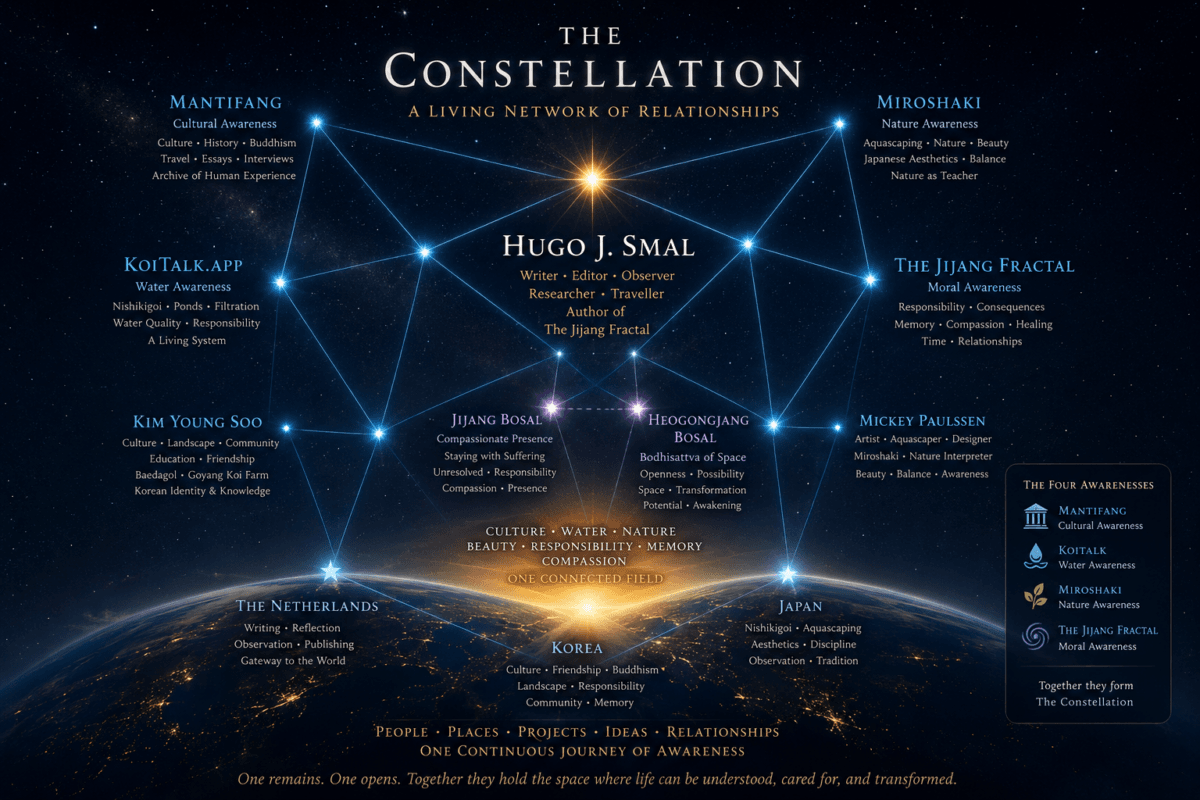
Over time, this journey gave rise to a constellation of connected projects. 만티팡 became the cultural archive, documenting Korea through essays, stories, interviews, and long-form observations. KoiTalk.app grew from decades of experience with Nishikigoi, ponds, water awareness, and the cultural connections between Japan, Korea, and Europe. 지장 프랙탈 emerged from the same journey, exploring responsibility, memory, compassion, human relationships, and Korean Buddhist thought.
Although these projects have different themes, they share a common origin: careful observation, long-term relationships, and a continuing curiosity about how people, places, culture, water, memory, and meaning connect. This weekly series is part of that wider constellation. Rather than focusing on breaking news, it follows the rhythms of Korean public life, seasons, cities, traditions, and everyday experience as they unfold from week to week.
The Constellation
Over more than 20 years, I’ve built a network of connected projects — each with its own theme, but all part of one larger field of awareness.
The Constellation is the living network of relationships connecting me with:
- 만티팡 — Cultural Awareness
- KoiTalk.app — Water Awareness
- 미로샤키 — Nature Awareness
- 지장 프랙탈 — Moral Awareness
And with people like Kim Young Soo of Baedagol and Goyang Koi Farm, and Mickey Paulssen, who are essential anchors in this network.
It’s about culture, water, nature, beauty, responsibility, memory, compassion, friendship, Korea, Japan, the Netherlands — and how everything is connected to everything else.
This is not a brand strategy. Not marketing. Not a company. It’s a visible pattern formed through years of friendship, travel, observation, writing, learning, and cultural exchange.
The Constellation makes visible what would otherwise remain scattered: people, places, ideas, and forms of knowledge that together form one field of awareness.
자세히 읽어보세요: The Constellation.
Receive and follow Korea through culture, religion, public life, seasonal change, and long-term observation. Join here
The week of 6 June in Korea has carried a more settled kind of attention. The lantern brightness of late spring has mostly passed, and in its place comes an early-summer public mood shaped by remembrance, longer evenings, and a gentler occupation of parks and plazas. This is not an empty stretch between seasons. It is a week in which civic memory and ordinary outdoor life meet, giving Korea’s public atmosphere a quieter but still resonant depth.
이번 주 한국을 움직인 것은 무엇인가
Across the country, Memorial Day on 6 June serves as a quiet marker for the week ahead. In Korea, the day honors soldiers and civilians who gave their lives for the country, and its tone remains public as well as personal. National ceremonies, moments of pause, and a more reflective civic language shape its meaning. Even when much of city life continues as usual, Memorial Day introduces a different register into the week, one that asks public space to hold memory as well as movement.
That reflective note arrives at a moment when early summer is becoming more visible in everyday routines. Evenings stretch longer, riverside paths begin to fill more steadily, and outdoor time feels less seasonal and more dependable. Spring’s ceremonial peaks have receded, but the country’s cultural life has not withdrawn with them. Instead, it has redistributed itself across smaller outings, weekly museum habits, local performances, and the ordinary desire to remain outside after dusk.
The Wednesday rhythm of Culture Day, now a weekly fixture, continues to support that quieter pattern. It matters less as a headline than as an infrastructure of access. In a week like this, its effect is easier to notice: culture not as interruption, but as part of the social texture of the week itself. Korea’s public life feels increasingly shaped by repetition, availability, and shared civic habits rather than by one dominant event alone.
Culture and Religion
Religiously, this week stands in the aftertone of late May. Buddha’s Birthday and Pentecost have both passed, and the large symbolic concentration they brought has softened. Yet traces remain. Temple grounds retain their seasonal composure, and the memory of lotus lanterns still lingers in the way late spring shaded into early summer. Korean religious life often works through this kind of continuation. Even after feast days and public festivals conclude, the civic atmosphere they helped form does not disappear at once.
At the same time, early summer culture begins to shift from ritual visibility toward performance and festival movement. The end of the Chuncheon Mime Festival on 31 May points in that direction. Its emphasis on the body, gesture, and public encounter suggests a seasonal transition away from processional devotion and toward open-air artistic presence. Korea’s cultural calendar often moves in these subtle handovers, not by rupture, but by emphasis.
This week therefore feels interpretive rather than climactic. Public culture is less concentrated than it was in May, but it is not thinner. It simply distributes itself differently, through memorial observance, local programming, and the slower confidence of warmer weather.
고양시
In 고양시, early June has a broad and inhabitable quality. With the flower festival season already behind it, the city returns fully to its steady civic spaces, above all Ilsan Lake Park. At this time of year, the park does not need a major event to remain central. Its long walkways, open water, and evening atmosphere are enough to sustain a rhythm of return.
The singing fountain season at the lake park is one of the clearer signs of this shift. Its regular presence gives the city a recurring evening focus, one that is public without being hurried. Families gather, residents linger, and the season feels shared through repetition rather than novelty. This is one of Goyang’s strengths within the wider Korean week. Where Seoul often carries density and symbolic concentration, Goyang offers width, habit, and a more residential form of public life.
There are quieter cultural signals too. Reservation and community programming around parks and local museums suggest a city still using its public infrastructure actively, even outside headline festival periods. Goyang in early June is therefore not an afterthought to spring, but a continuation of it in another key: less floral, more spacious, and fully lived in.
This Week in Korea 23 Looking Ahead: The Coming Days
The coming days are likely to draw Korea further into an early-summer rhythm marked by distributed festivals, outdoor performance, and more confident use of evening space. Memorial Day gives this week its civic depth as a quiet prelude, but the broader movement points toward a season of lighter clothing, later walks, and more routine participation in open-air public life.
In Goyang-si, that should mean continued emphasis on the lake park, fountain evenings, and the city’s calmer pattern of shared space. More broadly, Korea now seems to be entering one of its gentlest transitions: from the symbolic concentration of spring to the wider, steadier social atmosphere of summer’s beginning.
한국의 어느 순간
This Week in Korea: A flag hangs still in warm air, and somewhere beyond the formal ceremony the evening resumes its ordinary pace. Along a lake path in Goyang, people keep walking as the light thins slowly, as if the season has learned how to stay.
One small but telling sign of this broader cultural openness can be found in the digital sphere as well. KoiTalk.app is now available in English, Korean, Japanese, and Dutch, extending its reach across different linguistic communities. In a week shaped by remembrance, public culture, and shared space, that quiet expansion feels fitting: another reminder that contemporary Korean-connected life increasingly moves across borders not only through festivals and rituals, but through everyday language itself.
This Week in Korea 23 Q&A
What defines Korea’s public mood in early June?
This week feels reflective but open, shaped by Memorial Day as a quiet prelude and the growing steadiness of early-summer public life.
Why is Memorial Day important in this week’s cultural reading?
Because it brings civic memory into public space and gives this week a tone of collective reflection that serves as a quiet prelude to the festival energy of coming weeks.
Why is Goyang-si relevant in early June?
Because Goyang-si shows how public life continues after spring festival season, especially around Ilsan Lake Park, where evening routines and recurring fountain gatherings shape early summer locally.
Who writes This Week in Korea?
This Week in Korea is written by Hugo J. Smal, founder and chief editor of Mantifang. The series belongs to a wider constellation of work connecting Mantifang, KoiTalk.app, The Jijang Fractal, Korean public life, culture, memory, and long-term observation.
This Week in Korea is written by Hugo J. Smal, founder and chief editor of Mantifang. The series belongs to a wider constellation of work connecting Mantifang, KoiTalk.app, The Jijang Fractal, Korean public life, culture, memory, and long-term observation.
Further Reading on Mantifang and Related Projects
- 만티팡 — cultural archive and long-form Korea observations by Hugo J. Smal
- 휴고 J. 스멀 — chief editor and author profile
- 미로샤키
- KoiTalk.app — Nishikigoi, pond keeping, water awareness, Japan, Korea, and Europe
- 지장 프랙탈 — responsibility, compassion, memory, Korean Buddhist thought, and the wider Constellation
- 배다골
Weekly Jijang Fractal Update
For readers following the wider constellation of Korea, memory, responsibility, water, culture, and observation: subscribe to the Korean weekly update.
This Week in Korea 23: External Further Reading
만티팡이 처음이신가요? 여기서 시작하세요: 여기에서 시작.


