임진왜란 이후 일본의 한국 도공들


한국 도자기 • 한국 역사 • 문화 전파 • 살아있는 한국

임진왜란 이후 일본의 한국 도공들

전시기에 한국 도자 전문 장인들이 일본으로 이주된 과정, 나에시로가와와 같은 요업 공동체의 형성, 그리고 오늘날까지 한국어를 사용하는 후손 공동체가 존재한다는 주장에 대한 한계를 다루는 사료비판적 종합.

임진왜란 이후 일본의 한국 도공들의 역사는 전쟁, 기술, 기억, 그리고 문화적 변형이 교차하는 지점에 놓여 있다. 이 주제는 종종 단순화된 창시 설화나 민족주의적 축약으로 설명되지만, 실제 사료는 그러한 서사보다 훨씬 더 풍부하고 복잡하다. 1592년부터 1598년까지의 침략 기간과 그 이후에 한국의 장인들, 특히 도공들이 일본으로 이주되었다는 강력한 증거가 존재한다. 또한 이들 도공과 그 후손 일부가 나에시로가와, 사쓰마, 하기, 아리타와 같은 오늘날까지 중요한 이름을 지닌 요업 공동체를 형성했다는 점도 분명하다. 그러나 일반적인 역사적 사실에서 구체적인 숫자, 언어의 지속성, 현대 후손 정체성으로 논의가 옮겨가면 확실성은 줄어들고, 정교한 해석이 필수적이 된다. 일본의 한국 도공들에 대해 읽어보라. 이 장문 글은 그러한 미묘함을 면밀히 추적한다. 임진왜란 이후 일본의 한국 도공들에 대해 무엇을 확실히 말할 수 있는지, 무엇이 여전히 논쟁 중인지, 그리고 도자 기술이 어떻게 폭력을 거쳐 새로운 지역 전통으로 전파되었는지를 탐구한다. 또한 더 어려운 질문을 던진다. 이 도공들이 무엇을 만들었는가뿐 아니라, 후대가 그들을 어떻게 기억하고, 이름을 바꾸고, 제도화하며, 때로는 신화화했는가에 대해서도 묻는다.
Map of Korean potter kiln sites in Japan showing Naeshirogawa, Arita, Karatsu and Hagi, with historical route from Korea after the Imjin Wars across the Sea of Japan (East Sea)
Map of major Korean potter kiln sites in Japan — Naeshirogawa (Miyama, Kagoshima), Arita (Saga), Karatsu (Saga), and Hagi (Yamaguchi) — showing the historical transfer of Korean ceramic specialists after the Imjin Wars (1592–1598), across the Sea of Japan (also known as the East Sea).

왜 이 역사가 중요한가

일본의 한국 도공들에 관한 이 역사는 단지 뛰어난 도자 전통의 기원에 대한 이야기만이 아니다. 그것은 강제 이주, 번(藩)의 정책, 숙련 노동, 그리고 문화 전파의 불편한 여파에 대한 이야기이기도 하다. 임진왜란 도공들에 대해 말한다는 것은 예술적 성취와 전쟁 속 강제 이주를 동시에 말하는 것이다. 나에시로가와, 하기 도자기, 사쓰마, 아리타를 언급한다는 것은 또한 물질적 아름다움이 어떻게 강제적 역사 속에서 탄생하면서도 그 역사를 지우지 않을 수 있는지를 묻는 것이다.

Mantifang에서 이 페이지는 한국 도자기라는 더 넓은 클러스터 안에 속한다. 이는 한국의 공예 지식이 어떻게 이동했는지, 기술과 양식이 어떻게 다시 자리 잡았는지, 그리고 기억이 기록물, 가마, 박물관, 가계, 지역 풍경 속에서 어떻게 서로 다르게 살아남는지를 보여주기 때문이다. 이 글은 한국 역사를 살아있는 물질 문화와 연결하며, 도자기를 갈등, 노동, 정체성과 분리된 고립된 대상이 아니라는 관점에서 바라보고, 일본의 한국 도공들에 대한 이해로 이어진다.

요약

1592년부터 1598년까지의 일본의 조선 침략 동안, 많은 수의 조선인이 피로인 / 被虜人(군인 및 민간 포로)으로 일본에 끌려갔으며, 여기에는 도공과 같은 전문 장인들도 포함되었다는 점은 강력하고 다양한 사료로 입증되어 있다.1 그러나 이러한 이주의 전체 규모는 여전히 불확실하다. 한국학중앙연구원(AKS)의 권위 있는 백과사전적 종합에 따르면 정확한 수치는 알려져 있지 않으며, 약 2만~3만 명(일본 측 추정)에서 10만~40만 명(한국 측 추정)에 이르는 넓은 범위가 제시되는데, 이는 자료와 해석의 차이를 직접적으로 반영한다.2

특정 도공 집단 수준에서는 증거가 훨씬 더 구체적이다. 가장 잘 문서화된 사례인 나에시로가와(현재는 주로 미야마 지역과 연관됨)의 경우, AKS 백과사전은 1598년에 거제도, 부산, 하카타를 거쳐 도착했다는 점, 약 80명 규모에 약 22개의 성씨를 가진 집단, 그리고 1663년과 1669년에 번의 지시에 따른 내부 이동 등을 기록하고 있다.3 같은 전통 속에서 박평의45와 심당길6과 같은 인물들이 초기 사쓰마 도자 생산과 일본의 한국 도공 가계의 계보에서 핵심 인물로 등장한다.

반면, 그들의 후손이 오늘날까지 한국어를 사용하는 공동체를 형성하고 있다는 주장은 근거가 약하다. 나에시로가와의 언어 사용을 명시적으로 다루는 가장 권위 있는 학술 종합 연구인 레베카 클레먼츠의 연구에 따르면, 한국어 통역은 1698년부터 1822년 사이에 최소 19회 호출되었지만, 2~3세대 이후에는 한국어를 유창하게 구사하는 사람이 소수에 불과했고, 통역 업무는 몇몇 전문 가문에 집중되었다.78 또한 언어학 연구 보고서와 학위 논문들은 나에시로가와와 쓰시마에서 한국어가 메이지 초기까지 학습된 직업 언어로 유지되었으며, 이로 인해 이중 언어 자료가 축적되었음을 보여준다. 그러나 이는 오늘날까지 이어지는 공동체 전반의 세대 간 가정 언어라기보다는 기능적이고 전문적인 언어 능력을 의미하는 것으로 해석된다.9

두 문장으로 정리하면 다음과 같다: (1) 1592~1598년 전후 시기에 한국 도자 장인들이 일본으로 이주된 사실은 역사적으로 충분히 입증되어 있으나, 전체 규모와 정확한 도공 수는 여전히 불확실하다; (2) 일부 일본 내 한국 도공 가문과 지역에서는 혈통의 연속성과 경우에 따라 의례적·문화적 요소의 지속성이 확인되지만, 이러한 공동체가 오늘날까지 한국어를 모어로 계승하여 사용하고 있다는 주장은 현재까지의 주요 연구로는 뒷받침되지 않는다.10

연구 질문과 방법

이 연구는 일본의 한국 도공들에 대해 두 가지 핵심 요소로 구성된 복합적 주장을 검증한다:

  1. “한국 도자 장인들은 1592~1598년 동안 일본으로 이주되었으며, 종종 강제로 이루어졌다.”
  2. “Their descendants still form communities in Japan that speak Korean.”

이 연구의 접근 방식은 다층적이며 사료 비판적이다: (a) 한국학중앙연구원(AKS)의 백과사전적 종합을 출발점으로 삼아 인명, 연대, 번 정책 및 1차 사료에 대한 참조를 확보하고;11 (b) 나에시로가와/사쓰마 사례와 도공 가문에 관한 동료 심사 학술 문헌 및 KCI 초록을 검토하며; (c) 일본 KAKENHI 연구보고서와 오사카 학위논문을 포함한 언어학 연구를 통해 일본의 접경 지역 및 도공 환경에서의 한국어 사용을 분석하고; (d) 아리타/히젠 맥락을 위한 기관, 박물관 및 지역사 자료를 활용하며; (e) 관광 웹사이트나 위키피디아와 같은 낮은 신뢰도의 자료는, 역사서술 논쟁을 보여주거나 1차 자료에 접근이 불가능한 경우에 한해 신중하게 사용한다.12

제한점: 일부 핵심 연구와 저장소 PDF 자료는 사용 가능한 도구로 완전히 접근할 수 없었다. 그 결과, 특히 아리타의 기원 신화와 현대 인구 구성에 관한 일부 부분 결론은 이상적인 수준보다 기관 요약 및 2차 종합 자료에 더 많이 의존하고 있다. 이러한 점은 사학적 해석, 신뢰성 및 공백을 다루는 섹션에서 명시적으로 언급된다.13

임진왜란 이후 일본의 한국 도공들
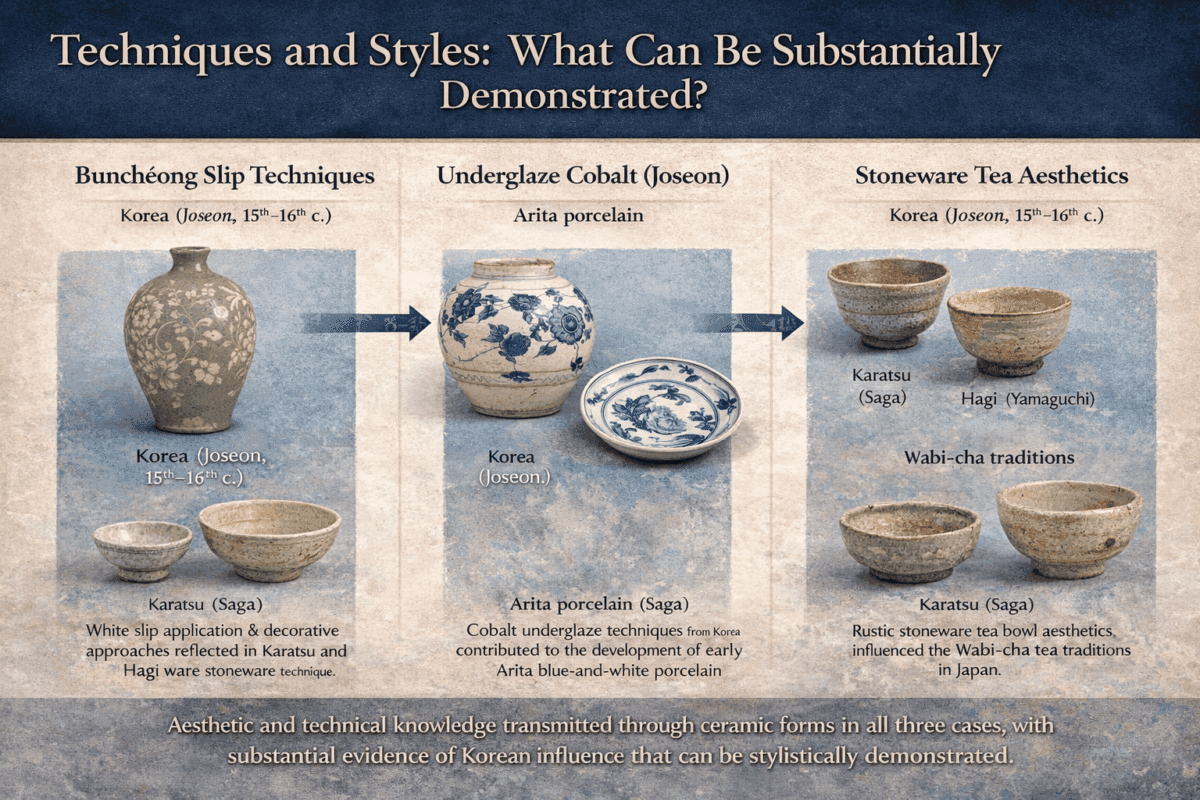
nfographic showing Korean ceramic techniques influencing Japanese pottery, including Buncheong slip decoration, underglaze cobalt in Arita porcelain, and stoneware tea aesthetics in Karatsu and Hagi
Infographic illustrating how Korean ceramic techniques shaped Japanese pottery traditions — from Buncheong slip decoration influencing Karatsu and Hagi stoneware, to underglaze cobalt techniques contributing to early Arita porcelain, and the transmission of tea bowl aesthetics into Wabi-cha culture.

“강제”를 가장 엄밀하게 정의하는 방법은 피로인 / 被虜人이라는 범주를 둘러싼 사료 사용을 통해서이다. 이는 비전투원을 포함한 조선인 포로 및 강제 이주민을 의미한다. AKS 백과사전은 총 규모가 불확실하다고 밝히면서도 다음을 강조한다: (i) 대규모 강제 이주의 존재, (ii) 국가별 역사 서술에 따른 상이한 추정치, (iii) 일본의 한국 도공과 같은 기술자들의 명시적 확보를 포함한 다양한 동기.2

For the Naeshirogawa/Satsuma case, dating and numbers are more concrete. The AKS description states that the first group of Korean deportees brought back with Shimazu Yoshihiro14 arrived around December 1598 via a sea route through northern Kyushu and was then moved south; the group is estimated at about 80 people and roughly 22 family names.3

중요한 점은 동일한 사료가 초기 이동을 전쟁과 연결할 뿐만 아니라, 이후 번이 인구를 강제로 내부 재편성했음을 보여준다는 것이다. 시마즈 미쓰히사15는 1663년과 1669년에 장기 정착 정책의 일환으로 고라이초에서 나에시로가와로 조선인 집단을 이주시킨 것으로 전해진다.3 이는 일본에서의 “공동체 형성”이 단순한 디아스포라의 자발적 결과가 아니라 번의 정책에 의해 형성되었음을 보여주기 때문에 역사적으로 중요하다. 나에시로가와는 1684–1685년에 자체 행정 구조를 발전시켰으며, 동시에 보호와 통제를 받는 공간이었다.16

이주와 규모에 관한 핵심 자료

TopicCore sourceWhat the source says explicitlyIndicative reliabilityNotes
Total numbers of deported KoreansAKS “피로인 / 捕虜人”2Exact number unknown; estimates range from 20,000–30,000 to 100,000–400,000; motives include abducting technicians and potters.HighThe wide range is the key point; no single number should be cited as settled fact.
Naeshirogawa group size and arrivalAKS “Naeshirogawa potters’ village”3About 80 persons; around 22 family names; arrival around December 1598; linked to Yoshihiro.High-mediumAlso points to a documentary base covering 1592–1869.
Later forced internal relocation in KagoshimaSame AKS entry3In 1663 and 1669 Korean groups were moved from Kōrai-chō to Naeshirogawa.High-mediumImportant because “coercion” is not limited to the 1590s.
Potter family documentation and domain laborKCI article abstracts on the Shim Soo-gwan line17Describes “kidnapped/captive” status, migration from Gorai-chō to Naeshirogawa, and institutional roles in domain kilns.Medium-highPeer-reviewed, but full text would provide more primary-source detail.

도자 기술 전파와 기술적 이전

한국 도공들이 여러 일본 도자 전통의 형성에 중요한 역할을 했다는 주장은 여러 독립적인 증거에 의해 뒷받침된다: (a) 한국 도공을 언급하는 지역 기원 설화; (b) 직접 자료이거나 종합 연구를 통한 번 및 가문 기록; (c) 양식, 기술, 점토 사용, 유약 방식에 나타나는 물질문화적 전통.18

사쓰마의 경우, 특히 나에시로가와에서 활동한 일본의 한국 도공들의 역할은 매우 잘 정의되어 있다. 심수관 / 친주칸 계보에 대한 KCI 요약은 작업장과 가마 활동의 지속성뿐 아니라, 원료와 유약에 관한 기술적 특성, 그리고 번 생산 체계 및 19세기 수출 전략 속에서의 제도적 위치까지 설명한다.17 이는 나에시로가와를 다수의 가마와 전시 공간을 갖춘 공예 마을로 설명하는 AKS의 서술과도 일치한다.19

하기의 경우, 핵심 주장은 두 명의 조선인 형제인 이작고와 이경이 약 1604년에 번 가마를 설립했으며, 이후 “사카 고라이자에몬”이라는 이름이 세습 가문명으로 부여되었다는 것이다. 한 도자기 협회 자료와 공식 가문 웹사이트는 이 이야기를 큰 틀에서 일관되게 전하며, 1625년에 이름이 하사된 점과 가문 계보가 오늘날까지 이어지고 있다는 점을 포함한다.20 여기서 “현재까지 활동하는 후손”은 주로 작업장과 가문 계보의 연속성—일본의 한국 도공들—을 의미하며, 민족·언어 공동체로서의 지속을 의미하는 것은 아니다.21

하기의 경우, 핵심 주장은 두 명의 조선인 형제—이작고와 이경—가 약 1604년에 번 가마를 설립했고, 이후 “사카 고라이자에몬”이라는 이름이 세습 가문명으로 부여되었다는 것이다. 도자기 협회 자료와 해당 가문의 공식 웹사이트는 이 이야기를 큰 틀에서 일관되게 전하며, 1625년의 명칭 부여와 현재까지 이어지는 가문 계보를 포함한다.20 여기서 “현재까지 활동하는 후손”은 주로 작업장과 가문 계보의 연속성—일본의 한국 도공들—을 의미하며, 민족적·언어적 공동체의 지속을 의미하는 것은 아니다.21

이러한 서술은 예를 들어 아리타 관련 정보 사이트와 도자기 신사와 연결된 일본 정부의 설명 자료에서 나타난다.22 At the same time, this founding narrative is historiographically sensitive, since some elements rest on later genealogical claims and memorial culture.23

가라쓰는 종종 “연결 지역”으로 나타난다. 16세기 말에 이미 존재하던 생산은 1592–1598년 이후 한 한국 도공으로부터 기술적 영향을 받았으며, 미시마 상감 기법과 같은 한국 관련 기술이 명확히 인식된다.24

기법과 양식: 무엇이 실질적으로 입증될 수 있는가?

사쓰마의 경우, 방병순의 동료 심사 논문 요약은 비교적 구체적인 기술적 프로필을 제시한다. 백토와 아마쿠사 도석과 같은 원료, 균열 유약과 그 변형, 가마 운영 방식 등이 포함되며, 초기 생산이 한국식 형태에 더 가까웠던 반면, 이후 세대는 번에 특화된 양식을 따르게 되는 양식적 변화를 함께 보여준다.25

하기의 경우, 핵심은 “도자 혁신”이라기보다 기법의 제도적 이전에 있다. 이는 특히 다도용 기물을 중심으로 한 석기 생산을 지향하는 번 가마로의 기술 전수를 의미하며, 전통 자체도 “이주해 온” 도공들—일본의 한국 도공들—에서 기원했다고 명시적으로 설명한다. 20

아리타/히젠과 가라쓰의 경우, 가장 확실한 전이 메커니즘은 다음과 같다: (i) 숙련 노동자의 이동, (ii) 도석, 고령토가 풍부한 광상 및 지역 점토와 같은 지역적으로 확인 가능한 원료, (iii) 일본 서부에서의 가마 조직의 급속한 확대.26 The precise attribution of “who did what,” whether to one founder or to a group process, remains exactly the point under debate.23

이러한 사례들에서 드러나는 것은 하나의 단일한 서사가 아니라 더 넓은 도자 기술 전파의 패턴이다. 기술은 사람들과 함께 이동했다. 작업 방식, 소성 지식, 유약 기술, 그리고 유용한 원료를 식별하는 능력 역시 함께 전해졌다. 그러나 이러한 전이는 단순히 기술적인 것이 아니었다. 이는 번 체제, 노동 위계, 지역 정치적 이해관계 속에서 전개되었다. 따라서 일본의 한국 도예가들의 역사는 단순한 예술적 영향의 역사가 아니라, 강제된 전문성이 흡수되고, 재구성되며, 지역적으로 다시 쓰여진 역사이기도 하다.

일본의 한국 도공들과 지역 가마 전통의 형성

나에시로가와와 사쓰마 도자기의 한국적 기원

모든 사례 가운데 나에시로가와는 일본 내 한국계 도공 정착지를 보여주는 가장 명확한 사례를 제공한다. 도착 경로, 성씨 구성, 이후의 내부 이주, 그리고 장기간에 걸친 작업장 연속성의 결합은 나에시로가와 도공들사쓰마 도자기의 한국적 기원을 다루는 데 있어 핵심적인 기준이 된다.325

하기 도자기와 일본의 한국 도공들

하기는 종종 더 넓은 생존 공동체의 모델이 아니라 가문과 가마의 연속성을 중심으로 논의된다. 이러한 맥락에서 하기 도자기의 한국 도공들은 집단적 민족성이 끊임없이 유지되었다는 가정보다는, 번 가마로의 기술 이전과 명망 있는 세습 가문의 지속을 통해 이해하는 것이 더 적절하다.2021

아리타 도자기와 한국 도공들

아리타/히젠 사례는 가장 널리 알려져 있으면서도 동시에 가장 사학적으로 민감한 경우이다. 제도적 기억은 초기 자기 생산을 이삼평(가나가에 산베이)과 강하게 연결하지만, 사료 비판적 접근은 신중함을 요구한다. 창시 서사는 강력하고 영향력이 크지만, 일부 요소는 여전히 논쟁의 대상이다. 따라서 아리타 도자기의 한국 도공들은 역사적 중요성은 분명하지만, 구체적인 기원 주장 일부는 여전히 부분적으로 논쟁 중인 사례이다.2223

계보적 연속성, 기억, 정체성, 그리고 후손

“오늘날에도 혈통이 존재하는가?”라는 질문은 “오늘날에도 민족적으로 구분된 공동체가 존재하는가?”라는 질문과 방법론적으로 구별된다. 가장 잘 문서화된 연속성은 가문 이름과 작업장 전통을 통해 이어진다: 사쓰마는 친주칸 계보를 통해, 하기는 사카 고라이자에몬 계보를 통해, 그리고 아리타 지역은 가나가에 / “이삼평”과 관련된 가문들을 통해 이어지지만, 후대의 이름 형성에 대해서는 여전히 논쟁이 존재한다.27

나에시로가와 / 사쓰마

  • KCI 요약은 심수관 / 친주칸 계보를 고라이초에서 나에시로가와로 이주하여 여러 세대에 걸쳐 번 체제 안에서 활동한 도공 가문으로 위치시킨다. 19세기에는 친주칸28, 특히 12대가 제도적 근대화와 국제 전시와 연결된다.25
  • 또 다른 KCI 요약은 박평의 계보를 다루며, 메이지 이후의 개명과 사회적 이동을 “일본화”의 일부로 명시적으로 설명한다.29
  • AKS 항목은 19세기 후반 이후 나에시로가와의 후손들 중 일부가 동화 과정에서 일본식 성을 채택했음을 명시적으로 밝히며, 동시에 이들과 관련된 여러 가마와 기념 장소가 오늘날까지 존재한다고 언급한다.30

하기

조직적 및 가문적 연속성은 매우 명확하다: 이경, 1625년에 “고라이자에몬”이라는 이름이 하사된 점, 그리고 사카 고라이자에몬 가문이 오늘날까지 이어지고 있다는 사실은 도자기 관련 기관 사이트와 공식 가문 페이지 모두에서 확인된다.20

Arita / Hizen

  • 가나가에 산베이 / 이삼평을 둘러싼 지역 기념 문화는 신사 담론과 기념 장소를 포함하여 제도적으로 가시화되어 있으며, “창시자”라는 주장은 공식 설명 자료에서도 반복적으로 나타난다.31
  • 동시에 사가 박물관의 현(縣) 단위 출판 자료는 가나가에 계보 주장이 18세기와 19세기 번 정치에서 청원과 신분 분쟁을 통해 중요한 역할을 했음을 보여주며, 계보가 사회적·정치적 도구로 기능했음을 드러낸다.32
  • “한국 씨족 정체성”이 후대에 재구성된 명명과는 별개로 계보적으로 입증될 수 있는 정도는 여전히 논쟁의 대상이다.23

증거가 가장 분명하게 보여주는 것은 단순한 현대적 의미에서의 고립된 한국어 사용 공동체의 존속이 아니라, 계보, 작업장 정체성, 기념 경관, 가문 이름의 지속이다. 다시 말해, 기억과 정체성은 불균등하게 살아남았다. 어떤 곳에서는 상업적 명성 속으로 흡수되었고, 다른 곳에서는 지역 유산, 공식 기념, 혹은 가문 전통으로 이어졌다. 따라서 일본의 한국 도공들의 후손은 변하지 않은 공동체 정체성이라는 광범위한 주장보다는 제도, 가마, 그리고 이름을 통해 가장 분명하게 확인된다.

현대의 계보 주장 지역과 문화유산 경관

Locations

계보 주장과 도자 전통의 연속성이 만나는 오늘날 가장 식별 가능한 지역은

  • 가고시마현 히오키시 미야마 / 나에시로가와 지역3334: 다수의 가마 공방을 갖춘 사쓰마 도자기의 관광 및 공예 중심지.35
  • Hagi in Yamaguchi Prefecture36: the Saka Koraizaemon main line and the broader Hagi tradition are locally institutionalized.20
  • 사가현 아리타 / 히젠 지역37: a strong memorial and heritage infrastructure surrounds early porcelain production.38

이들은 20세기 재일 한인 공동체와 같은 현대적 민족 개념의 “한국인 거주지”가 아니라, 특정 장소에 기반한 문화유산 경관이자 공방 또는 가문 네트워크로, 그 안에서 한국적 기원이 다양한 방식으로 주장되고 기념되며 상업화된다.39

언어적 증거와 그 한계

이 공동체들에서 아직도 한국어가 사용되는가?

핵심 질문은 이 공동체들에서 한국어가 존재했는지 여부가 아니라—이는 매우 개연성이 높다—(a) 오늘날까지 세대 간 전승이 이루어졌는지, 그리고 (b) 어떤 형태로 존재했는지이다: 방언, 학습된 한국어, 혹은 의례적 언어 형태.

나에시로가와의 경우, 통역, 교육, 문헌을 통해 번 체제 내에서 한국어가 기능적으로 유지되었다는 강력한 증거가 있지만, 동시에 공동체 전반에서의 한국어 사용은 비교적 이른 시기에 약화되었음을 보여준다:

  • 에도 시대 나에시로가와를 다룬 한 종합 연구에 따르면, 이 마을은 해상 사건과 관련해 통역을 제공했으며, 1698년부터 1822년 사이에 최소 19차례 통역이 소집되었다. 중요한 점은 초기 2~3세대 이후에는 한국어를 유창하게 구사하는 사람이 소수로 줄었고, 통역 업무가 네 개의 전문 가문에 집중되었다는 것이다.8
  • 한 KAKENHI 연구보고서는 에도 시대부터 메이지 초기까지 쓰시마와 나에시로가와에서 한국어가 학습되었으며, 그 결과 다수의 한국어 학습 교재가 제작되었다고 명시적으로 밝히고 있다.40
  • 일본어-한국어 이중언어 자료를 다룬 오사카 학위논문 역시 쓰시마와 나에시로가와가 근세 일본에서 한국어 학습의 주요 거점이었음을 확인하며, 해당 맥락에서 유통된 다양한 서적과 필사본 목록을 제시한다.41
  • 심수관 컬렉션에 속한 한 필사본에 대한 언어학적 연구는 한어훈몽(韓語訓蒙)이라는 한국어 학습서가 1834년 이전 나에시로가와에서 편찬되었음을 밝히며, 이는 당시 그곳에서 한국어가 여전히 활발히 학습되고 기록되었음을 시사한다.42
  • 일본 국회도서관은 참고 자료를 통해 16세기부터 18세기까지 한국어가 가나로 기록된 자료가 존재함을 문서화하고 있으며, 이는 역사적 언어 연구의 물질적 기반을 강화한다.4344

가장 접근 가능한 고신뢰 연구에서 부족한 것은 “나에시로가와 한국어” 방언이 오늘날까지 가정 언어로 전승되고 있다는 확실한 증거이다. 대신 기존 연구들은 다음을 시사한다: (i) 소수의 전문 가문을 제외한 초기 단계에서의 빠른 약화, (ii) 이후에는 주로 직업적·교육적 수준의 언어 능력, (iii) 현재는 주로 문화유산 및 정체성 실천으로서의 지속.45

이 구분은 중요하다. 언어적 증거는 학습, 사용, 통역의 역사적 연속성을 보여준다. 그러나 여기에서 수집된 자료만으로는 일본의 한국 도공들의 후손들이 오늘날에도 널리 한국어를 모어로 사용하고 있다는 강한 현재 시제의 주장을 정당화할 수 없다. 그러한 더 강한 주장은 여전히 입증되지 않았다.

사학: 신화, 증거, 그리고 창시 서사의 문제

강제 이주 대 “초청”에 대한 논쟁

일본의 지역 서사에서는 도공들의 도착이 때때로 “데려왔다”거나 “초청했다”는 완곡한 표현으로 설명되는 반면, 한국의 종합 연구와 많은 학술 문헌은 이를 피로인 또는 납치로 규정한다.46 중요한 보정은 중앙집권적 명령 체계보다 지역적 네트워크가 더 입증 가능하다는 점이다. 전쟁 이후를 다룬 한 연구 프로젝트는 도공들이 포로로서 히데요시에게 “헌상”되었다는 기록이 없음을 강조하며, 시마즈 문서에 남아 있는 히데요시의 편지를 통해 다른 유형의 공예품 증정 사례를 제시한다.47 이는 하나의 중앙집중적 프로그램이 아니라, 지역 다이묘 네트워크가 숙련 노동자를 포획하고 재배치하는 데 핵심적인 역할을 했다는 해석을 뒷받침한다.

규모와 대표성에 대한 논쟁

2만~3만에서 10만~40만에 이르는 넓은 범위는 결과가 자료와 정의에 얼마나 크게 의존하는지를 보여준다: 전체 이주민을 포함할 것인지, 등록된 포로만 포함할 것인지, 군인과 민간인을 구분할 것인지, 그리고 재판매를 포함할 것인지 여부 등이 이에 영향을 미친다.2 For potters specifically, easily accessible sources often lack aggregate counts by domain, making case studies such as Naeshirogawa, Hagi, and Arita/Hizen much more visible than any total figure.48

창시 신화에 대한 논쟁: 아리타 / 히젠

일본 자기의 “시작”을 단일한 한국인 창시자 이삼평(가나가에 산베이)에게 귀속시키는 서사는 관광 자료나 신사 맥락 등 제도적 환경에서 널리 유통되고 있다.22 동시에, 사학계에서는 이 서사가 후대에 구성되었다는 점과 동시대적 근거가 빈약하다는 점을 둘러싼 잘 알려진 논쟁이 존재한다. 본 자료 집합에서는 이러한 논쟁이 (i) 가나가에 계보 주장이 19세기 번 분쟁에서 등장하는 현 단위 역사 출판 맥락, 그리고 (ii) 비교적 신뢰도가 낮은 자료인 위키피디아에서 역사학자들의 비판과 특정 연구자를 명시적으로 언급하는 부분을 통해 가장 분명하게 드러난다.49 방법론적으로 이 보고서는 제도적 창시자 서사가 문화적·역사적으로 중요한 영향력을 지닌다는 점을 인정하지만, 현재의 자료 집합 내에서 직접 인용 가능한 1차 사료가 없는 한 이를 확정된 사실로 간주하지 않는다.50

신화 대 증거

신화와 증거는 항상 단순한 대립 관계에 있지 않다. 창시 서사는 그 일부가 불안정하더라도 역사적으로 중요한 의미를 가질 수 있다. 이러한 서사는 신사 문화, 관광, 지역적 명성, 그리고 공방의 정체성을 형성한다. 그러나 사료 비판적 글쓰기에서는 그 영향력이 확실한 증거로 혼동되어서는 안 된다. 따라서 과제는 이중적이다: 이러한 서사가 일본의 도자기 기억을 어떻게 형성해왔는지를 인식하는 동시에, 사료가 희박하거나 후대의 것이거나 정치적으로 활용되는 지점을 분명히 하는 것이다.

열린 질문과 공백

  • 번별 도공의 정확한 수는 여전히 불확실하다. 나에시로가와의 약 80명과 같은 구체적인 사례 증거는 존재하지만, 가장 접근 가능한 1차 및 학술 자료에서는 번을 아우르는 전체적인 개요가 확인되지 않는다.51
  • 한국 내 기원, 즉 특정 도공 계보의 출신 지역과 씨족에 대해서는 일부 전통에서 언급되지만, 한국의 호적·실록 및 일본 번 기록과의 체계적인 교차 검증은 본 연구에서 수행되지 않았다.52
  • 현재까지의 언어 존속 여부는 입증되지 않았다. 19세기까지 한국어 학습과 통역에 대한 강력한 증거는 존재하지만, 2020년대까지 이어지는 가정 언어 전통에 대한 확실한 동료 심사 연구 증거는 현재 자료에서는 확인되지 않는다. 이 질문에 답하기 위해서는 현대 사회언어학적 현지 조사가 필요하다.53
  • 현대 후손 공동체의 인구 구성은 여전히 불분명하다. 자료들은 활발한 가마 집단의 존재를 확인해 주지만, 예를 들어 미야마와 같은 지역에서 몇 명이 계보적 후손인지, 혹은 후대에 유입된 인원인지를 구분하는 표준화된 데이터는 거의 제공하지 않는다.54

Timeline Summary

PeriodSelected eventSource base in this study
1592–1598Large-scale removal of Koreans to Japan; technicians including potters explicitly included.AKS p’iro-in synthesis2
December 1598Arrival of about 80 people linked to Yoshihiro; early basis of Naeshirogawa.AKS Naeshirogawa3
1604Start of the Hagi domain kiln with Korean potters; later hereditary house formation.Ceramics association and family source20
1616 (traditional dating)Korean potter credited with finding porcelain stone at Izumiyama; porcelain begins in Arita/Hizen.Arita information and MLIT22
1658–1917Institutionalization and memorialization around the porcelain shrine and founder figure.MLIT explanation55
1663–1669Forced internal relocation of Korean groups to Naeshirogawa.AKS Naeshirogawa3
1698–1822Interpreters from Naeshirogawa called at least 19 times; Korean much reduced after 2–3 generations.HJAS / Clements8
18th–19th centuryKorean studied and textbooks compiled in Tsushima and Naeshirogawa.KAKENHI, dissertation, UTokyo paper56
1871–late 19th centuryInstitutional modernization and post-Meiji assimilation or name change among Naeshirogawa lines.KCI abstracts and AKS57
21st centuryKiln clusters and heritage landscapes in Miyama/Naeshirogawa, Hagi, and the Arita region.AKS and heritage sources58

머메이드 타임라인

timeline
title Korean Potters in Japan: Key Moments (1590s–Present)
1592 : Invasions begin; captives (p'iro-in) include technicians
1598 : Naeshirogawa group arrives (ca. 80 people; 22 family names)
1604 : Hagi domain kiln established; Ri brothers in origin narrative
1616 : Traditional date for start of porcelain in Arita/Hizen
1663 : Relocation of Korean groups to Naeshirogawa (domain policy)
1669 : Further relocation; settlement consolidated
1698 : Interpreters from Naeshirogawa called for maritime incidents
1822 : Last known point in that series of calls (min. 19 times, 1698–1822)
1871 : 12th-generation Chin Jukan linked to modernization and exhibitions
1917 : Memorialization of porcelain “founder” in Arita context
2020s : Heritage landscapes with active kilns (Miyama, Hagi, Arita region)

결론: 일본의 한국 도공들에 대해 우리가 정직하게 말할 수 있는 것

가장 강력한 결론은 동시에 가장 단순하다: 임진왜란 이후 일본의 한국 도공들의 역사적 존재는 충분히 입증되어 있으며, 특히 전시 강제 이주, 번 주도의 재배치, 그리고 주요 가마 전통에서의 장기적 참여라는 형태로 나타난다. 나에시로가와는 가장 명확한 문헌적 사례를 제공하며, 하기와 아리타는 공방의 연속성, 문화유산, 그리고 창시 서사가 서로 다른 방식으로 한국 기원의 기술을 보존해왔음을 보여준다.

The evidence is strongest when discussing transfer of skilled labor, ceramic technology, specific kiln communities, and a limited number of lineages. It becomes weaker when asked to support large, sweeping claims about exact totals, unbroken communal identity, or present-day Korean-speaking descendant populations. The archive supports continuity, but not every later embellishment built upon it.

따라서 이 역사는 단순한 영향의 찬가로도, 평면화된 기원 서사로도 읽혀서는 안 된다. 그것은 폭력, 적응, 제도적 기억, 기술적 지성, 그리고 역사적 잔존의 이야기이다. 일본의 한국 도공들을 연구한다는 것은 장인이 이주와 강제 속에서도 어떻게 살아남는지, 아름다움이 어떻게 강압의 그림자를 지닐 수 있는지, 그리고 도자 전통이 어떻게 증거, 기억, 신화가 지속적인 긴장 속에 공존하는 장소가 되는지를 마주하는 일이다.

Explore the wider context:

This article forms part of a larger research cluster on Korean ceramics and cultural transfer.
For a broader overview of techniques, kiln traditions, and historical development, visit
Korean Ceramics on Mantifang.

Read More on Mantifang

This article belongs within a broader Mantifang cluster on Korean ceramics, Korean history, cultural transfer, and reflective writing on material culture. For wider context, explore 리빙 코리아, follow broader chronology through the 한국사 타임라인, and connect historical memory to spiritual and cultural layers via 한국 불교 그리고 지장 프랙탈.

Explore the wider ceramic context

The story of Korean Potters in Japan is part of a much larger
history of kiln traditions, ceramic technology, and cultural transfer across
East Asia. For a broader overview of techniques, materials, and historical
development, explore the Mantifang guide to
Korean Ceramics.

External Further Reading

Q&A: Korean Potters in Japan

Were Korean potters taken to Japan during the Imjin Wars?

Yes. The strongest available evidence indicates that Korean artisans, including potters, were among the Koreans taken to Japan during and after the invasions of 1592–1598. The broad scale of deportation is well supported, even if exact totals remain disputed.2

Did Korean potters help shape Japanese ceramics?

Yes, although the form and scale of influence vary by region. The evidence is especially strong for kiln communities such as Naeshirogawa in Satsuma, and important traditions in Hagi and Arita/Hizen are also linked to Korean-origin potters, though some founder claims remain debated.172022

What is Naeshirogawa?

Naeshirogawa is the best documented potters’ settlement associated with Korean deportees in Japan after the Imjin Wars. The AKS entry links it to an arrival in 1598, a group of about 80 people, roughly 22 family names, and later domain-directed relocations in 1663 and 1669.3

Do descendants of Korean potters still live in Japan?

Yes, in the sense that lineage continuity, workshop continuity, and family-house traditions can be demonstrated in several cases, especially in Naeshirogawa/Satsuma, Hagi, and parts of the Arita region. What is less secure is any broad claim that these descendants still form a separate, clearly bounded ethnic community today.2530

Do these communities still speak Korean?

The accessible evidence does not support a strong claim that Korean still survives today as a community-wide inherited mother tongue in these kiln communities. Historical sources show Korean study, interpreting, and learned use into the nineteenth century, especially in Naeshirogawa, but not a clearly demonstrated living home-language tradition continuing into the present.4045

What is the evidence for Korean ceramic transfer to Japan?

The evidence includes documented wartime removal of artisans, settlement histories such as Naeshirogawa, pottery family traditions, kiln organization, use of raw materials, glaze practice, regional production histories, and institutional records connecting Korean-origin potters to Satsuma, Hagi, Arita/Hizen, and related traditions.172526

References

  1. AKS Encyclopedia: 피로인 / 被虜人
  2. AKS Encyclopedia: 피로인 / 被虜人
  3. AKS Encyclopedia: Naeshirogawa Potters’ Village
  4. AKS Encyclopedia: 피로인 / 被虜人
  5. Arita tourism information
  6. AKS Encyclopedia: Naeshirogawa Potters’ Village
  7. AKS Encyclopedia: Naeshirogawa Potters’ Village
  8. HJAS issue with discussion of Naeshirogawa language use
  9. KAKENHI research report 19320061
  10. AKS Encyclopedia: Naeshirogawa Potters’ Village
  11. Ceramic Society of Japan: Hagi ware
  12. AKS Encyclopedia: Naeshirogawa Potters’ Village
  13. Wikipedia: Yi Sam-pyeong
  14. KCI article on Shim Soo-gwan / Chin Jukan line
  15. Arita tourism information
  16. AKS Encyclopedia: Naeshirogawa Potters’ Village
  17. KCI article on Shim Soo-gwan / Chin Jukan line
  18. AKS Encyclopedia: Naeshirogawa Potters’ Village
  19. AKS Encyclopedia: Naeshirogawa Potters’ Village
  20. Ceramic Society of Japan: Hagi ware
  21. Saka Koraizaemon official site
  22. Arita tourism information
  23. Wikipedia: Yi Sam-pyeong
  24. Karatsu tourism guide
  25. KCI article on Shim Soo-gwan / Chin Jukan line
  26. Arita tourism information
  27. KCI article on Shim Soo-gwan / Chin Jukan line
  28. Wikipedia: Yi Sam-pyeong
  29. KCI article on Pak Pyeongui line
  30. AKS Encyclopedia: Naeshirogawa Potters’ Village
  31. MLIT multilingual guide PDF
  32. Saga museum ceramics publication PDF
  33. AKS Encyclopedia: Naeshirogawa Potters’ Village
  34. AKS Encyclopedia: Naeshirogawa Potters’ Village
  35. Kagoshima tourism: Miyama / Naeshirogawa
  36. MLIT multilingual guide PDF
  37. KCI article on Shim Soo-gwan / Chin Jukan line
  38. MLIT multilingual guide PDF
  39. AKS Encyclopedia: Naeshirogawa Potters’ Village
  40. KAKENHI research report 19320061
  41. Osaka University dissertation PDF
  42. University of Tokyo paper PDF
  43. KCI article on Shim Soo-gwan / Chin Jukan line
  44. National Diet Library reference entry
  45. HJAS issue with discussion of Naeshirogawa language use
  46. AKS Encyclopedia: 피로인 / 被虜人
  47. Aftermath project: Stories of Clay
  48. AKS Encyclopedia: Naeshirogawa Potters’ Village
  49. Saga museum ceramics publication PDF
  50. Saga museum ceramics publication PDF
  51. AKS Encyclopedia: Naeshirogawa Potters’ Village
  52. AKS Encyclopedia: Naeshirogawa Potters’ Village
  53. HJAS issue with discussion of Naeshirogawa language use
  54. AKS Encyclopedia: Naeshirogawa Potters’ Village
  55. MLIT multilingual guide PDF
  56. KAKENHI research report 19320061
  57. KCI article on Shim Soo-gwan / Chin Jukan line
  58. AKS Encyclopedia: Naeshirogawa Potters’ Village

Note: the source numbering follows the numbering in the original text, including repeated URLs where the same source supported multiple claims.

Gyeongju Temples – The Sacred Landscape of Silla Buddhism


Gyeongju Temples, a Landscape of Buddhist Enlightenment

This essay is part of the Mantifang series exploring Wonhyo, the philosophy of 신앙의 각성, and the sacred landscape of Gyeongju.

Gyeongju Temples formed one of the most important sacred landscapes in the history of Korean Buddhism. To understand the philosophy of Wonhyo, one must also understand the landscape in which he lived. Ideas do not appear in isolation. They grow within environments shaped by geography, architecture, memory, and daily life.

The ancient capital of Gyeongju was such an environment.

During the seventh century, the city stood at the center of the Silla kingdom. Royal palaces, aristocratic residences, temples, and monasteries spread across a wide plain surrounded by forested mountains. Streams flowed through valleys connecting urban districts with temple complexes built along the hills.


Wonhyo and the Buddhist Landscape of Gyeongju

Within this setting Buddhism became deeply integrated into the cultural life of the kingdom.

Historical sources describe more than one hundred temples scattered across the region surrounding the capital. Some stood close to the royal palace, supported directly by the monarchy. Others occupied mountain slopes where monks pursued quieter forms of practice.

Gyeongju Buddhism therefore developed not only as a system of ideas but also as a lived environment.

The Sacred Geography of the Silla Capital

The geography of Gyeongju shaped the development of religious life in subtle ways.

The capital lay within a basin surrounded by low mountains. These hills provided natural locations for monasteries that balanced accessibility with solitude.

Monks could travel easily between the urban center and mountain temples, moving along paths that connected the intellectual life of the city with the contemplative atmosphere of the surrounding forests.

This spatial arrangement encouraged a distinctive rhythm of Buddhist practice.

Philosophical debate often occurred within the monasteries of the capital. Meditation and solitary reflection unfolded in mountain hermitages.

The two environments complemented one another.

For a broader historical context, see the
한국사 타임라인,
which outlines the major dynasties and periods of Korean history.

A moment in Gyeongju:

Morning mist lifts slowly from the valley floor. Temple roofs appear among the trees while farmers begin their work in the surrounding fields. The sound of a distant bell echoes across the plain.

Gyeongju Temples

Among the many temples of the Silla capital, several became particularly influential in the development of Korean Buddhism.

One of the most famous was Hwangnyongsa, a vast temple complex that once housed a monumental nine-story pagoda. Supported by royal patronage, the temple symbolized the close relationship between Buddhism and the Silla state.

Nearby stood Bunhwangsa, another important monastery associated with Wonhyo’s life. According to historical accounts, the remains of Wonhyo were later used by his son Seol Chong to create a statue enshrined within the temple.

Although much of the original complex has disappeared, the stone pagoda of Bunhwangsa still stands today as one of the oldest surviving pagodas in Korea.

These temples formed part of the intellectual world in which Wonhyo lived and wrote.

Monks gathered in their halls to study Buddhist scriptures, debate philosophy, and compose commentaries that would circulate across East Asia.

Mountains and Hermitages

Beyond the urban districts of the capital lay a second dimension of Gyeongju Buddhism.

The surrounding mountains hosted numerous smaller monasteries and hermitages. Places such as Baengnyulsa and Golgulsa offered quieter settings where monks pursued meditation and contemplation.

These sites created a balance within the religious landscape.

While urban temples supported intellectual study and public ceremonies, mountain monasteries preserved traditions of solitude and reflection.

Travel between these environments allowed monks to move between different forms of practice.

A moment in Gyeongju:

A narrow path climbs through pine forests toward a mountain temple. Below, the capital spreads across the plain, its roofs and walls barely visible through the haze.

Wonhyo within the Landscape

The life of Wonhyo unfolded within this network of temples and pathways.

Although later tradition remembers him primarily as a philosopher, he was also a traveler moving through the physical geography of the Silla kingdom.

Historical accounts place him in several temples connected to the capital, including Bunhwangsa and smaller hermitages scattered throughout the region.

The famous story of his awakening in a cave illustrates how closely his philosophical insights were linked to lived experience within the landscape.

Moments of insight did not occur only within libraries or monasteries. They could appear along roads, in villages, or in remote places encountered during travel.

Memory in the Landscape

Over time the geography of Gyeongju absorbed these stories into its cultural memory.

Temples associated with historical figures became places where philosophy and history intersected.

Visitors walking through the ruins of Hwangnyongsa or the grounds of Bunhwangsa encounter not only archaeological remains but also traces of the intellectual world that once flourished there.

The landscape itself becomes a form of historical record.

Mountains, temple foundations, and ancient pathways preserve fragments of the past, allowing later generations to imagine the environment in which thinkers like Wonhyo developed their ideas.

The Continuity of Landscape and Thought

The landscape surrounding Gyeongju did not merely host temples and monasteries. It shaped the rhythm of intellectual life in subtle ways. Paths connecting valleys, streams crossing fields, and hills rising beyond the capital all formed part of a network through which monks, pilgrims, and scholars moved.

Ideas traveled along these routes just as people did.

Texts copied in temple libraries circulated between monasteries. Philosophical discussions continued across generations of teachers and students. Over time the physical geography of the Silla capital became intertwined with the development of Korean Buddhist thought.

When modern visitors walk through the historical areas of Gyeongju, they encounter the remains of this environment. Temple foundations, pagodas, and archaeological sites mark places where monks once gathered to discuss the nature of mind and reality.

The landscape itself becomes a quiet witness to those conversations.

A moment in Gyeongju:

Afternoon sunlight falls across the stone foundations of an ancient temple. Tourists pass quietly between the ruins while wind moves through nearby grasses. For a moment the distance between past and present seems unusually thin.

The Role of Memory in Sacred Places

In many religious traditions certain locations become associated with events that shaped spiritual history. Over time these sites acquire symbolic meaning that extends beyond their physical appearance.

Gyeongju developed many such places.

Temples connected with important monks became destinations for later pilgrims. Stories preserved in historical chronicles attached philosophical significance to particular landscapes.

The cave associated with Wonhyo’s awakening represents one example of this process. Whether the precise location can be identified or not, the story itself transforms the landscape into a place of reflection.

Standing near such sites, visitors are invited to imagine the moment when an ordinary experience revealed an extraordinary insight.

Through these associations geography becomes inseparable from cultural memory.

Landscape as Teacher

Buddhist philosophy often emphasizes the importance of direct experience. Insight arises not only through reading texts but also through observing the nature of mind and the patterns of the world.

For monks living in the Gyeongju temples the surrounding environment offered constant reminders of this relationship.

Mountains illustrated impermanence as seasons changed. Streams reflected the continuous movement of phenomena. Mist rising from the valley each morning suggested the transient nature of appearances.

Such observations reinforced the philosophical ideas explored in Buddhist texts.

The landscape itself functioned as a silent teacher.

A moment in Gyeongju temples:

At dawn the mountains surrounding the capital appear briefly through drifting fog. Within minutes the shapes dissolve again into white mist, leaving only the sound of wind moving through pine branches.

Gyeongju temples and Buddhism as Cultural Continuity

The religious environment of the Silla capital did not disappear when the political power of the kingdom declined. Many temples continued to function in later periods, while others survived as archaeological remains that still mark the historical landscape.

Modern Gyeongju therefore preserves multiple layers of history.

Ancient burial mounds, temple ruins, and reconstructed pagodas stand alongside modern streets and neighborhoods. Visitors moving through the city encounter traces of centuries of cultural development.

Within this layered environment the memory of figures such as Wonhyo continues to shape how the past is understood.

His philosophical writings remain part of the intellectual heritage of Korean Buddhism, while the places associated with his life contribute to the cultural identity of the region.

The Landscape of Enlightenment

For readers encountering the story of Wonhyo today, the landscape surrounding Gyeongju temples offers a powerful context for understanding his thought.

The temples of the capital, the mountains surrounding the valley, and the paths connecting them form a setting in which philosophical reflection and everyday life were closely connected.

Within this environment Buddhist ideas developed not as abstract theories detached from experience but as interpretations of the world encountered each day.

The hills surrounding the Gyeongju temples therefore represent more than historical monuments.

They form part of a landscape in which philosophy, memory, and place remain intertwined.

To walk through this landscape is to sense the environment in which one of Korea’s most influential Buddhist thinkers once lived and reflected on the nature of mind.

A moment in Gyeongju temples:

Evening light settles across the valley as temple bells echo from distant hills. The sound fades slowly into the quiet of the surrounding mountains.

Paths Between Gyeongju Temples

In the seventh century the temples surrounding Gyeongju were not isolated monuments scattered across the landscape. They formed a connected network linked by roads, mountain paths, and river valleys.

Monks traveled regularly between these sites. Some journeys were practical: carrying manuscripts, visiting teachers, or participating in ceremonies. Others were part of a more personal rhythm of practice.

A monk might spend several months studying texts within the libraries of a large temple such as Bunhwangsa. Later he might retreat to a smaller hermitage in the hills to reflect on what he had learned.

Movement between these environments shaped the intellectual life of the Silla capital.

Philosophical reflection was not confined to a single location. It unfolded across the landscape.

Paths connecting temples became pathways along which ideas circulated. Teachers traveled to meet other scholars. Students journeyed to learn from respected masters. Over time these movements created an informal network of intellectual exchange.

The philosophy associated with figures such as Wonhyo therefore developed not only through written texts but also through conversation, travel, and encounter.

A moment in Gyeongju temples:

A narrow path winds through pine forests toward a mountain monastery. Two monks walk slowly along the trail, discussing a passage from a Buddhist scripture while the sound of a distant stream accompanies their conversation.

The Quiet Dimension of the Capital

Although Gyeongju was the political center of the Silla kingdom, the presence of temples and monasteries introduced a quieter dimension into the life of the city.

Within temple courtyards the pace of life followed a different rhythm from the activity of markets and government offices. Bells marked the passing of hours. Rituals structured the day. Periods of meditation created spaces of silence within the larger movement of the capital.

This coexistence of political and spiritual life was characteristic of the Silla kingdom.

The monarchy supported Buddhist institutions not only as religious centers but also as places where philosophical and ethical ideas could develop.

Monks wrote commentaries, translated texts, and taught students who would later contribute to the intellectual life of the kingdom.

In this environment the philosophical writings of figures like Wonhyo were not distant theoretical exercises. They formed part of the broader cultural life of the capital.

The Atmosphere of the Silla Landscape

Descriptions of the Silla capital preserved in historical sources often emphasize the beauty of the surrounding landscape.

Low mountains encircled the city like a natural boundary. Forests of pine and oak covered the slopes, while streams descended toward the plains below.

Within this environment temples appeared as quiet architectural markers connecting the human world with the natural surroundings.

Pagodas rising above temple roofs served not only as religious symbols but also as visual landmarks within the landscape.

Travelers approaching the capital from distant regions would first see these structures emerging from the hills.

The combination of architecture and geography created an atmosphere in which spiritual reflection seemed naturally integrated into daily life.

A moment in Gyeongju:

The sun sets behind the mountains west of the city. For a brief moment the pagoda of a distant temple is illuminated against the evening sky before the valley gradually falls into shadow.

The Enduring Presence of the Past

Today the historical landscape of Gyeongju Temples still carries traces of this earlier world.

Visitors walking through the fields and hills surrounding the city encounter archaeological remains that mark the locations of temples once central to the intellectual life of the Silla kingdom.

Stone pagodas, temple foundations, and scattered artifacts reveal fragments of a cultural environment in which Buddhist philosophy flourished.

Although centuries have passed since the time of Wonhyo, the physical setting that shaped his thought remains partly visible.

The mountains surrounding the capital continue to frame the valley. Paths still lead toward temples where monks practice meditation and study.

In this way the landscape of Gyeongju Temples preserves not only historical monuments but also the memory of the intellectual and spiritual life that once unfolded there.

The philosophy of Wonhyo emerged within this environment — an environment where ideas, landscapes, and daily experience were closely intertwined.

To walk through Gyeongju today is therefore to encounter a place where the echoes of that philosophical world can still be sensed in the quiet spaces between temples, hills, and ancient roads.

For a broader historical context, see the
한국사 타임라인,
which outlines the major dynasties and periods of Korean history.


추가 읽기

External Further Reading

Q&A

Why was Gyeongju important for Buddhism?

Gyeongju was the capital of the Silla kingdom and became one of the most important Buddhist centers in East Asia during the seventh century.

Which temples were most important in Silla-period Gyeongju?

Major temples included Hwangnyongsa and Bunhwangsa, both of which played important roles in the intellectual and religious life of the capital.

How is Wonhyo connected to Gyeongju?

Wonhyo lived and worked in the Silla capital and its surrounding temple network, where he developed many of his philosophical ideas.

Why is Gyeongju sometimes called a sacred landscape?

The city and its surrounding mountains contain numerous temples, archaeological sites, and historical locations connected with Korean Buddhist history.


Related Topics on Mantifang


Confucian Scholars Seoul – Moral Order

Confucian Scholars – Moral Order, Examination Culture, and Advisory Distance

Confucian scholars Joseon formed the intellectual backbone of the state.


Confucian scholars formed the intellectual backbone of the

조선 왕조
state.

These scholars did not inherit power by birth. They earned entry into government through the

civil service examination system (gwageo)
.

The examinations tested mastery of classical texts such as the

Analects
에서

Mencius
, and other foundations of

Confucian philosophy
, as well as moral reasoning and administrative thought. Success granted access to official posts within the bureaucracy.

In Seoul, learning created proximity to authority.

Yet scholars were not merely administrators. They served as moral advisors to the throne, applying the ethical principles of

신유교
that shaped political thought across East Asia.

Confucian political philosophy required the ruler to govern according to virtue and propriety. Scholars therefore occupied an unusual role: loyal servants who were also expected to correct the king when necessary.

A moment in Seoul: a scholar kneeling before the throne, presenting a memorial that respectfully questions a royal decision.

In Seoul, disagreement could exist within loyalty.

Memorials, debates, and written arguments formed part of court culture.

The palace thus became a site not only of command but also of intellectual exchange.

Distance mattered.

Scholars lived outside the palace compound but entered it regularly to advise, debate, and administer.

Their authority came from knowledge and ethical reputation rather than proximity to royal blood.

Through them, Confucian ideals entered the architecture of governance.

Confucian Scholars Joseon Seoul

The Joseon dynasty built its political order on a Confucian foundation.

This did not mean simply that Confucian books were respected. It meant that government itself was imagined as a moral task. The ruler was expected to cultivate virtue. Officials were expected to embody ethical seriousness. Public life was not merely administrative. It was pedagogical. It was supposed to teach order through conduct, ritual, and example.

Within that world, Confucian scholars Joseon held an unusually important place. They were not only clerks of the state. They were interpreters of moral legitimacy. They explained what righteous rule should look like, how hierarchy ought to function, and where political action had to be restrained by ethical principle.

In Seoul, this made the scholar more than an educated man. It made him a structural figure within the capital itself. Ministries, examination halls, archives, academies, lecture spaces, and palace approaches all depended on a class of men trained to read texts, compose arguments, evaluate precedent, and advise authority.

A moment in Seoul: a scholar crosses from the city into palace space carrying not a weapon, but a memorial. Yet the document in his sleeves may influence the direction of the state.

Learning and Statecraft

Joseon political culture treated learning as a path into government.

That principle mattered deeply. In many dynastic systems, power could cluster overwhelmingly around hereditary privilege. Joseon never escaped hierarchy, but it developed a strong ideal in which education, examination, and moral cultivation justified public office. Knowledge created proximity to authority.

This is why the scholar-official became so central. He was supposed to unite textual mastery with moral seriousness. An official who merely obeyed was incomplete. An official who merely argued without discipline was equally suspect. The ideal scholar had to balance intellect, self-control, reverence for ritual, and willingness to admonish when necessary.

In practice, of course, social background still mattered. Families with books, teachers, and connections possessed enormous advantages. Yet the ideology of rule still insisted that office must be grounded in learning. This gave the court a distinctive intellectual tone. Government was expected to speak in the language of classical precedent and ethical reasoning.

In Seoul, administrative thought, literary culture, and moral discourse all met inside the same system.

The Civil Service Examination System

The civil service examination system, known as the gwageo, formed the official gateway into state service.

Its importance cannot be overstated. The examinations tested mastery of Confucian classics, composition, interpretation, and the ability to reason within a moral and administrative framework. Candidates did not simply display memory. They had to demonstrate that they could think within the language of state orthodoxy.

Preparation required years of study. Young men memorized canonical works such as the Analects에서 Mencius에서 Great Learning, and the Doctrine of the Mean. They also trained in composition and in the formal styles expected of official writing. A scholar’s education therefore shaped his mind toward both literary discipline and political participation.

Success in the examination system could transform a life. It brought prestige to the individual and honor to the household. More importantly, it opened the path toward real office. Through examinations, a scholar might enter the bureaucratic center of the state and eventually advise the throne itself.

In Seoul, examination success created not only status, but responsibility. Knowledge had to become service.

Confucian scholars Joseon were therefore products of both personal study and institutional selection. The examination hall was one of the places where the moral architecture of the dynasty became visible.

Moral Advisors to the Throne

Confucian scholars Joseon did not simply execute royal will.

They were expected to guide it.

This expectation gave Joseon politics one of its most distinctive features: scholars had a duty to admonish. Through memorials, discussions, reports, and debate, they could challenge decisions they regarded as morally flawed or politically unwise. This was not rebellion in principle. It was part of righteous service.

Confucian political philosophy did not imagine the ruler as beyond correction. On the contrary, a virtuous ruler should welcome honest counsel. A scholar’s loyalty was therefore not silent obedience. It included the courage to speak against error while remaining inside the framework of respect.

A moment in Seoul: a scholar kneels, submits his memorial, and risks displeasure not because he rejects the king, but because he believes the moral order of rule requires truth.

This creates a remarkable tension within court culture. Advice had to be respectful, yet real. Dissent had to remain loyal, yet meaningful. The palace thus became a site not only of command but of intellectual pressure, argument, and ethical interpretation.

Advisory Distance and Palace Access

Distance mattered in the world of Joseon scholars.

They were central to government, yet they did not live inside the innermost palace world. Their authority came not from royal blood, but from learning and ethical reputation. They approached the throne through office and argument, not through kinship. This created what might be called advisory distance.

That distance was politically important. It allowed the scholar to stand near authority without becoming identical to it. He could enter, advise, debate, and withdraw. He belonged to the court and yet remained slightly outside the most intimate zone of dynastic life. This partial distance protected the moral function of scholarship.

In Seoul, scholars lived in the city, moved through ministries, studied in academies, and entered palace spaces regularly to perform official duties. They did not represent the palace as household. They represented it as government.

Through this pattern of approach and withdrawal, Confucian ideals entered the architecture of governance. The scholar stood close enough to advise, but not so close as to disappear into royal intimacy.

Korean Neo-Confucianism

Joseon scholars did not merely repeat Chinese Confucian thought.

They developed distinctly Korean forms of Neo-Confucian philosophy that became among the most sophisticated in East Asia. Questions of moral self-cultivation, ritual precision, the relation between principle and material force, and the cultivation of the heart-mind were debated with great seriousness.

This matters because the scholar-official world of Seoul cannot be reduced to bureaucratic training alone. It was also a philosophical world. Scholars reflected on how inner moral life shaped public action. They asked how sincerity, reverence, and ethical attention should enter everyday conduct. They argued over metaphysics because metaphysics shaped ethics, and ethics shaped governance.

Several major Korean thinkers came to define this tradition. Among the most important were Jeong Do-jeon, Toegye Yi Hwang, Yulgok Yi I, Seo Gyeong-deok, Kim Jang-saeng, and Song Si-yeol. Each contributed differently, but together they helped make Joseon one of the most intellectually Confucian states in history.

Jeong Do-jeon and the Founding Vision of Joseon

Jeong Do-jeon was one of the most important architects of the early Joseon state.

His contribution was not simply philosophical in the abstract. He helped define the ideological form of the dynasty itself. At the founding of Joseon, the new state required more than military success. It needed legitimacy, administrative shape, and a coherent vision of rule. Jeong Do-jeon supplied much of that intellectual architecture.

He argued for a state grounded in Confucian governance rather than Buddhist institutional dominance. He helped articulate the principle that the dynasty should be ruled through moral order, ritual structure, and a bureaucracy staffed by educated officials. He emphasized that kingship must work together with ministers and institutions rather than exist as unrestrained personal rule.

In this sense, Jeong Do-jeon helped turn Confucianism into statecraft. He gave the dynasty an ideological frame in which scholar-official service would become central. Without thinkers like him, the palace of Seoul would not have become the kind of Confucian court it later became.

For the history of Confucian scholars Joseon, Jeong Do-jeon stands at the beginning: one of the men who made it possible for learning to become a governing principle of the realm.

Toegye Yi Hwang and Moral Principle

Toegye Yi Hwang was one of the most revered Confucian philosophers in Korean history.

His great contribution lay in the depth of his moral and metaphysical reflection. Toegye explored the primacy of principle, often discussed through the concept of li, and asked how inner moral cultivation could become the basis of ethical action. For him, learning was never only technical. It was transformative. It was a way of refining the heart-mind so that conduct might become upright, reverent, and sincere.

Toegye’s thought pushed Korean Confucianism toward extraordinary subtlety. He asked how moral awareness begins, how human emotions should be understood, and how reflection can deepen character. His writings on the Four Beginnings and the Seven Emotions became central to Korean intellectual history because they linked metaphysical theory to lived ethical experience.

His contribution to Joseon was therefore twofold. First, he elevated the standard of philosophical seriousness within the scholar tradition. Second, he gave later officials and students a powerful model of inward discipline. The true scholar was not merely one who passed examinations, but one who cultivated the self through reverence and moral attention.

Although Toegye served in office, he is also remembered for the power of withdrawal, teaching, and reflection. His academy at Dosan became emblematic of the scholar who seeks depth rather than courtly display. Yet his thought profoundly shaped the political culture of the dynasty. It taught that governance without inner cultivation is unstable at its root.

Yulgok Yi I and Practical Governance

Yulgok Yi I stands beside Toegye as one of the greatest Korean Confucian thinkers, yet his emphasis was different.

Where Toegye is often associated with moral inwardness and the primacy of principle, Yulgok brought philosophical subtlety into closer conversation with practical governance. He explored the interaction between principle and material force, often discussed through li 그리고 qi, and insisted that moral thought had to remain engaged with concrete administration, reform, and state responsibility.

Yulgok’s contribution to Joseon was therefore not only metaphysical but political. He argued for administrative reform, stronger preparedness, and more serious attention to the material conditions of the state. He understood that a dynasty cannot be governed by sincerity alone. Institutions, defense, resources, and practical foresight also matter.

This makes him especially important for understanding the scholar-official ideal in Seoul. The palace needed men who could think clearly, but it also needed men who could govern effectively. Yulgok showed that philosophical seriousness and political realism need not be opposites. A scholar could remain morally grounded while still addressing taxation, defense, administration, and reform.

If Toegye deepened the inner life of Korean Confucianism, Yulgok widened its public range.

Seo Gyeong-deok and Cosmological Thought

Seo Gyeong-deok contributed to Korean Confucianism through a different philosophical path.

He is especially associated with cosmological reflection and with efforts to understand the relation between the human person and the larger order of the universe. His thought did not remain confined to official politics. It helped broaden the conceptual field within which Korean scholars understood nature, energy, and moral existence.

His contribution matters because it shows that Joseon scholarship was never purely administrative. The intellectual world feeding the bureaucracy also included speculation about the cosmos, about transformation, and about how human cultivation fits into larger patterns of reality. This enriched the mental horizon of the scholar class.

In Seoul, not every official was a philosopher of this kind, but the wider prestige of such thought gave Joseon scholarship unusual depth. A civil official belonged to a civilization in which statecraft, ethics, and cosmology still touched one another.

Kim Jang-saeng and the World of Ritual

Kim Jang-saeng is especially important for the history of ritual in Joseon.

His contribution lay in clarifying and systematizing ritual practice. This matters greatly in a Confucian society, because ritual was not decorative. It structured hierarchy, mourning, family relations, ancestral practice, and official conduct. Ritual turned ethical order into visible action.

By working on ritual interpretation and practice, Kim Jang-saeng helped sustain one of the deepest foundations of Joseon life. He shaped the way families, scholars, and officials understood proper conduct. His influence therefore extended beyond court ceremony into everyday elite culture.

In Seoul, where so much of public life depended on distinction, timing, and formalized behavior, ritual learning was indispensable. Kim Jang-saeng helped ensure that the moral grammar of Confucianism remained embodied in practice rather than surviving only in texts.

Song Si-yeol and Orthodoxy

Song Si-yeol became one of the most influential later Neo-Confucian thinkers and political figures in Joseon.

His contribution is often associated with the forceful defense of orthodoxy. He represented a strand of scholarship that regarded doctrinal precision, moral seriousness, and fidelity to proper interpretation as central to the health of the state. In this he helped intensify the connection between philosophy and factional politics.

This had both strength and cost. On the one hand, Song Si-yeol embodies the seriousness with which Joseon scholars treated the moral order of the state. On the other hand, his career also reveals how philosophical conviction could become entangled with political struggle. The scholar world of Seoul was not always calm reflection. It could become contentious, even severe.

Still, his importance remains clear. He shows that Confucian scholars Joseon where not intellectually passive. It could shape real political alignments, moral debates, and definitions of legitimacy.

Seowon Academies and Intellectual Geography

The world of Joseon scholarship did not exist in Seoul alone.

Across Korea, academies known as seowon became important centers of study, teaching, ritual commemoration, and philosophical community. They trained students, preserved texts, and honored major thinkers through memorial rites. In this way, the intellectual geography of the dynasty stretched beyond the capital into regional landscapes of learning.

These academies mattered because they linked court service to cultivated retreat. A scholar might study or teach away from the capital while still shaping the future of government. The route to Seoul often began in spaces of rural study, disciplined reading, and philosophical exchange.

Toegye’s Dosan Seowon is one of the best-known examples, but the larger pattern is what matters here. Joseon scholarship was sustained by a network of places in which learning, ritual, memory, and regional identity all met.

Through these academies, the moral and philosophical energy of the dynasty continued to renew itself.

Scholars and the Palace World

Although scholars often lived outside the palace compound, they entered it regularly to serve the state.

They advised ministers, debated policy, participated in ceremonies, drafted memorials, interpreted precedent, and helped frame the language of government. Thus Confucian learning shaped the administrative life of the palace from within and without. The scholar belonged to the city and the court at the same time.

This gives the palace a distinctive character in Joseon Seoul. It was not only a royal residence. It was a place where moral reasoning entered governance. A throne hall might appear visually dominated by kingship, yet much of its political meaning depended on the scholar-official world surrounding it.

A moment in Seoul: a palace audience ends, but the argument continues in writing. A memorial leaves the hall and enters the archive. Scholarship extends the life of the political moment.

Confucian scholars Joseon therefore belong to the palace cluster not as background figures, but as one of its essential human types.

Why Scholars Mattered in Joseon Seoul

Scholars mattered because Joseon understood rule as a moral order.

Soldiers could defend gates. Officials could process administration. Royal families could embody dynastic continuity. But without a class of men trained to think through ethics, precedent, and governance, the state would lose one of its defining principles. Confucian scholars gave Joseon its intellectual conscience.

They also gave the dynasty continuity. Through teaching, writing, debate, memorials, ritual studies, and examination culture, they reproduced the assumptions by which the state understood itself. They trained future officials and preserved the language of legitimacy.

In Seoul, this made them central even when they were not visibly central in space. Their authority came from learned distance rather than dynastic blood. Yet through that very distance they could approach the throne as counselors, critics, and interpreters of moral order.

That is why the Confucian scholar belongs so naturally to the architecture of Joseon governance. He is one of the figures through whom the palace becomes more than residence. He makes it a site of argument, memory, discipline, and ethical expectation.

질문 및 답변

Who were Confucian scholars Joseon Korea?
They were educated officials and aspiring officials who studied the Confucian classics, passed civil service examinations, and served as administrators, advisors, and moral interpreters within the state.
What was the gwageo examination system?
The gwageo was the civil service examination system through which candidates demonstrated mastery of Confucian texts, composition, and administrative thought in order to enter official life.
Who was Toegye Yi Hwang?
Toegye was one of Korea’s greatest Confucian philosophers. He deepened Korean Neo-Confucian thought through his emphasis on moral principle, inner cultivation, and the philosophical analysis of human emotions and ethical life.
Who was Yulgok Yi I?
Yulgok was a major Korean Confucian thinker who joined philosophical reflection to practical governance. He is remembered for work on administration, reform, and the relation between moral thought and public responsibility.
What did Jeong Do-jeon contribute to Joseon?
Jeong Do-jeon helped provide the founding ideological framework of the Joseon dynasty, shaping its Confucian political order, administrative vision, and critique of alternative institutional models.
Why were scholars important to the king?
Because they were expected not only to serve but to advise and, when necessary, to admonish the ruler. Their role linked loyalty with moral criticism.

추가 읽기

Historical Context

For broader context on Joseon scholarship, Korean Confucian philosophy, and royal court culture, see the Korea Heritage Service, UNESCO material on Korean heritage, and standard reference works on the Joseon dynasty and Korean Neo-Confucianism.

Within Mantifang, this essay belongs to the larger Seoul and palace cluster, where architecture, hierarchy, family continuity, moral order, ordinary life, and controlled access are read together as parts of one courtly world.